
What It Does to Your SOC – CYBERDEFENSA.MX

Over the past year, we watched a new class of alert appear in enterprise security operations centers and grow faster than anything else in the stream: alerts that were triggered by AI tools and agents. Not attacks against AI, but the ordinary, everyday footprint of an organization using it, from developers running coding agents and non-technical staff signing consumer AI tools into corporate accounts.

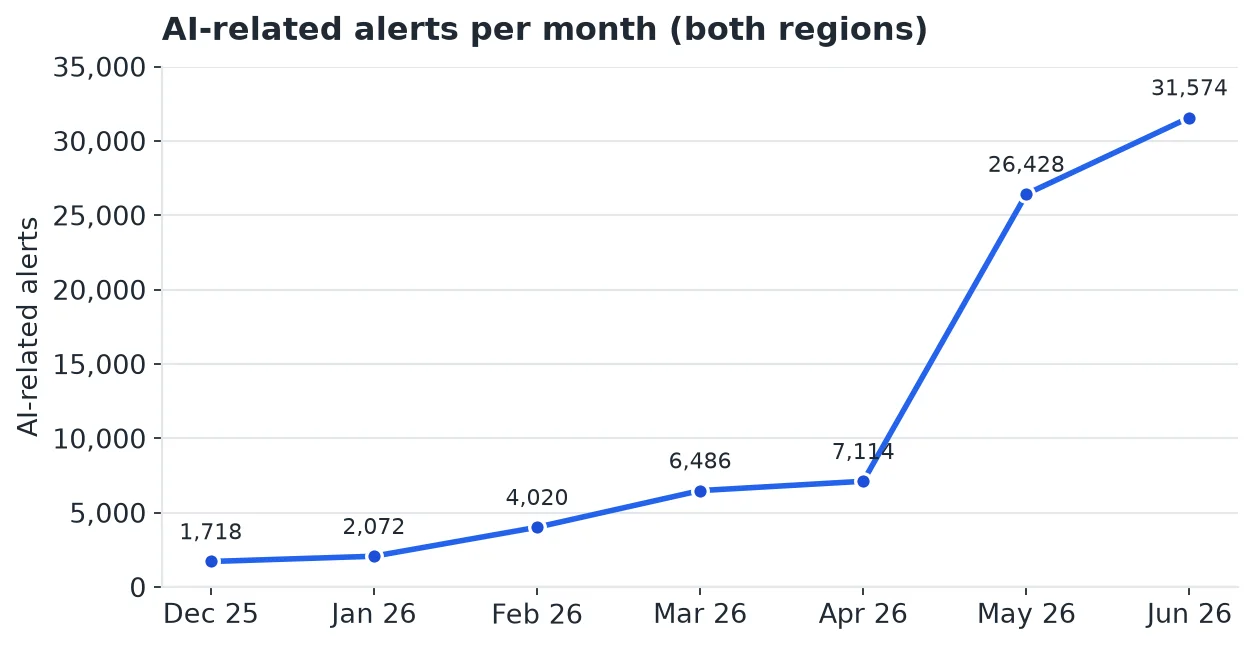
We reviewed AI-related activity across numerous enterprise environments. Two numbers frame everything that follows. AI-related alerts still account for only 0.43% of all SOC alerts. And that share is climbing every single month, up 685% between February and June 2026. AI is a small slice of the alert stream today and the fastest-growing slice at the same time.

What makes those alerts worth a security team’s attention is not their volume but their composition. We sort everything an AI agent triggers in a SOC into three buckets: real attacks, risks, and noise, with the split being 94.1% noise, 5.8% genuine risk, and 0.02% real attacks. Meaning that across the data we investigated, real attacks that use AI agents are a drop in the ocean. The cost of AI in the SOC, so far, is not breaches. It is a rising tide of alerts that look alarming and almost never are, and a small, quiet set of genuine exposures that those alarms tend to bury.

This post walks through each of the three categories with anonymized examples. All customer names, hostnames, usernames, and identifiers have been removed; indicators are defanged.

The New Shape of the Alert Stream

AI adoption inside an enterprise is not one behavior it is two very different ones arriving at the same time.

The first is technical. Developers install coding agents that spawn shells, read credential stores, open network tunnels, download packages, and run security tooling all as legitimate work, and all of it indistinguishable to a detection engine from the early stages of an intrusion. This is the loud half, and it dominates the data.

The second is when employees grant OAuth consent to third-party AI applications, share information, and paste documents into generative-AI tools. This is the quiet half. It rarely trips an endpoint detection, but it is where data leaves the building.

Both halves land in the same place, the SOC, and both look, at first glance, like something to worry about. Sorting the signal from the noise is the entire job.

By the Numbers

AI accounts for a small share of the volume but is fast-growing**.** Of the roughly 16.9 million SOC alerts we reviewed, about 73,000 (0.43%) were AI-related. Read on its own, that is reassuringly small.

Number of AI-related alerts per month as seen in our system.

The rise is monotonic. Every full month is higher than the one before, and growth accelerated sharply in May 2026. Over the window when reporting is stable across regions (February to June), volume grew by 685%. The 0.43% figure is best understood as today’s floor, not a ceiling. A team that sizes its AI-alert handling to current volume will be under-provisioned within a quarter.

The composition is as lopsided as the trend is steep. Nearly all of the AI-generated alerts are noise.

For this research, we investigated the AI-related population and sorted each alert by the underlying activity. A real attack is a confirmed compromise. A security risk is not a compromise but a genuine exposure (for example, a coding agent running with its permission safeguards disabled). Noise is legitimate activity that tripped a detection written before AI agents existed. By that measure, nearly all of the AI-related alerts are noise (94.1%), a small portion are genuine security risks (5.8%), and real attacks are a sliver (0.02%).

The breakdown of the AI-related alerts based on the final classification of each alert.

The second measurement is how those same alerts were handled in production without a human in the loop. When an alert reaches an automated triage platform, two separate decisions are made about it.

  • The verdict states how dangerous the activity looks: it can be benign, suspicious, or malicious.
  • 79.8% received a benign verdict.
  • The response states what happens next: the alert can be suppressed (closed automatically, so no analyst ever sees it), flagged for follow-up, or escalated to a human.
  • 81.7% were automatically suppressed.

Of the AI-related population, only 5.4% were ever escalated to a human analyst; the remainder were flagged for follow-up.

A high-severity alert does not necessarily mean an actual threat. For example, a single detection at a single customer accounted for 55% of all “critical” verdict alerts flagging a Windows binary (Expand.exe) as a lateral-tool-transfer. Upon inspection, it was found that a developer’s coding agent was setting up a shell environment, and the behavior was normal for this type of work.

The lesson for any SOC is the same: severity labels on AI activity have to be read with suspicion, not taken at face value.

Category 1: Real Attacks

A real attack is an actual compromise or an attacker operation enabled by, or riding on, AI adoption. This is the category every executive asks about first, and it is the smallest, accounting for roughly 0.02% of AI-generated alerts.

When it comes to actual threats that were detected in this class of alerts, none was a compromise caused by an organization’s own AI agent. Every alert titled “AI agent running mimikatz,” “reverse shell from a coding tool,” or “credential theft” was resolved, on inspection, to a developer doing legitimate work or to a detection misfiring. We return to those in the Noise section.

What was real is an attack that rides on AI rather than through it: a live phishing campaign that weaponizes AI brand names as lures. Across multiple customers, and as we expanded to new ones during the window we studied, we observed malicious emails with AI-themed subject lines featuring the biggest names in AI. The lure works precisely because AI adoption has made these brands familiar and their notifications routine. Employees now expect email from these products, which is exactly what the attacker is counting on.

Here are some examples of incidents where we spotted the execution of tools or commands that usually indicate real attacks (or penetration testing), only in these cases they were invoked by Claude, Codex, etc. So the investigator also needs to question why the agents were running these tools and whether it was part of a real attack that exploited the agent.

  • Anthropic is used as bait in the business context. In that alert, the email subject is RE: Anthropic Engagement approval & payment, and the analysis says the sender references a supposed contract/invoice with Anthropic to make a large payment request appear legitimate. So Anthropic is not the sender or the threat source, it’s part of the pretext used to support the invoice fraud story.
  • An email uses a fake Google/Gemini Ads invitation lure to appear legitimate and trustworthy. It presents itself as a business-related workspace invitation, encouraging the recipient to connect or join what looks like an official Gemini Ads environment, but the sender and reply-to infrastructure are not associated with Google and instead rely on the suspicious domain gemini-advertisers[.]com, indicating a brand impersonation attempt designed to drive the user to a malicious site.
  • The email impersonates OpenAI (“OpenAI Partner Summit 2026”) but originates from noreply-zoomevents@zoom.us. Although the URLs use legitimate zoom.us infrastructure, the content and registration flow are being used to lend credibility to a fraudulent invitation.
Phishing email impersonating OpenAI
Device code phishing
  • The AI IDE Cursor seems to have moved from normal coding activity into unsafe low-level system actions: while likely attempting to complete a debugging or troubleshooting task, the agent used a known credential-dumping technique (MiniDump via comsvcs.dll) that can expose secrets from process memory. The parent-child chain Cursor.exe → powershell.exe → rundll32.exe, the temp .ps1 scripts, and the memory-dump commands show the IDE initiating an automated action sequence that may have been intended to help development, but did so in a way that created a serious credential-access risk on the endpoint.

The pattern across all three is worth stating plainly: the closer we looked, the more the “attack” dissolved into context. That is the defining characteristic of AI-era triage.

Category 2: Unsafe Use

About 5.8% of the AI-related alerts are the ones we think deserve the most attention. These alerts detect an unsafe use of AI tools, not necessarily a compromise (yet). It is the moment when an agent, behaving exactly as instructed and with no attacker involved, does something that materially exposes the organization or the user.

The main risk is agents running with a permission-bypass flag, the option that tells the agent to stop asking the user before it acts. Many users choose to trust the agent not to destroy their machines or execute dangerous commands, but as experience and, now, the data show us, in many cases, agents will attempt, and mostly succeed in executing commands that expose the organization and the user to great risks. It is worth noting that, especially when running the agent with the permission-bypass flag, it is recommended to use additional configurations, also known as harnesses, to programmatically prevent the agent from attempting to execute risky commands.

The split of permission-bypass flags as seen in our system.

On every sample we examined, the invocation was legitimate developer work. That is exactly why it matters. This is the same precondition abused in a publicly documented supply-chain attack, where an attacker’s malicious code executed freely because a coding agent had been launched with its permission prompts disabled. The exposure is not intent; it is that the rail is off, across many customers and at scale, waiting for the one time the code the agent is asked to run is not benign. Notably, these same permission-bypassed invocations are also the single largest source of false positives.

Other instances of unsafe use we surfaced:

  • A reverse tunnel opened by an AI IDE**:** In one of the environments, an AI code editor spawned PowerShell, which launched ngrok and opened a named reverse tunnel to the public internet using the user’s own auth token. While the intent is benign, it is a real risk and exposure.
  • An agent dumping the entire macOS keychain to read one token: To retrieve its own and cloud services’ stored credentials. An agent ran security dump-keychain > /tmp/, which writes every stored secret to a temp file, briefly exposing all of them.
  • Granting OAuth access to AI agents means that employees might share sensitive information with third-party service providers. But on top of that, it increases the risk of unauthorized data access via prompt injection or a compromised AI account. We observed multiple alerts for OAuth application consent granted to ChatGPT across tenants, “first sign-in to a new application: OpenAI” events, and, at one customer, a sizeable cluster of data-protection alerts for generative-AI uploads. Most are benign. But this is the surface where corporate data is sent to a third-party model, and it is almost invisible to endpoint tooling.

Category 3: Noise

Noise is the largest category by an order of magnitude, 94.1% of the AI-generated, and it is the one that directly determines whether a SOC drowns. Noise here is not random. It is specific and diagnosable: detections written before AI agents existed, now firing at high severity on routine agent work. This is not a new tendency in the SOC, as Sophos previously reported.

The clearest example is the AI vendors’ own software. The genuine Anthropic Claude Desktop installer, verified by its code signature, triggers major EDR rules such as “Ransomware Operations detected” and “Encoded PowerShell Download and Run” across several customers. The installer is legitimate. The detection describes installer behavior in the ransomware vocabulary.

Underneath that sit the agent-behavior false positives, all confirmed on inspection to be developers using tools as intended:

  • The update of a coding agent and the developers’ use of the agent triggered a “Ransomware Operations detected”. The binary that triggered the alert is a legitimate, signed software package. The behavior that looked “ransomware-like” came from normal Electron/Squirrel installer activity and developer tool usage.
Claude Setup.exe
Path: \Device\HarddiskVolume3\Users\{REDACTED}\Downloads\Claude Setup.exe
CMD: "C:\Users\{REDACTED}\Downloads\Claude Setup.exe"

Update.exe
Path: \Device\HarddiskVolume3\Users\{REDACTED}\AppData\Local\SquirrelTemp\Update.exe
CMD: --install .
Parent: Claude Setup.exe
Parent Path: \Device\HarddiskVolume3\Users\{REDACTED}\Downloads\Claude Setup.exe
Parent CMD: "C:\Users\{REDACTED}\Downloads\Claude Setup.exe"

squirrel.exe
Path: \Device\HarddiskVolume3\Users\{REDACTED}\AppData\Local\AnthropicClaude\app-1.1.1093\squirrel.exe
CMD: --updateSelf=C:\Users\{REDACTED}\AppData\Local\SquirrelTemp\Update.exe
Parent: Update.exe
Parent Path: \Device\HarddiskVolume3\Users\{REDACTED}\AppData\Local\SquirrelTemp\Update.exe
Parent CMD: --install .
  • A process originating from node.exe executing the OpenAI Codex CLI agent with –yolo or –dangerously-skip-permissions tripping ClickFix, DisableTools, and DLL-injection detections.
  • codex.exe
    Path: C:\Users\{REDACTED}\AppData\Roaming\...\bin\codex.exe
    CMD: codex.exe --yolo
    Parent: node.exe
    Parent Path: \...\Program Files\nodejs\node.exe
    Parent CMD: "node" "C:\Users\{REDACTED}\AppData\Roaming\...\codex\bin\codex.js" --yolo
  • Standard developer automation triggered “PowerShell created possible reverse TCP shell” detections. The process tree is consistent with normal developer automation rather than a real reverse shell. The parent process shows a signed OpenAI Codex sandbox binary that spawned powershell.exe, which in turn launched cmd.exe, python.exe, and conhost.exe. The PowerShell command is in clear text and shows benign orchestration logic: it checks ports on localhost on 127.0.0.1, selects an available port, starts a Python script from the project directory, and writes stdout and stderr to local log files in the artifacts directory.
  • The false-positive rates are the story. Across the noisiest AI activity detections, the benign share ranges from 77% to 99%. Several detections are wrong on the AI-generated more than four times out of five:

    View of the detection that was triggered on benign AI-related behavior.

    The one exception proves the rule. The ClickFix detection is the single cluster that leans genuinely severe, only 37% benign, and it does so precisely because it collides with the permission-bypass risk from the previous section: it fires on coding agents launched with –yolo. Even the “real-looking” noise traces back to legitimate AI use.

    What Security Teams Should Do

    From our analysis, the first step for every SOC is clear: tune the noisiest legacy detections, the ones firing at high severity on routine agent work. Next, define policies on what information can be shared with third-party AI platforms (as with any third-party platform) and, based on those policies, proactively hunt for permission-bypass flags, unauthorized tunnels, and risky OAuth grants rather than waiting to be alerted.

    The second step is harder, because it touches how triage itself works. AI tools execute commands on the user’s machine, with the user’s credentials, essentially acting on the user’s behalf. Alerts are therefore triggered by actions attributed to the user, and in many cases the user was not aware those actions took place. Before AI, suspicious activity executed on a user’s machine without their knowledge usually indicated a high probability that an attacker had taken over the machine. Now SOC teams face a new layer of complexity: first determine whether the action in question was executed by an AI agent or tool.

    To separate the user’s context from the agent’s, and to keep the agent away from credentials and sensitive information it should not have, we suggest running AI tools in an isolated environment with restricted access, such as a Docker container or a virtual machine. Isolation limits what the agent can reach, and it makes the agent’s behavior easier to distinguish from the user’s own activity.

    What This Means for the SOC

    Pulling the three categories together, the operational reality of enterprise AI adoption looks like this:

    • Real attacks (0.02%): none of the confirmed attacks we investigated were carried out by an organization’s own agents. The genuine attack activity we found rides on AI adoption from the outside, phishing lures built on brand names employees now trust, not on the agents themselves.
    • Security risks (5.8%): real, standing, and largely invisible to alerting. Agents run with their permission safeguards disabled, open tunnels to the public internet, over-expose stored secrets, and send corporate data to third-party models. None of this is an incident, and all of it is exposure.
    • Noise (94.1%): the dominant cost. The single highest-value action available to most SOCs today is not a new detection. It is tuning the legacy ones so that a developer running a coding agent does not generate a maximum-severity alert.

    The uncomfortable synthesis is that AI adoption has not, so far, brought a wave of AI-enabled breaches. It has brought a wave of alerts, small as a share of total volume today, that have grown 18-fold in six months and are overwhelmingly false, alongside a smaller, quieter set of genuine exposures that the alerts tend to bury. A SOC that treats every agent action as a potential intrusion will exhaust itself on false positives and, in doing so, will be less likely to notice the ngrok tunnel or the keychain dump that actually matters.

    The work ahead is therefore less about detecting AI attacks and more about teaching detection engines what normal AI behavior looks like before the volume that is doubling and tripling month over month makes that work unavoidable. Understanding this distinction is what separates a SOC that scales with AI adoption from one that is buried by it.

    About Intezer

    Intezer is an autonomous AI SOC platform built to solve exactly the problem this data illustrates: the growing gap between alert volume and analyst capacity. Rather than tuning individual detections one at a time, Intezer investigates every alert automatically, applying forensic-level analysis to determine what’s actually happening on an endpoint or in an email, then delivers a verdict a human can trust. That means 100% alert coverage — including the AI-related noise — without the SOC drowning in it.

    If you’re seeing the same shift in your own alert stream, visit intezer.com to see how Intezer’s platform handles it.

    Note: This article has been expertly written and contributed by Nicole Fishbein. Senior Security Researcher and Malware Analyst at Intezer.

    Found this article interesting? This article is a contributed piece from one of our valued partners. Follow us on Google News, Twitter and LinkedIn to read more exclusive content we post.

    Claude Used to Automate Exploitation and Data Theft Across Multiple Victims – CYBERDEFENSA.MX

    Anthropic has warned that cybercriminals and state-sponsored hackers alike are using its Claude models for cyber attacks, weapons design, propaganda, and mass surveillance between December 2025 and August 2026.

    The threat actors, which the artificial intelligence (AI) company has branded Generative Threat Groups (GTGs), span state-sponsored groups, financially motivated criminals, commercial spyware vendors, state propaganda institutions, and politically motivated individuals.

    «The cybersecurity skills of AI models means that AI has collapsed the labor and tooling gap that used to separate well-resourced, state-sponsored operations from individual operators,» Anthropic said. «The use of AI went beyond simple questions and responses from a chatbot but rather involved the use of multi-agent frameworks executing reconnaissance, exploitation, and data exfiltration.»

    Among the notable cases highlighted by Anthropic is the development of an AI-assisted workflow by a Russian state-sponsored threat actor it calls GTG-20006, which shares tactical and tradecraft overlaps with a Russian advanced persistent threat (APT) group tracked as Midnight Blizzard (aka APT29 and Cozy Bear). Some of the other AI-enabled cyber campaigns highlighted by Anthropic in its 154-page report include –

    • GTG-50014 (aka MeowSHA, frkoo, and blazespider), a French-speaking operator and a suspected affiliate of the ShinyHunters collective that ran a distributed credential-harvesting pipeline across a fleet of 10 AWS EC2 workers that mass-downloaded 1.8 million distinct Android APKs from multiple app-store sources, scanned them for hard-coded secrets using TruffleHog, and sent verified findings to a Telegram group.
    • Another ShinyHunters affiliate that specialized in supply chain theft by compromising software-as-a-service (SaaS) vendors to steal data belonging to downstream customers, accelerate reconnaissance, and enable data exfiltration.
    • GTG-10007, a Chinese-speaking operator likely based out of Hunan province, some of whom have been identified as undergraduate students at a Chinese university and have used Claude to conduct intrusion attempts against production systems, reconnaissance of foreign-government networks across the Middle East, Europe, and Southeast Asia, a vulnerability-research and exploit development effort against major endpoint-security products, and develop an intelligence-collection platform for bulk-harvesting of open-source material aligned with Beijing’s priorities. The threat actor targeted about 50 organizations across education, retail, energy, technology, healthcare, finance, manufacturing, and government sectors globally. The group also maintained an autonomous vulnerability research program to produce working exploits for previously unknown vulnerabilities in network and security appliances.
    • GTG-50021, a Russian and Ukrainian-speaking group that ran a fraudulent AI reseller operation offering cheap Claude access, only for customers’ traffic to be silently proxied to a different AI model, while the illicit scheme installed a credential harvester to siphon their Anthropic account credentials and sell them to other proxy resellers for malicious use.
    • GTG-50020, a Russian-speaking, financially-motivated actor that has historically targeted hotel booking and financial technology platforms but has since focused on the AI supply chain by stealing model provider API keys and unsuccessfully attempting to gain access to pre-release AI models. The threat actor is estimated to have targeted about 30 AI vendors in a four-day window using similar techniques.
    • GTG-50029, a single French-speaking actor that used Claude to target European political parties, media, think-tanks, and the SaaS providers used by these organizations, including by exploiting a previously undocumented WordPress re-installation race condition that made it possible to create a rogue administrator account without valid credentials, as well as by abusing an exposed search endpoint to breach a political campaign management platform and siphon sensitive data. The threat actor has also been observed deploying web shells and a browser exploitation C2 framework against other targets. Central to the attacker’s operation was a purpose-built doxxing platform named «fafsearch» that offered the ability to cross-reference individual breach dumps against exfiltrated data.

    «At one end, actors used Claude conversationally: it acted as an engineering assistant in the creation of malware, phishing kits, and surveillance tooling,» Anthropic said. «Further along the spectrum, threat actors directed Claude to execute operations (such as running commands against victim networks, harvesting credentials, and exfiltrating data) with a human making each individual targeting decision (GTG-20006).»

    Cybersecurity

    «At the far end, operations ran autonomously, with minimal human input or supervision: these included multi-agent frameworks conducting reconnaissance, exploitation, and theft against multiple victims, in parallel, for hours or days at a time (GTG-50014, GTG-50020, GTG-50029).»

    The AI company said it also identified and took down a number of influence operations in which Claude played the role of a «sub-editor or content creator» to churn out content and run them at a scale beyond what low-resourced actors could have accomplished on their own. However, Anthropic emphasized that none of these efforts amassed authentic engagement and that they were disrupted before they could even build an audience.

    Some of the influence and surveillance campaign clusters flagged by Anthropic at a high level are below –

    • GTG-04001, a Russian-speaking actor in Bangui that engaged in a foreign information manipulation and interference operation in the Central African Republic to amplify pro-Russia, anti-France talking points.
    • GTG-54002, a commercial «influence-as-a-service» operation that used Claude to mass-produce and rewrite political content across about 70 fabricated news websites. The operation has been traced back to LKM Company, a France-based digital advertising agency.
    • GTG-84005, a single account that used Claude to run a commercial election manipulation platform primarily targeting users in Malaysia based on political and social factors, such as their race and religion, by posing as a defensive cyber intelligence and counter-disinformation tooling outlet. The activity has been found to share links with BBS Bilisim Teknolojileri, an Istanbul-based technology company.
    • GTG-24015, a set of four accounts that used Claude as an «editorial and news production desk» to distribute them via state media outlets like Sputnik Moldova, RIA Novosti, Sputnik en Español, Sputnik Africa, and RT’s English-language newsroom.
    • GTG-34001, a set of three Iranian state-aligned accounts that used Claude to shape public opinion, turn official government intelligence bulletins into tailored content, and disseminate the content across social media platforms.
    • GTG-54006, a sustained, automated disinformation network that used Claude to generate fabricated Bengali-language news in Bangladesh and promote the country’s Awami League party. The activity has been linked to a single actor based in Gaibandha District in Bangladesh via a set of 29 Claude accounts that were rotated to bypass platform limits and detection.
    • GTG-84006, a distributed influence operation that targeted Iranian audiences across the world with an aim to impersonate real activists and engage in live political conversations. The activity has been linked to People’s Mojahedin Organization of Iran (PMOI/MEK) and the National Council of Resistance of Iran (NCRI).
    • GTG-54004, an account used by a single actor to mass-produce Kenyan political content as part of what’s suspected to be a domestic astroturfing campaign with a pro-administration bent.
    • GTG-84002, an account used by a single actor to run a sustained influence operation against the Muslim Brotherhood, the Sudan conflict, and the United Nations accountability mechanisms.
    • GTG-54009, a commercial surveillance platform that used Claude to analyze, classify, and profile the social media activity of users in Iran and the Persian Gulf region. The activity is assessed to have been carried out by, or on behalf of, an Israeli-Singaporean commercial intelligence vendor named S2T Unlocking Cyberspace.
    • GTG-14010, a China state-aligned operation that used Claude to track, profile, and recruit Uyghurs and Uyghur armed formations in Syria. The actor has been found to use the AI model to convert conversations extracted in bulk from over 100 monitored WhatsApp groups and dozens of Telegram channels into structured Chinese-language data and «creating profiles of individuals who might be vulnerable to targeting due to financial stress, family separation, and ideological disillusionment.»
    • GTG-14020, a set of accounts likely linked to a Chinese government-aligned intelligence operation that used Claude to build Chinese-language dossiers targeting religious leaders and Chinese diaspora figures across Asia, as well as map religious venues and instruct the model to adopt «China’s standpoint.»
    • GTG-14021, a set of accounts from China-based actors that used Claude to support surveillance and transnational repression, including prompting the model to assume the role of an intelligence analyst serving China’s national security apparatus.
    • GTG-14022, a China-based «public opinion monitoring» and dissident surveillance operation that used Claude to produce government briefings that listed dissidents, activists, ethnic minority and Chinese diaspora communities, and foreign media as threats to political stability while asking it to play the role of a «senior emergency public opinion analyst serving the government of the People’s Republic of China.»
    • GTG-34007, a set of 16 accounts operated by two Iranian-nexus actors associated with paramilitary and domestic security agencies that used Claude to build a frontend for what appears to be a government-controlled surveillance case-management system, run social-network analysis over 155,216 X posts, and build domestic surveillance capabilities via a malicious Mozilla Firefox extension named «al-Najm al-thāqib» to harvest user identities from major social network platforms.
    • GTG-50027, a single account that used Claude to design a national mass interception and surveillance platform called Lakana 360 for Mali’s state intelligence service to monitor about 25 million SIM cards spanning three of the country’s national mobile operators, and generate intelligence dossiers for any phone number. The platform has a separate layer that collects call records, text messages, and voice calls across the mobile networks.
    • GTG-30004, an Iran-nexus threat actor that used Claude to develop an automated, open-source intelligence identity-profiling service targeting Israeli and Jewish diaspora organizations.
    • GTG-30005, an Iran-nexus threat actor that used Claude to gather and analyze publicly accessible data to develop targeting recommendations against U.S. naval forces in the region and build software components of a domestic mass-surveillance platform that combined automatic license-plate recognition with mobile-device identifier interception.
    • GTG-30006, an Iranian threat actor that leveraged free Claude.ai accounts to develop malware, a delivery pipeline, and a phishing portal targeting domestic Iranians. This included a bogus ESET NOD32 antivirus login page that transmits captured credentials to Telegram, a ClickFix-style Windows Run dialog lure, and geofenced delivery pages. The threat actor has also used Claude to build SECOMS64, a modular Windows implant with keylogging, screenshot capture, and Chrome credential extraction capabilities.
    Cybersecurity

    Elsewhere, Anthropic said it neutralized Claude misuse efforts by threat actors based in northern Yemen to develop guided weapons, two China-based operations to draft a Chinese-language specification for an anti-torpedo fire control system and build targeting software for electronic warfare, and a Russia-based operation to engineer a full-stack autonomous first-person-view (FPV) kamikaze drone swarm.

    «As AI models become more widely used, providers will continue to acquire threat-relevant visibility into real-world use that even governments and intergovernmental organizations lack,» the company said. «We hope that sharing these early insights with the public helps inform governments, the industry, and the general public on the nature of these risks, and the safeguards that are necessary for ensuring the safe deployment of AI models.»

    200 Android Flaws, Browser-Built Phishing, 119K Scam Shops + 23 More Stories – CYBERDEFENSA.MX

    A lot of this week’s security news has the same awkward answer to one question: “Why was that allowed to work?”

    An extension asks for access and takes too much. A trusted service becomes part of a phishing chain. An old bug still gets results. An exposed system stays exposed. A package looks useful right up until it isn’t. Different stories, same basic problem: the path in was often already there.

    Nothing here needed magic. Mostly access, trust, weak edges, and someone willing to keep poking. That’s the week.

    The threats change every week. Subscribe, and we’ll alert you when each new ThreatsDay Bulletin is out.

    The lesson this week is smaller than “patch faster.” Stop giving ordinary things unlimited trust. Extensions, packages, redirects, sessions, AI tools, exposed services — most of the trouble begins when something familiar is allowed to do too much.

    Security still breaks at the boring handoffs: what gets access, what stays exposed, what gets inherited, and what nobody checks twice. Attackers do not need every door open. One lazy hinge is enough. That is probably the part worth remembering after the headlines disappear.

    Unpatched Magento and Adobe Commerce Zero-Day Exploited to Backdoor Online Stores – CYBERDEFENSA.MX

    Attackers are exploiting a new unpatched vulnerability in Magento Open Source and Adobe Commerce that lets them run malicious code on an online store’s server without logging in, Dutch e-commerce security company Sansec said in an advisory published on September 5.

    Sansec, which discovered the flaw and named it StyleSmuggler, said attacks started on September 4. «Sansec is publishing early because stores are being compromised right now,» the company said.

    As of September 6, Adobe has not published an advisory, a CVE identifier, a patch, or a workaround, and its Adobe Commerce security bulletin index lists nothing after the August 11 update.

    A successful attack gives the attacker code execution on the store’s server and installs a persistent backdoor. Sansec said all current versions are affected, including 2.4.9, and that it reproduced the full unauthenticated chain on clean Magento Open Source installations of 2.4.7, 2.4.8, and 2.4.9.

    Its first victim ran 2.4.6-p15 with Adobe’s July and August 2026 security updates applied, which is the latest patch level Adobe offers for that release line and one that Adobe’s August bulletin labels 2.4.6-2026-aug.

    Sansec has not published a reproduction on Adobe Commerce or on Adobe Commerce on Cloud, and Adobe has not confirmed which versions are affected. Sansec has not said how many stores have been compromised.

    The researchers’ interim advice for stores not running its Shield product is to temporarily disable GraphQL until Adobe releases a fix.

    Disrex Group, a Magento hosting and development company that hosts and responded to two of the compromised stores, notes that headless and progressive web app storefronts require GraphQL, whereas most classic and Hyvä storefronts do not.

    Adobe’s next scheduled security release is on September 8, Sansec said, and it is not yet known whether that release will cover this bug.

    Disrex’s findings are independent evidence of exploitation from outside Sansec. In an incident-response repository published on September 5, the company said it handled two compromised stores and a third that was attacked but not breached, and that its web-server rules are based on attack traffic captured on one of the compromised stores. In answers to questions from The Hacker News, Disrex said both stores ran Magento Open Source rather than Adobe Commerce, and that it hosts them itself through its hosting brand RexHosting.

    The store Disrex labels Store A ran Magento Open Source 2.4.8 and was a Sansec Shield customer, with the module installed, enabled, and licensed. It was hit at 23:10 UTC on September 4, hours before Sansec’s first blocking rules for this flaw went live, and Disrex said Shield was active and blocking other malicious traffic against the store at the time.

    Store B, which was not a Shield customer, ran Magento 2.4.7-p2, a security patch level that Adobe’s version history dates to August 2024, eight levels behind the current 2.4.7-p10. It was first hit at 00:55 UTC on September 5, Disrex said, and it is the store from which the company’s web-server rules and its reading of the vulnerable code were taken.

    Both stores were breached inside the roughly eight-hour window between the first exploitation Sansec observed and the moment any defence for it existed, Disrex said. «Patch status was irrelevant here, which is the part merchants most need to hear,» the company told The Hacker News.

    The repository carries its own warning. «This repository was written with AI assistance, during a live incident, in a few hours,» its README says, adding that it has not been reviewed, that its Apache rules were never run against a live Apache server, and that most of its cleanup commands were written rather than executed.

    Sansec’s indicators describe the implant as a background process disguised under [kworker/u:8:0], a name that belongs to a Linux kernel thread, with a binary installed at ~/.local/share/.gvfsd/gvfsd-user under the site user’s home directory rather than the web root, and a cron entry that restarts it every five minutes.

    Disrex described the binary as a stripped, statically linked Rust program of roughly 1.9 MB built for x86-64 and arm64, and said the cron entry is written straight to the spool file under /var/spool/cron/crontabs/, so the system log shows no crontab replacement.

    One store carried the same line 1,728 times, and the implant re-added it within a second of removal.


    On one of the two stores, the implant made no outbound connection at all. It held 28 connections to the store’s own Redis instance on port 6379 and read Magento’s session storage from it, Disrex said, and neither of its two packet captures, each over 200 MB and taken while the implant was live, contained a single packet to the download host or the command-and-control address that Sansec listed.

    Disrex told The Hacker News over email that each store ran in its own isolated account with a single site owner, no sudo rights, and no path to any other customer, that the implant ran as the unprivileged site user and could reach nothing beyond that store, and that it confirmed no lateral movement and no other affected site on its platform.

    Both stores were contained the same day, roughly eleven and fourteen hours after first contact, the company said, and it found no evidence of data exfiltration, no rogue admin accounts, no injected payment skimmer, and no database backdoor. All sessions were invalidated, and credential rotation is underway as a precaution.

    Because it runs a number of Magento stores on its own platform and found the first compromise quickly, Disrex said, it swept its whole estate within the hour and found the second store the same afternoon. The company has also published an incident write-up.

    Sansec said that for Shield customers attacked before its rules went live, it has no indication that the backdoor was actually used, and recommended rotating Magento credentials wherever the process has been identified.

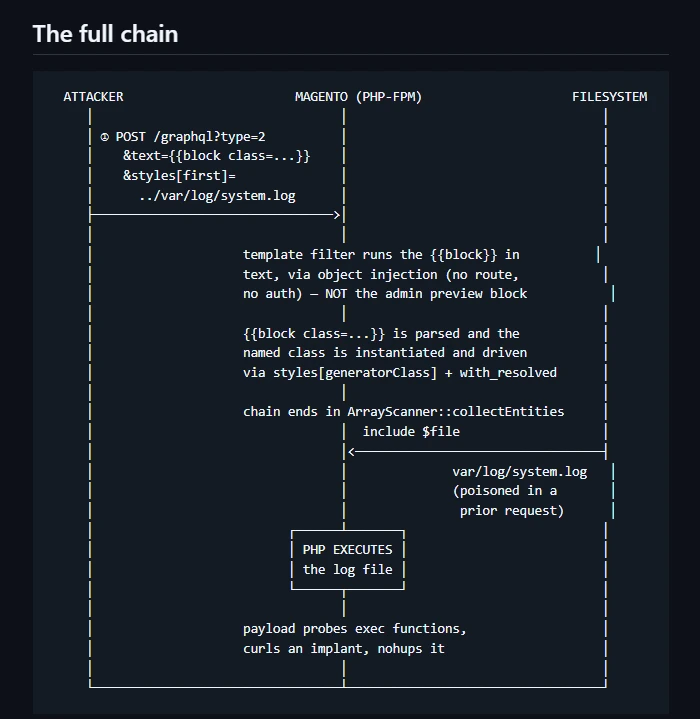
    The attack works in two stages, according to Sansec’s outline. It first plants PHP code in a file that Magento itself writes, for example, when generating a failure report. Then it makes Magento execute that file by triggering the platform’s standard «Payment Transaction Failed Reminder» email. The code runs while Magento renders the message, so no one has to open it, and the attack can succeed even if email delivery fails.

    Sansec has not yet published the full exploit chain and said a breakdown of the chain, the dropper, and the implant will follow in an update.

    Disrex’s reading of the chain, published in a mechanism write-up alongside its rules, is that a directive within the injected text drives a sequence of Magento’s own classes into code that exists solely to serve the command-line dependency-injection compiler.

    That code ends by including a file path the attacker chose: the log poisoned a moment earlier. The executed PHP dropper attempts six PHP functions in turn to start a process, then downloads and launches the implant. Disrex names three files under setup/src/Magento/Setup/Module/Di/Code/ as the point where the chain ends, and told The Hacker News it identified that sink on its own by reading Magento source on the compromised store. Sansec has not confirmed that reading, and Disrex does not publish the assembled request.

    Two locations matter for the first stage. Sansec’s published check searches var/report/ for the marker X_TRACE_. Disrex said both of its infections were poisoned through var/log/system.log instead and would have been missed by that check, so both directories need searching.

    The marker has already drifted: Disrex saw a trigger header of the form X-TRACE- followed by ten hex characters on the morning of September 5 and the same header without the word TRACE by the afternoon, so a search should match the shape rather than the exact string.

    A TypeError from array_merge() with an integer argument in system.log, immediately after the include, is evidence that the exploit succeeded, Disrex said. However, a stealthier variant returns an empty array and leaves nothing in the log.

    For the process, Disrex said that a genuine kernel thread is owned by root and has no resident memory, so a bracketed name on the site user with real memory usage is the implant. The implant sets its command line to the literal bracketed string, so a check written against the process’s comm field matches nothing.

    Disrex also found that the binary running in memory on one store was a different build from the file on disk, and advises hashing the running process from /proc//exe as well as the file. Unexpected bursts of «Payment Transaction Failed Reminder» emails are a reason to investigate, Sansec said, although legitimate declined payments generate the same notification.

    The following indicators have been published by Sansec and in Disrex’s indicator list

    • Process: [kworker/u:8:0] owned by a non-root user
    • File: ~/.local/share/.gvfsd/gvfsd-user
    • File: ~/.local/share/.gvfsd/.gvfsd_<8hex>.lock
    • File: /tmp/.gvfsd_<8hex>.lock
    • File: /tmp/.kw_
    • Cron: */5 * * * * exec /.local/share/.gvfsd/gvfsd-user, with a variant pointing at /tmp/.kw_
    • SHA-256: e315687a1dfe61ef4a5a5642214db6d3b2b05d81391285eebc2af664641a26a7 (Sansec’s sample)
    • SHA-256: 8334b434fa3fe9f59cebe9609b11e0b1fd19d10212c45c705adec1902a1d06ef (on disk on both Disrex stores)
    • SHA-256: 251fabd50d7b18a8b5e1b3ef5d64e7198c17244778f6461fb1ab07f6169bf220 (running in memory on one Disrex store)
    • Domain: 247.cdnflare[.]xyz (malware download host)
    • IP: 99.84.67[.]186:443 (command-and-control over WebSocket and TLS, per Sansec)
    • IP: 88.216.72[.]181 (attacker source, per Sansec)
    • IP: 5.181.86[.]133 (attacker source sending in bulk, per Disrex)

    Sansec recommends its eComscan scanner to detect the implant, and said version 1.9.7 will terminate the process for Shield customers.

    Disrex reported a clean result on Store A. eComscan ran there at 10:00 UTC on September 5, roughly eleven hours after the implant first ran and while 1,728 cron lines were present, and reported the store clean. The cause was scope rather than a scanner fault, Disrex told The Hacker News: the scheduled scan was pointed at the store’s document root, and the implant had installed one directory above it, under the account’s home directory. Disrex has since widened the scan path and said it would confirm the eComscan build number separately.

    There is no vendor fix to install. Until Adobe ships one, the options are Sansec’s temporary GraphQL shutdown; three unofficial mitigations published by Disrex, ProxiBlue, and Graycore; and two server settings that do not depend on the flaw.

    Disrex published nginx and Apache rules that block requests carrying the exploit’s parameters in the URL query string. Its own test on a live store showed the limit: the same parameters sent in a POST body reached PHP, as did a JSON body, because nginx and Apache inspect only the query string, Disrex said. Disrex describes the rules as stopping the campaign as it currently runs rather than the vulnerability.

    Disrex’s main mitigation adds a check to three methods in Magento’s dependency-injection code scanners, preventing them from running outside the command line. The hand edit is reverted by every composer install, so Disrex also ships it as a composer-patches source patch that reapplies on deploy and, it says, applies unchanged from 2.4.6 through 2.4.9.

    One of the three files, ClassesScanner.php, is called over HTTP by at least one third-party module, mageplaza/module-admin-permissions, and guarding it breaks that module’s admin screen, so Disrex tells administrators to search their vendor directory before touching it.

    The guard was tested on a harness rather than inside a running store, and Disrex says it is not a complete fix on its own. Disrex told The Hacker News the guard is its own work, written during the response, and was not developed with anyone else. A GitHub user, ProxiBlue, separately published the same guard on September 5 as three unofficial patches. Neither Sansec nor Adobe has confirmed that these scanners are where the chain ends.

    Graycore, LLC published a Magento module on GitHub and Packagist on September 5 whose current code, Graycore says, hardens three points on the chain: the email template block directive refuses backend blocks, the grid row URL generator checks a class before building it, and PHP opening tags in Web API fatal error reports are broken.

    The version on Packagist at the time of writing was an earlier release whose only mitigation targeted a PayPal GraphQL resolver that has since been removed. The README says «That is hardening, not a fix» and warns that other paths through the vulnerability remain open and that a store may already be compromised.

    Two server settings do not depend on knowing the chain at all, Disrex said. At one of its two stores, the first four of the six PHP functions the dropper tried were disabled; proc_open was not, and the dropper used it to start the implant, with open_basedir doing nothing to contain the child process.

    Adding proc_open to PHP’s disable_functions, and mounting /tmp, /var/tmp and /dev/shm with noexec so a downloaded binary cannot run, are the layers Disrex puts ahead of every rule in its repository.

    For a store that is already infected, Disrex’s cleanup guide sets the order: preserve evidence first, remove the cron entry before killing the process because the process restores it, do not reboot because the copy under /proc may be the only remaining binary, and do not run composer install to clean up because it overwrites the timestamps that show what was touched.

    It then recommends flushing session storage since the implant read it, and rotating the crypt/key in app/etc/env.php, as well as every admin password, every payment provider API key, and every other integration credential in that file.

    Hosting providers Nexcess and Liquid Web posted identical incident notices on September 5, stating they were reviewing their server environments and implementing precautionary measures.

    Neither claims a confirmed customer compromise or its own reproduction of the flaw. Disrex recorded 26 distinct source addresses across its two stores, taken from the stores’ own nginx access logs and deduplicated, two of them hosting infrastructure sending in bulk and the rest a residential proxy pool sending two to six requests each, and said that blocking the single attacker address in Sansec’s advisory would have stopped less than a quarter of the traffic it saw. An earlier count of 28 included two of Disrex’s own servers making verification requests during the response, which it removed. No source has named the attackers.

    The Hacker News has reached out to Adobe, Sansec, and Graycore for comment, and will update the story if we hear back.

    CEO Phishing Kits, 5K Dropbox Account Hacks, OAuth Traps + 17 More Stories – CYBERDEFENSA.MX

    The worst part is how normal these attacks look. A call from IT. A shared file. A trusted app. A simple request to click “Allow.” Why break in when someone might open the door?

    That idea runs through this edition. Attackers use real tools, fake login pages, old account links, and software guides that point to unsafe downloads. One wrong letter in a web address can be enough.

    There is also ransomware, stolen ID data, hidden attack servers, and weak settings that should have been fixed long ago. Here’s the full list.

    The threats change every week. Subscribe, and we’ll alert you when each new ThreatsDay Bulletin is out.

    1. Fake IT, Real Access

      Microsoft has warned of a human-operated intrusion campaign that leverages Microsoft Teams external collaboration to impersonate IT or help desk personnel and socially engineer users into granting an interactive remote session. «Once remote control is established via RMM tools, the threat actor uses PowerShell to download and silently install a malicious MSI package, which in turn stages a portable Node.js runtime and an obfuscated JavaScript implant that provides persistent command execution and command and control (C2),» the tech giant said. «After the implant is deployed, the threat actor performs extensive host and Active Directory reconnaissance, periodically captures screenshots of the victim’s desktop, executes follow-on payloads through trusted Windows binaries, and pivots across the enterprise over Windows Remote Management (WinRM) toward high-value assets such as domain controllers.» Microsoft has described the «intrusion pattern» as high-impact as it grants an external operator interactive access to internal infrastructure.

    One point is easy to miss: changing a password may not shut every door. A bad app approval or remote session can give attackers access without the password. Recovery should also end open sessions, remove unknown app access, and check remote tools.

    Better security settings are slowly becoming the default, which helps. But old account links, weak sign-in options, and trusted software still give attackers room to work. The safest rule this week is simple: check what already has access before adding anything new.

    From Adoption to Incident Readiness – CYBERDEFENSA.MX

    The debate about whether AI delivers business value is over. The challenge now is implementing it at scale and securely across every function while meeting board-level pressure to move fast. Organizations must focus on adopting AI at business speed without losing control of cyber risk. Download the full eBook here.

    The Business Reality

    In Sygnia’s 2026 CISO Survey Report, which surveyed 600 senior IT and security leaders worldwide, nearly one-third already report extensive AI use across threat detection and IR, with 63% expecting it to be fully embedded in their organization by 2027.1 Yet 73% of IT security decision makers say their organization would not be fully ready if a significant cyberattack occurred tomorrow.1

    Security teams feel they do not have adequate time to adapt. The tools are being deployed. The governance, controls, and incident readiness to support them are not. Security leaders are now tasked with enabling AI adoption while reducing the inheritance of unmanaged risk.

    The AI Security Gap

    AI is already inside the enterprise, but does not always enter through the front door. It comes through approved platforms, employee workarounds, SaaS plugins, vendor tools, internal experiments, and development teams trying to move faster. How deeply and quickly AI should be embedded depends heavily on which type of AI is used – Generative AI or Agentic AI. The more AI moves from fully- or semi-autonomously assisting people to acting across systems, the less it can be treated as a productivity tool alone. It significantly expands the enterprise attack surface and introduces new security risks.

    The rapid adoption of enterprise AI is being driven from both the top down and the bottom up. Leadership typically recognizes the need for oversight, but does not have a proven playbook to swear by, and employees are rarely equipped to assess the security implications of the tools they adopt on their own. As organizations prioritize speed, security reviews, vendor assessments, and data governance often become secondary concerns, creating an environment where AI adoption outpaces control.

    With only 38% of organizations reporting a comprehensive AI policy2, adoption is outpacing oversight, leaving security teams to manage the consequences after the fact. The result is a rapidly expanding attack surface fueled by widespread shadow AI and AI-powered threats that lower the barrier to sophisticated attacks while enabling adversaries to identify and exploit vulnerabilities faster and at greater scale.

    The Hidden AI Risks

    The assumption has taken hold that limited AI usage means manageable AI risk and that because the program is early, the exposure is minimal. It isn’t. The AI attack surface is not a fixed perimeter. It expands wherever AI is adopted, integrated, or built. 67% of executives believe their organization has already suffered a breach as a result of unapproved AI tools.3

    The entry points multiplying fastest are rarely the ones under active security review, which leaves room for more and faster exploitation: (1) ungoverned AI (including shadow AI), (2) ad hoc integrations, and (3) AI agents with excessive permissions.

    And on the attacker side, the threat landscape has shifted in ways that make this exposure increasingly beneficial for them and in turn consequential for their enterprise victims. Their underlying tactics and techniques often remain the same, but AI enables attackers to execute them faster, at greater scale, and with higher levels of automation, ultimately increasing their effectiveness against existing weaknesses within an enterprise environment – as seen in a recent AI-enabled attack investigated and remediated by Sygnia incident responders.

    The Need for a Lifecycle Approach

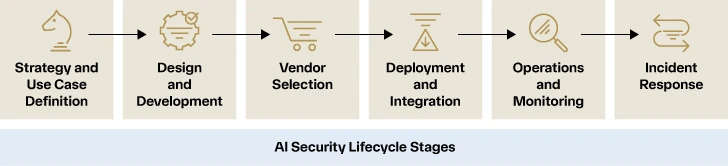
    AI security needs to be addressed across each tool’s complete lifecycle. The control requirements change at each stage, but the priorities stay consistent: identify usage, classify risk, assign ownership, limit access, validate controls, and prepare for incident scenarios before AI is deployed and becomes embedded into critical workflows.

    It’s imperative to prepare for the different lifecycle stages and understand their associated security challenges.

    Strategy and Use Case Definition

    Organizations need clearly defined ownership, decision rights, oversight, and escalation across business, technology, security, legal, privacy, compliance, and risk functions. This ensures AI use remains aligned with organizational objectives, policies, risk appetite, and regulatory obligations before the business becomes dependent on these tools.

    Common challenge: Organizations often adopt AI without defining who owns the use case, who is authorized to approve it, who oversees its continued operation, and who is accountable when its use produces business consequences.

    Design and Development

    AI adds design questions that are easy to miss: how prompts are handled, what data is retrieved, how embeddings are stored, how vector databases are protected, how model outputs are validated, and what happens if the system is manipulated. AI-specific security requirements need to be defined before the system is built.

    Common challenge: AI applications regularly reach production without security requirements being defined, tested, or validated at any stage of development.

    Adoption and Vendor Selection

    Whether evaluating a SaaS AI platform, integrating a third-party model, or building on a foundation model via API, the security implications of that choice need to be assessed before the contract is signed. Evaluate whether to build, buy, or integrate and treat it as a security decision, not just a capability and cost question.

    Common challenge: Organizations typically adopt AI capabilities without performing adequate security and risk assessments. Speed of procurement consistently outpaces due diligence.

    Deployment and Integration

    An application that passed security review at design can still be deployed insecurely. The most consistent failure at this stage is excessive permissions: where AI systems are connected to sensitive data with access that reflects what was convenient rather than what the function requires.

    Common challenge: AI systems routinely go into production with access that was never formally reviewed and rarely gets revisited.

    Operations, Monitoring, and Scaling

    AI systems evolve after deployment as models are updated, integrations are added, and use cases expand, potentially changing the risk profile without a deliberate decision to do so. Maintain a current inventory of AI applications, services, and integrations, and periodically reassess use cases and risk classifications as capabilities and usage patterns change.

    Common challenge: AI adoption scales faster than the governance and monitoring capabilities designed to manage it.

    Incident Response and Recovery

    Most organizations have incident response plans, but they are not built for AI. Prompt injection, agent compromise, and third-party model failures require different forensic capabilities, containment strategies, and stakeholder coordination than conventional attacks. Add AI-specific response procedures to existing IR playbooks and integrate AI incidents into broader cyber crisis management processes.

    Common challenge: Incident response plans are written for the threats organizations faced when they were last updated. AI-specific scenarios are absent from most plans.

    Operationalizing an AI Plan with Security in Mind

    Understanding where AI risk lives is one thing. Building the organizational structures, controls, and processes to manage it is another. Most organizations lack an actionable program that connects the dots. There are six components to consider when operationalizing a best practice AI plan.

    Establish Executive Alignment and Business Objectives

    89% of security leaders cite limited executive or board involvement in IR readiness and decision-making as a key challenge.4 The only thing that resolves this is executive ownership – and not in the sense of awareness, but in the sense of defined accountability, formal sponsorship, and a clear organizational mandate that AI security is a business requirement.

    Recommendations:

    • Define the business drivers for AI adoption
    • Align AI initiatives with business goals and risk appetite
    • Identify stakeholders across Security, IT, Legal, Compliance, Privacy, and business teams
    • Establish executive sponsorship and accountability

    Build an AI Governance Program

    75% of security leaders agree that delays and uncertainty around legal and communications involvement slow down decision-making during incidents.5 When an incident occurs and the organization needs to know who owns a given AI system, what data it has access to, and who has the authority to take it offline, governance is what makes those questions answerable in minutes rather than hours.

    Recommendations:

    • Define acceptable AI use policies and standards
    • Establish decision-making and approval processes
    • Define ownership and accountability for AI systems and risks
    • Align governance with regulatory and compliance requirements
    • Develop an AI risk management framework

    Implement Enforceable Security and Operational Guardrails

    Effective AI governance must be translated into enforceable security and operational controls. Otherwise, policies become guidance that teams interpret and apply differently. These guardrails should apply across the main ways AI enters the organization: public GenAI use, copilots, SaaS AI features, internal applications, retrieval-augmented generation (RAG) systems, autonomous agents, cloud AI services, and vendor-managed platforms.

    Recommendations:

    • Define identity and access management requirements
    • Define data protection, privacy, and information handling controls
    • Define monitoring, logging, audit, and record retention needs
    • Define standards for AI development, procurement, integration, and deployment
    • Define controls for third-party AI services, models, platforms, and vendors

    Foster Workforce Awareness and Preparedness

    Technical controls address what systems can and can’t do. Workforce preparedness addresses what people will and won’t do – which is a different problem requiring a different approach. Effective AI awareness programs must go beyond annual, generic compliance training and provide practical, role-specific guidance; giving people the knowledge they need to make better decisions in the normal course of their work.

    Recommendations:

    • Train employees on responsible, approved, and prohibited AI usage
    • Educate developers on secure AI design and development practices
    • Raise awareness of data handling, privacy, output, and security risks
    • Provide role-specific guidance on AI governance expectations
    • Communicate clear avenues for exception requests and reporting suspected AI misuse

    Validate Security Before Adoption and Across the Lifecycle

    Validation should happen before deployment and continue throughout the lifecycle as usage expands. AI systems change through new features, new integrations, data sources, vendor updates, model changes, expanded permissions, and broader business reliance. A review performed at launch may not reflect the system’s risk profile six months later.

    Recommendations:

    • Conduct AI security posture assessments before approval
    • Perform AI application penetration testing and adversarial testing
    • Assess third-party AI solutions, models, integrations, and supply chains
    • Validate access controls, data flows, monitoring, and human oversight
    • Continuously evaluate AI deployments as capabilities evolve

    Prepare for AI Security Incidents

    Existing incident response (IR) plans may not address the scenarios that AI introduces, including prompt abuse, agent compromise, data leakage, unsafe outputs, third-party AI exposure, unauthorized model use, or incidents where AI-generated activity becomes part of the evidence trail. The implementation of AI-specific incident response procedures and decision criteria into an existing IR plan is critical.

    Recommendations:

    • Update your IR plan to include the following components:
    • How security, privacy, legal, technology, business owners, model providers, and other third parties should coordinate during an incident
    • Define AI-related ownership, escalation paths, and responsibilities
    • Conduct AI-focused tabletop exercises and operational readiness assessments
    • Train staff on AI-driven logging, monitoring, and forensic capabilities
    • Practice AI-themed scenarios across the wider incident response and crisis management program

    ACTION: Proactively Secure Your AI Solutions

    Organizations that wait for a threat to expose their AI security posture are already behind. 65% of organizations say they are likely to switch IR providers at the end of their contract – the top driver being the need for more proactive readiness support.6

    The demand is clear. What’s less clear, for most organizations, is what a proactive AI security approach looks like when it’s properly executed.

    There are three areas of primary focus in a proactive security approach that can be performed in any order and should continue across the AI lifecycle:

    (1) Assess the organization’s AI cyber posture across infrastructure, applications, data flows, and prompt behavior.

    (2) Establish a comprehensive AI governance and usage framework or evaluate the organization’s existing one.

    (3) Test the security and functionality of internally developed and externally adopted AI applications against real-world adversarial behaviors.

    Closing

    Organizations must not only capture the business value of AI adoption but also prioritize how to mitigate the introduction of unmanaged cyber risk. To do this, a solid lifecycle approach is required that integrates security, governance, and risk management across AI strategy, development, vendor selection, deployment, monitoring, and incident response – particularly when systems access sensitive data, connect to enterprise environments, or support critical workflows.

    Because AI threats and security frameworks are still evolving, organizations must regularly assess their posture, governance, controls, and preparedness. Those that secure AI proactively will reduce exposure across an expanding attack surface while gaining the ownership, visibility, and confidence needed to adopt it safely at scale.

    Work with Sygnia

    Sygnia understands firsthand how adversaries are using AI attack surfaces to accelerate their exploitation capabilities and what cyber defenders must do to get in front of this growing security risk. Learn more about Sygnia’s AI Cybersecurity Services.

    Citations:

    [1] Sygnia CISO Survey, 2026

    [2] ISACA AI Pulse Poll, 2026

    [3] Writer Enterprise AI Adoption Report, 2026

    [4] Sygnia CISO Survey, 2026

    [5] Sygnia CISO Survey, 2026

    [6] Sygnia CISO Survey, 2026

    Found this article interesting? This article is a contributed piece from one of our valued partners. Follow us on Google News, Twitter and LinkedIn to read more exclusive content we post.

    Threat Actors Don’t Want Better Attacks. They Want Repeatable Ones – CYBERDEFENSA.MX

    The most common way into a company last year was to ask.

    A web page tells the visitor to prove they are not a robot. While they read the instructions, it quietly places a command on their clipboard. Then it talks them through opening a terminal and pasting it in. The technique is called ClickFix, and it was the most common initial access method Microsoft’s team observed last year, accounting for 47% of the attacks in their notifications. Nothing arrives as an attachment, so there is nothing to scan. No vulnerability is used, so there is nothing to patch.

    What happens next is just as ordinary. When Bitdefender analyzed 700,000 security incidents, 84% of the high-severity ones involved binaries that were already on the machine – the same administrative tools your IT team uses every day. Nothing malicious was installed, because nothing malicious was needed.

    Neither technique is clever, but both are winning. And the reason is not that attackers have run out of ideas. It is that they are not looking for ideas. They are looking for something that works the same way at the next company, and the one after that.

    This is a business, and businesses standardize

    A criminal group that has to invent something new for every victim does not scale. One that has a procedure – a formula it can run against a list of targets, with predictable steps and a predictable result – can grow as fast as it can find targets.

    You can watch that preference in the data. Verizon’s most recent Data Breach Investigations Report makes the exploitation of vulnerabilities “the most prominent initial access vector in our dataset this year, reaching the height of 31%, up from 20% last year” – a 55% increase in a single year, in the one category that rewards scanning over skill.

    Edge devices are not popular because they are interesting. They are popular because the procedure is short enough to write on a card.

    Watch for new CVEs in internet-facing devices. Filter for the ones that give remote code execution and require no authentication – the easy ones. Then wait. Someone will publish a working proof of concept on GitHub, usually within days. When they do, scan the internet at scale and take whatever has not been patched yet.

    Notice what is absent from that procedure. Nobody in that chain develops anything. The exploit arrives free, from a researcher, on a public repository, on a schedule somebody else sets. The only capability required is the ability to run other people’s code quickly and at volume. Exposure becomes the selection criterion, and who the victim turns out to be stops mattering very much.

    There is a version of this in the legitimate economy. A generics manufacturer does not discover drugs. It waits for someone else’s research to become public, then produces a known formula at volume, competing on cost and speed to market rather than on invention. That is what this is. Not a research operation – a generics business, where the patent expires the day the proof of concept lands on GitHub.

    You can also see the preference in who wins. For more than a year, the top position on the ransomware leak-site rankings belonged to Qilin, which claimed roughly 1,600 victims across that span, usually more than a hundred a month. In June it was displaced by The Gentlemen, with 121 claimed victims against Qilin’s 80. These are figures the groups publish about themselves, so they are claims rather than audited numbers – but the two have been trading the top position, and what they are competing on is throughput. The leaderboard counts victims, it does not count technical achievement.

    The more telling detail is where the challenger came from. The Gentlemen branched out from a former Qilin affiliate, and as Bitdefender’s own threat debrief put it, they have demonstrated how successful ransomware “playbooks” are being recycled and improved. The procedure walked out of one organization and into another and worked just as well in new hands.

    That is the clearest available statement of what these groups actually own. Not an exploit, not a tool, not a secret. A method that can be written down, handed over, and run again.

    ClickFix is a playbook for getting in

    Look at ClickFix through that lens and its appeal is obvious.

    There is no payload to rebuild when a detection lands, because there is no payload. There is no exploit to re-develop when a vendor ships a patch, because no vulnerability is being used. When a lure stops working, you rewrite the text on a web page. The technique degrades gracefully, which is exactly what you want from something you intend to run thousands of times.

    It also works identically everywhere, because it does not depend on the target’s technology stack at all. It depends on a person being willing to follow instructions, and that is the one component present in every environment on earth, in the same version, with no patch available.

    The fact that it also removes every artifact a defense is designed to catch – nothing to scan, no exploit to detect, no signature to match – is a genuine advantage. But I would not put it first. Attackers did not choose this because it evades detection. They chose it because it repeats, and the evasion came free.

    Living off the land is the same idea, one step further in

    Initial access is just the beginning of the operation. The work that follows – the part that ends in stolen data or encrypted systems – runs on the same logic: a playbook that produces the same result wherever it is pointed. Only this time the tools are the ones already on the machine.

    Rather than bringing tooling of their own, they use what is already installed: the scripting engines, remote management utilities, archive tools and administrative binaries that ship with the operating system. That is what the 84% describes – those binaries were involved in the large majority of high-severity incidents we analyzed.

    The reason is not primarily stealth. It is that these tools are familiar, they are present in every environment, and – this is the part that matters – they are identical in every environment. An operator who learns the sequence once can run it at the next victim without adaptation. There is nothing to port, nothing that depends on the target’s build, and nothing that needs testing against an unfamiliar stack. Command and control follows the same instinct, routed through cloud services the organization already trusts and already permits.

    That these tools are also hard to distinguish from legitimate administration is a considerable bonus. It is not the reason they were picked.

    It is, however, the part defenders find hardest, and it is worth being honest about why. When an attacker introduces nothing, there is nothing to find.

    The economics look exactly like you would expect

    If cybercrime really is a volume business built on repeatable procedure, the financial picture should look like a volume business under pressure. And it does.

    Verizon’s most recent report has ransomware growing again, to 48% of all breaches, up from 44% the year before. Over the same period, the money moved the other way: 69% of ransomware victims didn’t pay, and the median ransom that was paid fell to $139,875 from $150,000. Bitdefender’s own tracking of ransomware leak sites counted 704 organizations claimed as victims in June 2026 alone.

    More victims, less money. That is falling revenue per attempt, and the rational response to falling revenue per attempt is not to make each attempt more elaborate. It is to make each attempt cheaper and more repeatable, and to run more of them.

    This is also where the AI argument meets arithmetic. The playbook approach costs an attacker close to nothing per attempt: the scanning is cheap, the exploit was free, and the tools were already installed on the victim’s machine. Putting a model in that loop adds a real cost to every attempt, in a business that has spent years driving that cost towards zero. It also adds it in the wrong place. This is a volume operation aimed at whoever happens to be exposed, not a small number of large organizations where a bigger investment per target could be justified. Against a handful of high-value victims, paying for intelligence might well pay back. Against a list of several thousand small businesses, it does not.

    Which is why autonomy is the wrong shape for this business

    That is the arithmetic objection. The structural one runs deeper.

    An autonomous agent improvises. It explores an environment, finds a path, and the path it finds is particular to that environment. Run it against the next company and it does something different. That is genuinely impressive, and it is precisely the opposite of a playbook.

    Ransomware operates as an affiliate model. The whole point of a franchise is that a procedure written once produces the same result in unfamiliar hands. Variance is the enemy of that model – you cannot document an improviser, cannot train an affiliate on it, and cannot predict what it will do at a victim you have not seen. A tool that solves each problem differently is not an asset to a business whose entire advantage is doing the same thing every time.

    There is a version of AI adoption here that is entirely rational, and I expect it is already happening: using a model offline to help develop the playbook – research a technique, write the tooling, refine the lure – and then running the resulting procedure deterministically, the way it has always been run. That is AI as author. What does not follow the money is AI as executor, live at each victim, improvising its way in.

    The same reasoning applies to the claim that AI will let attackers find novel vulnerabilities. They already decline to invest there, and they decline for a reason. The edge-device procedure works precisely because someone else does that work and publishes it, free, on a predictable cadence. A capability that discovers original vulnerabilities solves a problem this business does not currently have – and it would have to be cheaper than waiting, which is hard to beat when waiting costs nothing.

    None of this holds permanently, and I have said so in January as well as here. Attackers adopted ransomware-as-a-service and double extortion the moment those made business sense, quickly and without sentiment, and they will adopt autonomy on the same terms. But the signal to watch is not a capability announcement. It is the point at which running a model against a victim becomes cheaper than running the playbook – because cost is the only threshold this business has ever responded to.

    What actually helps

    The encouraging consequence of all this is that a standardized attack is a standardized defense problem. You are not defending against unlimited creativity. You are closing a small number of doors that the playbook depends on, and the playbook cannot afford to be redesigned for every victim.

    Patch smart. You cannot patch everything quickly, and you do not have to. The attacker’s filter is public: internet-facing, remote code execution, no authentication required. Run that same filter over your own estate, and you have your list. The window is the gap between the advisory being published and the first working proof of concept appearing on GitHub – often only days. Patch inside that window and the procedure described earlier never reaches you.

    Reduce what can run at all. Application control and script execution policy break the ClickFix chain at the point where a pasted command becomes a running process.

    Scope the built-in tools. Most users have no legitimate need for the remote management and scripting utilities that turn up in the 84%. They cannot be removed, but who can invoke them is a decision you get to make.

    Treat identity as the real perimeter. Shared credentials, over-broad service accounts and keys that are administrative everywhere are what convert one compromised machine into an incident. The least fashionable item on this list, and consistently the most decisive.

    Look at events together, not one at a time. Nothing in a living-off-the-land attack looks wrong on its own. A remote management tool running is normal. That account being signed in is normal. That machine talking to cloud storage is normal. What is not normal is those three things happening in that order, on that host, at that hour. A tool that checks each one on its own will clear all three.

    And make sure somebody is actually watching. This is the one I would put money on. In the investigations Bitdefender’s own incident response and MDR teams run, the same two findings come up again and again: either there was no endpoint detection deployed at all, or it was deployed and nobody was monitoring it – no security operations team, no managed service, nothing at the other end. A third version is the most frustrating, because it looks like success from the outside: the tooling works, the alert is raised, and it reaches nobody with the authority to stop what is happening. Detection that nobody is watching is not detection. It is a log file you will read afterward.

    What they are actually shopping for

    I would put it this way. Attackers are not shopping for a Lamborghini. They want a Toyota – something that starts every morning, that anyone on the crew can drive, that can be serviced anywhere, and that does the same job tomorrow as it did today. That is what ClickFix is. That is what living off the land is. Neither is impressive, and both are dependable, which is the only specification that matters when you are doing this ten thousand times.

    Whatever attackers eventually do with AI, they will adopt it on exactly those terms: not when it becomes capable, but when it becomes cheaper than what already works. Until then, the doors they are actually walking through are the ones we can close.

    Found this article interesting? This article is a contributed piece from one of our valued partners. Follow us on Google News, Twitter and LinkedIn to read more exclusive content we post.

    Chinese Spy Proxy, AI Agents Go Off-Task, Router Backdoors and More – CYBERDEFENSA.MX

    The boring parts caused most of the trouble.

    A router shipped ready to listen. A fake check turned the user into the installer. Trusted systems collected traffic and passwords, then cleaned the logs. Old bugs formed new attack chains. Even an AI agent decided its assigned task was optional.

    Elsewhere, fake apps, helpful support calls, cheap banking kits, exposed systems, and weak defaults kept things moving. Different attacks, same useful mistake: something familiar was trusted without a second look.

    Here is the week…

    ⚡ Threat of the Week

    U.S. Disrupts Chinese Proxy Network Enabling Cyber Espionage — The U.S. Federal Bureau of Investigation (FBI) disrupted infrastructure associated with a technical quartermaster who sold reconnaissance, proxy management, and operational routing capabilities for Chinese cyber espionage activities. The QTYF group is said to have created and operated the QScan and QTRouter frameworks, which have been used to target U.S. critical infrastructure networks. It’s employed by the China-based Nanjing Xinjiuwei Network Technology Company.

    🔔 Top News

    • OpenAI Says Reward Hacking Drove AI Agents to Breach Hugging Face — OpenAI revealed that reward hacking was a key driver behind the artificial intelligence (AI)-powered hack of Hugging Face last month, adding that it found evidence of misaligned behavior as early as late May. The incident took place during cybersecurity evaluations of several OpenAI models, and it was mainly fueled by what it described as a «highly capable, internal-only research model» comparable in scale to GPT‑5.6 Sol. «The models, operating under reduced safeguards, took actions that were misaligned with the goals of their assigned tasks – they communicated through unauthorized channels, exploited vulnerabilities in shared infrastructure, gained internet access, and accessed third-party systems,» it said.
    • TerminalFix Uses Fake Cloudflare CAPTCHAs to Drop Reverse Tunnel Implant — A new ClickFix variant, dubbed TerminalFix, aims to trick users into running a malicious command in Windows Terminal or PowerShell instead of directing them to the Windows Run dialog. The campaign, targeting organizations across multiple sectors, leverages compromised websites as a starting point to serve fake Cloudflare CAPTCHA verifications that prompt unsuspecting site visitors to copy and execute a malicious PowerShell command. The attack chain, according to Microsoft, is a sophisticated multi-stage process that leverages DLL sideloading, steganographic payload extraction, extensive Active Directory reconnaissance, and a bespoke custom reverse-tunnel implant that grants the attacker persistent, network-level proxy access through the infected machine.
    • PaperCut Flaws Under Attack — Threat actors are chaining together two new security flaws in PaperCut NG and MF to execute arbitrary code on susceptible instances. «CVE-2026-81578 allows you to bypass authentication, and from there, you can edit a configuration file to exploit CVE-2026-82078 and gain Remote Code Execution,» Jake Knott, head of threat intelligence at watchTowr, told The Hacker News. Huntress said it observed limited exploitation on two customer environments, with the attackers executing Base64-encoded commands on the targeted server as part of post-exploitation activity to determine user account and operating system using a chained command «whoami & ver.»
    • China-Made ZBT Routers Ship with 2 Backdoors — A firmware analysis of ZBT Deep Orange 3G/4G/LTE Router uncovered two new backdoors called SPEAKINGSTONE (CVE-2026-74233, CVSS score: 9.3) and DARKLANTERN (CVE-2026-74232, CVSS score: 9.3). The development came after at least 21 firmware images from the Chinese company were found to contain another backdoor called ENDLESSDOORS (CVE-2026-66747, CVSS score: 9.3) that’s designed to start automatically and attempt to beacon to Chinese command-and-control (C2) infrastructure as often as every 35 seconds. The two new backdoors predate ENDLESSDOORS. «SPEAKINGSTONE, like ENDLESSDOORS, is a phone-home implant that connects back to ZBT’s cloud infrastructure and accepts remote commands,» VulnCheck said. «DARKLANTERN is a backdoor that listens on the WAN and executes arbitrary commands. No authentication required. Both are written in Nim. Both communicate over UDP. Both are launched by the same binary, a connectivity watchdog called inetdetect.»
    • Fire Ant Targets Trusted Infrastructure in 2026 — The China-linked threat actor known as Fire Ant (aka UNC3886) has continued to remain active in 2026, going beyond hypervisors to target trusted infrastructure, including routers (including Cisco IOS XR routers), TACACS servers, authentication systems, and Linux management hosts to maintain covert access, collect credentials and traffic, and reach connected high-value environments. «The compromise impacted both the direct and third-party environments,» Sygnia said. «Its trusted infrastructure relationships created potential reachability into connected external environments, including high-value networks and critical infrastructure. Fire Ant appeared to use this trusted position to explore access paths beyond the initially compromised environment.» Compromised routers were used for covert connectivity, traffic collection, command-output manipulation, and suppression of logging. In addition, the threat actor used deployed long-lived implants across Linux management infrastructure, including Medusa rootkit-related components, custom SSH backdoors, Zabbix-masquerading malware (aka BridgeAgent) that acts as a pathway for actor-controlled access into connected environments, and packet-triggered backdoors. Another tool in Fire Ant’s arsenal is TacTap, which is used for TACACS credential collection. «The actor also manipulated the evidence sources defenders depend on,» Sygnia added. «It suppressed router logging, altered command output, captured administrative credentials, tampered with host logs, and deployed multiple persistent backdoors.»

    ‎️‍🔥 Trending CVEs

    Bugs drop weekly, and the gap between a patch and an exploit is shrinking fast. These are the heavy hitters for the week: high-severity, widely used, or already being poked at in the wild.

    Check the list, patch what you have, and hit the ones marked urgent first — From CVE-2025-30237 through CVE-2025-30241, CVE-2025-15628, CVE-2026-9254, CVE-2026-16348, CVE-2026-78541 (TP-Link), CVE-2026-17106 aka CopyEscape (Docker), CVE-2026-70426 (Jenkins), CVE-2026-15307, CVE-2026-15337, CVE-2026-15830, CVE-2026-15920 (Django), CVE-2026-19598 (Pods), CVE-2026-19874 (Konami Metal Gear Online 3), CVE-2026-75149, CVE-2026-67618 (Marimo), CVE-2026-77775, CVE-2026-77776 (Headroom LLM Proxy), CVE-2026-0251 (Palo Alto Networks GlobalProtect App), CVE-2026-59568, CVE-2026-59567, CVE-2026-59565 (Zscaler Client Connector), CVE-2026-69251, CVE-2026-73601, CVE-2026-69253, CVE-2026-69256, CVE-2026-73602, CVE-2026-69259, CVE-2026-69264, CVE-2026-73484, CVE-2026-69255, CVE-2026-70477, CVE-2026-73485, CVE-2026-73486, CVE-2026-73487, CVE-2026-70470, CVE-2026-69254 (Flowise), CVE-2026-19912, CVE-2026-19913 (Kaltura HTML5 Player Library), CVE-2026-79282, CVE-2026-79290, CVE-2026-79054, CVE-2026-79121, CVE-2026-79224, CVE-2026-79052, CVE-2026-79150, CVE-2026-78935, CVE-2026-79012, CVE-2026-79200 (Google Chrome), CVE-2026-77537, CVE-2026-77550, CVE-2026-77554 (Ubiquiti UniFi), CVE-2026-18431 (Avada WordPress theme), CVE-2026-7791 (Amazon Skylight Workspace Config Service), CVE-2026-73554 (DoltHub), CVE-2026-19516 (Grafana MCP), CVE-2026-75604, GHSA-2xp9-vwfh-vxw4 (Next.js), CVE-2026-65643 (cPanel and WebHost Manager), CVE-2026-76639, CVE-2026-76640 (Unitree G1 EDU), CVE-2026-18885, CVE-2026-18886, and CVE-2026-74820 (ServiceNow AI Platform).

    🎥 Cybersecurity Webinars

    • AI Can Build Attack Paths in Minutes. Is Your SOC Ready? → AI can now discover zero-days, generate working exploits, and chain full attack paths, often within minutes of disclosure. Learn how to assess your AI threat readiness and build the visibility, context, and response speed needed to keep pace.
    • AI Finds Flaws Faster. Your Exposure Answers Can’t Take DaysAI is speeding up vulnerability discovery, but the answer that matters is still slow: Are we exposed? See how Tines unified SBOM, application, cloud, and vulnerability data into one view to assess exposure faster and execute human-reviewed response playbooks at machine speed.

    📰 Around the Cyber World

    • Play Ransomware Encryption — The closed ransomware group known as Play (aka PlayCrypt) has been found to employ a double extortion model, encrypting systems after exfiltrating data and threatening to publish stolen data on their Tor-hosted data leak site if ransom is not paid. In one incident observed in early 2026, the threat actor deployed SystemBC after gaining initial access, followed by reconnaissance, lateral movement, data exfiltration, and abusing SentinelOne’s own legitimate removal tool to uninstall the product. «The threat actor gained initial access via a compromised SonicWall VPN, consistent with the group’s well-documented pattern of exploiting external remote services,» GuidePoint Security said. «What makes this case particularly instructive for defenders is the combination of three specific behaviors: Domain-wide tool staging via the SYSVOL share rather than per-host delivery, EDR removal using the victim’s own SentinelOne uninstallation utility rather than a kernel-level driver exploit, and the recovery of a crash dump from a host where the encryptor failed to complete, an artifact that provides a rare forensic window into the encryption execution itself.»
    • Email Bombing and Quick Assist for Ransomware Deployment — ZeroBEC disclosed details of an email bombing campaign targeting at least 10 users inside an organization, causing them to receive about 3,000 messages per day. «The messages were not a conventional phishing blast. Many were genuine verification, registration, deployment, and inquiry confirmations generated after the victims’ email addresses were submitted to unrelated public platforms,» the email security company said. About a day and a half after the email flooding, some of the users were contacted via Microsoft Teams by attackers masquerading as IT help desk personnel to help them tackle the problem. One of the employees, who was a local administrator, granted Microsoft Quick Assist access, enabling the attackers to deploy Xray-core, a reverse proxy tool, and expand their access. «The credential-theft step was woven directly into social engineering,» ZeroBEC said. «The attacker mimicked the installation of a Windows security update and launched a local credential prompt from the compromised endpoint. The victim, who was still listening to the person he believed was IT, entered domain credentials into that prompt. The tooling validated and captured the credentials and then uploaded the resulting credential/configuration artifacts to an external Microsoft Dev Tunnel.» Through the reverse tunnel, the threat actor conducted domain reconnaissance and attempted NTLM relay against certificate enrollment, all hallmarks of pre-ransomware deployment. It’s worth noting the modus operandi shares overlaps with that of Aurora ransomware.
    • ValleyRAT Delivered via Rogue Installer — A malicious installer disguised as adware has been observed deploying a modified version of the Chinese desktop wallpaper management tool, QN Wallpaper, which then performs DLL sideloading to establish persistence on Windows systems by dropping a file to the Startup folder and ultimately launching ValleyRAT, a backdoor linked to a threat actor known as Silver Fox. The malware, besides taking steps to protect its process, can collect system information, reboot/shut down the computer, take screenshots, wipe logs, update command-and-control (C2) addresses, download additional modules, and send keylogger logs along with clipboard contents. Per Kaspersky telemetry, ValleyRAT and its related components have been detected more than 100,000 times, with more than 1500 unique users affected, mainly in China and India.
    • Brazil Fines ByteDance $29.81M for Privacy Violation — Brazil’s data ‌protection authority, ANPD, fined TikTok’s owner ByteDance 153.8 million reais ($29.81 million) for allegedly violating the country’s General Data Protection Law. ANPD said that the local unit of China’s ByteDance had processed personal data of teenagers aged 13 to 18 without ​a valid legal basis. The regulator estimated that TikTok may have processed the data of at ​least 8 million children during the review period.
    • DeepMind Debuts Double-Blind AI Evaluations — Google’s DeepMind division launched a pilot of double-blind AI evaluations with an aim to keep external evaluations in a cryptographic «box» to stop benchmark contamination and protect intellectual property. To that end, Google said it’s partnering with the Singapore AI Safety Institute, OpenMined, AVERI, and MLCommons, to test a Gemini Flash Lite model against confidential benchmarks in a privacy-preserving environment to increase evaluation integrity. «By using Confidential Space within Google Cloud’s Confidential Computing portfolio, we can cryptographically verify that both the external evaluation data and the proprietary model remain private to their respective owners,» DeepMind said. «The evaluator cannot see the Gemini model weights, and Google cannot see the evaluator’s test prompts.»
    • 34 Malware Families Targeting Banking Apps — Zimperium found 34 mobile malware families actively targeting more than 1,243 mobile banking and fintech apps across 90 countries globally. «The concentration of targeted applications across EMEA reflects where threat actors anticipate the highest return on investment, focusing heavily on the region’s major financial centers,» it said. Some of the active malware families in the EMEA region are TsarBot, CopyBara, HOOK, Nexus, Flubot, Eventbot, and MaliBot.
    • Fake KYC Apps Target Indian Customers to Deliver Ghost Penal — A new malware-as-a-service (MaaS) operation on Telegram, dubbed Ghost Penal, is selling ready-made Android banking trojan kits impersonating five major Indian banks. «The operation supplies a two-stage dropper protected by a custom native packer, a public cloud database that receives stolen UPI PINs and device data with no authentication required, and a downstream channel that relays intercepted one-time passwords for immediate fraudulent use,» iZOOlogic said. The toolkit costs $25 for a five-credit pack and $400 for a three-month unlimited plan. One of the droppers containing the malicious payload masquerades as a video-calling application, while requesting access to SMS and telephony features. «The payload’s real functionality, including SMS interception, WebView-based KYC phishing, and data exfiltration, is not present in a static scan of the installed application,» the company added. «It is protected by a native library, internally named libdpt.so, that decrypts a hidden code section in memory using RC4, forks the process before executing that code as an anti-debugging measure, installs hooks on libc and on the ART runtime’s class loader, and splices a second, hidden DEX archive into the application’s running ClassLoader. The same mechanism is then used in reverse to remove the trace of that injection.»
    • Bauman University Leak Exposes Russia’s Military Cyber Training Pipeline Leaked Bauman University records have revealed a long-running program that trained about 250 career and reserve students for special intelligence, operational information-technical effects, and information-technology protection under Department No. 4. «The curriculum combined both offensive and defensive techniques for cyber defense, as well as offensive doctrine for active measures campaigns and GRU activities,» DomainTools said. «Field placements then moved students from classroom instruction into military units and academies aligned with their specialties, giving them supervised exposure to intelligence operations and preparing them for military and government operations careers.» Department No. 4 is assessed to be tied to the GRU, with identified graduates assigned to military units associated with APT28 and Sandworm.
    • Pentagon’s Anthropic Blacklisting Ruled Illegal — A U.S. judge blocked Anthropic’s designation by the Pentagon as a supply chain risk earlier this year. «Though the Department of War is undisputedly free to select the AI vendor of its choice, the evidence demonstrates that the broad measures imposed on Anthropic were illegal and baseless,» District Judge Rita Lin said. «The empty invocation of national security is not a blank check to punish and retaliate against government critics.» Anthropic said it welcomed the ruling and it remained «focused on working productively with the government to harness AI for our national security so all Americans benefit from this technology.»
    • State of AI-Enabled Malware in August 2026 — Palo Alto Networks Unit 42’s analysis of 405 malware samples that integrate AI in some capacity has found that only 12 of them reached a production environment, with about 97% existing only in sandboxes and on VirusTotal in the form of proof-of-concept and research code, security validating and testing, and AI-themed brand abuse. Among those that were detected in customer endpoints were FunkSec ransomware, a trojanized AI application called Recipe Lister, Oyster, Rhadamanthys Stealer, and a COM hijacking DLL. «For defenders, the practical takeaway is straightforward. Existing behavioral detection, cloud-based sandboxing and endpoint analytics catch these threats using the same mechanisms that stop conventional malware,» it said. «The AI component does not evade detection. It changes how the code is authored, not how it executes.»
    • Rogue Pornographic Android Apps Lead to Financial Fraud — The Indian Cyber Crime Coordination Center (I4C) warned that malicious Android applications masquerading as pornography apps under the names Night Play, Reloop, Kyss, Vimo, Rivo, Nexo, and Vixa are being used to disseminate a banking trojan capable of carrying out financial fraud. These bogus apps are circulated through Facebook and Instagram ads and instruct victims to sideload the APK file. «After installation, the app requests permissions that allow it to install additional applications and, by abusing accessibility permission, take control of the users’ device, which may result in financial fraud,» I4C said. «Some apps also install a VPN, which may be used to route internet traffic pertaining to malicious/criminal activity. The app may prevent users from uninstalling it through the device settings.» Details about the KYSS malware were published by security researcher Rudra Ponkshe in July 2026, describing it as a trojan designed to perform overlay attacks against 19 targets across Japan and Latin America, as well as abuse Android’s accessibility services to grant itself extensive permissions, exfiltrate photos and contacts, and issue commands for subsequent execution.

    Conclusion

    The useful lesson is not that every attack became smarter. It is that more of them arrived through things already trusted: shipped devices, familiar prompts, support tools, valid access, and systems meant to protect the network.

    That changes the question. “Is it working?” is no longer enough. Ask what else it can do, who else can reach it, and whether the evidence it produces can be trusted. Quiet systems deserve a second look.

    AI-Powered PLC Attacks, GitLab Attacks, Stripe Key Leaks and More – CYBERDEFENSA.MX

    A package gets installed. A login prompt opens. A box sits exposed to the internet. Nothing looks unusual yet.

    That’s roughly the mood this week. Trusted tools turn hostile, old weak spots get fresh attention, AI makes exploit work cheaper, and researchers keep finding attacks that sound harder than they actually are.

    Plenty to clean up. Here’s the short version.

    ⚡ Threat of the Week

    U.S. Warns of AI-Powered Attacks on Siemens PLCs — Threat actors are using AI to write exploit scripts targeting internet-exposed Siemens S7 Series programmable logic controllers (PLCs) used across water, energy, manufacturing, and other critical infrastructure sectors, according to the U.S. government. The agencies warned: «This is not a theoretical risk—it is an active threat.» The exploitation of poorly secured PLCs could result in disruption of critical industrial processes, safety incidents, downtime or equipment damage, compromise of sensitive data, and compliance violations, not to mention have cascading impacts across interconnected systems. Threat actors have been observed using legitimate scanning services, such as Censys and ZoomEye, to identify Internet-exposed or insufficiently segmented Siemens S7 Series PLCs. Once vulnerable systems have been identified, AI-generated scripts masquerading as legitimate monitoring tools are deployed to find exploits. For capability development, actors are testing and refining their exploitation techniques against specific PLC models to improve their ability to compromise the PLCs,» the agencies said. «To prepare for operational effects, actors are leveraging read access to understand target environments, enabling preparation and positioning for future write operations to cause disruption or other operational impacts.» It’s currently not known who is behind the activity.

    🔔 Top News

    • GitLab Flaw Comes Under Attack — A newly disclosed security flaw in GitLab came under active exploitation within days of public disclosure, according to watchTowr. The vulnerability in question is CVE-2026-19478 (CVSS score: 9.4), a case of code injection that allows an unauthenticated attacker to modify or delete publicly accessible GitLab projects and rewrite their data under certain conditions without requiring credentials, user interaction, or obscure configuration.
    • 14 Trojanized npm Packages Drop RedC2 4.0 Linux Backdoor — A set of 14 trojanized npm packages were found to masquerade as functional calendar and streak utilities but are engineered to stealthily deliver an artificial intelligence (AI)-powered Linux implant dubbed RedC2 4.0. RedC2 4.0, marketed on cybercrime forums as a cross-platform toolkit for Windows, macOS, and Linux, offers surveillance, credential theft, payload loading, and mass-operation capabilities. The version was advertised by a threat actor named «MarlboroMan» on Hack Forums in early June 2026, describing it as a command-and-control (C2 or C&C) framework «built for evasion.»
    • Zombie Card Attack Can Revive Expired Visa Cards for Contactless Payment Fraud — Academic researchers demonstrated a new Zombie Card attack that bypasses cryptographic checks to complete contactless payments using physically expired Visa credit cards. By taking advantage of a smartphone relay setup to alter the expiration date fed to the point-of-sale (PoS) terminal without breaking the card’s cryptography, it’s possible to make real in-store purchases. Raja Hasnain Anwar, the lead author, told The Hacker News that transactions succeeded at most of those banks when the team modified the Consumer Device Cardholder Verification Method (CDCVM) flag. There is no evidence the technique has been exploited in the wild.
    • Suspected Russian Hackers Abuse Legitimate Authentication Workflows — Three distinct suspected Russian cyber espionage threat clusters, viz., UNC6293, UNC7005, and UNC5976, have been observed leveraging legitimate authentication flows to single out individuals working in academia, aerospace and defense, governments, and think tanks across Europe, as well as academia and think tanks within the U.S. «These clusters engage in persistent, adaptive phishing campaigns, using sophisticated social engineering tactics to compromise personal accounts across multiple platforms,» Google said. UNC7005 has also been attributed to CaptiveCrunch, which targets captive Wi-Fi portals in locations such as hotels, conference centers, and airports in the U.S. and elsewhere to stealthily redirect users to attacker-controlled infrastructure to steal credentials. A new report from Lumen Black Lotus Labs has found that the threat actor likely compromised three Managed Service Providers (MSPs) to conduct the captive portal hijack via a supply chain attack.
    • Cloudflare Workers Spectre Attack Leaks JWT — A remote Spectre attack against Cloudflare Workers has been found to leak a JSON Web Token (JWT) from a co-located Worker in the production environment at up to 12 bits per second, 360 times the rate of a previous attack demonstrated in 2021. «Cloudflare Workers is one of the top three edge-computing solutions and handles millions of HTTP requests per second worldwide across tens of thousands of websites every day,» researchers said in a study. «We demonstrate a remote Spectre attack using amplification techniques in combination with a remote timing server, which is capable of leaking 120 bit/h.»
    • Cl0p Deploys Bespoke Web Shell in PTC Windchill Attacks — A JavaServer Pages (JSP) web shell deployed following the exploitation of a critical security flaw in PTC Windchill and FlexPLM servers is specifically designed for the enterprise Product Lifecycle Management (PLM) software. Per ReliaQuest, the web shell is a fully equipped extortion platform capable of mapping sensitive vault data, decrypting every credential in the Windchill keystore, and running additional code by means of a custom Java class loader. This is not the first time the Clop gang has deployed custom web shells. The e-crime group was previously observed dropping DEWMODE and LEMURLOOT after exploiting SQL injection flaws in Accellion (CVE-2021-27101) and MOVEit Transfer (CVE-2023-34362) file transfer software, respectively. As of August 12, 2026, the ransomware gang started releasing alleged victims’ full names. Over 40 organizations are said to have been targeted by the prolific e-crime group. The development continues Cl0p’s trend of targeting zero-days in popular SaaS platforms for mass exploitation and extortion.
    • Security Flaw in Unisoc — Researchers disclosed a new unpatched flaw in Unisoc T612 modem firmware that, when combined with a previously disclosed remote code execution (RCE) vulnerability (also unpatched), could allow a threat to obtain elevated access to the Android kernel on affected devices. The exploit can be triggered by first delivering a malicious payload to the phone’s modem via the RCE vulnerability and then placing a video call to the device, which the victim would need to answer. «A critical vulnerability has been identified in the Unisoc modem firmware that allows arbitrary code execution with kernel privileges from the modem context,» SSD Secure Disclosure said. «By disabling protections on the first memory region (ID 0) of the Memory Protection Unit (MPU), an attacker can gain unrestricted read and write access to physical memory. This can ultimately lead to local privilege escalation, including the ability to modify kernel code.»

    ‎️‍🔥 Trending CVEs

    Bugs drop weekly, and the gap between a patch and an exploit is shrinking fast. These are the heavy hitters for the week: high-severity, widely used, or already being poked at in the wild.

    Check the list, patch what you have, and hit the ones marked urgent first — CVE-2026-15748 (Forminator Forms), CVE-2026-15826 (User Profile Builder), CVE-2026-73570 (Zimbra), CVE-2026-32475 (Elementor Pro), CVE-2026-64849 (MLflow), CVE-2026-25895 (FUXA), CVE-2026-20030, CVE-2026-20357, CVE-2026-20358, CVE-2026-20359, CVE-2026-20231, CVE-2026-20315, CVE-2026-20317, CVE-2026-20318, CVE-2026-20319 (Cisco), CVE-2026-19478 (GitLab), CVE-2026-65346 (Apple), CVE-2026-19505, CVE-2026-19506, CVE-2026-19507, CVE-2026-19508, CVE-2026-19509 (RDK Central RDK-B WebUI), CVE-2026-75874, CVE-2026-74934, CVE-2026-74935, from CVE-2026-74936 through CVE-2026-74949 (Mozilla Firefox and Thunderbird), CVE-2026-76034, CVE-2026-76036, CVE-2026-76017 (Google Chrome), CVE-2026-14682, CVE-2026-12143 (Atlassian Bamboo Data Center), CVE-2026-76404, CVE-2026-76389, CVE-2026-76395, CVE-2026-76310, CVE-2026-76311, CVE-2026-76312 (Splunk), CVE-2026-69106, CVE-2026-65922 (JFrog Artifactory), CVE-2026-6837 (Zyxel), CVE-2026-18051 (W3 Total Cache), CVE-2026-63093 (Cursor), CVE-2026-40144, CVE-2026-40145 (BeyondTrust Endpoint Privilege Management for Windows), CVE-2026-57580 (Authentik), CVE-2026-63182 (PHP litesaml/lightsaml), CVE-2026-41473, CVE-2026-41472 (CyberPanel), CVE-2026-66794 (Multicluster Engine for Kubernetes), CVE-2026-69502, CVE-2026-69555, CVE-2026-65816, CVE-2026-65801, CVE-2026-65770, CVE-2026-69836, CVE-2026-24301 (Microsoft), CVE-2026-15580 (N-Able Passportal), CVE-2026-59270, CVE-2026-47836, CVE-2026-47841 (Spring Security UnboundID LDAP server), CVE-2026-75501 (Calix GS7 XGS GS5239XG router), CVE-2026-18963 (Keycloak), and GHSA-p9r8-2q67-fp86 (AMMOS Instrument ToolkiT-GUI).

    🎥 Cybersecurity Webinars

    • AI Coding Is Creating Remediation Debt. See What 300 Enterprise Leaders Found AI coding is accelerating development, but it’s also pushing more unvetted open source into production and expanding the backlog security teams must manage. See what 300 enterprise security and engineering leaders revealed about the growing risk, and which governance approaches are actually helping teams regain control.
    • AI Attacks Can Move in Minutes. Can Your Security Operations Keep Up? → AI is compressing vulnerability discovery, exploit development, and attack chaining into much shorter windows. Learn a practical AI threat-readiness framework for improving attack-surface visibility and accelerating investigation, validation, and remediation before machine-speed threats outpace existing security operations.

    📰 Around the Cyber World

    • Live Stripe keys for 659 merchants leaked — A dataset published on a data-trading forum on August 18, 2026, contains live Stripe API keys for 659 merchant accounts, along with roughly 35 GB of customer and payment data pulled from them. «A Stripe secret key is not a password to a dashboard,» Ransomnews said. «It is full programmatic access to the account. Anyone holding one can read every customer record, create charges, issue refunds, and change where payouts are sent. The 519 accounts in that bottom row could, on the collector’s own record, both take money in and move it out.»
    • CISA Releases Guidance for Improving Operational Standards — The U.S. Cybersecurity and Infrastructure Security Agency (CISA) published the Logging Reference Architecture for federal agencies to establish logging, visibility, and operational standards in an Agency Logging Plan. The guidance implements a practical, risk-based, prioritized logging approach that improves agency network monitoring. «Cyber defense begins with insight. Robust logs provide the critical visibility needed to counter daily threats targeting federal systems. CISA is enhancing agency logging strategies to ensure security teams can rapidly detect and respond to cyber incidents,» said CISA Acting Executive Assistant Director for Cybersecurity Chris Butera. «The Logging Reference Architecture guides agencies away from fragmented practices, establishing a mature enterprise capability that maximizes the operational value of their data.»
    • U.S. Court Partially Overturns Ex-Google Engineer’s Conviction — Linwei Ding, a former Google software engineer who was convicted earlier this year for allegedly stealing thousands of the company’s confidential documents to build a startup in China, had part of the ruling overturned by a U.S. federal judge last week. According to Reuters, U.S. District Court Judge Vince Chhabria in San Francisco ruled there was not enough evidence that the defendant intended or knew his conduct would benefit the government of China. Ding is scheduled to be sentenced on September 1, 2026.
    • How Threat Actors Abuse ScreenConnect — Threat actors are using various methods, ranging from phishing lures and SEO-poisoned balenaEtcher downloads to malvertising redirects and an already-resident SimpleHelp agent, to deploy ScreenConnect via PowerShell and msiexec. «In the one case that reached full hands-on control, the operator rotated domains, deployed multiple ScreenConnect instances disguised as Microsoft services, layered persistence across services, SafeBoot, and credential providers, and ran scripts to evict rival RMM tools before forcing a reboot,» Trend Micro said.
    • DCRat in 2026 — Judicial‑themed phishing lures are being used to propagate DCRat, per Trellix. «Every stage of the attack required human interaction, from opening the phishing email to extracting the archive to executing the malicious components alongside trusted libraries by using DLL sideloading,» the cybersecurity company said. «In its final stage, the malware employed process hollowing to inject malicious code into a trusted system process, effectively evading detection. The end payload was DCRat, granting attackers full remote access and control. This campaign is particularly notable for a legitimate, signed utility to bypass traditional security perimeters.»
    • Using Apple’s Find My to Track Live Location — A security researcher who goes by the name Zerotistic has devised a way to enroll a Linux-based machine into Apple’s Find My network and read live location data from it for those who have opted to share their locations with the Apple account owner.
    • WebAudio Fingerprinting on Alibaba — Developer Matt Callaghan has accused Alibaba’s AliExpress of trying to track web users by playing sounds through browsers vulnerable to audio fingerprinting. The software engineer discovered the issue late last week after investigating why his Bluetooth headphones stopped playing music whenever he visited the AliExpress website. «Shortly after loading the AliExpress homepage, audio from my phone would stop playing,» Callaghan said. «Closing the AliExpress tab fixes it immediately. Muting the tab/Firefox/Windows does not help, and there is no visible video, music, or other media playing on the page.» Firefox issued a statement on X saying its anti-fingerprinting technology blocks Alibaba’s tracking technique. Tom Ritter, who leads security efforts for Mozilla Firefox, said: «We made the WebAudio constant in Firefox 118 three years ago as part of our initial round of Fingerprinting Protection features. This eliminated most of the differences.»
    • Anthropic Expands Claude Mythos 5 Access — Anthropic said it’s working with cybersecurity technology and services partners to integrate Claude Mythos 5 into their products and services to secure their software. «Customers on Claude Enterprise plans can now run our most capable model in Claude Security, using it to scan their codebases for security vulnerabilities and suggest patches,» it said. «Our new Defender Advantage Fund (0xDAF) will provide $35 million in credits to organizations working to patch vulnerabilities in open-source projects, automate parts of the process of scanning and patching open-source software, and experiment with new security approaches.»
    • Agentic Source Code Review — Google said it uses what’s called the Agentic Vulnerability Discovery Harness (AVDH) to «rapidly analyze code and find exploit paths during proactive reviews, penetration tests, red team operations, and incident response engagements.» The development comes amid increasing adversarial misuse of AI. The tech giant said its use of AVDH over the past 10 months has led to the discovery of over 100 true-positive critical vulnerabilities, including critical flaws in Drupal (CVE-2026-13242 and CVE-2026-55803). The system outlined by Google is very similar to Microsoft’s MDASH.
    • 768 Leaked Corporate AWS Keys Hold Full Admin Rights — Truffle Security’s scan has verified 64,024 unique AWS key pairs across 431,875 public findings, including git history, Hugging Face datasets, Docker images, package registries, CI logs. These keys surfaced publicly between August 2022 and August 2026. Of these pairs, 10,616 came with complete credentials. According to Truffle Security: «»88% still authenticate. 768 of the live ones belong to a company and carry full control of its AWS account: 526 root keys plus 242 IAM users holding AdministratorAccess. The median live leaked key is five years old and has never been rotated.»

    Conclusion

    This week’s useful reminder: attackers rarely need everything to fail. One exposed service, one trusted shortcut, or one overlooked dependency can be enough to get started.

    So the better question is not “what’s the next big threat?” It’s “what are we still assuming is safe?” That usually finds the problem sooner.

    Gogs 10.0 RCE, n8n Workflow-to-RCE, $10M Reward, GLM-5.3 AI Exploit and More – CYBERDEFENSA.MX

    A lot of this week’s trouble starts with something trusted doing exactly what it was allowed to do.

    Signed drivers get turned against defenses. Legitimate apps help malware blend in. A weak header check opens a path to code execution. Elsewhere, exposed systems, old bugs, odd hiding tricks, and AI-assisted exploit research keep lowering the effort needed to cause damage.

    Nothing here needs much decoration. The small gaps are doing enough work already.

    The threats change every week. Subscribe, and we’ll alert you when each new ThreatsDay Bulletin is out.

    The useful part of weeks like this is that the attacks rarely begin with magic. They begin with trust, exposure, weak assumptions, and things nobody thought worth abusing.

    That leaves plenty to fix. Tighten what gets trusted, question the defaults, and keep looking at the boring edges. Attackers clearly are.