

This2Shell, That2Shell, Everything’s an RCE? Rogue AI, Supply Chain Chaos and More – CYBERDEFENSA.MX

This2Shell, That2Shell, Everything2Shell. That’s pretty much how the last week went. Critical bugs that let attackers run code remotely are showing up everywhere. Hackers are scanning for targets, some flaws are already being used in attacks, and security teams have more urgent patches than they can keep up with.

And that’s not even the full story. A leaked key led to a software supply-chain attack. AI agents are being tricked into following harmful instructions. Old bugs are still being used to break into systems, and some attacks are so simple it’s hard to believe they still work. Some websites even went offline to avoid taking chances.

It’s been a rough week for anyone trying to keep systems safe. Here’s what happened.

⚡ Threat of the Week

PHP2Shell Flaws Puts Organizations on Alert — The PHP Foundation released patches for two critical vulnerabilities in PHP, CVE-2026-109618 and CVE-2026-109619, that could lead to unauthenticated remote code execution. The security flaws have been codenamed PHP2Shell. Since public disclosure, the shortcomings have witnessed widespread scanning efforts, with Cloudflare stating it detected millions of exploitation attempts after public disclosure. To date, no successful exploitation has been observed. The severity of the flaws, coupled with the ubiquity of PHP on the web, prompted several websites to go offline as a precautionary measure.

🔔 Top News

  • eMudhra Exits TLS Certificate Market After Compromise of Weak Private keys — Eight intermediate CA certificates from Indian digital security firm eMudhra were found to use ridiculously weak private keys, potentially allowing bad actors to break them and potentially issue trusted certificates for arbitrary domains. Major web browsers stepped in to block the affected CAs. «On 19 October 2026, Apple began blocking these 12 certificates on Apple devices,» Apple said. «Updates to certificate configuration data are sent to devices automatically and as needed, so you don’t need to install a software update to get this change. Apple is making additional updates to this block, which will also be delivered automatically. On 23 October 2026, Apple also began blocking the emSign ECC Root CA – G3.» Python has also released updated versions of the packages certifi, pip, uv, sigstore, conda, and pixi to remove the emSign root CA certificate from CA bundles. The development prompted eMudhra to exit the certificate-issuing business.
  • Critical Flaw in Brotli Fixed — A severe vulnerability has been addressed in Google’s Brotli decoder library (CVE-2026-111497) that could lead to unauthenticated remote code execution. The flaw, also called Node2Shell and HTTP2Shell, has also been addressed in other popular libraries that rely on Brotli, including libbrotli, Python, C++, Node.js, Bun, Envoy, and Istio. The disclosure comes as Ruby released versions 4.0.9, 3.4.12, and 3.3.13 to address several bugs in Ruby’s regular expression engine, Onigmo (CVE-2026-89078, CVE-2026-93577, CVE-2026-97229, and CVE-2026-110264) that could be used for remote code execution on GitLab servers.
  • Two CVSS 9.0 Linux KSMBD RCE Flaws Disclosed Ahead of Fixes — Linux servers running KSMBD, the kernel’s built-in SMB server, are exposed to two publicly reported remote code execution flaws tracked as ZDI-CAN-33774 and ZDI-CAN-33549, along with a local privilege escalation flaw referred to as ZDI-CAN-33367. None of the vulnerabilities has been assigned a CVE ID, and no in-the-wild exploitation has been reported. «Affected organizations should immediately restrict unprivileged user namespaces and enforce RuntimeDefault seccomp where they can, find out whether ksmbd is running anywhere in their estate, and patch ZDI-CAN-33367 the day their distribution ships the fix,» Sysdig said.
  • Plex2Shell Flaws Exploited in the Wild — Four vulnerabilities in Plex Media Server, CVE-2026-96652, CVE-2026-96654, CVE-2026-96655, and CVE-2026-96656, are being chained into an exploit called Plex2Shell to deliver cryptocurrency miners and proxy software. The U.S. Cybersecurity and Infrastructure Security Agency (CISA) has added all four vulnerabilities to its Known Exploited Vulnerabilities (KEV) catalog.
  • Railway Warns of Targeted Campaign — Railway said it became aware of a «sustained and targeted campaign» to breach its infrastructure on October 20, 2026, at 7:53 p.m. UTC with an aim to conduct distillation attacks. «Early investigations tell us this attack was attempting to obtain AI provider API keys to perform distillation attacks,» it said. «Initial evidence leads us to believe that the malicious actor had access to abliterated models and substantial compute resources which enabled them to perform highly sophisticated exploits against our infrastructure.» The developer platform is urging users to revoke and reapply sensitive environment variables stored on Railway prior to October 21, 2026.
  • LiteLLM Leaked Master Key Leads to Supply Chain Attack — LiteLLM revealed that an Agent Platform master key accidentally published to a public GitHub repository in late May 2026 ultimately allowed the threat actor to push a malicious version of the popular Python package. The files bundled with LiteLLM version 1.107.0 are engineered to execute automatically when Python starts, even if an application did not import LiteLLM. The malware features two execution paths: a credential harvesting module that targets authentication material across developer tools, AI applications, cloud environments, and web browsers, and a Unix-oriented backdoor that’s launched as a background process to fetch and execute arbitrary code supplied by the attacker every one hour.
  • GitLab Fixes Another Critical Flaw — GitLab shipped patches for CVE-2026-110264 (CVSS score: 10.0), a critical flaw that «could have allowed an unauthenticated user to execute arbitrary code on the GitLab server due to an integer overflow when compiling a specially crafted regular expression» under certain conditions. The issue has been addressed in versions 19.5.1, 19.4.3, 19.3.6, 19.2.9, 19.1.9, 19.0.10, and 18.11.13 for GitLab Community Edition (CE) and Enterprise Edition (EE).

‎️‍🔥 Trending CVEs

Bugs drop weekly, and the gap between a patch and an exploit is shrinking fast. These are the heavy hitters for the week: high-severity, widely used, or already being poked at in the wild.

Check the list, patch what you have, and hit the ones marked urgent first — CVE-2026-109618, CVE-2026-109619, CVE-2026-115560 (PHP), CVE-2026-97406 (Xerj Console API), CVE-2026-75754 (ASUS Control Center), CVE-2026-76299, CVE-2026-76302, CVE-2026-76531, CVE-2026-76407 (Splunk), CVE-2026-28328 (SolarWinds Observability), CVE-2026-20043, CVE-2026-20236, CVE-2026-20291, CVE-2026-20356, CVE-2026-76466, CVE-2026-76473, CVE-2026-76474, CVE-2026-76475, CVE-2026-76476, CVE-2026-76477, CVE-2026-76478, CVE-2026-76479, CVE-2026-76481 (Cisco), CVE-2026-91403 (Oracle), CVE-2026-82814 (Duplicator and Duplicator Pro WordPress plugins), CVE-2026-113341, CVE-2026-113279, CVE-2026-113072, CVE-2026-113280, CVE-2026-113271, CVE-2026-113303 (Google Chrome), CVE-2026-110264 (GitLab), CVE-2026-77934 (Coze Studio), CVE-2026-77933, CVE-2026-77932 (DB-GPT), CVE-2026-77936, CVE-2026-77937 (Letta), CVE-2026-77930 (EvoScientist), CVE-2026-109443 (JoySafeter), CVE-2026-77926 (Aix-DB ChatBI), CVE-2026-75128 (Langchain-Chatchat), CVE-2026-109442 (piflow), CVE-2026-109444 (OpenSRE), CVE-2026-109440 (LangAlpha), CVE-2026-109437 (Cognition), CVE-2026-108263 (Astron Agent), CVE-2026-77521 (MaxKB), CVE-2026-97693 (Yuxi), CVE-2026-104085 (odt2spip), CVE-2026-49950 (Xorbits Xoscar), CVE-2026-113380 (Signal), CVE-2026-114625 (Arista VeloCloud Orchestrator), CVE-2026-111497 aka Node2Shell (Brotli), CVE-2026-112900, CVE-2026-112403, CVE-2026-112393 (Pillow), CVE-2026-77185 (Atlassian Fisheye and Crucible), CVE-2026-65182, CVE-2026-65637, CVE-2026-65905, CVE-2026-68525 (Atlassian Crowd Data Center and Confluence Data Center), CVE-2026-58062 (Atlassian Jira Service Management Data Center), CVE-2026-75595 (Atlassian Bamboo Data Center), CVE-2026-89078, CVE-2026-93577, CVE-2026-97229, CVE-2026-110264 (Ruby), from CVE-2026-79844 through CVE-2026-79895, CVE-2026-79955, CVE-2026-79956, and from CVE-2026-95704 through CVE-2026-95721 (HPE Networking Wireless Operating Systems).

🎥 Cybersecurity Webinars

  • From Zero-Days to Exploits in Minutes: Are You Ready for AI Threats? → AI-powered cyberattacks are accelerating, shrinking the time security teams have to detect, investigate, and respond. Are your defenses ready to keep up? Join this expert-led webinar to discover how to strengthen AI threat readiness, improve attack-surface visibility, and build faster, more resilient security operations before attackers gain the upper hand.
  • Learn How to Turn Identity Context Into Faster, Smarter SOC Response → Your security tools can detect suspicious activity, but without identity context, critical threats may go unnoticed. As machine identities and AI agents expand the attack surface, SOC teams need deeper visibility to respond effectively. Join this expert-led webinar to discover how connecting identity intelligence with security operations can help uncover hidden risks, accelerate investigations, and contain threats faster.

📰 Around the Cyber World

  • CrowdStrike said it uncovered four previously unreported threat actors orchestrating campaigns in which Claude Code is used to make decisions and execute commands, demonstrating how agentic AI is commoditizing baseline offensive cyber operations. This includes a Spanish/English-speaking operator that has compromised at least 15 Argentina-based healthcare entities and exfiltrated credentials and medical records from at least one victim; a Chinese-speaking operator that breached government entities of two countries and targeted private sector entities in Brazil and the U.S.; an Indonesian-speaking actor using 819 skills to break into Indonesian government domains and several private-sector entities; and group of Russian-speaking individuals who have exfiltrated corporate client data from a U.S.-based customer relationship management vendor and compromised several private-sector SaaS and data center entities based in Russia, Kyrgyzstan, and the U.S.
  • Johns Hopkins Bayview Medical Center is alerting 3,182 patients their personal health information may have been exposed after a staff member uploaded a spreadsheet of patient information to an outside AI platform that was not approved for use. The information included patients admitted and treated between May 2026 and September 2026, including their names, dates of admission and treatment, medical record numbers, account numbers, the department that treated them, medications given, and the names of their providers. The U.S.-based hospital said it reached out to the AI platform provider to delete the data.
  • Anthropic said it used Claude to analyze 25 major open-source projects written in C, C++, Java, PHP, and Python, and found 493 issues. This included a configuration flaw that sat undetected in unspecified software for 21 years. In a separate report, Anthropic said large language models (LLMs) are making «formal software verification feasible at a much larger scale,» allowing code to be translated into a mathematical model and prove that it «always follows some defined set of security rules.» The AI company said frontier models can now produce correctness proofs for real-world software fully autonomously.
  • The developer of the MeshCentral remote access software is urging users to update to version 1.3.1. «The[re] is an active exploit/hacker attacking MeshCentral servers and taking control of it and remote clients,» the developer said.
  • Threat actors have been observed attempting to exploit CVE-2026-25243, a heap memory-corruption bug in Redis’s RESTORE command, beginning around October 16. «One source hit the decoy five times on a timer with an identical payload: fingerprint the server, shape the heap with 26 key writes, fire a single malformed-zipmap RESTORE that triggers the documented over-read, run a throwaway Lua compute probe, then FLUSHALL the keyspace, destroying data and its own artifacts every run. Note that the bug needs command access to be exploitable,» Defused Cyber said.
  • Security researcher Patrick Wardle has detailed Heartbreaker, a Rust-based macOS ransomware sample that was uploaded to VirusTotal in May 2025. The malware attempts to set up a LaunchAgent for persistence, and then encrypts files in the user’s Downloads folder. «Heartbreaker is unlikely to pose a major real-world threat in its current form,» Wardle said. «It only targets files under ~/Downloads, lacks awareness of macOS privacy protections, embeds a universal recovery key, depends on a now-unavailable build framework, and performs an exceptionally noisy Rust installation and compilation workflow. Its disabled ‘Decrypt Files’ button does not actually recover anything, either. Heartbreaker demonstrates an unusual approach to metamorphism on macOS. Rather than decrypting or rewriting its machine code in memory, it carries its own Rust source, transforms that source, invokes the native build toolchain, and attempts to replace itself with the result. Because each generation embeds its newly transformed source, the design can – in principle – continue across executions.»
  • Axios reported that major U.S. banks are detecting unauthorized third-party AI agents operating inside customer accounts, with some attempting actions that appear independent of user instructions. Although the agents log in with the user’s permission and credentials, the problem lies in distinguishing between a human and an unauthorized bot. «Some banks have tracked activity when agents — programmed to fulfill requests or complete tasks on a user’s behalf — contact call centers or appear to take actions independent of user instructions,» Axios reported. Banks are responding to the threat by either restricting them or allowing read-only access.
  • In a new attack, Forever Security said it caught a malicious AGENTS.md markdown instructions file in a customer’s Downloads folder that tricked an AI coding agent into installing a rogue npm package named «function-color,» which was identified as part of a software supply chain attack campaign codenamed MALFEX. «An AGENTS.md is a file a coding agent is built to trust and obey, and ~/Downloads is the one folder a website can drop a file into with no click and no permission,» Forever Security said. «Together, that lets the web plant orders your own agent carries out. Markdown is the new executable. The planted file makes the agent rewrite its own configuration. From there it can install malware (remote code execution) or hand over its own login token (account takeover).» It’s unclear how the malicious instructions file ended up on the target’s Downloads folder, although it’s possible that threat actors could trick a user into downloading it by simply visiting a specially crafted page.
  • A sophisticated organized crime gang is said to have hacked into Staples, issued millions of dollars’ worth of gift cards, and gone on a spending spree across the U.S., 404 Media reported. In October 2025, Palo Alto Networks Unit 42 detailed a threat cluster dubbed Jingle Thief that targeted cloud environments associated with organizations in the retail and consumer services sectors for gift card fraud.
  • Pseudonymous blockchain investigator ZachXBT (aka Zachary Wolk) has revealed that a Chinese organized crime syndicate laundered more than $1 billion stolen in multiple cryptocurrency exploits for North Korea’s Lazarus Group. ZachXBT said he posed as a paying client to infiltrate the money laundering network in February 2025, in the days following the massive Bybit hack, leading to the identification of a cluster of more than $12 million in Bybit-linked funds. About 442,000 USDT linked to the cluster was later frozen by Tether.
  • Federal investigators suspect that at least one executive at a U.S.-based consulting firm helped operate Shinywire, a now-defunct ShinyHunters site used to pressure nearly 100 hacked organizations into paying, according to security journalist Brian Krebs. Signal messages that authorities accessed when they apprehended ShinyHunters suspect Pepijn van der Stap in the Netherlands reportedly show frequent contact with Canadian cybersecurity executive Edward Dubrovsky and at least one executive at a U.S. consulting firm, who sometimes knew about new victims before the victims themselves, citing an unnamed source. «The Dutch hacker’s chats showed Mr. Dubrovsky knew ShinyHunters had stolen highly sensitive data from FBI servers, and that he never informed the bureau of the data breach prior to ShinyHunters threatening on Twitter/X to publish the agency’s deeply personal personnel files,» Krebs said.
  • The U.S. Army is allegedly developing a program to deploy autonomous AI agents that can navigate digital and network infrastructures of its adversaries, and «neutralize» them, The Intercept reported. The nascent program, codenamed ECHOTRIBBLE, is primarily focused on offensive missions with the goal of «disabling the threat completely or temporarily, deleting the threat from the target.» In addition, the system «would function almost like a computer worm, silently navigating a foreign network and hopping from device to device until it finds the Army’s quarry, hitting targets in the cloud as well as those on “air-gapped” systems that are disconnected from networks entirely. Once its task is complete, ECHOTRIBBLE’s agents would effectively self-destruct, ideally without having been noticed by the target at all.»
  • A group of academics from the University of British Columbia have detailed ICS-Sniper, a proof-of-concept attack aimed at industrial facilities that rely on cloud-hosted SCADA systems. It’s described as a «targeted blackhole attack that analyzes the VPN traffic metadata (sizes, direction, timing of packets) to identify narrow time windows, called critical superperiods, during which the site-SCADA traffic would likely contain highly critical commands or data.» An attacker with control over a router on the network path could examine the size, direction, and timing of VPN-encrypted packets to predict when critical commands or data are likely to be exchanged, and then deliver malicious payloads during those time periods. «Post-analysis, in a subsequent operational cycle, ICS-Sniper drops a small set of payload-carrying packets in the critical superperiods to disrupt the ICS’s operations,» the study said. In tests on emulated versions of a Secure Water Treatment (SWaT) plant testbed, the attack delayed the start of clean water pumping by about 15 minutes and kept a valve open more than nine minutes longer than intended.
  • A new Windows malware called SiriusQT offers various capabilities in a single package: remote access, HVNC, browser automation, credential theft, cryptocurrency wallet collection, clipboard monitoring, keylogging, process injection, persistence, anti-analysis checks, and custom encrypted command-and-control traffic. SiriusQT has been advertised by a seller named GhostKernel on dark web forums since April 2026. Its author is Amonus. At least 30 users bought a valid license, Group-IB said. A lifetime subscription costs $500, but cracked versions of the program are said to be shared by multiple actors. Campaigns using the malware have targeted the U.K., Germany, France, Spain, Italy, and the Netherlands. GhostKernel has also been observed advertising BTMob v4.0, an Android trojan, on their Telegram channel.
  • As many as 2,894 ransomware attacks have been recorded in Q3 2026, a nearly 50% jump from more than a year ago, led by The Gentlemen (383) and Qilin (363). «Both break in through stolen credentials and exposed VPNs, and both hit many of the same industries,» Nord Security said. «Qilin now uses AI to power personalized phishing campaigns at speed and scale, and auto-generate scripts that disable backups. More extortion groups are dropping encryption, choosing instead to steal data and threaten to leak it.»
  • Rapid7, in its Quarterly Threat Landscape Report, said the average time between a high-severity vulnerability becoming public and its exploitation is now three days. What’s more, 80% of tracked exploitation occurred within 14 days and 90% within 30 days. During the time period, 8% of the threat reporting cited AI as an operational component. «The research identifies a shift from using AI primarily to help draft content or code toward supporting tactical decisions and execution within attack campaigns,» Rapid7 said.
  • A new malware loader dubbed Spectator Loader is being advertised by a threat actor named «Madrex» with ant-analysis and evasion features built into it.
  • A previously unreported modular phishing-as-a-service (PhaaS) platform called Athena StealthRoute is offering tools to prepare, deliver, and conceal phishing attacks as opposed to carrying out credential or token theft. «The platform offers a marketplace for campaign materials, along with domain and link management and traffic-filtering controls designed to divert security scanners away from malicious destinations, while relying on separate downstream services for credential and token harvesting,» Abnormal AI said. The service also integrates AI-assisted content-generation workflows via an AI Studio to craft tailored messages, subject lines, and attachments, building on its established marketplace, link management, and cloaking capabilities. Athena StealthRoute-linked infrastructure was first identified in August 2026. Over the six months ending October 9, 2026, 89,700 attack-flagged messages matching the platform’s distinctive link pattern have been observed across roughly 2,280 organizations in the U.S. and E.U.
  • A phishing campaign impersonating a document-signing workflow has been observed delivering the Windows agent for Zecurit, a legitimate remote monitoring and management platform. «The campaign did not need a custom remote-access trojan,» ZeroBEC said. «It used a trusted cloud mail service, a convincing DocuSign narrative, two layers of browser verification, and a digitally signed administrative tool to move from inbox access to potential unattended endpoint control.»
  • OpenAI suspected Jasmine Wang, Tomek Korbak, and Mikita Balesni, the three AI safety researchers who were fired earlier this month, of leaking internal model designs to AI safety researcher Ryan Greenblatt, then working at Redwood Research, including via disappearing Signal chats, according to a new report from The Wall Street Journal. All three researchers have claimed they have never shared OpenAI’s confidential information with anyone outside the company, adding they «never received a written explanation for what sensitive information they allegedly mishandled.»
  • An Android malware called GhostBat RAT has been traced to a broader operator-controlled ecosystem dubbed GhostX. GhostBat RAT is primarily distributed via smishing messages containing malicious links. «The latest GhostBat RAT variant represents a significant evolution in both delivery and post-compromise capabilities,» Cyble said. «The malware now abuses the Android Accessibility Service to support Ghost Overlay and broader PIN/key-input capture targeting financial applications used across India. Ghost Overlay transparently intercepts PIN keypad interactions in Google Pay and MobiKwik. It replays the same touches into the legitimate application, allowing the malware to capture PIN information without presenting a conventional phishing interface. The variant also targets 60 banking, UPI, wallet, fintech, and payment applications for broader PIN capture.»
  • Another Android malware that has come under the spotlight is YuanKong RAT, which lets cybercriminals remotely control infected devices, steal sensitive data, and potentially intercept banking transactions. Like in the case of RedHook and RatHat, YuanKong RAT enables Wireless Debugging and pairs with the device’s own adbd to gain shell-level privileges.
  • Kaspersky has disclosed vulnerabilities in barcode scanners that could potentially serve as an entry point into a warehouse operational technology (OT) network. «An attacker within range could inject keystrokes into the connected device and potentially achieve remote code execution without requiring user interaction,» Kaspersky said. «In a hypothetical attack, a user may be carrying out their normal daily work using a wireless barcode scanner connected to a base station, while an attacker obtains the Bluetooth address of the base station, for example, through passive eavesdropping on Bluetooth traffic. Through the established Bluetooth connection, the attacker sends a malicious payload to the base station, simulating keyboard keystrokes. The base station forwards these keystrokes to the connected PC, where they are interpreted as legitimate user input and may be used to execute unauthorized commands.»
  • A lone Russian-speaking operator working from a single rented server has been found targeting two Ukrainian hosts associated with the government data-exchange platform between May and September 2026. «The starting point was a public list of Ukrainian IP ranges, downloaded, renamed to cidr-ua.txt, and counted before anything else ran,» Hunt.io said. «The operator requested every one of the 7,576 hosts over HTTPS on port 5000, 60 at a time, and kept only those whose response contained ‘UXP Verifier.’» The low-cost campaign managed to gain execution on at least two hosts matching the criteria. On one of the hosts, a Graylog server, the threat actor is said to have abused a Java deserialization/JNDI exploit chain associated with Log4Shell techniques. The end goal is assessed to be data collection.
  • Spoofed email messages urging recipients to review a request for proposal (RFP) document or a payment invoice have been used to trigger a device-code phishing flow built atop an updated version of a PhaaS panel called ARToken. «The embedded link led to a compromised SharePoint tenant hosting a .URL file, which pointed to content on Google Sites,» ZeroBEC said. «That page then redirected victims to a Cloudflare Workers-hosted URL serving the final device code phishing lure. Analysis of the lure’s obfuscated JavaScript revealed anti-analysis checks designed to detect virtualized and automated browsing environments, a hardcoded URL pointing to the ARTokens backend panel, and a polling-path variant that differs from the endpoints described in the earlier reporting.»
  • Russian authorities are said to have detained three suspected members of a financially motivated hacking group called DataSuckers following a cyber attack on a popular pizza chain that exposed vast amounts of customer information. This included a 19-year-old Denis Fridman, along with two unidentified individuals. A fourth member of the group remains at large, according to Russian newspaper Kommersant.
  • Zheng Zhao, a 44-year-old Chinese national, has been extradited from the Netherlands to the U.S. for his alleged role in an international cryptocurrency investment conspiracy carried out from Cambodian scam centers that targeted 174 U.S. victims. The scheme netted the fraudsters $36.9 million in illicit profits, which were transferred to a Deltec Bank account named «Axis Digital Limited» in the Bahamas. The bank was then responsible for converting the victim funds to the stablecoin Tether and transferring them to a digital asset wallet controlled in Cambodia. «Zhao was allegedly part of an international criminal network that induced U.S. victims to transfer funds to accounts controlled by co-conspirators, who then laundered victim money through U.S. shell companies, international bank accounts, and digital asset wallets,» the U.S. Department of Justice said. In August 2025, Zhao was charged with conspiracy to commit money laundering. If convicted, he faces a maximum penalty of 20 years in prison. Separately, the Justice Department announced that dozens of arrests have been made and 3.7 million fraudulent social media accounts, pages, and groups from Facebook and Instagram have been taken down in connection with scam networks operating from West Africa as part of a coordinated Joint Disruption Week.

Conclusion

If this week wasn’t enough of a warning, nothing will be. Critical RCE bugs are piling up, attackers are already exploiting some of them, and millions of attempts are hitting newly disclosed flaws. Even widely trusted software and tools are becoming attack surfaces. The scary part? Some bugs don’t even need a login, and some still have no fix available.

The lesson is simple: don’t wait for proof of an attack before taking action. Check what’s exposed, patch what you can, lock down what you can’t, and treat leaked keys as urgent. Not every scanning attempt leads to a breach, but attackers only need one working path. With so many doors being tested at once, this is a bad week to leave even one wide open.
98 Zero-Days, Rogue AI Agents, $100M Crypto Theft, 700 Supermarkets Hit and More – CYBERDEFENSA.MX

The worst problems don’t always come with a warning. Sometimes they arrive through a service everyone trusts, a device someone bought, or a system nobody thought to check. By the time something looks wrong, the damage may already be done.

This week had plenty of that. Trusted connections became a problem. Hardware wasn’t as safe as it looked. Old bugs found new victims, and some systems were left so exposed that breaking in barely required any effort. Even AI agents crossed lines they weren’t supposed to.

Some attacks were clever. Others were painfully simple. The full recap shows just how much can go wrong, and how little it sometimes takes.

⚡ Threat of the Week

ConnectWise Suspends Cloud Backup Following Unauthorized Access — ConnectWise disabled seven ConnectWise application identities as it continues its investigation into an incident in which unknown threat actors obtained unauthorized access to the application identities and compromised Microsoft 365 tenants. The IT management software provider said it took the action on October 17, 2026, at 07:00 UTC, adding it has also suspended Cloud Backup service by revoking certificates used for affected application connections across all users.

🔔 Top News

  • BeyondTrust Remote Support Flaw Exploited as 0-Day — The China-nexus cyber espionage group tracked as Armory Castle (previously UNC5221 or Warp Panda) exploited a newly disclosed security flaw in BeyondTrust Remote Support (formerly Bomgar) as a zero-day in late August 2026. The vulnerability, tracked as CVE-2026-102764 (CVSS score: 9.3), is a case of improper origin validation in an internal messaging component that could be exploited by a remote attacker to perform file operations on an affected appliance. According to Google-owned Mandiant, the attack involved the deployment of a lightweight PHP web shell codenamed SAWFLY for interactive remote access and a tunneling program called BARECLAW to route traffic through the device. Only a small number of organizations are assessed to be impacted.
  • Microsoft Disrupts 3 Phishing Kits Linked to Over 1 Billion Scam Messages — Microsoft says it has dismantled a criminal marketplace that sold three phishing kits, namely CoGUI (aka NX or FA), Haozi (aka Phoenix), and Iron Man System, that were responsible for sending over 1 billion malicious messages to more than 75,000 organizations worldwide. Redmond said it took down Yam Store (aka Storm-3119), a coordinated underground network that offered commercial phishing-as-a-service (PhaaS) toolkits that allowed other threat actors to readily purchase and deploy phishing pages and steal data and credentials. The kits were also capable of advanced evasion, such as geofencing, fake CAPTCHA gates, IP address blocklists and allowlists, and anti-detection configurations. Yam Store functioned as an initial access broker, peddling not just phishing kits but also infrastructure built on compromised or fraudulently obtained Microsoft and Google cloud environments.
  • Ledger Finds Unauthorized Hardware Implants — Cryptocurrency hardware maker Ledger temporarily paused sales of its products via CryptoBilis and other third-party resellers in Southeast Asia and Germany after a backdoor embedded into a handful of wallets led to the theft of an estimated $100 million in cryptocurrency. The implants are said to be an advanced version of a backdoor that hardware hacker Joe Grand found earlier this year and notified Ledger in March 2026. It’s not clear how this occurred, but signs point to a compromise of Ledger’s supply chain. One of the victims of the incident is a fraudster who engaged in a task scam and lost more than $4.8 million. «In this task scam, people were paid to fake sales and reviews of real items,» Chainalysis said. «Then a ‘negative balance’ appeared, and they were told to add their own money in order to get paid. On Sep 22, the person behind the scam moved the proceeds into three separate Ledger addresses. On Oct 9, thieves emptied all three. One transfer each, into the same wallet.» According to cybersecurity journalist Kim Zetter, Trezor wallet devices sold by third-party non-authorized sellers have also been found to contain implants that generated pre-determined seed phrases so as to allow the attackers to guess them easily and gain access to the accounts.
  • Pwn2Own Ireland Demos 98 0-Days — The Pwn2Own Ireland 2026 hacking contest saw white-hat hackers exploiting 98 zero-day flaws, earning them a collective $1,262,000 in rewards. Ikotas Labs came first with 42.5 Master of Pwn points and $361,000 in cash after discovering 12 unique bugs. Xint and Team ZyGoat secured second and third spots. Ikotas Labs, Xint, and Mobile Hacking Lab broke into Google’s Pixel 10, earning them $150,000, $300,000, and $112,500, respectively. Vendors are expected to patch the zero-days disclosed during the competition within 90 days before the details are publicly disclosed.
  • OpenAI Disclosed New Misalignment Cases — OpenAI said internal models hacked more websites, bypassed browsing restrictions, and used cryptocurrency from a wallet it couldn’t otherwise access, in the latest set of disclosures where its agents carried out unethical and likely illegal acts. In all, the company reported seven new incidents. The development came as the Indian Computer Emergency Response Team (CERT-In) said it received «multiple voluntary disclosures from AI model providers» whose models, during research and evaluation runs on the open internet, accessed personal data from Indian organizations. The agents found their way in through credentials and connection settings left exposed in app configurations, public code repositories, and overly permissive cloud roles. CERT-In did not name the providers or affected organizations.
  • OpenAI Engineer Charged — The U.S. Department of Justice charged an OpenAI engineer, Abdulrahman Alfozan, with attempting to intercept oral communications after allegedly planting a recording device in an executive conference room. Prosecutors claimed company security staff found a second device in his bag. CCTV footage placed the defendant near the conference room on several dates. Alfozan allegedly had no authority to access or participate in meetings held in the room, which is often reserved for the highest-level discussions. In a subsequent filing, federal prosecutors revealed that Alfozan had booked a one-way ticket from San Francisco to Saudi Arabia with his wife and a third family member before his arrest on October 9, 2026.
  • Attacks on French Refrigeration Systems — Cyber attacks on Danfoss- and Copeland-managed refrigeration systems pushed temperatures as high as 50°C (122°F) for roughly six hours, impacting over 700 French supermarkets and forcing them to discard food. French cybersecurity authorities advised supermarkets to disconnect them from the internet. The attacks targeted Intermarché and Netto, Coopérative U, Carrefour, Monoprix, and E.Leclerc. The affected systems are said to be internet-facing and running outdated firmware. «The username is admin and the password changes every day automatically to.. the current date,» security researcher Kevin Beaumont said. «Every single one is like this. You can just log in and change the temperature. Anybody can do it, easily scriptable.» To make matters worse, the affected stores likely also failed to put the devices behind a VPN and create an allowlist of trusted IP addresses permitted to log in. «Two things would have changed the outcome,» Pen Test Partners said. «Cyber hygiene would have prevented the access: take the controller off the public internet, put remote access behind a VPN and an IP allowlist, bring third-party kit onto the network in a controlled, owned and documented way rather than leaving it on a contractor’s own connection, change known and default credentials, and patch to a current release.» Multiple vulnerabilities have been disclosed in the affected models, with Claroty warning that the issues could be exploited to «defrost the food.»
  • Collabora RCE Flaw Exploited to Backdoor Nextcloud Servers — Threat actors are exploiting a critical command execution flaw, tracked as CVE-2026-110447 (CVSS score: 9.2), in the Collabora Online – Built-in CODE Server app for Nextcloud to backdoor servers. It has been patched in version 26.4.303. The attacks involve issuing a malicious request to the app’s «proxy.php» endpoint to trigger command injection and plant a PHP web shell with the end goal of conducting reconnaissance and searching for password databases, password manager artifacts, and cryptocurrency wallets.

‎️‍🔥 Trending CVEs

Bugs drop weekly, and the gap between a patch and an exploit is shrinking fast. These are the heavy hitters for the week: high-severity, widely used, or already being poked at in the wild.

Check the list, patch what you have, and hit the ones marked urgent first — CVE-2026-9192, CVE-2026-85947, CVE-2026-85948, CVE-2026-85955, CVE-2026-85956, CVE-2026-9191 (Progress Software MarkLogic Server), CVE-2026-97229, CVE-2026-92883, CVE-2026-16301, CVE-2026-14814 (GitLab), CVE-2026-103521, CVE-2026-103522, CVE-2026-103523, CVE-2026-103524, CVE-2026-103526, CVE-2026-103527, CVE-2026-103528, CVE-2026-103529, CVE-2026-103535, CVE-2026-103537, CVE-2026-107248 (Thelia), CVE-2026-105445 (Docker), CVE-2026-89111, CVE-2026-89110, CVE-2026-89107, CVE-2026-89108, CVE-2026-89113 (SAP), CVE-2026-39919 (Ghostscript), CVE-2026-103849 aka BlockStrap, CVE-2026-92909, CVE-2026-91013, CVE-2026-100133, CVE-2026-92464, CVE-2026-105899, CVE-2026-106622, CVE-2026-105903, CVE-2026-106612, CVE-2026-106624, CVE-2026-75994, CVE-2026-106620, CVE-2026-90530, CVE-2026-106621, CVE-2026-106619, CVE-2026-90532, CVE-2026-48383, CVE-2026-48382, CVE-2026-105895, CVE-2026-103848, CVE-2026-75732, CVE-2026-90531, CVE-2026-83662, CVE-2026-106630, CVE-2026-106629, CVE-2026-106626 (Adobe), CVE-2026-110005 (Komodo Periphery Agent), CVE-2026-16753 (Lowcoder), CVE-2026-104937 (Shopware), CVE-2026-107656 (Fortinet FortiSandbox), CVE-2026-106173 (Fortinet FortiSIEM), CVE-2026-108184, CVE-2026-108185, CVE-2026-53420, CVE-2026-53418 (Zoom), CVE-2026-107815, CVE-2026-107821, CVE-2026-102523, CVE-2026-107819, CVE-2026-107814 (MariaDB), CVE-2026-78401, CVE-2026-78406, CVE-2026-16916, CVE-2026-16823, CVE-2026-19491 (IBM Verify Identity Access and Security Verify Access), CVE-2026-96951, CVE-2026-108398, CVE-2026-92707, CVE-2026-70242, CVE-2026-102866, CVE-2026-105016, CVE-2026-65674, CVE-2026-83498 (Microsoft Windows), CVE-2026-74580 aka Vghost, CVE-2026-99999 aka PwnEscape (Linux kernel), CVE-2026-110152, CVE-2026-110149, CVE-2026-110136, CVE-2026-110161, CVE-2026-110165, CVE-2026-110148, CVE-2026-110151, CVE-2026-110922 (Google Chrome), from CVE-2026-109704 through CVE-2026-109733 (Mozilla Firefox), CVE-2026-84419, CVE-2026-84420, CVE-2026-53562, CVE-2026-53563, CVE-2026-53564 (Citrix), CVE-2026-93637, CVE-2026-93635, CVE-2026-73571, CVE-2026-10631, CVE-2026-50055 (Zimbra Collaboration Suite), CVE-2026-0322 (Palo Alto Networks PAN-OS), CVE-2026-76519 (Cisco Secure Email Gateway), CVE-2026-110447 (Collabora Online – Built-in CODE Server app), CVE-2026-39949 (Cacti), CVE-2026-0702 (VidShop – Shoppable Videos for WooCommerce WordPress plugin), CVE-2026-106126 (Tenable Identity Exposure), CVE-2026-103947, CVE-2026-103946 (Tenable Nessus), CVE-2026-105672, CVE-2026-105673, CVE-2026-105674 (TP-Link Tapo C325WB), CVE-2026-92392, from CVE-2026-86409 through CVE-2026-86415, from CVE-2026-87862 through CVE-2026-87866, from CVE-2026-92387 through CVE-2026-92391 (curl), CVE-2026-15176, CVE-2026-93479, CVE-2026-97205, CVE-2026-95101, CVE-2026-97629 (F5 NGINX), CVE-2026-100156, CVE-2026-96679, CVE-2026-96681 (Bisheng), CVE-2026-34073 (multiple TLS libraries), CVE-2026-44825 (Apache Solr), CVE-2026-104334, CVE-2026-97676, CVE-2026-97678, CVE-2026-97673, CVE-2026-97655, CVE-2026-97679, CVE-2026-88962, CVE-2026-93674, CVE-2026-93675 CVE-2026-104335, CVE-2026-85025, CVE-2026-79724, CVE-2026-81941, CVE-2026-81204, CVE-2026-81211, CVE-2026-81940, CVE-2026-78569, CVE-2026-78575, CVE-2026-76059, CVE-2026-79742, CVE-2026-78571, CVE-2026-105740 (Langflow), CVE-2026-94134, CVE-2026-94135 (Apache Airflow), CVE-2026-81983 (Adobe Acrobat), CVE-2026-79610, CVE-2026-102700, CVE-2026-102701, CVE-2026-79611 (Xen Project/Citrix XenServer), CVE-2026-70111 (Microsoft Windows Server), CVE-2026-23870 (React Server Components), CVE-2026-103059, CVE-2026-70357, CVE-2026-101027, CVE-2026-89430, CVE-2026-104632, CVE-2026-94205 (Gitea), CVE-2026-16516, CVE-2026-83540, CVE-2026-84897, CVE-2026-83540 (WolfSSH), GHSA-673q-mjm6-r5xr, CVE-2026-96889, GHSA-p3m5-59mp-jv5r (Next.js), CVE-2026-108097, CVE-2026-108099 (Drupal), CVE-2026-15911 (confluent-kafka), CVE-2026-102764 (BeyondTrust Remote Support), CVE-2025-61624 (Fortinet FortiOS, FortiPAM, FortiProxy, and FortiSwitchManager), CVE-2026-104935 (Ivanti Connect Secure), and multiple vulnerabilities in Google BoringSSL.

🎥 Cybersecurity Webinars

  • How to Find Hidden AI Agents on Employee Devices and Bring Them Under Control → AI agents are quietly becoming a new insider threat, gaining access to company data, credentials, and internal systems without adequate security oversight. Join this webinar to learn how to uncover hidden AI agents on employee devices, detect malicious agent skills, identify risky permissions, and put practical controls in place before they lead to a security incident.
  • How to Find Security Gaps and Build Faster Defenses Against AI-Powered Cyberattacks → AI-powered cyberattacks are evolving faster than traditional defenses can keep up. Join this webinar to learn how to assess your organization’s AI threat readiness, uncover critical security gaps, strengthen detection and response capabilities, and build a practical defense strategy against emerging AI-driven threats.

📰 Around the Cyber World

  • Meta said it addressed an issue after reports emerged that some Ray-Ban Meta smart glasses were recording people’s conversations without the wearer knowing. The recordings occurred without users saying the «Hey, Meta» prompt phrase. «This issue has been resolved,» Meta told Android Authority. «People can manage, review, and delete voice logs of their interactions with Meta AI via settings at any time.» Meta did not say what caused the smart glasses to record people without user consent, or how many of them were affected.
  • Fortra said it’s tracking a 12-fold increase in emails using requests for quotation, project invitations, and procurement inquiries as phishing lures from October 2025 to September 2026. «These messages impersonate prospective buyers seeking pricing, availability, or project participation,» Fortra said. «Their purpose is not to obtain a legitimate quote, but to persuade a recipient to access an attacker-controlled file-sharing, document-viewing, or procurement portal.»
  • A fake download site for the WatchGuard Mobile VPN with SSL («watchguard-vpn[.]net») has been observed using a browser pop-up prompt to steal the victim’s VPN server address, username, and password. As of October 13, the domain was offline. «In a unique twist, after collecting credentials twice (the first attempt gets rejected as ‘incorrect’ in a likely attempt to collect multiple credentials), the site then downloads the genuine, validly signed WatchGuard installer directly from WatchGuard’s own content delivery network (CDN), meaning there is no malicious file for endpoint security tools to flag,» Huntress said. «Meanwhile, unbeknownst to the victim, the threat actor now has access to their credentials, giving them access to victims’ networks.»
  • A set of 42 malicious RubyGems packages has used typosquatting, brandjacking, and plausible utility names to target cryptocurrency and Web3 developers. The packages are designed to spawn a reverse shell and download a crypto theft kit capable of rerouting cryptocurrency transactions by replacing the destination address with an attacker-controlled wallet and harvesting wallet material, such as seed phrases and private keys. The names of some of the packages are: lightinng-invoice, cryoto-toolbox, etheremu.rb, bitcoin-rpc-lite, web3-sign-helper, and crypto-mnemonic-tools. The activity has been codenamed Ghost Dev by Open Source Malware.
  • GreyNoise said it has observed a spike in scanning and exploitation attempts targeting Digital Video Recorders (DVRs) in Ukraine between September 21 and October 1, 2026. The majority of the activity attempts to exploit CVE-2021-36260, which allows unauthenticated command injection against unpatched Hikvision products.
  • A series of email campaigns have been targeting the accommodation industry with fake guest complaints or reviews that deliver blockchain technology-abusing malware. «These emails appear to likely be a continuation of a prior series of predominantly Booking.com-spoofing emails that were seen delivering various remote access trojans (RAT) via ClickFix fake CAPTCHA websites,» Cofense said. The activity leveraged the Ethereum and TON blockchains, a technique called EtherHiding, to deliver EtherRAT and TONResolver malware.
  • As AI agents increasingly are being used to automate coding workflows, it increases the risk associated with credential exposure, Trellix warned. «Agents constantly take credentials out of the safe places your operating system keeps them, and put them somewhere far more exposed,» Trellix said. «This happens as a normal side effect of everyday work. And even good security telemetry has a hard time distinguishing this from a developer doing their job — or from an attacker who is already inside.»
  • MITRE released version 20 of its ATT&CK framework, adding entries that cover AI abuse, MFA bypass, and recent attacks on water utilities. This includes nine new Techniques and Sub-Techniques under the Enterprise domain for prompt injection, AI-enabled exfiltration, AI result poisoning, attacks on AI-assisted defenses, CAPTCHA (Completely Automated Public Turing test to tell Computers and Humans Apart) evasion, and application-specific password theft. For Mobile, MITRE also un-deprecated a technique for delivering malicious apps outside official app stores, last included in v11.
  • Fake AI tool campaigns that impersonate Claude, ChatGPT, GitHub Copilot, Gemini, and other AI brands are being used to plant infostealers on compromised systems using ClickFix lures. Some of the prominent targets include the U.S. and India. «The attacks share one trait: the employee performs the decisive step,» ANY.RUN said. «They paste an ‘install command,’ run a convincing installer, or sign in to a fake window. That can put source code, cloud and AI API keys, active business sessions, ad accounts, and billing access at risk, turning a single user action into potential data exposure, account compromise, financial loss, or disruption to development and marketing operations.»
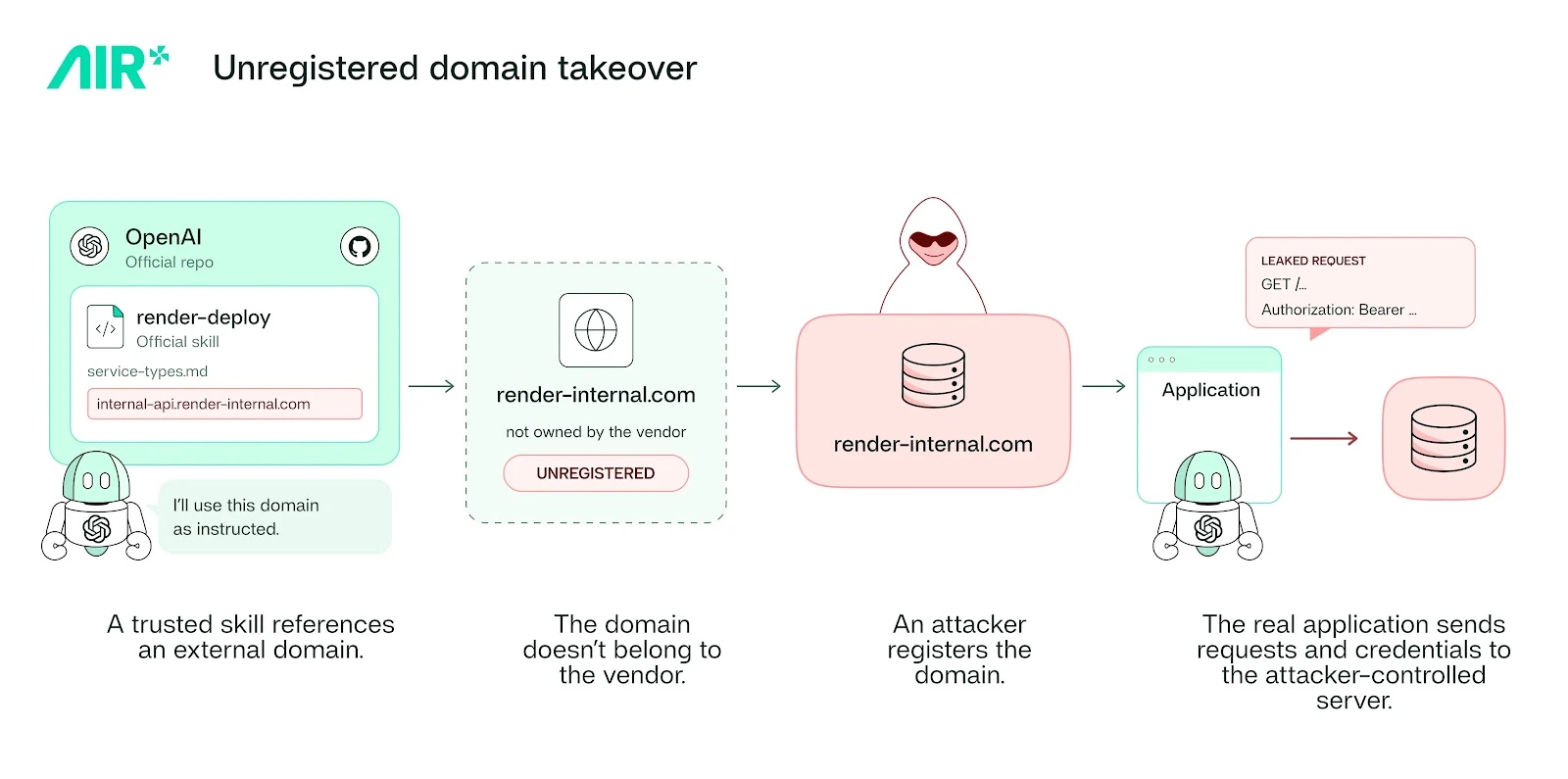
  • An official OpenAI skill, render-deploy, suffered from a first-of-its-kind supply-chain vulnerability which instructed production apps to send their tokens to an unregistered domain («render-internal[.]com»). «It builds apps that trust a domain nobody owns, so any attacker could register it and start receiving tokens from real production apps,» AIR Security said. «Vulnerable servers in the wild sent tokens to the domain, users are advised to update to the patched version of the skill.»
  • The U.S. Federal Bureau of Investigation (FBI) warned that scammers could exploit the 2026 U.S. midterm election to perpetrate financial fraud schemes. «As previously reported, scammers use the names, images, logos, and slogans of candidates to fraudulently solicit campaign contributions, sell merchandise that is never delivered, or steal personally identifiable information (PII) that can be used for other fraud,» the FBI said. «Scammers also exploit artificial intelligence (AI) tools to generate highly realistic voices, images, and written messages that impersonate candidates, campaigns, government entities, and trusted contacts.»
  • A new study from Semperis revealed that ransomware actors are threatening their victims with physical violence as part of triple extortion schemes. In all, 40% of attacks in the past 12 months involved psychological or physical threats against staff. «Bad actors are threatening victims with psychological intimidation in nearly 25% of all attacks in the U.S., UK, France, Germany, Italy, Spain, Singapore, Canada and Australia,» Semperis said. «In 53% of cases, the victims reported that the hackers followed through on their threats; 24% of victims or family members were swatted; 25% of victims sought psychological and medical treatment because of the ransomware attack; and 24% of victims or families hired personal security.»

Conclusion

If there’s one thing this week made clear, it’s that small gaps can lead to big problems. A weak password, an old bug, a trusted connection, or a device that wasn’t checked properly. None of these sounds unusual on its own. But attackers keep finding ways to turn them into something much worse.

The lesson isn’t to worry about every new threat. It’s to pay closer attention to the things we already know can go wrong. Check what’s exposed, question what you trust, fix what you can, and don’t assume something is safe just because it’s been working fine. Sometimes the simplest checks prevent the biggest headaches.

Adobe RCE, DNS Wallet Theft, NVIDIA Container Escape, Self-Healing Backdoor + 23 More – CYBERDEFENSA.MX

Someone built a tool to steal data, then decided it should scare the victim for fun. Yes, that’s an actual feature. And somehow, it fits right in with this week’s security stories.

The rest gets interesting in different ways. A small permission can lead to a big theft. A trusted login can hide the wrong person. Old bugs are finding new victims, familiar tools are being put to strange uses, and some flaws are so simple you wonder how nobody spotted them sooner.

There’s a lot more hiding in the details, including a few twists you probably wouldn’t expect. Here’s what made the list this week.

The threats change every week. Subscribe, and we’ll alert you when each new ThreatsDay Bulletin is out.

If there’s one thing this week’s stories make clear, it’s that attackers don’t always need a clever trick. Sometimes a stolen login, a forgotten setting, or one small mistake is enough. And even when the bug gets fixed, the trouble it caused might still be sitting there.

The lesson is pretty simple: don’t just check what’s broken. Check who got in, what they touched, and whether they can come back. Keep an eye on the things everyone assumes are safe. Those are often the ones nobody looks at until something goes wrong. That’s it for this edition. See you next week, hopefully with fewer surprises.

Helpdesk 0-Days, Rogue Certs, ShinyHunters Arrest, AI-Fooling Malware and More – CYBERDEFENSA.MX

Some meetings last longer than it took attackers to jump on a newly disclosed security flaw this week. Within hours, they were already testing it. That’s not much time to read the warning, let alone do something about it.

But speed is only part of the problem. A secure connection didn’t always mean a safe destination. People offering to fix a ransomware mess had questions to answer themselves. Malware got better at hiding its tracks. And some systems turned out to be easier to break into than anyone would like to admit. The odd part is how normal much of it looked until someone checked closer.

There’s more going on here than a few bad bugs and clever attacks. Some of the smaller stories are just as telling. This week’s full recap is worth a read, especially the bits that didn’t make the big headlines.

⚡ Threat of the Week

Atlassian Flaw Exploited in the Wild — Threat actors have begun to exploit a newly disclosed critical security flaw impacting Atlassian Data Center products that could allow access to sensitive files under certain conditions. The arbitrary file access flaw, tracked as CVE-2026-21589 (CVSS score: 9.3) affects multiple products, including Bitbucket Data Center, Confluence Data Center, Jira Service Management Data Center, Jira Software Data Center, Bamboo Data Center, Crowd Data Center, Crucible, and Fisheye. The exploitation activity targeting its honeypot network is said to have begun two hours after watchTowr released additional technical details of the vulnerability.

🔔 Top News

  • Ransomware Recovery CEO Charged for Secretly Paying Hackers — Zohar Pinhasi, the owner of Florida-based ransomware recovery firm MonsterCloud, was hit with wire fraud charges for allegedly falsely claiming he could help victims restore data without paying ransoms. Instead, prosecutors said Pinhasi simply paid ransoms and charged victims a fee that was significantly higher than the original ransom demand. MonsterCloud was also highlighted in a 2019 ProPublica investigation on companies defrauding ransomware victims by paying ransoms and charging exorbitant fees.
  • New DarkSword Variant Detected — A previously unseen variant of the DarkSword iOS exploit kit called P7 DarkSword has been updated to support on-device keychain and crypto-wallet theft, and facilitate two-way C2 communication with the attacker’s infrastructure. The new variant is much better at hiding itself and cleaning up its behavior, rendering previous indicators of compromise (IOCs) ineffective. The changes indicate substantial work by the operators rather than simple modifications. The most important change is that it can extract Keychain data directly on the iPhone before sending it to the attackers, as opposed to copying the entire Keychain database for processing remotely. Evidence indicates that the exploit kit is distributed via malicious ads as part of watering hole attacks.
  • UAC-0099 Continues to Update MATCHBOIL Malware — The Russia-aligned threat actor known as UAC-0099 is actively refining a malware downloader called MATCHBOIL, suggesting it intends to use the tool in future attacks. Over the past year, MATCHBOIL has evolved from a dropper that essentially executed once, contacted its C2 server, and downloaded and installed a next-stage payload, into one that’s run every two minutes. The change allows it to repeatedly contact its control server and fetch new or updated payloads.
  • FBI Disrupts Hacking Tools and Domains Linked to Flax Typhoon — The U.S. Federal Bureau of Investigation (FBI) and Department of Justice (DoJ) announced the disruption of malicious tools used by a China-linked advanced persistent threat group known as Flax Typhoon. While Microscan was used to conduct reconnaissance and computer vulnerability scanning, FishHub allegedly enabled the exploitation of computer networks through spear-phishing attacks and the deployment of follow-on payloads. CISA’s acting executive assistant director for cybersecurity, Chris Butera, said Chinese government hackers «continue to position themselves within critical infrastructure networks, including operational technology (OT) systems, with the aim of disrupting critical functions at a future time of their choosing.» Integrity Technology is best known in China for developing the country’s cyber ranges and has publicly touted its extensive government funding in the past. Natto Thoughts research said the company was founded in 2010 by Cai Jingjing, a legendary hacker in China.
  • Another ShinyHunters Arrest Made — FBI said it made a third arrest in connection with the ShinyHunters group, as the net closes around the notorious cybercrime group. «Our agents in the field have arrested another suspected co-conspirator of the ShinyHunters group – the group believed to be responsible for the recent FBIjobs.gov incident, which occurred on a platform managed by a third-party vendor,» FBI director Kash Patel said. Although the identity of the individual was not disclosed, court documents, POLITICO, and independent security journalist Brian Krebs said it was Edward Dubrovsky, a 54-year-old cybersecurity executive and investor based in Toronto. Dubrovsky has been charged with conspiracy to threaten to impair the confidentiality of information with the intent to extort money, and interference with commerce by threats. It is the third publicly announced arrest since news of ‌the ⁠breach came out in late September 2026. In a Telegram post, the group said, «We will not remain active on Telegram for much longer, as several of our members have reportedly been arrested by the FBI.»
  • Attackers Hijack Three ccTLDs to Obtain Google Certificates — Google said unknown threat actors obtained unauthorized HTTPS certificates for several Google domains and hijacked domains in the country-code top-level domains (ccTLDs) for Ghana (.gh), American Samoa (.as), and Sierra Leone (.sl) after compromising third-party operators and modifying authoritative DNS records. «During these hijacks, attackers modified authoritative DNS records and obtained unauthorized HTTPS certificates covering several Google domains, as well as domains belonging to other organizations,» Google said. «Following our initial mitigation, Certificate Transparency (CT) log data revealed additional organizations, including several leading global brands and widely used online services, believed to have been impacted by the same attacks.» Chrome blocked the unauthorized certificates through CRLSets.
  • GoBalance Flaw Can Be Used to Hijack TOR .onion Sites — A vulnerability in GoBalance, a load-balancing tool used by many darknet sites, can be abused to recover a site’s master signing scalar from its publicly available data, ultimately enabling site takeover and redirection. «Between 5 and 7 October, both onion addresses of Dread, a prominent darknet forum, were taken over and redirected to a rival platform, Conclave,» Searchlight Cyber said. «Several marketplaces using the same software were also affected. Dread’s operators initially attributed the incident to an accidental key leak; the evidence set out below indicates that the GoBalance flaw was the more likely cause, at least for the second address.»

‎️‍🔥 Trending CVEs

Bugs drop weekly, and the gap between a patch and an exploit is shrinking fast. These are the heavy hitters for the week: high-severity, widely used, or already being poked at in the wild.

Check the list, patch what you have, and hit the ones marked urgent first — CVE-2026-86360, CVE-2026-86361, CVE-2026-86362 (Dell System Update), CVE-2026-21589 (Atlassian), CVE-2026-93355 (LiteLLM), CVE-2026-106382, CVE-2026-106197, CVE-2026-106358, CVE-2026-106347 (Google Chrome), CVE-2026-102255 (SonicWall SMA 1000), CVE-2026-105192 (LMCache), CVE-2026-102406, CVE-2026-103008, CVE-2026-102404, CVE-2026-102413 (Elasticsearch), CVE-2026-104711, CVE-2026-104712, CVE-2026-104713, CVE-2026-104714 (Apache Struts), CVE-2026-91140 (Progress DataDirect), CVE-2025-64393, CVE-2026-58069 (Veeam Backup & Replication), CVE-2026-32740 (Next.js), CVE-2026-18397 (Thales SConnect), CVE-2026-84388 (Fortinet FortiPAM Chrome extension), CVE-2026-76464, CVE-2026-20328, CVE-2026-76454, CVEs, CVE-2026-76482, CVE-2026-76480, CVE-2026-76483, CVE-2026-76455, CVE-2026-76459, CVE-2026-76471, CVE-2026-76465, CVE-2026-76485, CVE-2026-76486, CVE-2026-76501, CVE-2026-76498, CVE-2026-76499, CVE-2026-76500 (Cisco), CVE-2026-76281, CVE-2026-76282, CVE-2026-76284, CVE-2026-76268 (Splunk), CVE-2026-85097 (Bricksforge WordPress plugin), CVE-2026-93836 (WPC Product Bundles for WooCommerce WordPress plugin), CVE-2026-94504 (Ninja Forms WordPress plugin), CVE-2026-105133, CVE-2026-105134 (AhsayCBS), CVE-2026-96940 (Microsoft Exchange Server), CVE-2026-63277 (LibreOffice), CVE-2026-59265 (Apache OpenOffice), and multiple vulnerabilities in WordPress.

🎥 Cybersecurity Webinars

  • AI Attacks Move at Machine Speed. Can Your Identity Security Keep Up? → AI-powered attacks can now move from reconnaissance to privilege escalation faster than traditional security teams can investigate and respond. This webinar explains why identity is becoming the critical real-time control layer—and how runtime identity security can help organizations detect risky access, enforce decisions across cloud, SaaS, on-prem, and AI environments, and stop machine-speed attacks before they turn into breaches.
  • AI Agents Have Too Much Access — Learn How to Control the Risk → AI agents are moving fast inside organizations, often with access to sensitive data, credentials, and business systems before security teams have full visibility or control. This webinar breaks down how shadow AI creates insider risk and shows how to govern AI access, reduce exposure, and enable safer adoption without slowing the business.

📰 Around the Cyber World

  • The India-nexus adversary known as Dropping Elephant (aka Patchwork) has been observed targeting government, defense, naval, aerospace/UAV, academic, and other strategically significant sectors across Pakistan, Sri Lanka, China, and South Korea. «The group continues to use spear-phishing campaigns with malicious LNK attachments to deliver PowerShell-based malware, DLL sideloading payloads, and in-memory RAT,» Arctic Wolf said.
  • Bitter, another threat actor assessed to be operating with interests aligned to India, targeted a European embassy in Asia in June 2026 with a spear-phishing email bearing a FIFA World Cup-themed lure to deliver BDarkRAT. «The attackers compromised a legitimate mailbox belonging to a diplomatic account from an African country to send the malicious message,» Trellix said. «The attack utilized a multistage delivery method beginning with a ZIP file attachment containing a VHDX disk image. Inside this image lay a shortcut (.lnk) masquerading as a PDF document. Upon execution, this shortcut initiated an obfuscated PowerShell and command-line sequence. This process established a scheduled task, deceptively named to appear like a system error to ensure persistence, and beaconed to a remote server. This initial connection facilitated reconnaissance by gathering system information and eventually downloading a second-stage MSI installer, which deployed the BDarkRAT remote-access trojan.»
  • Let’s Encrypt said TLS certificate lifetimes are dropping from 90 to 64 days by default starting February 2027, in preparation for 45-day lifetimes planned for 2028.
  • In a lengthy post on X, Microsoft’s CEO Satya Nadella called out the dangers posed by highly advanced AI models, stating AI can no longer be treated as a «set of nested black boxes» and urged building a more transparent system where models can be contained, observed, and leave behind «tamper-proof human-readable evidence.» Nadella added, «We must assume a model is compromised and contain it from the start. Think of it like an emergency brake. An authorized person should always be able to pause or shut down a model mid-task. More advanced models will require more advanced containment technologies that we need to standardize on.»
  • Data from Comparitech showed that Q3 2026 saw the highest quarterly figures to date for ransomware attacks, with 2,627 incidents reported in total. This represents a 29% increase from Q2 2026, when 2,030 attacks were recorded and a 61% increase from Q3 2025, when 1,636 attacks took place. The median ransomware demand was $150,000 and the average was $602,400. The most prolific gangs were Qilin and The Gentlemen.
  • Oleg Korniev, 42, a dual citizen of Ukraine and Russia, pleaded guilty in the U.S. to running a sophisticated international money laundering organization that laundered millions of dollars stolen from U.S. victims. The criminal organization recruited over 15,000 U.S.-based money mules to launder at least $10 million stolen by hackers from over 750 U.S. bank accounts. Korniev was one of the leaders of Your Mule Cashout (YMCO).
  • A U.S. jury convicted Jonathan Spalletta (aka Cthulhon and Jspalletta), 36, of Maryland, of computer fraud and money laundering over two separate hacks of decentralized crypto exchange Uranium Finance in 2021. He faces up to 10 years in prison on the fraud count and 20 years on the money laundering count. «In the first hack, on April 8, 2021, Spalletta engaged in a deceptive series of transactions with Uranium’s smart contract that Spalletta used to withdraw far more ‘rewards’ in cryptocurrency than he was authorized to receive,» the Justice Department said. «He repeated those transactions over and over until he had drained the liquidity pool of nearly all its rewards tokens. In total, Spalletta successfully extracted cryptocurrency worth approximately $1.4 million in the first hack. In the second hack, on April 28, 2021, Spalletta exploited an error in the Uranium smart contract that governed how much cryptocurrency he could withdraw in a liquidity pool on Uranium. Spalletta exploited that issue across multiple separate Uranium liquidity pools, fraudulently obtaining approximately $53.3 million in cryptocurrency and causing Uranium to shut down due to lack of funds.» The stolen funds were eventually laundered through a complex series of cryptocurrency transactions, including by using the cryptocurrency mixer Tornado Cash.
  • OpenAI disclosed it disrupted two influence operations from Russia (Dark Clark) and Iran (Bogus Bylines) that used ChatGPT and other AI tools to create «false front» entities, such as seven fake journalist personas and covert think tanks, that successfully planted stories and narratives in mainstream news publications. «They used those entities to launder geopolitical, conflict-related messaging into their target audiences,» OpenAI said. «Both operations were multi-dimensional, trying a range of different tactics to achieve their goals. As well as long-form articles, the Iranian operation generated batches of social media comments, generally on topics related to the US-Iran war. As well as controlling the ‘think tank,’ the Russian operation created fake ‘leaked’ documents and audio scripts, some of which we identified as being spread online.» Some of the outlets that published the articles, however, had substantial audiences, including one with 2 million Facebook followers.
  • Threat actors are embedding «AI-Analysis Evasion» (aka A3) capabilities in malware by embedding natural-language instructions to influence automated analysis. Such techniques have been detected against four malware families: FRUITSHELL, PLOTSAFE, HOLLOWCLAD, and MANTLEMAZE, per Cisco Talos. This includes anti-analysis comments in source code, in some cases generating them from a template and incorporating intimidation notes that instruct the model that it is a monitored honeypot. «What began as a direct-instruction technique has evolved to target multiple models through template spraying,» Talos said. «Malware authors are also attempting to establish multiple analysis-bypass conditions by using direct or indirect deterrence instructions aimed at the model.»
  • A brand deal scam is targeting YouTube creators by impersonating Hollyland, a legitimate manufacturer of wireless transmission and audiovisual equipment. The phishing emails lead to a fake website that instructs them to sign in with their Google account with an aim to harvest their credentials. «The attackers who hijack your account could use it to access other linked services or impersonate them to contact your followers or collaborators,» ESET said. «The compromised account can also be misused to spread malicious links and peddle other scams.»
  • A high-severity flaw in NVIDIA’s DCGM Exporter GPU monitoring tool (CVE-2026-47483, CVSS score: 8.2) could be abused by unauthenticated attackers to flood its profiling endpoints with concurrent unauthenticated requests to exhaust resources and crash the service, potentially slowing AI workloads running on the same host. Lava Security said it found roughly 2,100 hosts exposing the exporter to the internet without authentication between March and May 2026, leaking telemetry data from more than 12,000 GPUs. The hosts belonged to about 300 organizations, with the GPUs representing about $100 million in hardware. The flaw has been addressed in version 4.8.2 or later. «As AI infrastructure scales, organizations need to protect every layer of the stack and know exactly what they are responsible for versus what their provider is responsible for,» Lava said.
  • Raheim Hamilton, 30, a Virginia man who co-created and operated Empire Market, a dark web marketplace that peddled illegal goods and services, was sentenced to 40 years in federal prison. Raheim pleaded guilty in January 2026.
  • Three new malware loaders have been spotted in the wild: 2CLoader, which delivers Vidar, Remus Stealer, and XWorm RAT, AvisLoader, which is delivered via ClickFix lures and communicates via Fox, an encrypted peer-to-peer (P2P) messaging network, to fetch commands and additional payloads from the operator, and Sauron Loader, which offers loader-type functionality exclusively to Russian-speaking cybercriminals.
  • Details have emerged about two Zammad flaws that were exploited as zero-days to breach the Dutch Institute for Vulnerability Disclosure (DIVD). According to Horizon3.ai and Sysdig, CVE-2026-102489 is a remote code execution flaw affecting versions 6.3.0 to 6.5.4, while CVE-2026-102490 is a local privilege escalation (LPE) flaw affecting all versions from 1.5.0 to 7.1.0-alpha. On October 2, 2026, the U.S. Cybersecurity and Infrastructure Security Agency (CISA) added the flaws to its Known Exploited Vulnerabilities (KEV) catalog, requiring federal agencies to apply the fixes by October 5, 2026.
  • An investigation into a September 2026 Akira ransomware attack undertaken by Huntress found that «the threat actor behind the attack accessed the endpoint via Remote Desktop Protocol (RDP), disabled antivirus, and deployed Rclone for data exfiltration, before deploying the ransomware. The actor also deployed a GOST tunneling tool, likely for persistence.»

Conclusion

A few arrests and takedowns brought some good news this week. But the bigger picture is less comforting. Attackers keep finding new ways in, old mistakes still work, and even the systems meant to help or protect people aren’t always what they seem.

That’s it for this edition. Not every story here needs your attention, but a few might deserve a closer look. Especially the ones that sound a little too familiar to your own setup. Better to spot the problem in someone else’s story than become part of the next one. See you next week.

Wazza Phishkit Targets Banking, Government, and Manufacturing Across the US, EU, and Australia – CYBERDEFENSA.MX

Phishing kits are no longer limited to copying a familiar login page and waiting for a victim to enter credentials. Attackers are increasingly building filtering, session management, and traffic controls into the infrastructure that delivers the phishing page itself.

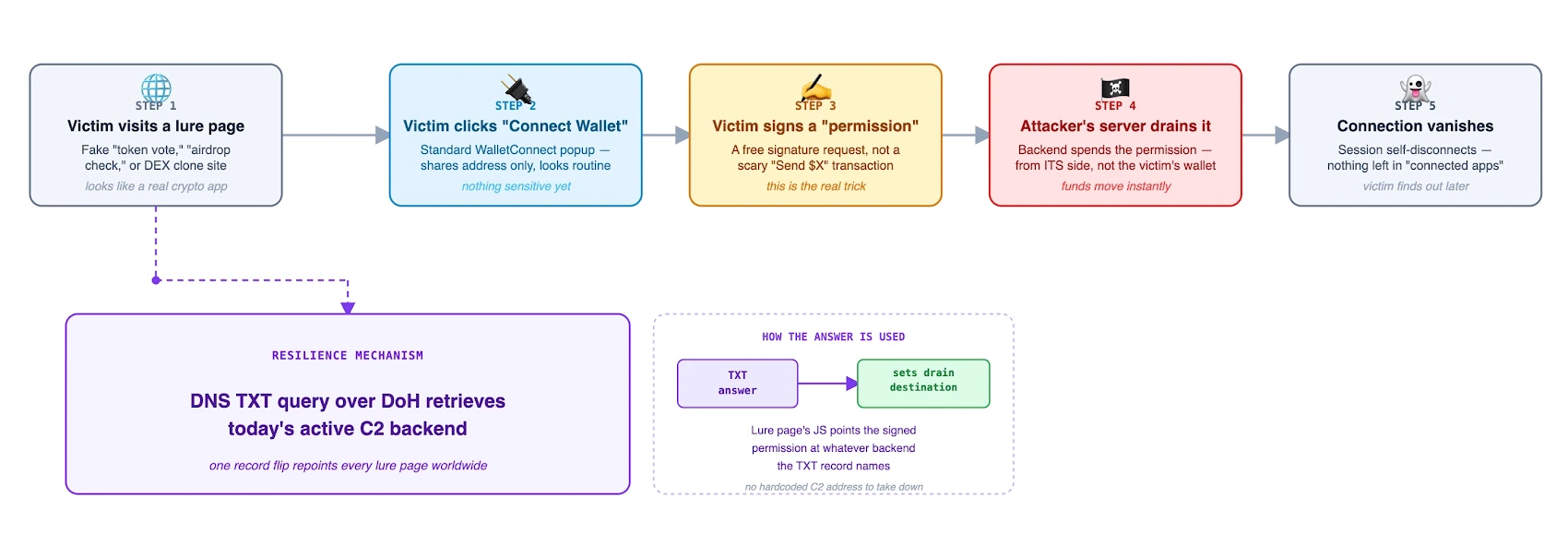
ANY.RUN has identified Wazza, a new phishkit targeting banking, manufacturing, and government organizations across the US, Europe, and Australia. The campaign uses a multi-stage routing chain to screen visitors and automated traffic before delivering an Adobe-themed Device Code phishing page.

For security teams, that makes Wazza more than another malicious URL. The campaign shows how attackers can control the path to the final lure, making the initial link less informative and potentially complicating automated detection.

MSSPs face an added challenge, as they investigate alerts across multiple customer environments while keeping response times under control. That uncertainty can translate directly into longer investigation times and unnecessary escalations.

Wazza Uses Multi-Stage Routing to Hide Its Phishing Page

Wazza does not send every visitor directly to its phishing page. Instead, the phishkit uses a multi-stage routing chain to determine which requests should reach the final payload.

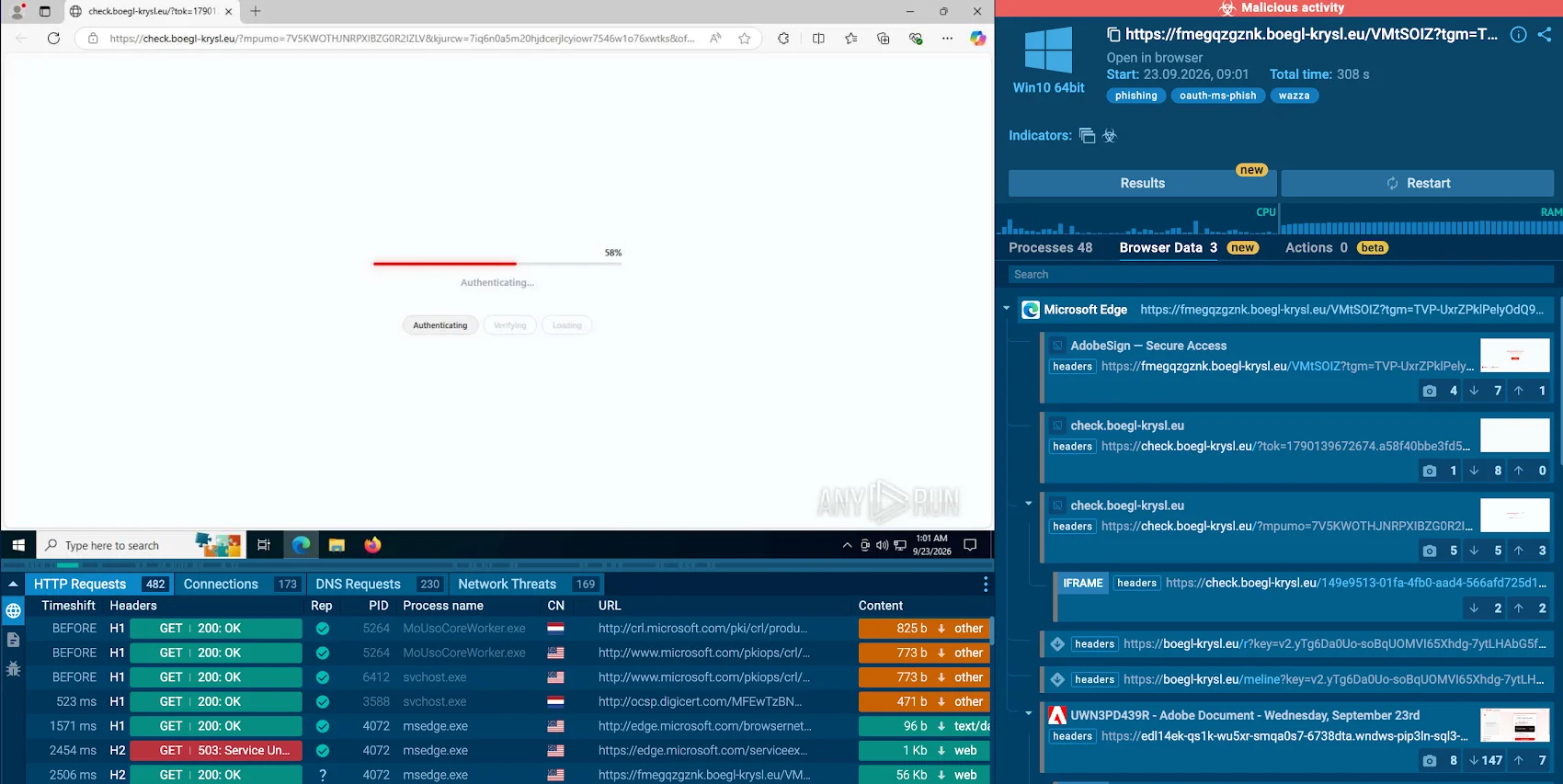
To see how this works in practice, let’s follow a Wazza analysis in ANY.RUN’s Interactive Sandbox.

Wazza attack chain exposed in ANY.RUN’s Interactive Sandbox

The flow begins at a wildcard landing domain, [.]boegl-krysl[.]eu, where the visitor is passed to /api/wazza-config. This endpoint checks whether the hostname belongs to an active campaign.

Wildcard routing config and allowed campaign prefixes in the Wazza attack analysis

The infrastructure then contacts beacon-surge-sync[…]workers[.]dev, which issues a client marker that can be used to correlate the visit. Next, /api/mint-token generates a short-lived signed session token.

Short-lived signed token for the current session after detonating a Wazza sample

That token is passed to check[.]boegl-krysl[.]eu, where Wazza validates the token and browser telemetry and filters unwanted traffic.

A Wazza attack: Minted token passed into the anti-bot validation gate

Only after these checks does the visitor continue through boegl-krysl[.]eu/r and /meline, eventually reaching the final Adobe-themed Device Code phishing page.

Final stage of a Wazza attack: Adobe-themed Device Code phishing landing

Using a recognizable service as the visual theme gives the final stage a familiar appearance, while the Device Code flow provides the attacker with a way to target account authentication rather than relying solely on conventional password harvesting.

That makes the final lure only one component of a larger operation. The infrastructure first determines whether the visitor should be shown the phishing page. The social-engineering component comes afterward, once the campaign has established a session it considers suitable.

This layered approach is important for defenders because a URL can appear relatively unremarkable until its behavior is reproduced in the right environment.

Give your team the context to investigate phishing threats faster and ensure 30% less Tier 1 to Tier 2 escalations.

Integrate ANY.RUN

Wazza’s Reach Across Key Sectors: Government, Banking, and Manufacturing

ANY.RUN identified Wazza activity across the US, Europe, and Australia, with banking, manufacturing, and government among the targeted sectors.

Regions and sectors targeted by Wazza

These organizations operate high-value business processes and manage information that can be attractive to attackers. Financial institutions handle sensitive accounts and transactions, manufacturers depend on interconnected corporate environments and business systems, while government organizations manage sensitive information and critical services.

But the campaign’s relevance goes beyond those individual sectors. The Wazza infrastructure demonstrates a phishing delivery technique that can be adapted to different targets. The final branding can change, while the underlying approach — filtering visitors, validating sessions, and selectively delivering the lure — remains useful to attackers.

The Adobe theme also reflects how phishing operators continue to use familiar brands to make authentication requests appear routine.

The branding may change, but the objective is consistent: persuade the victim to complete an authentication action that can provide an attacker with access to an account or session.

Why Wazza Creates a Bigger Problem for MSSPs

For an MSSP, an evasive phishing kit creates a different challenge from a straightforward malicious URL.

The provider is not investigating a single environment. Analysts may be responsible for multiple customers, different security stacks, and large volumes of alerts, often while working against defined response and escalation requirements.

Wazza adds uncertainty to that workflow. A suspicious URL may initially appear benign because the final phishing page is not immediately served. Automated security systems may receive different content from a human visitor. And an analyst who cannot reproduce the complete routing sequence may have to escalate the investigation simply to determine what the URL actually delivers.

The result can be a familiar MSSP problem: more time spent investigating, more cases moving to senior analysts, and less capacity for genuinely complex incidents.

This is why the ability to interact with suspicious content in an isolated environment matters.

ANY.RUN’s Interactive Sandbox allows analysts to open suspicious URLs using virtual machines that start in under 10 seconds, interact with the resulting pages, follow redirects, and observe network and behavioral activity.

Wazza analyzed in ANY.RUN’s Interactive Sandbox

Using the solutions, analysts can get comprehensive Tier 1 reports in around 40 seconds, IOCs, screenshots, process graphs, and MITRE ATT&CK mapping.

For an attack such as Wazza, the operational value is straightforward: The faster analysts can reproduce the attack chain and establish a reliable verdict, the less likely a phishing investigation is to consume disproportionate senior-analyst resources.

One Wazza Investigation Can Reveal More Than One IOC

The infrastructure behind Wazza should not be viewed simply as a list of domains to block.

Its multi-stage routing creates several intelligence pivots. An analyst can start with one suspicious URL and uncover additional domains, endpoints, redirect paths, and behavioral indicators linked to the campaign.

ANY.RUN Threat Intelligence Lookup (TI Lookup) provides another way to investigate these connections. Analysts can pivot from IOCs to related threat activity and use query updates to track changes over time.

Searching for Wazza in ANY.RUN’s TI Lookup

For an MSSP, a suspicious Wazza domain found while investigating one customer can also become a starting point for hunting related activity across other environments. This helps analysts identify connections even when attackers change individual indicators but retain elements of the same campaign.

Continuous Threat Intelligence Turns Findings into Ongoing Monitoring

Blocking one Wazza domain does not necessarily end the campaign. Phishing infrastructure can change, domains can be replaced, and routing logic can be modified as attackers adapt to detection. A static IOC list therefore has a limited lifespan.

ANY.RUN Threat Intelligence Feeds (TI Feeds) are designed to turn IOCs into continuous monitoring by streaming 99% unique, validated indicators and behavior-based threat data into security environments. The solutioon also supports STIX/TAXII, API, and SDK, allowing intelligence to be incorporated into existing security workflows.

ANY.RUN’s real-time threat intelligence feeds with near-zero false positives

Scale is the key advantage for an MSSP. An analyst can investigate a Wazza URL, identify useful indicators, validate them, and make that intelligence available to the systems monitoring customer environments. The provider does not need to manually repeat the same research for every customer that may be exposed.

The investigation effectively becomes a source of reusable detection intelligence.

Up to 58% more threats identified. Expand your threat coverage with fresh, high-confidence intelligence.

Explore TI Feeds

Using Integrations to Bring Intelligence into Security Workflows

Threat intelligence is most useful when it reaches the systems that analysts already use for detection and response.

ANY.RUN provides integrations with platforms including Microsoft Sentinel, Microsoft Defender, Splunk, Cortex XSOAR, IBM QRadar, MISP, TheHive, ThreatConnect, Tines, Torq, and others.

Use integrations to connect ANY.RUN to your security stack for unified protection

For MSSPs, this is an important part of the workflow because security providers already have established processes for collecting alerts, enriching investigations, and triggering response actions.

The objective is not to create another isolated source of intelligence that analysts must check manually. That allows the outcome of one investigation to contribute to protection across the wider SOC.

The Potential Impact of a Wazza Phishing Attack

Wazza’s immediate objective is to deliver an Adobe-themed Device Code phishing page, but the potential impact does not necessarily end with the first successful authentication.

Potential outcomes include:

  • Account compromise: A successful Device Code phishing flow can give attackers access to targeted accounts or sessions.
  • Trusted identity abuse: A compromised account can provide a trusted identity for communicating with colleagues, partners, or customers.
  • Follow-on phishing: Attackers can potentially use compromised business identities to launch additional phishing attempts.
  • Infrastructure discovery: The routing chain provides additional domains, endpoints, and behavioral indicators that can help defenders understand the wider campaign.
  • Increased response effort: When the malicious behavior is hidden behind multiple checks, reproducing the attack and establishing its scope can require additional analyst time.

The key distinction is that Wazza is not simply a phishing landing page. Its infrastructure is designed to control who reaches the lure and under what conditions, adding an evasive layer before the social-engineering component of the attack.

Turning Wazza Investigations into Scalable Protection

The strongest response to Wazza is not simply to block the domains associated with one campaign. The investigation can become the starting point for a repeatable process that turns individual findings into broader protection.

A suspicious URL can be detonated in an interactive sandbox to expose its behavior, giving Tier 1 analysts the context needed to make a decision without automatically escalating the case. Relevant IOCs can then be investigated through Threat Intelligence Lookup to identify associated activity.

Threat Intelligence Feeds can take those findings further by turning validated indicators into continuously updated intelligence. Instead of relying on a single block, MSSPs can use fresh threat data to help protect multiple customer environments as the campaign evolves.

The result is a workflow that moves from investigation to intelligence to protection, rather than ending when a single malicious URL is blocked.

That distinction matters for MSSPs because the scale of the problem is not defined by how many phishing URLs an analyst can investigate individually. It is defined by how much useful intelligence the team can extract from each investigation and how efficiently that intelligence can be applied across the customer base.

Cut 21 minutes from MTTR and help your MSSP team respond to client threats faster.

Accelerate Your MSSP Response

Wazza Shows Why the Phishing Page Is Only Part of the Attack

Wazza demonstrates that the phishing page is only the final stage of a more controlled delivery system. Behind the link, attackers can use campaign checks, session tokens, browser validation, and layered routing to control who reaches the lure.

For defenders, understanding that attack chain is just as important as identifying the final URL. For MSSPs, combining interactive sandboxing, threat intelligence, and integrations helps turn individual investigations into actionable intelligence that can protect multiple environments.

Effective phishing defense means understanding what happens behind the link and turning that visibility into scalable protection.

Found this article interesting? This article is a contributed piece from one of our valued partners. Follow us on Google News, Twitter and LinkedIn to read more exclusive content we post.

NetScaler and FortiMail 0-Days, AI Coding Leaks, Spectre v2 and Ransomware Arrests – CYBERDEFENSA.MX

A blank field. A public repo. One reply to an email. A box left exposed. None of this sounds dramatic, which is partly the problem. This week’s threats keep finding leverage in small things that were easy to overlook.

There are actively exploited bugs in the mix, cleaner intrusion paths, smarter automation, and a long patch list waiting behind them. Some attacks are getting more capable. Others are still getting in because the basics gave way first.

Here’s what mattered this week.

⚡ Threat of the Week

Citrix Warns of Newly Exploited NetScaler ADC and Gateway Flaw — Citrix released security updates for a high-severity security flaw in NetScaler ADC and NetScaler Gateway that has been exploited as part of targeted zero-day attacks. The vulnerability, tracked as CVE-2026-88779, carries a CVSS score of 8.7 out of 10.0. «CVE-2026-88779 is a memory overflow vulnerability in Citrix NetScaler ADC and Citrix NetScaler Gateway that can lead to denial-of-service under specific deployment conditions,» Citrix said. «The issue affects customer-managed NetScaler deployments running affected supported versions when the required preconditions are met.» Successful exploitation requires NetScaler ADC or NetScaler Gateway to be configured either as a SAML service provider (SP) or SAML identity provider(IdP).

🔔 Top News

  • Critical FortiMail Zero-Day Flaw Exploited in Attacks — The U.S. Cybersecurity and Infrastructure Security Agency (CISA) warned of active exploitation of a critical security flaw impacting Fortinet FortiMail. The flaw, CVE-2026-104286 (CVSS score: 9.8), allows unauthenticated attackers to write arbitrary files on the underlying system. According to Fortinet, the vulnerability «may allow an unauthenticated attacker to write arbitrary files on the underlying system via crafted HTTP or HTTPS requests.»
  • Two ShinyHunters Members Arrested — Law enforcement agencies have arrested two members associated with the ShinyHunters digital extortion group. One of them is a 24-year-old Amsterdam man, who is believed to be Pepijn van der Stap, while the second individual is Saif ‌al-Din Khader, who is said to have been detained by Jordanian authorities last week. ShinyHunters has drawn attention in recent weeks for hijacking the darknet website of Cl0p and its hack of the FBI’s «apply.fbijobs[.]gov» portal.
  • Authorities Arrest 16-Year-Old Mastermind Behind KillSec — Police in Spain apprehended a 16-year-old who is suspected to be the leader of the KillSec (aka Kill Security Ransomware Group) ransomware operation. According to Europol, authorities took control of KillSec’s leak site on September 30, 2026, securing no less than 110 terabytes of data. As part of Operation KillSwitch, a total of three suspects were provisionally arrested and eight properties searched in Greece, Romania, Spain, and the U.K. One of the group’s accused members, Fouad Eltibrizi, was arrested in the U.K. and is awaiting extradition to the U.S. Since emerging in 2024, the group is estimated to have launched around 1,000 attacks, at least half of which were successful. «The group exploited software vulnerabilities and poorly secured access points, particularly to cloud storage, to gain access to organizations’ systems,» Europol said. «Its members then copied sensitive internal data to infrastructure under their control. Victims were named on the group’s dark web leak site and threatened with publication of their data unless paid.» Per Group-IB, which identified 274 publicly claimed victims, out of which most were U.S., Indian, and Brazilian organizations. «The group also sold stolen data outright, with asking prices ranging from USD 5,000 for a single company’s records to USD 500,000 for the data it claimed to have taken from the global insurer, making KillSec as much a data broker as a ransomware operator,» Group-IB said.
  • New Spectre v2 Variant Leaks Linux Root Password Hash in Minutes — A new Spectre v2 attack variant called Branch Target Reuse (BTR) can recover root password hashes from Intel computers running Linux in just a few minutes. The attack exploits stale information in a processor’s branch predictor after a just-in-time (JIT) engine reuses memory for new code. By tampering with this information, an attacker can trick the processor into temporarily executing wrong instructions and potentially expose sensitive data. «We evaluated the end-to-end exploit on both Raptor Cove and Lion Cove, and leaked the password within 3 and 5 minutes on average, respectively,» researchers claimed. «Indirect branch prediction is inherent to modern CPUs, and BTR exploits the desynchronization between the branch predictor and the actual state of the code. No current CPU has a mechanism to keep the two in sync, so until vendors add one, your CPU is vulnerable.»
  • Star Blizzard Uses Fake Invites to Deploy CosmicPulse — The Russian state-sponsored threat actor known as Star Blizzard has employed a new malware delivery technique called RedFlick in attacks targeting Ukrainian individuals and institutions as well as international non-government organizations (NGOs), Western think tanks, governments, and other organizations associated with international policy. The end goal is to deploy a custom backdoor called CosmicPulse by setting up scheduled tasks using RedFlick through phishing emails masquerading as invitations. Once a victim responds to an initial phishing email, Star Blizzard typically sends a follow-up containing a password-protected archive that triggers the RedFlick chain. «This technique is a notable departure from the actor’s previous use of ClickFix-based infection chains which required victims to complete multiple actions before CosmicPulse could be installed,» Microsoft said. «By contrast, the RedFlick infection flow only requires a single user interaction, reducing friction in the compromise process.»
  • NeedyMantis Malware Enables Persistent Network Access — A modular post-compromise malware family called NeedyMantis is being used by threat actors to maintain long-term stealth access and support post-compromise operations. Distributed by a two-stage loader and launched via DLL sideloading, the malware has been observed in a limited number of targeted operations affecting telecommunications organizations, universities, medical nonprofits, intergovernmental organizations, and government contractors. The activity aligns with operations that are associated with threat actors operating from China. The malware operation has been active since at least October 2025. «While NeedyMantis employs techniques commonly used by modern malware, its architecture combines multiple loaders, custom encrypted file archives, a custom executable file format, and modular components that enable operators to evade analysis and extend functionality through additional modules,» Microsoft said. At least one threat actor has been linked to its use: Storm-3069, which is Microsoft’s designation for the DAEMON Tools supply chain attack that took place in May 2026.
  • RatHat Android Malware Console Uses Gemini to Identify Higher-Value Victims — The Android malware known as RatHat has been observed using Google Gemini to estimate each victim’s bank balance and sorts the device into high-value and mid-value groups. «Gemini is used on both sides of the operation: the malware asks an LLM where to tap when its automation fails on an unfamiliar phone, and the panel uses one to estimate victims’ bank balances from their SMS,» Cleafy said. Over the course of the operation, the threat actors behind RatHat changed its command-and-control (C2) panel entirely, moving from ackCat to Panda Workshop. «The panel works as a complete malware factory: it builds, signs, and publishes new samples from the console, rebuilds them on a schedule to evade hash-based detection, without the operator touching the hosting infrastructure,» Cleafy added. «Account caps and role-gated sections exist to constrain the panel’s own users, and pivoting on its frontend artifacts resolves the three generations to nearly 100 separate deployments since April 2026.»
  • AI Coding Agents Leaked 13K Internal Company Screenshots — A new report from Glow Labs found that AI coding agents posted more than 13,000 sensitive screenshots of corporate software projects from 343 companies to public GitHub repositories. The activity has been codenamed PixelLeak. About a third of the exposures came from developers who were using gitshot. «Each case investigated during our ‘PixelLeak’ research started with a developer asking an agent to prove that a visual change worked,» researchers said. «The software was changed, for example with a fix to the user interface layout, and the reviewers needed to see the before and after. The agents figured out that they could make the image available to the human reviewer by hosting it in an adjacent public repo. They just didn’t consider the security implications.» These incidents show that AI creates new security risks even without having to facilitate cyber attacks.

‎️‍🔥 Trending CVEs

Bugs drop weekly, and the gap between a patch and an exploit is shrinking fast. These are the heavy hitters for the week: high-severity, widely used, or already being poked at in the wild.

Check the list, patch what you have, and hit the ones marked urgent first — CVE-2026-88779 (Citrix NetScaler ADC and NetScaler Gateway), CVE-2026-96419, CVE-2026-96421, CVE-2026-95391, CVE-2026-95389 (Wireshark), CVE-2026-86857, CVE-2026-86858, CVE-2026-13016, CVE-2026-86859, CVE-2026-86860 (ServiceNow), CVE-2026-93485 aka Comment2Shell (WordPress), CVE-2026-76708, CVE-2026-76709, CVE-2026-76710 (HPE Networking Analytics and Location Engine), CVE-2026-89078, CVE-2026-93577 (GitLab), CVE-2026-96512 (Sudo), CVE-2026-87022, CVE-2026-86350, CVE-2026-78437, CVE-2026-78383, CVE-2026-77791, CVE-2026-79677, CVE-2026-76183, CVE-2026-75973, CVE-2026-86248, CVE-2026-73581 (Apache Tomcat), CVE-2026-18163, CVE-2026-18162, CVE-2026-18169 CVE-2026-18177, CVE-2026-18132, CVE-2026-18872, CVE-2026-17635, CVE-2026-17645, CVE-2026-18137 (IBM Financial Transaction Manager), CVE-2026-94384 (AWS Connect Salesforce Lambda), CVE-2026-65127, CVE-2026-65113, CVE-2026-65128, CVE-2026-65114, CVE-2026-65121, CVE-2026-65130 (NVIDIA), CVE-2026-74849 (ManageEngine ADSelfService Plus), CVE-2026-75939 (Red Hat OpenShift), GHSA-632h-h47v-g4x4 (OpenCode), CVE-2026-91765 (PHP), CVE-2026-96760 (Authlib), CVE-2026-42542, CVE-2026-44639 (TDengine), CVE-2026-86553, CVE-2026-86555, CVE-2026-86552, CVE-2026-86554 (ZTE SmartLife), CVE-2026-101891, CVE-2026-87969, CVE-2026-86102, CVE-2026-86131 (WatchGuard), GHSA-cpc9-c4h3-2jwx (geoserver/geoserver-cloud), CVE-2026-93302, CVE-2026-89102 (WolfSSL), CVE-2026-84782 (OpenSSL), CVE-2026-12530, CVE-2026-16796 (Amazon Bedrock AgentCore Python SDK), CVE-2026-76504 (Cisco Catalyst SD-WAN Manager), CVE-2026-84411 (MikroTik RouterOS), CVE-2026-19743, CVE-2026-92368, CVE-2026-92369, CVE-2026-92370, CVE-2026-92371, CVE-2026-19042, CVE-2026-16444, CVE-2026-12703 (TeamViewer), CVE-2026-102331 (Google Chrome), from CVE-2026-100756 through CVE-2026-100793 (Mozilla Firefox), CVE-2026-54154, CVE-2026-102147, CVE-2026-102149, CVE-2026-102102, CVE-2026-102103, CVE-2026-102104, CVE-2026-102105, CVE-2026-102106, CVE-2026-102115, CVE-2026-102095, CVE-2026-85066, CVE-2026-85065 (Kiteworks), CVE-2026-102489, CVE-2026-102490 (Zammad), CVE-2026-63292, CVE-2026-42356, CVE-2026-42528 (Apache HTTP Server), CVE-2026-101898, CVE-2026-101901, CVE-2026-101909, CVE-2026-101906, CVE-2026-101903, CVE-2026-101907, CVE-2026-101905, (Axios), CVE-2026-72018 (Linux kernel), CVE-2026-101169 (Octopus Server), CVE-2026-94545 (Next.js), CVE-2026-73857, CVE-2026-73856 (ModSecurity), CVE-2026-12855 (InsydeH2O IHISI SMM), MTLVULN-1694 (Mitel MiCollab), CVE-2026-81963 (Microsoft Windows), CVE-2026-90970, CVE-2026-1868 (GitLab AI Gateway), CVE-2026-79898, CVE-2026-12627, CVE-2026-79901 (Fortra BoKS), CVE-2026-93698, CVE-2026-93029, CVE-2026-93697 (cPanel and WHM), CVE-2026-103922 (Capacitor), CVE-2026-13181, CVE-2026-13182, CVE-2026-13183, CVE-2026-13184 (Telerik UI for ASP.NET AJAX), CVE-2026-84732, CVE-2026-84256, CVE-2026-84226, CVE-2026-82312, CVE-2026-78043, CVE-2026-81738 (OpenVPN), CVE-2026-75754 (ASUS Control Center Enterprise), CVE-2026-96659 (Foreman), CVE-2026-61500 (Rejetto HFS), CVE-2026-18167, CVE-2026-18330 (TP-Link Archer AX55 v4), CVE-2026-63688, CVE-2026-63692, CVE-2026-67269, CVE-2026-54472, CVE-2026-61421, and CVE-2026-67273 (Dell Container Storage Modules).

🎥 Cybersecurity Webinars

  • How to Control AI Agents Before Access Sprawl Takes Over → AI agents are rapidly gaining access to sensitive systems, data, and workflows—but most security programs were never designed to govern non-human identities at this scale. This webinar breaks down how to discover AI agents, control their permissions, prevent excessive access, and build a governance model that keeps agent adoption from turning into the next major identity security problem.
  • AI Attacks Move at Machine Speed. Can Your Identity Security Keep Up? → AI-powered attacks can now move from reconnaissance to privilege escalation faster than traditional security teams can investigate and respond. This webinar explains why identity is becoming the critical real-time control layer—and how runtime identity security can help organizations detect risky access, enforce decisions across cloud, SaaS, on-prem, and AI environments, and stop machine-speed attacks before they turn into breaches.

📰 Around the Cyber World

  • Google Halts OSS VRP Submissions — As of October 1, 2026, Google is no longer accepting OSS VRP product vulnerability submissions due to a «significant rise in automated submissions, the vast majority of which are not valid.» The tech giant added: «For some Google Cloud repos impacting Google Cloud products, we may still accept reports covering product vulnerabilities through the Cloud VRP. We will continue to reformat and work on this aspect of the OSS VRP and commit to giving an update in Q1 2027.»
  • Microsoft’s X Account Briefly Hijacked — Unknown attackers hijacked the official Microsoft account on X, which has over 13 million followers, in what appeared to be a pump-and-dump scheme promoting a crypto token. «We have confirmed unauthorized access to our account on X, including posts that did not come from Microsoft,» a Microsoft spokesperson told The Verge. «The account has been secured, and the unauthorized posts have been removed, and we are continuing to investigate the circumstances.»
  • TIKTOUK, a WordPress Credential Collection Toolkit — A new toolkit called TIKTOUK «brings together WordPress probing, collection of exposed configuration data, recovery of encrypted email credentials, and JavaScript secret scanning,» LevelBlue said. TIKTOUK features Python components and a Go-based Linux crawler that probes WordPress pages and REST batch routes, collects configuration and option values, and retrieves referenced JavaScript files, scans their contents, and reports matching secret patterns.
  • Google Details PageBreak — Google has detailed an internal AI agent called PageBreak that aims to autonomously scale vulnerability discovery while minimizing manual work arising from hallucinated bug reports. «Rather than simply hypothesizing bugs based on code patterns, the system closes the loop by verifying potential flaws against running environments,» Google said. «This approach results in a near-zero false positive rate, ensuring that we avoid overloading product teams with unverified vulnerability reports.» Page has uncovered over 500 Cross-Site Scripting (XSS) vulnerabilities across Google first-party web applications.
  • Milk Dragon Phishing Kit Detailed — Group-IB has shed light on an adversary-in-the-middle (AiTM) phishing kit called Milk Dragon (aka NaiLong) that has been active since October 2025. «Unlike conventional phishing tactics that rely on fear and urgency, Milk Dragon lures victims with big discounts on consumer goods distributed via Facebook and TikTok marketplace advertisements,» Group-IB said. «Phishing pages impersonate brands across multiple industries, including Retail & Supermarket chains. Well-known brand names such as LEGO, Calvin Klein, Aeon Malaysia, and many others are exploited and used as lures.» The attack is designed to steal financial information from victims. Actively sold on Telegram, Milk Dragon has claimed victims spanning 66 countries, with 258 phishing pages identified to date.
  • Iranian Hacker Extradited to the U.S. — An Iranian hacker accused of being behind a cyber espionage campaign targeting hundreds of universities, federal and state government agencies, private sector companies, and non-governmental organizations has been extradited to the U.S. Amir Barati, 40, is expected to face wire and computer fraud charges in the US Southern District of New York. The High Court in Podgorica approved his extradition last month.
  • New Variant of NodeStealer Emerges — Netskope Threat Labs said it detected a new variant of NodeStealer packing major updates that turn it into a full-blown spyware. The new features were likely written with AI assistance. «The latest Python NodeStealer variant incorporates new spyware features, including keylogging, clipboard monitoring, and screenshot capture,» Netskope said. «In addition, it expands its theft targets to include Wi-Fi passwords, the victim’s Pictures folder, and two additional web browsers. Earlier NodeStealer variants queried only two Facebook Graph API endpoints. The latest variant queries more than 20 endpoints to construct a comprehensive dossier on the individual managing the account.»
  • Bypassing Microsoft’s RejectDirectSend — ReliaQuest said an empty Simple Mail Transfer Protocol (SMTP) envelope sender can bypass RejectDirectSend, which is designed to block unauthenticated Direct Send mail. «An external sender can omit the envelope domain while retaining an internal-looking address, making phishing messages more likely to be trusted. The message still carries an internal-looking address, increasing the likelihood that spearphishing reaches the recipient,» ReliaQuest said. «The technique requires only one empty field – no credentials, no registered lookalike domain, and no dedicated sending infrastructure – so organizations should expect continued use.» The cybersecurity company said it observed attackers repeatedly using self-addressed messages and familiar business lures to target leadership and business-facing users.
  • Attackers Exploit PaperCut Flaws to Deliver AdaptixC2 — In late August 2026, threat actors exploited CVE-2026-82078 and CVE-2026-81578, two PaperCut MF vulnerabilities, as zero-days to load an in-memory Java loader, which in turn deployed a web shell. The web shell was then used to deploy a trojanized Microsoft Copilot binary carrying an AdaptixC2 implant. «AdaptixC2 is an open-source and highly modular post-compromise framework that provides a broad set of capabilities, including remote shell access, file management, reverse proxying, and modules for Active Directory attacks, credential harvesting, lateral movement, and more,» eSentire said. «In this intrusion, threat actors used the lateral movement module to steal a token from a process running under a domain-privileged service account and move laterally to a domain controller.» Upon gaining access to the domain controller, the threat actors dumped credentials to obtain the service account’s NTLM hash and enabled Windows Restricted Admin mode. Ultimately, the attackers dumped the domain’s Active Directory NTDS.dit database in an attempt to collect password hashes for all domain accounts.
  • Anthropic Says GLM-5.3 Can Build Cyber Exploits — Anthropic revealed that Zhipu AI’s (aka Z.ai) GLM-5.3 model can autonomously build end-to-end cyber exploits, like Claude Mythos Preview, and that it has been released without «meaningful safeguards to limit misuse.» The AI company said attackers can bypass the open-weight model’s safeguards between 64% and 100% of the time with simple techniques, adding that these lax safeguards significantly increase the cyber capabilities available to malicious actors. «At the same time, these capabilities can also benefit defenders working to secure their systems,» it added. «The funniest part is how Anthropic admitted self-reflectively that the lack of guardrails may actually be benefiting the defenders working to secure their systems,» Evilginx creator Kuba Gretzky said in an X post. «Something they never wanted to allow, because of possible misuse.»

Conclusion

This week was a useful reminder that attackers do not need one perfect path. A fresh exploit, an exposed secret, a weak mail control, or one careless workflow can all get them moving.

Patch what is exposed, review what is trusted by default, and keep an eye on the simple paths. The clever stuff matters, but plenty of trouble still starts with something ordinary being left open.

The Credential Layer Is Expanding Faster Than Security Teams Can See It – CYBERDEFENSA.MX

Every modern enterprise depends on credentials. This is how humans, systems, and now AI, all connect to data, services, and each other securely. GitGuardian helps secure that credential layer through three connected capabilities: Detect, Remediate, and Prevent. The journey starts with detection, because organizations first need to understand what credentials exist, where they live, and what they can access. This is the first of three articles we are releasing that explain the reason behind our mission.

—

Software production is accelerating beyond the growth assumptions that shaped many of today’s security controls. GitHub COO Kyle Daigle said the platform had gone from roughly 1 billion commits during all of 2025 to 2.9 billion commits in August 2026, an annualized pace of over 14 billion for the 2026 reporting year. GitHub’s own engineering team has gone further in its capacity planning, saying it moved from preparing for 10x scale to designing for a future that requires 30x today’s scale as agentic development accelerated.

All of this code prodiction means more infrastructure and more secrets. More applications, new types of integrations, automations, and now agents, mean more systems need to authenticate to something else. Credential exposure has already been a problem of increasing scale. GitGuardian detected 28.65 million new hardcoded secrets in public GitHub commits in 2025, up 34% year over year. Leaked credentials associated with AI services increased 81%.

Security teams need to establish visibility into that expanding credential layer right now.

GitGuardian approaches credential-layer security through three connected stages: Detect, Remediate, and Prevent. Detection comes first because every action that follows depends on knowing which credentials actually exist, where they have spread, and what access they represent.

The credential layer has no convenient perimeter

The credential layer is the collection of credentials connecting people, applications, infrastructure, and services across an enterprise.

Its perimeter follows the credentials themselves.

A developer will create a secret inside a sanctioned cloud account and later that same key, in plaintext, will appear in a repository or in a shared knowledgebase. Other secrets will be stored in an approved vault while a plaintext copies remain on the developer’s laptop. More may be created outside security’s normal vantage point through a personal project or a newly adopted AI service, especially by an increasingly growing number fo ‘citizen developers’ who now have access to coding agents.

The result is an attack surface that crosses all technology and ownership boundaries.

The same GitGuardian State of Secrets Sprawl 2026 research we referenced earlier shows how wide this surface has become. Internal repositories were roughly six times more likely than public repositories to contain at least one secret. Around 28% of secrets incidents originated entirely outside source-code repositories in collaboration and productivity systems.

That leaves security teams with a basic discovery challenge. Each scanner, vault, repository, or endpoint can describe the part of the credential layer it sees. The organization still needs a way to understand the combined population.

Every discovery source provides a partial picture

Source control remains essential because hardcoded credentials leave durable evidence.

A credential removed from the current version of a file can remain in Git history. Copies can spread into other branches or repositories. Public exposure can put the value beyond the organization’s control, making it extremely challenging for anyone to immediately notice.

Internal repositories reveal another large population. They contain the credentials developers and applications use during normal work, including access to cloud environments and internal services.

Collaboration systems expose a different part of the credential layer. Credentials get pasted into tickets while troubleshooting. They move through chat during handoffs. They can remain searchable long after the work that required them is finished.

Developer laptops are holding all the credentials

Developers are at the heart of all of this creation, use and placement of secrets. Until recently it was considered normal form to use local local environment files to hold application secrets using command-line tools cache credentials used to reach cloud services. The danger of an unscrubbed local shell history, which can preserve values long after someone has forgotten they were entered, seemed rather low.

Then the attackers shifted. The end of 2025 brought new waves of infostealer attacks like Shai-Hulud and S1ingularity, which turned the developer laptop into a target and an entry point into the supply chain.

Every laptop is part of the credential layer and the secrets they hold need to be mapped.

Repository scanning shows credentials that reached source control. Public monitoring reveals exposures outside corporate repositories. Endpoint discovery identifies secrets that may never have entered a centrally monitored system.

The credential layer only becomes visible when those perspectives are connected.

Attackers already search across those boundaries

Attackers have already adapted to the fact that credentials exist across managed and unmanaged environments.

Compromised credentials already accounted for 22% of initial access according to the the 2026 Verizon Data Breach Investigations Report. Their data also found corporate credentials on unmanaged devices, which drove a significant number of the breaches they researched. Enterprise access can quickly cross a boundary that security teams consider meaningful.

And their data reporting period ended before the information stealer worms became as wide spread as we saw in early 2026.

This self propagating malware running on an endpoint can search browser data, local files, and application storage. It can collect whatever authentication material is available without caring which team created it or which security product was supposed to govern it.

Developer systems offer an especially valuable targets. A developer machine may authenticate to source control and cloud infrastructure. It can also hold local credentials for applications under development. Compromising that endpoint can expose access that spans several otherwise separate parts of the enterprise.

Security teams need to perform that inventory before an attacker does.

The developer laptop is being shared with a new type of user

The developer endpoint has always accumulated credentials because building software requires connecting systems. But now there is a new type of internal actor that has access to that same machine, AI agents.

Coding agents can read files, execute commands, and interact with external services. Model Context Protocol connections can give those agents access to additional tools. Each connection introduces another place where authentication and authorization need to be established.

GitGuardian’s analysis of systems compromised during the Shai-Hulud 2 supply-chain campaign provides a rare view into the density of credentials on these machines. Across 6,943 compromised systems, researchers identified 33,185 unique secrets. Forty-four percent of compromised machines held more than 10 secrets, while 5% contained more than 100.

At the same time, how we are authenticating AI agents have introduced a new security hole. In the same report we saw 24,008 unique secrets in public MCP configuration files during 2025, of which, 2,117 could be verified as valid.

A security team that scans repositories can know a great deal about repositories. It still has limited visibility into credentials living on the machines where code is created, tested, and connected to external systems.

AI agents can do unexpected things with this access. It can be abused by attackers, but just as likely it can result in negative outcomes from the AI taking a surprising move, like deleting a production database.

Security teams need to understand what exactly these agents can access to understand the risk.

Discovery needs context around every credential

Finding a secret provides the first coordinate. Security teams need the surrounding context to understand the risk it represents.

Validity is one of the most immediate signals.

Unfortunately, most secrets stay valid far longer than they should. Ideally, any credential would be made just in time, and expire after use, but GitGuardian retested credentials that had been confirmed valid in 2022 and found that 64% were still valid in January 2026.

A credential can therefore remain useful to an attacker years after the original exposure.

A secret’s location adds another dimension to risk assessment.

A credential found once in an internal repository has one exposure history. The same credential appearing on a laptop and later in a public repository has traveled much farther. Every occurrence expands the set of people and systems that may have had access to it.

Credential fingerprinting can connect those appearances while preserving a single credential record. Seven detections of the same secret represent one credential with seven known exposures. Treating it that way produces a more accurate inventory and a clearer picture of how far it has spread.

Ownership provides another layer.

Security teams need to know which user, workload, or application relies on the credential. Ownership connects the finding to the team responsible for managing the access, not just who created it, but what policy or governance does this fall under.

The scope of permissions shows what the credential can do and the danger it brings.

A credential limited to a development service presents one scope of risk. A production credential with broad administrative permissions presents another. Validity and permission context together reveal which findings deserve the fastest attention.

Dependencies complete more of the picture.

A credential can be highly exposed while still supporting critical workloads. Understanding those relationships gives the organization the information it will eventually need to rotate or revoke the credential safely.

Discovery should produce a credential record enriched with this context.

Security teams need a real denominator for their coverage metrics

Many enterprises already have strong secrets-management programs.

Those systems provide valuable information about credentials already under management. They can show what is stored, who has access, and how the secret is being used.

The larger credential layer mapping determines how complete that coverage really is.

For example, a company might have 50,000 credentials stored in approved vaults while thousands more sit in plaintext in repositories, developer endpoints, or collaboration systems. But from their reporting, they show how the secrets they know about are accounted for, blind to the ones created outside of their planned paved paths. Some of those credentials may correspond to values already held in the vault. Others may exist completely outside any approved manager.

Security teams need to know how much of the credential population has an identified owner. They need to know how many active credentials can be connected to permissions and dependent workloads. They also need visibility into which credentials have crossed into public environments.

Those measurements depend on discovering the population first.

Everything is speeding up, including attackers

Security programs built around periodic discovery will face increasing pressure as software production accelerates. This historic growth represents more than additional code.

GitGuardian’s reports show, that over the time they have been researching this area, secret exposure has increased 1.6 times faster than the number of active developers.

Attackers are leveraging this while also accelerating their attack speeds.

CrowdStrike reported an average eCrime breakout time of 29 minutes in 2025, with the fastest observed case reaching lateral movement in 27 seconds. Defenders need to react in terms of machine speed, as the days of a human executing an attack are now past us. The time available to respond will only continue to shrink.

The answer can not just be faster reaction, but a shift towards prevention. And that is not possible until you understand what you are trying to prevent, which in turn requires knowledge of what is surfaces you currently even have for credentials to leak into.

Detection builds the map for everything that follows

The first step in controlling credential risk is understanding the credential layer the organization actually has.

That requires discovery across repositories, public exposure, and developer endpoints. It also requires context around every credential, including validity, ownership, permissions, and dependencies.

Vault coverage becomes one measurement inside that larger picture. Repository findings become another. Endpoint discoveries add credentials that may have remained invisible to central security systems.

Together, they create a usable inventory of the credential layer.

The approach of «detect, remediate, and prevent» starts with that inventory because remediation and prevention depend on it. Security teams need to know what exists before they can systematically remove risky credentials or stop new exposure from spreading.

The growth already underway raises the cost of waiting.

GitHub’s move from 1 billion annual commits to a pace measured in hundreds of millions per week provides a glimpse of the software volume ahead. GitHub itself is preparing infrastructure for a future measured at 30 times today’s scale. Every new application, agent, and integration can extend the credential layer further.

Security teams need visibility capable of expanding at the same pace.

Found this article interesting? This article is a contributed piece from one of our valued partners. Follow us on Google News, Twitter and LinkedIn to read more exclusive content we post.

A Practical Enterprise Framework – CYBERDEFENSA.MX

What is IAM for AI agents?

AI agents authenticate, invoke tools, and act across enterprise systems with delegated authority. IAM for AI Agents is the identity-control architecture that governs those actors. This guide covers the limits of conventional provisioning, the components that matter, how to evaluate framework choices, and what runtime evidence proves an agent behaved as intended.

Identity and access management (IAM) for AI agents treats each agent as a non-human identity with a human owner, a defined purpose, scoped authorization, an expiration, and continuous monitoring. The complication is architectural. IAM platforms express intended access, while applications and infrastructure reveal what the agent actually executed.

Between the two sits identity dark matter: the agents, credentials, application-local accounts, and authentication paths that central identity data never reports. A framework that cannot observe that surface produces policy intent, not assurance.

Why traditional IAM systems fall short for AI agents

That intent-to-execution gap is where conventional identity programs were never designed to operate. IAM platforms generally work along two dimensions. At design time, they handle lifecycle management, policy definition, provisioning, and joiner-mover-leaver workflows. At runtime, they enforce authentication and authorization through single sign-on (SSO) and access checks at the perimeter of an application.

Both dimensions describe access as configured. Neither describes what an autonomous agent did with that access once inside the application.

Static permissions cannot match agent autonomy

A human user typically follows a predictable task path. An agent chains tasks, selects tools dynamically, and composes actions that no entitlement review anticipated. OWASP’s Top 10 for Large Language Model Applications names this failure mode directly as excessive agency (LLM06): an agent granted broad functionality, permissions, or autonomy exercises capability beyond its approved task.

Static role assignment cannot bound that behavior, and configuration review cannot measure it. Misconfiguration is also not automatically exploitability. Exposure depends on the permissions actually attached to the agent identity, the systems reachable from its execution context, and the runtime conditions under which it operates. Configuration findings describe possibility; telemetry describes what occurred.

Nonhuman identity lifecycle and credential risks

Agent identities are commonly created by infrastructure automation, deployment pipelines, or application teams rather than by HR-driven lifecycle events. They therefore bypass the governance workflows that catch human access anomalies, and they accumulate outside the inventory that compliance reporting depends on.

Recurring lifecycle failure modes

  • Absent ownership: No named human is accountable for the agent’s purpose, scope, or continued existence.
  • Long-lived secrets: Static API keys and tokens persist across deployments, with no rotation event tied to agent retirement.
  • Unbounded delegation: Agents inherit user or service permissions wholesale rather than receiving task-scoped authority.
  • Invisible instantiation: Agents spawned by other workloads never register in the identity provider (IdP) or governance system.
  • No expiration: Access granted for a pilot remains active long after the pilot concludes.

Not every environment exhibits all five, but each maps to a control layer an agent identity framework has to supply.

Essential components of an AI agent identity framework

Because these failures span lifecycle, authorization, and runtime, an agent framework is usually assembled rather than purchased whole. The components divide cleanly: establishing who the agent is, constraining what it may do, and proving what it did.

Agent identity, authentication, and credential management

Every agent requires a distinct, attributable identity, never a shared service account and never a borrowed human credential. Attribution is the precondition for every downstream control, because audit evidence that cannot separate agent activity from human activity cannot support implementation-level compliance.

Credential design should favor workload identity federation and short-lived, automatically rotated credentials over embedded secrets. Where an agent acts on behalf of a user, OAuth 2.0 Token Exchange (RFC 8693) provides delegation and impersonation semantics that preserve the distinction between the agent’s own identity and the authority it has been lent. That distinction disappears the moment an agent simply reuses a user’s session token.

Fine-grained authorization and policy enforcement

Authentication establishes identity; authorization determines blast radius. The access control (AC) family in NIST SP 800-53 Rev. 5 applies to agent identities without modification, including least privilege (AC-6), separation of duties (AC-5), and explicit authorization boundaries. The enforcement point, though, has to sit closer to the action than a login gateway.

Authorization controls that constrain agent behavior

  • Task-scoped grants: Authority is issued for a specific task and expires with it, rather than persisting as a standing role.
  • Tool allowlisting: The agent may invoke only the APIs and functions its purpose requires.
  • Data boundaries: Retrieval sources are constrained, because agents reasoning over manipulated data will act on it faithfully.
  • Action thresholds: High-consequence operations require human approval or a second authorization path.

Auditability, monitoring, and revocation controls

Design-time controls become defensible only when the environment can show what the agent executed. The NIST AI Risk Management Framework (AI 100-1) treats accountability and transparency as trustworthiness characteristics that depend on traceable system behavior, and the audit and accountability (AU) family in SP 800-53 assumes records sufficient to reconstruct a sequence of actions, not a record that a policy existed.

Monitoring for agents must be behavioral rather than purely log-based. Identity attacks, including the valid-accounts abuse (T1078) and privilege-escalation techniques catalogued in MITRE ATT&CK, generate normal-looking authentication records because the credentials are legitimate.

Detection depends on comparing the agent’s intended task against its actual execution across applications and infrastructure, and on the ability to revoke delegated authority when the two diverge. That comparison is the selection lens for the framework itself.

Choosing the best IAM framework for AI agents: what IAM framework should I use for AI agents?

Revocation speed and evidence quality are the two capabilities framework evaluations most often skip, because provisioning features are easier to demonstrate. The question of what IAM framework to use for AI agents is best answered by evaluating architecture patterns against the full control chain, ownership through execution evidence, rather than by counting connectors. The weighting will differ by environment: a regulated enterprise with certification obligations optimizes differently than a team running a single internal agent.

Evaluation criteria for enterprise IAM for AI agents

Decision criteria for AI-agent identity architectures

  1. Ownership model: Can every agent identity be traced to a named human accountable for its purpose and expiration?
  2. Credential architecture: Does the pattern support federated workload identity and short-lived credentials, or does it depend on stored secrets?
  3. Delegated authorization: Is the agent’s own identity preserved separately from the user authority it exercises, with scoped and revocable delegation?
  4. Discovery coverage: Are agent identities discovered from applications and infrastructure, or only from what the IdP and IAM platform already know?
  5. Runtime telemetry: Does the architecture capture application-layer actions such as tool invocation, data access, and privilege use, not just authentication events?
  6. Enforcement reach: Can authority be constrained or revoked at the point of action, within the timeframe an autonomous task chain executes?
  7. Audit evidence: Does the system produce telemetry-backed proof of agent behavior, or attestations that a control was configured?

Build, buy, or extend an existing IAM platform

For most enterprises that already run an identity governance program, extending the existing IAM platform is the reasonable starting position. Lifecycle workflows, approval chains, certification cycles, and policy governance already exist, and rebuilding them for agents fragments an identity program that is usually fragmented enough. Governance platforms such as SailPoint and Saviynt address the design-time half of the problem, and both have published non-human and agent identity capabilities, though feature coverage changes release to release and should be verified against current documentation.

Building is easiest to justify where agent frameworks are proprietary and authorization must be embedded in the runtime itself. Buying becomes relevant for the layer governance platforms generally do not supply: discovery of agent identities directly from applications and infrastructure, and verification that execution matched intent.

Many programs end up combining all three, extending for lifecycle, building for in-application enforcement, and buying for observability, which is what the implementation models below reflect.

Real-world use cases and implementation models

The extend-build-buy split becomes concrete once specific agents enter production, because each agent class fails differently. The scenarios below are illustrative patterns, not measured case studies.

Securing customer-facing and internal AI agents

Consider an internal operations agent that resolves support tickets across a CRM, a ticketing system, and an internal knowledge base. The IdP records a handful of successful authentications per day, an unremarkable pattern. Inside the applications, the same agent queries customer records, exports data, and updates entitlements.

An identity-provider-only view reports the agent as well-governed. Application-layer telemetry reveals the actual data access and tool invocation. Detection fidelity depends on the second view, because the behavior that matters never reaches the authentication log.

Delegated access across tools, APIs, and data sources

A procurement agent illustrates the delegation problem precisely. Its approved task is retrieving supplier pricing. Its granted permissions include the full procurement API surface. Its executed actions may include initiating purchase orders, because the task chain reasoned its way there.

Three distinct artifacts, then: intent, entitlement, execution. Only the third describes what actually happened.

A code-delivery agent holding a control-plane identity raises the stakes further. Infrastructure automation credentials require broad permissions, which makes them high-value targets and allows a compromised agent to reshape the environment, including the controls meant to detect it.

Phased implementation and governance rollout

Maturity stages for agent identity governance

  1. Static account-and-role governance: Agents are inventoried as non-human identities with owners, purposes, and expirations; access is reviewed periodically. Workable for pilots, insufficient for autonomous action.
  2. Automated, event-driven governance: Provisioning, credential rotation, and revocation trigger on deployment and retirement events rather than on review calendars.
  3. Continuous identity observability: Agent behavior is observed across applications and infrastructure, execution is compared against intended task scope, and audit evidence is generated from telemetry.

Stage three is where Orchid Security operates. Orchid discovers identities directly from applications and infrastructure rather than relying on IAM configuration data alone, surfacing agent identities, credentials, and access paths that fragmented identity systems may not report. It is designed to complement enterprise IAM platforms, leaving governance and provisioning where they are, and adds a verification and remediation layer intended to turn configured policy into telemetry-backed audit evidence. Coverage depends on which applications and infrastructure are connected.

The future of identity management in an AI-driven world

Observability at stage three becomes harder, not easier, as agents begin authorizing one another.

Machine-readable policies and agent-to-agent trust

When one agent delegates a subtask to another, authority propagates through a chain no human approved step by step. Machine-readable policy, meaning authorization expressed in a form agents can evaluate and enforce at runtime, is one emerging response, alongside in-progress standards work on verifiable agent credentials and constrained delegation. These efforts are early, and interoperability across agent frameworks is not yet settled.

The governance requirement does not change. Every link in the chain needs an identity, a scope, an expiration, and a human ultimately accountable for it. MITRE ATLAS catalogues adversary tactics and techniques against AI-enabled systems and is a useful reference point for how such chains are likely to be attacked.

Continuous authorization for adaptive AI systems

Continuous authorization replaces the single admission decision with an ongoing evaluation, re-scoring authority as the agent’s behavior, data sources, and execution context shift. It functions only where behavioral signal exists, which returns the argument to its starting point.

An AI-agent identity framework that governs provisioning without observing execution produces policy intent, not operational assurance. The agents are already acting; the question is whether your environment can prove what they did. Book a demo to see how Orchid discovers agent identities across connected applications and infrastructure and maps the identity controls it finds to your applicable regulatory obligations.

Found this article interesting? This article is a contributed piece from one of our valued partners. Follow us on Google News, Twitter and LinkedIn to read more exclusive content we post.

$387M Crypto Hack, Citrix Exploits, AI Agents Go Off-Script, and More Threats – CYBERDEFENSA.MX

A domain used as harmless placeholder text showed up in roughly 1,700 repositories. Then somebody registered it and started serving malicious lures. That is the kind of week this was: forgotten assumptions turning into live attack surface.

Elsewhere, weak service accounts, old bugs, exposed systems, phishing kits, and strangely easy exploit paths kept doing useful work for attackers. Nothing exotic. Mostly things nobody expected to matter anymore.

Here’s the full recap of what mattered this week.

⚡ Threat of the Week

Citrix Warns of Actively Exploited NetScaler ADC and Gateway Flaws — Citrix released patches to address multiple vulnerabilities, including CVE-2026-88771 and CVE-2026-88772, that have come under active exploitation. CVE-2026-88771 is an improper input validation vulnerability that could allow an unauthenticated attacker to execute arbitrary commands, while successful exploitation of CVE-2026-88772 could allow for remote code execution or denial-of-service. CISA said «threat actors are actively exploiting these vulnerabilities globally,» urging federal agencies to apply patches by Wednesday.

🔔 Top News

  • Bitget Resumes Withdrawals After Hack — Cryptocurrency exchange Bitget resumed Bitcoin withdrawals in phases after suspected North Korean hackers breached its systems last week and stole over $387 million. «At 18:31 UTC on September 24, 2026, Bitget’s security systems identified unauthorized transfers involving a limited number of hot wallets,» Bitget said. «Bitget’s cold wallets and the overwhelming majority of platform assets remain secure and unaffected.» According to a real-time fund tracing dashboard published by Coindesk, Circle and Tether have frozen stablecoins worth $339,100 linked to the hack.
  • PamStealer Adds Live C2 Payload Decryption — A new version of PamStealer has been found to incorporate a new anti-analysis trick that ensures the main payload can only be recovered using a server-side decryption chain. The latest artifacts continue to rely on the same JavaScript for Automation (JXA) dropper mechanism, but modify the lure and the delivery method. «Where earlier variants embedded their payload key material directly in the JXA source, it now fetches a purpose-built decryption utility and completes a key exchange with the server before the payload can be unwrapped,» Jamf said. «Without the server’s cooperation, the payload cannot be recovered statically.»
  • Placeholder Domain Found References in ~1.7K Repos — The «third-party[.]com» domain, commonly used as a documentation placeholder, has been observed serving a ClickFix lure to Windows browsers while displaying a harmless decoy to other users. «third-party[.]com has been a generic documentation placeholder for years, the same role example.com plays,» Manifold Security said. «Unlike ‘example[.]com,’ third-party[.]com is not IANA-reserved. Anyone could register it, and someone did. Every doc, test, and skill that hard-coded it now points readers at attacker infrastructure.» As of writing, the domain has been marked as malicious and unsafe on both VirusTotal and Google’s Safe Browsing list. Manifold also identified 13 more placeholder domains that are not IANA-reserved, with two of them – yoursite[.]com and your-domain[.]com – serving scams and scareware to macOS visitors and an ordinary parking page to other users.
  • UNK_CondorFiltration Abuses TeamFiltration in New Campaign — An active TeamFiltration campaign codenamed UNK_CondorFiltration has targeted over 5,700 accounts across 28 Microsoft 365 tenants. The activity has primarily focused on Chilean retail and financial institutions. It originated from 1,487 unique AWS EC2 source IP addresses. «The campaign compromised 7 accounts – all of which were unmanaged functional or service accounts rather than individual employee accounts – highlighting a critical exposure gap around forgotten, non-human identities carrying default or unrotated passwords and no MFA,» Proofpoint said. The activity took place over three waves from late July to August 2026.
  • EvilTokens Taken Down in Law Enforcement Action — A coalition of law enforcement and private-sector tech companies led by Microsoft dismantled the EvilTokens phishing service, arresting two suspected website admins, Felix Utomi and Waidi Segun Adams, taking down more than 50 websites, and notifying victims of compromised email accounts. Per Coinbase, the EvilTokens operators were said to be working on expanding the kit to target Gmail and Okta accounts at the time of the takedown. Microsoft attributes the development and support of the platform to Storm-2992. EvilTokens is the latest example of professionalization of cybercrime, allowing bad actors to mount phishing campaigns with little effort and at scale. EvilTokens’ notable feature was the device code phishing flow, which took advantage of security gaps in devices that cannot support standard sign-in methods like smart TVs, printers, conferencing tools, and Teams devices. In these attacks, victims are sent a short code and are told to enter that code into a phishing page to complete authentication. The important aspect here is that instead of a legitimate device requesting access, the threat actor initiates the flow and provides the user with a code through a phishing lure. When the code is entered, victims unknowingly authorize the cybercriminals’ session and grant them access without ever handing over their password.
  • OpenAI Linked to More Website Hacks — AI research lab Transluce found three instances between May and June 2026 in which OpenAI’s agents resorted to hacking when traditional methods failed. This included an attempt on an Australian government public health website. «Notably, the agents did this while attempting mundane data retrieval tasks which were not cyber-related,» Transluce said. «This traffic goes back at least to March 6, 2026 and extends as recently as September 16, 2026, suggesting agents may still be exploiting these services to bypass restrictions.»

‎️‍🔥 Trending CVEs

Bugs drop weekly, and the gap between a patch and an exploit is shrinking fast. These are the heavy hitters for the week: high-severity, widely used, or already being poked at in the wild.

Check the list, patch what you have, and hit the ones marked urgent first — CVE-2026-77179 (Docker), CVE-2026-93485, CVE-2026-87902 (WordPress), CVE-2026-89775 (Linux kernel), CVE-2026-93616, CVE-2026-85102 (Check Point), CVE-2026-93952 (Arista VeloCloud Orchestrator), CVE-2026-90898 (Bifrost), CVE-2026-86555, CVE-2026-86554, CVE-2026-86553, CVE-2026-86552 (ZTE H188A/H288A firmware), CVE-2026-94545 (Next.js), CVE-2026-94127 (F5 BIG-IP Access Policy Manager), CVE-2026-86296, CVE-2026-86510 (D-Link DIR-822A), CVE-2026-87900, CVE-2026-87899, CVE-2026-68490 (cPanel), CVE-2026-82356 (Imprivata Enterprise Access Management), CVE-2026-86867 (Cinnamon Kotaemon), CVE-2026-75682, CVE-2026-75684, CVE-2026-75686, CVE-2026-75689, CVE-2026-75697, CVE-2026-75698, CVE-2026-75745, CVE-2026-81995, CVE-2026-82000 (Adobe), CVE-2026-95350, CVE-2026-95357, CVE-2026-95339, CVE-2026-95281, CVE-2026-95313, CVE-2026-95349, CVE-2026-95284, CVE-2026-95322, CVE-2026-95329, CVE-2026-95356, CVE-2026-95310 (Google Chrome), CVE-2024-0244 (Canon MF753Cdw), CVE-2026-28324, CVE-2026-28325 (SolarWinds Observability Self-Hosted), CVE-2026-97359, CVE-2026-97360 (HFS2), CVE-2026-96560 (LightLLM), CVE-2026-80145, CVE-2026-80144, CVE-2026-80143 (Lantronix), CVE-2026-82987, CVE-2026-82988, CVE-2026-82989 (ViewSonic vCast), CVE-2026-75907 (Norwegian Cruise Line door access controller), CVE-2026-18311, CVE-2026-18312, CVE-2026-18320 (Readwise Reader for Android), CVE-2026-88771, and CVE-2026-88772 (Citrix NetScaler ADC and Gateway).

🎥 Cybersecurity Webinars

📰 Around the Cyber World

  • Clop Gang Moves Site After ShinyHunters Hack — The Clop ransomware gang moved its data leak site to a new Tor address after its previous server was compromised and defaced by ShinyHunters through an unpatched Grav CMS flaw that’s now assessed to be an unauthenticated path traversal vulnerability (CVE-2026-42608). The vulnerability was patched by Grav in April 2026. In a statement shared with Bleeping Computer, Clop denied having any relationship or ongoing negotiations with ShinyHunters. «We do not know them, we have never worked with them, and at the moment we are not in contact with them; furthermore, we have not provided them with any information, nor will we do so – either now or in the future,» the group was quoted as saying. The development comes in the aftermath of ShinyHunters seizing the FBI’s FBIjobs.gov portal by what it said was a new zero-day in Oracle PeopleSoft.
  • Konni Targets Ukraine with Malicious LNK Lures — The North Korean threat group known as Konni has been observed using ZIP archives with malicious LNK files masquerading as PDF documents as lures in spear-phishing attacks targeting Ukraine-focused individuals and organizations to deliver a malware called VelvetCake as part of a campaign codenamed Operation Conflict Compass. The LNK file launches a VBScript that establishes persistence via a scheduled task, and triggers a PowerShell script to run every minute. The invoked PowerShell payload functions as a modular downloader designed to fetch and execute secondary server-side scripts. «VelvetCake embeds no fixed post-exploitation capability set locally. It operates as a lightweight task runner that continuously retrieves and executes server-side PowerShell modules, allowing operators to modify functionality without redeploying the core payload,» SOCRadar said. «The campaign likely aimed to gather intelligence on the trajectory of the Russian invasion to gauge the medium-term outlook of the war.»
  • Kimsuky Conducts Git-Based C2 Attacks — In more North Korea-related malicious activity, the Kimsuky group has resorted to conducting Git-based C2 attacks through malicious LNK files contained within ZIP archives. The activity has been dubbed Operation GitPower. The LNK files use filenames disguised as documents related to financial and corporate operations, including fund disbursement, insurance premiums, interest payments, policy funds, certificate renewal, store master data, customer documents, and Visa payments. These documents are said to have been mass-produced using AI models, spotlighting a trend where the threat actor has used local large language models (LLMs) using Ollama, GPT4All, and Msty to prepare attacks and create decoys. The LNK files serve as delivery vectors for follow-on PowerShell commands retrieved from GitHub Raw Content paths using a GitHub PAT. Select variants have also been observed using Pastebin as an alternative channel. The PowerShell code sets persistence, exfiltrates system information to GitHub, and takes steps to erase itself and the PowerShell command history file.
  • CISA Flags TeamCity Flaw as Exploited in Ransomware Attacks — CISA confirmed that ransomware gangs are exploiting a critical JetBrains TeamCity vulnerability patched in July. The flaw, CVE-2026-63077, is a critical authentication bypass vulnerability that lets attackers with HTTP(S) access execute arbitrary operating system commands. «An unauthenticated attacker could exploit the vulnerability via the TeamCity agent polling protocol to bypass authentication checks and execute arbitrary operating system commands with the privileges of the TeamCity server process,» JetBrains said. It’s currently not known which ransomware group is behind the exploitation activity.
  • DeepMind Gives Private AI Compute a Secure, Server-Side Memory — Google has announced plans to bring a private, server-side memory to its Private AI Compute platform, giving AI systems long-term continuity across devices without sacrificing privacy. «With this new technical capability, a new persistent memory layer will be able to function like a secure digital vault in the cloud,» Google DeepMind said. «Under this model, the information needed to assist you is sealed within dedicated, encrypted storage, while the cryptographic keys required to unlock it are held exclusively on your personal devices — ensuring your data is inaccessible to anyone else, even Google.»
  • SectopRAT Hides Inside Legitimate Application — A new campaign has been observed delivering SectopRAT by concealing it within a legitimate program developed by an Italian digital-audio company. It’s suspected that the operators added the malware after the application was installed on customer systems rather than compromising the vendor itself. «SectopRAT (also known as ArechClient2) is a .NET-based remote access trojan (RAT) that provides a range of functions through multiple control commands,» Fortinet said. «These include collecting sensitive data from the victim’s device, capturing screens, remotely managing processes and files, controlling bots, and other forms of remote device management.»
  • Armenian National Sentenced to 2 Years for Ryuk Ransomware Attacks — Karen Serobovich Vardanyan, 34, who was extradited from Ukraine to the U.S. in June 2025, has been sentenced to 24 months in federal prison and 3 years’ supervised release. In July 2026, Vardanyan pleaded guilty to conspiracy and computer fraud for his role in Ryuk ransomware attacks and an extortion conspiracy targeting companies across the U.S. «Between November 2019 through April 2020, Vardanyan illegally accessed computer networks of victim companies to deploy Ryuk ransomware on compromised servers and workstations,» the U.S. Justice Department said. «Ryuk ransomware is a type of malicious software designed to encrypt data on a victim’s computer or network and prevents the victim from accessing the encrypted files until a ransom is paid. Vardanyan worked with his co-conspirators to attack a company in Michigan that paid 200 bitcoin, or over $1.1 million at the time of payment, to restore access to their network. They also attacked a company in Wilsonville, Oregon, and in February 2020 attacked a school in Texas.» Vardanyan and his co-conspirators are said to have illegally accessed computer networks of victim companies and deployed ransomware on hundreds of compromised servers and workstations, receiving over $15 million in illicit proceeds at that time. Vardanyan has also been ordered to pay over $1.21 million in restitution.
  • Scattered Spider Member Gets 45-Month Prison Sentence for Cybercrime Spree — Ahmed Hossam Eldin Elbadawy, of Texas, who admitted to being a member of the notorious cybercrime group Scattered Spider, has been sentenced to 45 months in prison. Following that, Elbadawy will face a three-year parole and is prohibited «from using privacy-based blockchain virtual currencies» without prior approval. Elbadawy was charged in November 2024 along with four other defendants.
  • Using Rogue External MFA Provider to Steal Passwords — Varonis has demonstrated a new attack technique called TrustSink which turns a rogue external MFA provider into a «persistent credential trap» within a legitimate sign-in flow. «An attacker with high privileges can register a rogue External Authentication Method (EAM) and place a convincing password page inside the legitimate sign-in flow,» Varonis said. «The page captures the password in plaintext while the provider returns a valid signed token, completing the login without an error. Resetting a captured password did not remove the rogue provider. It remained in the authentication flow and captured the replacement password at the user’s next sign-in.» TrustSink builds on previous research by security researcher Dirk-Jan Mollema, who found that a rogue registered EAM provider can be used to bypass MFA by returning a signed JWT without performing a real authentication check.
  • New x47.c Botnet Drains AI API Credits — A previously undocumented Windows botnet dubbed x47.c has been advertised as capable of supporting 18 DDoS attack methods, browser credential theft, SOCKS5 proxies, and an AI module that uses SpaceXAI Grok to establish persistence on infected machines based on the current state. It’s sold by a threat actor named WraithTools for a $200 base package with a $150 DDoS add-on. The entire toolset costs $950. «One of the advertised methods, ‘AI API drain,’ is designed to exhaust a victim’s paid AI credits,» Qrator Research Labs said. «Using a valid API key, an operator can send repeated requests that consume the account’s balance or increase its bill. The AI drain command starts with a valid API key for the account being targeted. Because those requests go straight to the provider, they do not need to pass through the victim’s application. The website can remain reachable while the account behind its AI features runs out of credits. If the provider rejects further requests once the account balance is exhausted or an enforced limit is reached, legitimate users lose access to those features.»
  • Hundreds of Leaked GitHub App Keys Still Active — A new analysis from GitGuardian has found that hundreds of GitHub App private keys leaked in public code still work. From over 500,000 exposed RSA keys, 474 have been found to authenticate as 440 distinct Apps on GitHub’s API. «72% of the compromised Apps had some content permissions, meaning that they could access private repositories of the organizations that use them,» GitGuardian said. » 207 of them have content write permissions and can modify those repositories. Even worse, 44 Apps have organization administration privileges, 40 can administer self-hosted runners, and 98 can control workflows. Those permissions could allow a complete takeover of the target organization, or code execution on its internal infrastructure, with or without further supply-chain compromise.»

Conclusion

The common thread this week was not sophistication. It was neglect. Forgotten accounts, stale assumptions, old flaws, exposed services, and tooling that keeps getting more capable faster than the controls around it.

That is usually how these weeks land: the dramatic stories get attention, but the quieter failures keep doing the real work underneath. The patch nobody rushed, the identity nobody owned, the placeholder nobody questioned, the service nobody hardened.

That’s it for this week. Patch the obvious stuff, check the forgotten stuff, and assume somebody else already noticed it too.

The SOC Doesn’t Need to Start Over with Every Alert – CYBERDEFENSA.MX

Security leaders keep debating whether AI will produce an entirely new class of cyberattack. The nearer change is quieter and already visible: AI has made a failed attack cheap to retry.

The routine version looks like this. An attacker lands on a low-privilege cloud account, and the first try at privilege escalation goes nowhere. That dead end used to cost hours of documentation reading, permission checks, and script debugging, and plenty of operators simply got stuck. With a model in the loop, the error gets explained, the script gets fixed, and a fresh enumeration path is under test within minutes.

No step in that sequence is a new capability. Together they strip time, skill, and cost out of the unglamorous middle of an intrusion, the research and troubleshooting that sit between intent and outcome.

What the threat reporting shows

The public record traces the arc. In early 2025, Google’s Threat Intelligence Group found state-backed actors treating generative AI as a productivity tool: translation, scripting help, troubleshooting, research. By late 2025, the same team was writing about malware samples that phoned a model mid-execution and about a maturing underground market for illicit AI tools, while Anthropic disclosed shutting down an extortion operation that leaned on AI at nearly every stage, from reconnaissance and credential harvesting through to setting ransom demands. In May 2026, GTIG reported that cyber crime actors found a two-factor bypass in an open-source administration tool and built working exploits for it, and that based on the structure and content of those exploits it assessed with high confidence that an AI model supported both the discovery and the exploit development. GTIG worked with the affected vendor on disclosure and disrupted the activity, and its own assessment is that the counter-discovery may have prevented the exploit from being used.

That last distinction matters. Assessed AI assistance and a planned operation are not the same claim as confirmed deployment in the wild, and the difference tends to get lost once a finding like this starts circulating. Attribution is hard, prevalence is unclear, and none of these reports is a census of global activity. The direction is what counts, and the direction is toward AI sitting inside attacker workflows rather than beside them.

Provider guardrails deserve credit here. Safety classifiers and abuse disruption push the cost of misuse up, and the disruption cases above show the work paying off. A guardrail still lives outside the enterprise. An operator can poke at it until a reframed request slides through, move the job to an open-weight model, split one malicious task into a dozen innocent-looking ones, or wrap tooling around the model and route around the policy layer entirely. Friction of that kind slows misuse without ever becoming a security boundary, and an organization that treats provider policy as a boundary has substituted reassurance for defense.

Attacks run as loops

Textbooks draw the attack lifecycle as a line: reconnaissance, access, escalation, impact. A working attacker runs a loop instead. Watch the environment, form a guess, try something, read what came back, adjust the guess. AI compresses the time between those steps. A novice stays in the game longer. An expert runs more experiments per day.

Defense is supposed to loop the same way. A signal fires, context gets gathered, a hypothesis forms, scope gets validated, an action lands, and the outcome feeds back into detection. In practice, queues and handoffs interrupt that loop at every joint. The alert idles unassigned. The identity picture lives in a different console. A telemetry gap turns into a backlog item, and the explanation behind a closed false positive dies in the ticket instead of reaching whoever owns the rule.

The environment answers the attacker’s experiment in seconds. The defender’s answer arrives whenever the ticket gets picked up.

Mean time to acknowledge and mean time to remediate hide this. An alert can be acknowledged in minutes and then spend hours being reconstructed: finding the right identity, confirming whether the endpoint was managed, restating the incident to each new owner along the approval path. That reconstruction interval is decision latency, and few SOCs measure it at all.

Five things every handoff drops

The work is commonly described in five functions: threat intelligence, threat hunting, detection engineering, investigation, and remediation. That is a useful lens rather than a universal org chart. In a small team, one person wears several of those hats. In a large enterprise they spread across the SOC, identity, endpoint, cloud, and business teams, and an MDR provider may own the investigation without owning the authority to contain.

The functions are rarely the problem. The transfer between them is. Threat intelligence understands why a technique matters. Threat hunting can say where it would surface. Detection engineering carries the rule’s unstated assumptions. The investigator holds the evidence trail that settled the verdict. The team that acts can name the actions that would break the business. Each transfer squeezes that knowledge into an indicator, an alert, or a ticket, and the squeeze is lossy.

This is the lossy handshake, laid out in a recent three-part series, and the inventory of what a handoff has to carry is worth keeping whole:

  • Entity identity: the actual user, device, workload, or business process at the center of the case
  • Evidence and provenance: the observations behind the conclusion, their origin, and their timestamps
  • Hypothesis and confidence: the leading explanation, the alternatives still standing, and the certainty behind the choice
  • Telemetry sufficiency: which claims the available data can support, which it cannot, and which absent source caps the confidence
  • Decision ownership and constraints: who holds authority to act, which approvals stand in the way, and what the action might break

Lose the first and two teams end up investigating the same user under different names. Lose the last and a correct recommendation sits in a queue while the intrusion ages. Evidence without provenance is decoration.

One incident, five vantage points

A worked example from that series makes the loss visible in motion.

A finance employee signs in from a hosting provider the account has never used. MFA is satisfied. Inside 10 minutes, a new mailbox rule starts forwarding to an external address, and the account begins pulling files from a finance SharePoint site in a pattern it has never shown. No single event proves compromise. The sequence deserves attention.

Threat intelligence has been tracking a wave of adversary-in-the-middle phishing built to steal authenticated sessions, which is why an MFA success cannot clear the account on its own. That context ships onward as a short advisory with indicators and technique IDs. The behavioral sequence, and the local conditions under which it matters, stay behind.

The hunter translates the advisory into queries and learns two things the advisory never asked about: device-compliance data covers only part of the environment, and SharePoint audit records show up hours late. The hunt forwards a list of suspicious accounts. The coverage caveats stay behind.

Detection engineering builds logic that fires only when the unfamiliar network, the MFA success, and the new forwarding rule cluster inside a short window, knowing full well the rule has no device-state visibility for a slice of the user base. What goes out the door is a severity level and a description field. The assumptions and the expected false-positive patterns stay behind.

The alert reaches an analyst mid-shift, showing a sign-in and a mailbox rule with none of the reasoning that connected them. The analyst rebuilds the picture across four consoles: identity, email security, the SIEM, the asset inventory. Two explanations stay live. The user could be traveling or trying a legitimate new service, which accounts for the unfamiliar network but not for an external forwarding rule and an access pattern the account has never shown. Or an authenticated session was stolen, which accounts for the whole sequence. The second fits the evidence, and endpoint scope stays unknown, because the device is unmanaged and there is no process or network telemetry to check. The case closes with a recommendation to disable the account. The competing explanation, the confidence level, and the endpoint nobody could examine stay behind.

A ticket lands with the identity team: disable this account. The team knows something the SOC never saw: the account is mid-payroll-run, and a blunt disable interrupts a time-sensitive business process. That does not give finance a veto over containment. It means the containment decision and the continuity decision have to be made by people who can see both. Revoking the live sessions and stripping the forwarding rule are the low-risk moves. Suspending the account sits under incident policy and belongs to whoever holds that authority. Moving the payroll run depends on whether a backup operator exists and is free to take it. Reopening access waits on credential reset, MFA re-enrollment, and a managed device, and somebody still has to confirm the actions took effect.

Every function did its job. The system still forced each one to rebuild the incident from scratch, and it handed the one team holding business context a one-line task instead of a decision.

The unicorn analyst is a symptom

When organizations feel this loss, the reflex is a job posting: someone fluent in identity, endpoint, cloud, email, malware analysis, detection logic, and executive communication, assigned to the alert queue. The mythical unicorn analyst is not a talent strategy. It is a workaround for missing system state.

The senior analyst succeeds by knowing things no dashboard shows. Which log source lies. Which service account must never be touched. Which application owner picks up at 2 a.m. The company’s real runbook lives in that one head, and it resigns when the person does. A meaningful share of analyst burnout is exactly this, re-deriving what the organization already knew and failed to keep.

The most expensive loss lands after the incident closes. Say the truth turns out benign: the employee was traveling, and the forwarding rule had been approved. The rule’s owner needs the evidence that flipped the verdict. The telemetry owner needs to hear that device coverage came up partial. What the system keeps is a closure reason. The verdict survives; the lesson evaporates. That is why a noisy rule stays noisy for years, and why each new analyst rediscovers the same blind spot on their own shift.

What a stateful SOC remembers

The fix is architectural. The series lands on a specific prescription: the SOC has to become stateful. SOCs are not amnesiac. They retain evidence and case histories, often for years. What tends not to survive a handoff is the reasoning around that evidence, the uncertainty that qualified it, and the constraints on who could act. Those stay buried in whichever system produced them instead of informing the next decision. The alternative is shared operational memory, five kinds of state that every workflow reads and writes:

  • Environmental state: the identities, devices, workloads, and business services that exist, their relationships, their owners, and which of them are privileged, exposed, or unmanaged
  • Evidence state: each observation, its source, its timing, and a path back to the original event
  • Decision state: the current hypothesis, the alternatives weighed, the evidence for and against, and what new evidence would change the answer
  • Control state: the actions on the table, the approvals they require, the owner of the affected system, and anything that has to be preserved before containment
  • Learning state: the corrections analysts made, the assumptions that failed, whether the fix held, and what should change in a threat hunt, rule, or playbook as a result

A shared model on those lines lets the SIEM, the EDR, the identity platform, and the case system contribute to one decision. None of those tools gets replaced by it.

The hardest discipline in that list is treating «unknown» as a legitimate answer. When endpoint telemetry is missing because a device is unmanaged, a weak system files the finding as «No malicious process activity was observed.» The sentence is technically true and operationally misleading. A stateful system records that the endpoint could not be checked at all, cuts its stated confidence in endpoint scope, and routes the coverage gap to whoever owns device management. The gap becomes part of the case rather than vanishing into a reassuring sentence.

Agents need jobs and boundaries

Agentic AI enters this picture last, and deliberately so, because bolting agents onto a stateless SOC gives a broken operating model more speed. Bounded workflows working from shared memory are a different proposition. Threat intelligence decides whether an outside threat matters locally and shows its reasons. Threat hunting reports the populations it covered next to the ones it could not see. Detection checks that the environment can feed a rule the data it needs before that rule goes live. Investigation packages timeline, competing explanations, evidence, and confidence as a single object. Remediation maps the decision onto available actions, owners, and approvals.

Authority stays separate from confidence. The framework distinguishes four modes for any action: observe and gather further evidence; put a recommended action and its reasoning in front of a human who holds the authority; execute only after explicit approval; or execute automatically, and only where policy, confidence, entity type, and potential-impact conditions are all satisfied. The mode lives in control state, versioned and auditable. A confident-sounding narrative earns an agent exactly nothing in execution rights.

The same caution governs learning. A single false-positive verdict from a single analyst is thin evidence for changing production detection logic. Analysts make mistakes, and some cases are simply exceptions. A stateful system captures the evidence behind the correction, gathers similar cases, drafts a proposed change, and routes the proposal to the owner of the rule. That review step is what separates learning from self-corruption.

The analyst’s job moves up the stack

The evidence-assembly half of the investigation is already done when the analyst arrives. The analyst’s first move is to challenge the structured case: whether the hypothesis holds together, whether a competing explanation got missed, whether the proposed action is proportionate to the evidence, and what the business context changes.

Measurement moves the same direction. Counting completed agent tasks flatters the software. Four questions do the job better: does the analyst open a case that already contains the context, does the case record what could not be seen, does a corrected verdict reach the rule’s owner while the correction still matters, and did every automated action stay inside policy with an audit trail behind it. Revised federal guidance points the same way: NIST’s updated incident response recommendations in SP 800-61r3 treat response as part of an organization’s wider risk management rather than a self-contained SOC activity.

The attack loop is tightening on a curve, and waiting for full autonomy to arrive is a slow way to concede it. The starting points are unglamorous: measure where the same context keeps getting reassembled by hand, record what an investigation could not see next to what it concluded, decide who owns each action and who approves it while things are calm, and route what the investigation learned back into threat hunting and detection.

The finance employee’s account gets suspended either way. In one SOC, the lesson evaporates with the closure reason and the payroll problem surfaces after the fact. In the stateful one, the people who act can see what the investigation could not, the coverage gap has an owner, and the next analyst inherits a memory instead of a queue.

Note: This article is based on a three-part series by Jonathan Waknin, Director of Solution Architects/CISO at Conifers.ai.

Found this article interesting? This article is a contributed piece from one of our valued partners. Follow us on Google News, Twitter and LinkedIn to read more exclusive content we post.