

From Adoption to Incident Readiness – CYBERDEFENSA.MX

The debate about whether AI delivers business value is over. The challenge now is implementing it at scale and securely across every function while meeting board-level pressure to move fast. Organizations must focus on adopting AI at business speed without losing control of cyber risk. Download the full eBook here.

The Business Reality

In Sygnia’s 2026 CISO Survey Report, which surveyed 600 senior IT and security leaders worldwide, nearly one-third already report extensive AI use across threat detection and IR, with 63% expecting it to be fully embedded in their organization by 2027.1 Yet 73% of IT security decision makers say their organization would not be fully ready if a significant cyberattack occurred tomorrow.1

Security teams feel they do not have adequate time to adapt. The tools are being deployed. The governance, controls, and incident readiness to support them are not. Security leaders are now tasked with enabling AI adoption while reducing the inheritance of unmanaged risk.

The AI Security Gap

AI is already inside the enterprise, but does not always enter through the front door. It comes through approved platforms, employee workarounds, SaaS plugins, vendor tools, internal experiments, and development teams trying to move faster. How deeply and quickly AI should be embedded depends heavily on which type of AI is used – Generative AI or Agentic AI. The more AI moves from fully- or semi-autonomously assisting people to acting across systems, the less it can be treated as a productivity tool alone. It significantly expands the enterprise attack surface and introduces new security risks.

The rapid adoption of enterprise AI is being driven from both the top down and the bottom up. Leadership typically recognizes the need for oversight, but does not have a proven playbook to swear by, and employees are rarely equipped to assess the security implications of the tools they adopt on their own. As organizations prioritize speed, security reviews, vendor assessments, and data governance often become secondary concerns, creating an environment where AI adoption outpaces control.

With only 38% of organizations reporting a comprehensive AI policy2, adoption is outpacing oversight, leaving security teams to manage the consequences after the fact. The result is a rapidly expanding attack surface fueled by widespread shadow AI and AI-powered threats that lower the barrier to sophisticated attacks while enabling adversaries to identify and exploit vulnerabilities faster and at greater scale.

The Hidden AI Risks

The assumption has taken hold that limited AI usage means manageable AI risk and that because the program is early, the exposure is minimal. It isn’t. The AI attack surface is not a fixed perimeter. It expands wherever AI is adopted, integrated, or built. 67% of executives believe their organization has already suffered a breach as a result of unapproved AI tools.3

The entry points multiplying fastest are rarely the ones under active security review, which leaves room for more and faster exploitation: (1) ungoverned AI (including shadow AI), (2) ad hoc integrations, and (3) AI agents with excessive permissions.

And on the attacker side, the threat landscape has shifted in ways that make this exposure increasingly beneficial for them and in turn consequential for their enterprise victims. Their underlying tactics and techniques often remain the same, but AI enables attackers to execute them faster, at greater scale, and with higher levels of automation, ultimately increasing their effectiveness against existing weaknesses within an enterprise environment – as seen in a recent AI-enabled attack investigated and remediated by Sygnia incident responders.

The Need for a Lifecycle Approach

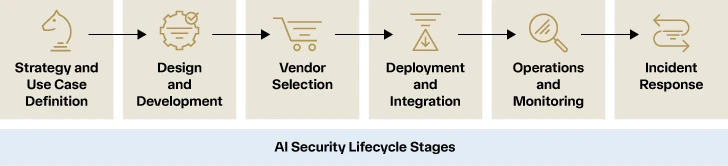
AI security needs to be addressed across each tool’s complete lifecycle. The control requirements change at each stage, but the priorities stay consistent: identify usage, classify risk, assign ownership, limit access, validate controls, and prepare for incident scenarios before AI is deployed and becomes embedded into critical workflows.

It’s imperative to prepare for the different lifecycle stages and understand their associated security challenges.

Strategy and Use Case Definition

Organizations need clearly defined ownership, decision rights, oversight, and escalation across business, technology, security, legal, privacy, compliance, and risk functions. This ensures AI use remains aligned with organizational objectives, policies, risk appetite, and regulatory obligations before the business becomes dependent on these tools.

Common challenge: Organizations often adopt AI without defining who owns the use case, who is authorized to approve it, who oversees its continued operation, and who is accountable when its use produces business consequences.

Design and Development

AI adds design questions that are easy to miss: how prompts are handled, what data is retrieved, how embeddings are stored, how vector databases are protected, how model outputs are validated, and what happens if the system is manipulated. AI-specific security requirements need to be defined before the system is built.

Common challenge: AI applications regularly reach production without security requirements being defined, tested, or validated at any stage of development.

Adoption and Vendor Selection

Whether evaluating a SaaS AI platform, integrating a third-party model, or building on a foundation model via API, the security implications of that choice need to be assessed before the contract is signed. Evaluate whether to build, buy, or integrate and treat it as a security decision, not just a capability and cost question.

Common challenge: Organizations typically adopt AI capabilities without performing adequate security and risk assessments. Speed of procurement consistently outpaces due diligence.

Deployment and Integration

An application that passed security review at design can still be deployed insecurely. The most consistent failure at this stage is excessive permissions: where AI systems are connected to sensitive data with access that reflects what was convenient rather than what the function requires.

Common challenge: AI systems routinely go into production with access that was never formally reviewed and rarely gets revisited.

Operations, Monitoring, and Scaling

AI systems evolve after deployment as models are updated, integrations are added, and use cases expand, potentially changing the risk profile without a deliberate decision to do so. Maintain a current inventory of AI applications, services, and integrations, and periodically reassess use cases and risk classifications as capabilities and usage patterns change.

Common challenge: AI adoption scales faster than the governance and monitoring capabilities designed to manage it.

Incident Response and Recovery

Most organizations have incident response plans, but they are not built for AI. Prompt injection, agent compromise, and third-party model failures require different forensic capabilities, containment strategies, and stakeholder coordination than conventional attacks. Add AI-specific response procedures to existing IR playbooks and integrate AI incidents into broader cyber crisis management processes.

Common challenge: Incident response plans are written for the threats organizations faced when they were last updated. AI-specific scenarios are absent from most plans.

Operationalizing an AI Plan with Security in Mind

Understanding where AI risk lives is one thing. Building the organizational structures, controls, and processes to manage it is another. Most organizations lack an actionable program that connects the dots. There are six components to consider when operationalizing a best practice AI plan.

Establish Executive Alignment and Business Objectives

89% of security leaders cite limited executive or board involvement in IR readiness and decision-making as a key challenge.4 The only thing that resolves this is executive ownership – and not in the sense of awareness, but in the sense of defined accountability, formal sponsorship, and a clear organizational mandate that AI security is a business requirement.

Recommendations:

  • Define the business drivers for AI adoption
  • Align AI initiatives with business goals and risk appetite
  • Identify stakeholders across Security, IT, Legal, Compliance, Privacy, and business teams
  • Establish executive sponsorship and accountability

Build an AI Governance Program

75% of security leaders agree that delays and uncertainty around legal and communications involvement slow down decision-making during incidents.5 When an incident occurs and the organization needs to know who owns a given AI system, what data it has access to, and who has the authority to take it offline, governance is what makes those questions answerable in minutes rather than hours.

Recommendations:

  • Define acceptable AI use policies and standards
  • Establish decision-making and approval processes
  • Define ownership and accountability for AI systems and risks
  • Align governance with regulatory and compliance requirements
  • Develop an AI risk management framework

Implement Enforceable Security and Operational Guardrails

Effective AI governance must be translated into enforceable security and operational controls. Otherwise, policies become guidance that teams interpret and apply differently. These guardrails should apply across the main ways AI enters the organization: public GenAI use, copilots, SaaS AI features, internal applications, retrieval-augmented generation (RAG) systems, autonomous agents, cloud AI services, and vendor-managed platforms.

Recommendations:

  • Define identity and access management requirements
  • Define data protection, privacy, and information handling controls
  • Define monitoring, logging, audit, and record retention needs
  • Define standards for AI development, procurement, integration, and deployment
  • Define controls for third-party AI services, models, platforms, and vendors

Foster Workforce Awareness and Preparedness

Technical controls address what systems can and can’t do. Workforce preparedness addresses what people will and won’t do – which is a different problem requiring a different approach. Effective AI awareness programs must go beyond annual, generic compliance training and provide practical, role-specific guidance; giving people the knowledge they need to make better decisions in the normal course of their work.

Recommendations:

  • Train employees on responsible, approved, and prohibited AI usage
  • Educate developers on secure AI design and development practices
  • Raise awareness of data handling, privacy, output, and security risks
  • Provide role-specific guidance on AI governance expectations
  • Communicate clear avenues for exception requests and reporting suspected AI misuse

Validate Security Before Adoption and Across the Lifecycle

Validation should happen before deployment and continue throughout the lifecycle as usage expands. AI systems change through new features, new integrations, data sources, vendor updates, model changes, expanded permissions, and broader business reliance. A review performed at launch may not reflect the system’s risk profile six months later.

Recommendations:

  • Conduct AI security posture assessments before approval
  • Perform AI application penetration testing and adversarial testing
  • Assess third-party AI solutions, models, integrations, and supply chains
  • Validate access controls, data flows, monitoring, and human oversight
  • Continuously evaluate AI deployments as capabilities evolve

Prepare for AI Security Incidents

Existing incident response (IR) plans may not address the scenarios that AI introduces, including prompt abuse, agent compromise, data leakage, unsafe outputs, third-party AI exposure, unauthorized model use, or incidents where AI-generated activity becomes part of the evidence trail. The implementation of AI-specific incident response procedures and decision criteria into an existing IR plan is critical.

Recommendations:

  • Update your IR plan to include the following components:
  • How security, privacy, legal, technology, business owners, model providers, and other third parties should coordinate during an incident
  • Define AI-related ownership, escalation paths, and responsibilities
  • Conduct AI-focused tabletop exercises and operational readiness assessments
  • Train staff on AI-driven logging, monitoring, and forensic capabilities
  • Practice AI-themed scenarios across the wider incident response and crisis management program

ACTION: Proactively Secure Your AI Solutions

Organizations that wait for a threat to expose their AI security posture are already behind. 65% of organizations say they are likely to switch IR providers at the end of their contract – the top driver being the need for more proactive readiness support.6

The demand is clear. What’s less clear, for most organizations, is what a proactive AI security approach looks like when it’s properly executed.

There are three areas of primary focus in a proactive security approach that can be performed in any order and should continue across the AI lifecycle:

(1) Assess the organization’s AI cyber posture across infrastructure, applications, data flows, and prompt behavior.

(2) Establish a comprehensive AI governance and usage framework or evaluate the organization’s existing one.

(3) Test the security and functionality of internally developed and externally adopted AI applications against real-world adversarial behaviors.

Closing

Organizations must not only capture the business value of AI adoption but also prioritize how to mitigate the introduction of unmanaged cyber risk. To do this, a solid lifecycle approach is required that integrates security, governance, and risk management across AI strategy, development, vendor selection, deployment, monitoring, and incident response – particularly when systems access sensitive data, connect to enterprise environments, or support critical workflows.

Because AI threats and security frameworks are still evolving, organizations must regularly assess their posture, governance, controls, and preparedness. Those that secure AI proactively will reduce exposure across an expanding attack surface while gaining the ownership, visibility, and confidence needed to adopt it safely at scale.

Work with Sygnia

Sygnia understands firsthand how adversaries are using AI attack surfaces to accelerate their exploitation capabilities and what cyber defenders must do to get in front of this growing security risk. Learn more about Sygnia’s AI Cybersecurity Services.

Citations:

[1] Sygnia CISO Survey, 2026

[2] ISACA AI Pulse Poll, 2026

[3] Writer Enterprise AI Adoption Report, 2026

[4] Sygnia CISO Survey, 2026

[5] Sygnia CISO Survey, 2026

[6] Sygnia CISO Survey, 2026

Found this article interesting? This article is a contributed piece from one of our valued partners. Follow us on Google News, Twitter and LinkedIn to read more exclusive content we post.

The Operational Gaps That Break Incident Response – CYBERDEFENSA.MX

Having an incident response retainer, or even a pre-approved external incident response firm, is not the same as being ready for an incident. A retainer means someone will answer the phone. Operational readiness determines whether that team can do meaningful work the moment they do. 

That distinction matters far more than many organizations realize. In the first hours of a security incident, attackers are not waiting for your identity team to provision emergency accounts, for legal to decide whether an outside firm can access sensitive systems, or for someone to figure out who owns the EDR console. Every delay gives the attacker more uninterrupted time in your environment. Every hour lost to logistics increases the likelihood of deeper compromise, broader impact, and more expensive recovery. 

The same is true internally. An organization may have an incident response plan, a capable security team, and a list of escalation contacts, yet still be unprepared to respond under pressure. Readiness is not measured by what exists on paper. It is measured by how quickly responders, internal or external, can gain visibility, understand what the attacker has already touched, and make informed decisions. 

On Day Zero, responders are not asking for unlimited control. They are asking for visibility first and authority second. Without visibility, containment decisions are made blindly, timelines cannot be reconstructed, and the true scope of the compromise remains unknown while the response team debates access and approvals. 

This guide outlines what responders need on Day Zero, where organizations most often fall short, and how to ensure your internal team and external IR partner can begin effective work immediately when an incident is declared. 

What determines response speed 

Whether the first responders are internal security staff, an external retainer firm, or both working in parallel, they need access to the same core systems. Internal teams may already have some of that access. External responders usually do not unless it has been prepared in advance. 

Not all access is equally urgent. Identity comes first, because identity reveals the blast radius. It shows how the attacker got in, which credentials are compromised, how privilege may have changed, and where the attacker is likely to move next. Cloud, endpoint, and logging access are all critical, but without identity visibility, responders are building a timeline on guesswork. 

Identity and authentication access 

Modern attacks run on identity. Stolen credentials, abused tokens, misconfigured privileges, and compromised sessions are now central to how attackers gain persistence and move laterally. If responders cannot see identity activity, they cannot explain the initial compromise, trace privilege escalation, or identify which accounts are already unsafe to trust. 

For external IR firms, identity access is often the first major bottleneck. Organizations delay access while teams debate permissions, search for the right administrator, or attempt to create accounts during the incident itself. During that delay, responders are effectively blind to the attacker’s movement. 

On Day Zero, responders need read and investigative access to the identity provider, directory services, SSO platforms, and federation layers. They need visibility into authentication logs, MFA events, token issuance, session activity, privileged accounts, service accounts, and recent permission changes. They also need a defined path for urgent actions such as credential resets, token invalidation, or temporary restrictions on privileged users. 

Cloud and SaaS access 

In cloud environments, attacker activity often looks normal unless responders can see it in context. It may appear as API calls, configuration changes, new role assignments, service account abuse, or use of legitimate automation. Without immediate access, critical evidence may disappear before it is reviewed. 

On Day Zero, responders need read access to relevant cloud accounts, subscriptions, and SaaS platforms. They need visibility into audit logs, control plane activity, IAM and RBAC configurations, compute workloads, storage access patterns, serverless functions, service accounts, and secrets management. Delays in cloud access are especially damaging because some telemetry is ephemeral. If it is not captured quickly, it may be gone permanently. 

Endpoint and EDR access 

Endpoint telemetry often provides the clearest picture of attacker behavior, especially in the early stages of an investigation. Process execution, command-line activity, credential dumping, persistence mechanisms, and lateral movement frequently show up first in the EDR. 

Without direct access, responders are forced to rely on screenshots, summaries, or findings relayed through internal teams who are already under pressure. That is not a serious investigation. It is a game of telephone during a crisis. 

On Day Zero, responders need investigator-level access to EDR tools, visibility into process and network activity, the ability to query historical telemetry across hosts, and the authority to isolate systems or initiate containment when needed. If those permissions are not ready in advance, valuable time is lost, and the risk of misunderstanding grows. 

Logging and monitoring access 

Logs are how responders reconstruct the full story of an attack, not just what happened after detection, but what happened before it. Too often, organizations discover that their retention periods are designed for compliance or cost efficiency rather than investigation. 

Fourteen days of retention is common. Ninety days should be the minimum baseline. If an attacker has been active for six weeks before detection, a 14-day window means the initial access event, early reconnaissance, and much of the lateral movement may already be gone. 

Responders need access to centralized SIEM or log aggregation tools, firewall and IDS/IPS logs, VPN and remote access logs, email security logs, cloud and SaaS audit trails across all relevant tenants. If those logs are incomplete, siloed, or overwritten, responders are forced to make high-stakes decisions with partial evidence. 

Access must be real, not theoretical 

Access is only useful if it can be activated immediately. If access depends on a chain of approvals, manual setup, or first-time configuration, it will fail when the pressure is highest. 

Operational readiness means required accounts already exist across identity, cloud, EDR, and logging systems. MFA enrollment must already be completed. Permissions must already be approved and mapped to responder roles. The team responsible for enabling access must know exactly how to do it and must have practiced the procedure before. 

On Day Zero, access should function like a switch: predefined, controlled, and fast to activate. Anything else is a delay, and in incident response, delay always benefits the attacker. 

Communication under breach conditions 

Access problems receive the most attention in readiness discussions, but communication failures are just as damaging. Even with perfect technical visibility, an incident response breaks down quickly if teams cannot coordinate, make decisions, and share sensitive information securely. 

Assume normal channels may be compromised 

During an active breach, organizations should assume that email, chat platforms, and internal collaboration tools may no longer be private. If the attacker has access to those systems, then discussions about containment, investigative findings, and next steps may also be visible. 

That applies to internal conversations and communication with an external IR firm. Sharing credentials, containment plans, or investigative conclusions over a compromised channel can give the attacker visibility into your response in real time. 

Establish out-of-band communication 

Every organization needs an out-of-band communication method that is separate from corporate identity, production email, and the internal network. This could be a dedicated secure messaging platform, a preconfigured encrypted group, or a structured phone-based process. The specific tool matters less than the requirements. 

The channel must be independent of the compromised environment. It must include internal responders and external retainer contacts. It must support secure sharing of sensitive information. Most importantly, it must be tested. A communication channel that has never been used is not a response plan. It is an experiment being conducted in the middle of a crisis. 

Designate an incident manager 

Every response needs a single point of coordination. This is not necessarily the most senior person in the room. It is the person with the clearest operational ownership and the authority to keep the response aligned. 

The incident manager coordinates activity across security, IT, legal, leadership, and external responders. They control information flow, maintain a consistent picture of scope and status, and serve as the primary interface to the IR firm. Without that role, organizations drift into fragmented communication, conflicting instructions, and slow decision-making. 

Define stakeholder notification paths 

Who gets notified, when, and by whom should never become a live debate during an incident. Notification tiers need to be defined in advance. Internal escalation thresholds, executive updates, legal and regulatory decision-making, customer communications, and external messaging all need clear ownership. 

Organizations should also define exactly what information is shared with the IR firm on initial contact, who acts as the consistent liaison, and how updates are handled. Poor communication is not just inconvenient. It measurably slows containment and increases damage. 

Building a pre-approved IR access policy 

A pre-approved incident response access policy exists to eliminate decision-making overhead at the worst possible moment. When an incident is declared, the question of who can access what should already be answered. 

What the policy should define 

The most common failure in IR access policies is vagueness. A statement such as “responders will be granted appropriate access upon incident declaration” is not an operational policy. It is a placeholder that guarantees confusion later. 

An effective policy should clearly define who can declare an incident and trigger emergency procedures. This should not require a full executive chain. A CISO, security leader, or designated on-call authority should be empowered to make that call. 

It should define who can approve temporary access for external responders without reopening procurement, legal review, or vendor onboarding. Those controls matter, but they are not built for incident timelines unless pre-cleared. 

It should specify the scope of access by responder role, such as IR investigator or IR lead, rather than negotiating permissions during a live event. It should also define time-boxed access, with a clear review and revocation cadence, and designate who is responsible for removing access once the incident stabilizes. 

Finally, it should require post-incident cleanup, access validation, and governance review. Governance should catch up after stabilization, not slow down the first hours of investigation. 

Pre-created accounts and tested workflows 

Policy is only as good as the workflows behind it. If the accounts do not exist, the permissions have not been validated, or the identity team has never enabled them under realistic conditions, then the organization does not have a capability. It has documentation. 

Dormant IR accounts should be created in advance across the identity provider, EDR, SIEM, and cloud tenants. They should be disabled by default, with a documented and tested enable procedure. MFA enrollment should already be complete. Hardware tokens or secure authentication workflows should be assigned before an incident occurs. 

Role assignments should also be pre-approved. Enabling emergency access should be a single action, not the beginning of a conversation. 

Background checks and legal friction 

Background checks are a common friction point, especially in regulated sectors. The issue is not whether checks are appropriate. It is when they are enforced. 

If background checks are first raised during an active incident, the organization has already failed the readiness test. Reputable IR firms handle vetting, certifications, and internal controls during onboarding. Those conversations belong in the retainer setup phase, not in the first hours of a breach. 

The same is true of legal approval. If legal needs to decide in real time whether external responders can access production systems or regulated data, the response will slow immediately. Those decisions should be resolved before the incident. 

A practical Day Zero readiness checklist 

Organizations can test readiness by asking simple, operational questions. 

Can a dormant IR account be enabled and used to pull authentication logs within 30 minutes? 

Is a scoped read-only cloud role already defined, and are audit logs enabled across all relevant tenants? 

Does the EDR platform have an investigator role that an external responder can use immediately, with access to at least 30 days of historical telemetry? 

Can an external responder query the SIEM directly, and does retention cover at least 90 days across identity, endpoint, network, and cloud sources? 

Who can authorize host isolation, VPN shutdown, credential rotation, or account suspension, and has that authority been exercised in an exercise? 

If any of these questions produce hesitation, uncertainty, or the phrase “we’ll figure it out during an incident,” then that area is not ready. 

For organizations with an IR retainer, additional questions matter. Are dormant accounts already created for retainer responders? Is MFA preconfigured? Are legal approvals complete? Does the IR firm have current contact information for the incident manager, CISO, and identity lead? Is there an established out-of-band channel that includes the IR firm? Has the full activation workflow been tested in a tabletop exercise from initial call through working access? 

If several of these answers are no, the retainer is a contract, not an operational capability. 

What organizations commonly overlook 

Even mature organizations with strong security tooling and formal plans routinely discover important gaps only after a real incident begins. 

Backups are a common example. Many organizations know backup jobs are completing, but have not verified that backups are isolated from the environment that an attacker has already compromised. If the same credentials, networks, or service accounts can reach backup infrastructure, attackers may be able to destroy recovery options before deploying ransomware. A backup that has never been restored, and never been tested for isolation, is still an assumption. 

Containment authority is another frequent gap. Teams may know whether a system should be isolated or credentials should be rotated, but no one has explicit authority to disrupt operations. As the decision moves through leadership, legal, finance, or business operations, the attacker remains active. Prepared organizations decide in advance which systems can be shut down immediately, who can authorize those actions, and how emergency decisions will be escalated when necessary. 

Short or fragmented logging retention is also common. Logs may exist but only for seven to fourteen days, or they may be scattered across tools and teams with no centralized access. In those cases, the organization can often see what is happening now but not how it started. 

Untested response plans are equally dangerous. Many plans look complete in a binder and fail in practice because people do not know their roles, approvals take too long, and critical steps have never been exercised. Testing does not need to be elaborate. It needs to be realistic, cross-functional, and honest about what breaks. 

Finally, many organizations lack a current asset inventory or network map. Systems are deployed outside formal processes, cloud resources are spun up without central registration, and ownership is unclear. Responders cannot investigate what they do not know exists. Untracked assets are not just documentation gaps. They are blind spots that attackers actively exploit. 

A readiness exercise you can run now 

Most of the recommendations in this guide can be tested this week with the people and systems already in place. 

Start with access. Create dormant IR accounts and measure how long it takes to enable them. Attempt to pull 90 days of authentication logs. Ask your EDR administrator to create or validate an external investigator role. Confirm cloud audit logging is enabled across all relevant tenants and that a scoped read-only role can be activated immediately. 

Then test the response itself. Run a tabletop exercise in which the IR firm has just been called in. Measure how long it takes before they can access identity logs, endpoint telemetry, and cloud audit trails. Test whether the incident manager can be reached and whether the out-of-band channel can be established quickly. Run a containment decision through the approval chain and time it. 

Whatever fails in that exercise will fail the same way during a real incident. The difference is that during a real breach, the attacker is operating inside that gap while the organization is still figuring it out. 

Conclusion 

Readiness is not a policy document, a signed retainer, or a successful audit. It is the result of practical decisions made before an incident begins: access provisioned, authority clarified, communication paths tested, and operational gaps closed before an attacker can exploit them. 

The organizations that contain incidents quickly are rarely the ones with the most impressive slide decks. They are the ones who did the unglamorous work in advance. They created the accounts, tested the workflows, validated the logs, practiced the decisions, and ensured that when the call came in, the response could begin immediately. 

That is the real meaning of Day Zero readiness: not just having help available but being prepared to use it the moment it matters most. 

Found this article interesting? This article is a contributed piece from one of our valued partners. Follow us on Google News, Twitter and LinkedIn to read more exclusive content we post.