

Más de 400 paquetes AUR de Arch Linux secuestrados para implementar Infostealer y eBPF Rootkit – CYBERDEFENSA.MX

Los atacantes se apoderaron de más de 400 paquetes en el Arch User Repository (AUR) esta semana y reescribieron sus scripts de compilación para instalar un ladrón de credenciales en cualquier máquina que los haya creado.

El malware es un binario de Rust creado para recopilar secretos de los desarrolladores. Cuando aterriza con root, también puede cargar un rootkit eBPF para ocultarse. AUR es la colección de paquetes comunitarios de Arch Linux y está separada de los repositorios oficiales de Arch, que no se vieron afectados.

Si instaló o actualizó un paquete AUR a partir del 11 de junio, compárelo con las listas actuales de paquetes afectados antes de confiar en el host. La lista de nombres es larga, sigue creciendo y aún no está completa.

Este ataque persigue el modelo de confianza, no una falla de software. Los paquetes comprometidos conservaron sus nombres, sus historias y la confianza que los acompañaban. Sólo cambiaron las instrucciones de construcción.

La trampa estaba en la receta, dejando el paquete exactamente igual al software que los usuarios pretendían instalar. Ningún exploit, ningún día cero y ninguna señal de que los propios sistemas de Arch hayan sido violados.

Los atacantes adoptaron paquetes abandonados, editaron los archivos de compilación y permitieron a los usuarios ejecutar la carga útil por ellos. Sonatype, que nombró la campaña Arco Atómicolos encontró persiguiendo proyectos huérfanos: paquetes cuyos mantenedores se habían retirado, dejándolos abiertos para que cualquiera los adoptara.

También falsificaron los metadatos de git commit para que los cambios parecieran provenir de un mantenedor de larga data, una cuenta que un usuario de confianza de Arch Linux confirmó más tarde que nunca estuvo comprometida.

Ciberseguridad

Una vez que se adoptaba un paquete, se editaba su script PKGBUILD o .install para ejecutar npm install atomic-lockfile durante la compilación, colocando el paquete npm malicioso junto con un par de paquetes legítimos para cubrirse. Ese paquete, atomic-lockfile@1.4.2, lleva un gancho de preinstalación que ejecuta un ELF de Linux incluido llamado deps. Compile el paquete y el binario se ejecutará.

Los ejemplos confirmados reportados a la lista de correo de Arch incluyen los paquetes alvr y premake-git.

Qué hace el malware

Investigador independiente Whanos ingeniería inversa la carga útil de deps y describe un ladrón de credenciales de Rust dirigido a estaciones de trabajo de desarrolladores y sistemas de compilación. Recoge:

  • Cookies, tokens y almacenamiento local de navegadores basados ​​en Chromium (Chrome, Edge, Brave y muchos más)
  • Datos de sesión de aplicaciones de Electron, incluidos Slack, Discord y Microsoft Teams
  • Tokens de GitHub, npm y HashiCorp Vault, además de material al portador OpenAI/ChatGPT y metadatos de cuenta
  • Claves SSH, hosts_conocidos e historiales de shell
  • Credenciales de Docker y Podman y perfiles VPN

Los archivos robados se envían a través de HTTP a temp.sh. El comando y el control se ejecutan a través de un servicio cebolla Tor a través de un proxy de bucle invertido local.

Para lograr persistencia, instala un servicio systemd con Restart=always. Con root, se copia a sí mismo en /var/lib/ y escribe una unidad en /etc/systemd/system/; como usuario normal, utiliza el directorio de inicio y una unidad por usuario en ~/.config/systemd/user/. De cualquier manera, quiere volver.

Los primeros artículos sobrevendieron el rootkit eBPF. Es opcional y solo se carga cuando el binario ya tiene raíz y la capacidad adecuada. No se utiliza para ganar privilegios. Cuando se activa, oculta los propios procesos del malware, los nombres de los procesos y los inodos de socket de las herramientas estándar, utilizando mapas BPF anclados llamados hide_pids, hide_names y hide_inodes, y elimina los intentos de adjuntar un depurador.

Eso cambia los consejos de limpieza. Eliminar el paquete AUR no es suficiente una vez que se ha ejecutado la carga útil. Un administrador de paquetes puede eliminar los archivos que conoce. No puede demostrar que la máquina esté limpia después de que una carga útil compatible con rootkit haya tenido la oportunidad de ejecutarse.

El binario también presenta un segundo archivo vinculado a monero-wallet-gui que el análisis señala como un posible criptominero no analizado. Un rootkit eBPF acoplado a un ladrón que ataca y atrapa es inusual, y es por eso que éste vale más que encogerse de hombros.

Alcance y una segunda ola

El primer artículo de Sonatype contó más de 20 paquetes secuestrados. En un día, los rastreadores comunitarios y el Arco hilo general de aur había catalogado más de 400, con una lista maestra compilada al buscar el espejo git de AUR, colocándola alrededor de 408, y listas consolidadas subiendo más.

El paquete atomic-lockfile npm en sí mostró solo 134 descargas semanales en Enchufe antes de que fuera retirado del registro, por lo que la exposición real es la ruta de compilación de AUR en lugar de las instalaciones de npm.

Una segunda ola utilizó bun install js-digest, impulsado desde un conjunto separado de cuentas que los rastreadores de la comunidad vinculan al mismo editor npm que atomic-lockfile. Su carga útil es un binario diferente, un ELF separado por su hash, que la comunidad también marcó como malicioso.

Ciberseguridad

Aún se está contando hasta qué punto se ha extendido esta ola. Los primeros desgloses enumeraron unas pocas docenas de paquetes, mientras que las búsquedas posteriores basadas en grep en el espejo AUR arrojaron números mucho más altos que pueden incluir la deserción a medida que se eliminan las confirmaciones. De cualquier manera, no es una nota a pie de página de la primera ola, así que verifique tanto atomic-lockfile como js-digest.

Que hacer ahora

Los mantenedores de Arch están restableciendo las confirmaciones maliciosas, prohibiendo las cuentas y pidiendo a los usuarios que sigan informando paquetes sospechosos en el hilo de la lista de correo.

Trate la lista publicada de paquetes afectados como incompleta. Por tu parte:

  • Verifique cualquier paquete AUR instalado o actualizado a partir del 11 de junio con las listas de paquetes de la comunidad y los scripts de detección, que comparan sus paquetes externos con el conjunto defectuoso conocido. Grep historial de compilación reciente y cachés para npm install atomic-lockfile, bun install js-digest y la ruta de carga útil src/hooks/deps.
  • Si se ejecutó un paquete marcado, trate al host como con credenciales comprometidas. Rote todo lo que toca el ladrón: sesiones de navegador, claves SSH, tokens de GitHub y npm, sesiones de Slack, Teams y Discord, tokens de Vault, credenciales de Docker y Podman, y cualquier clave de nube.
  • Caza por la perseverancia. Busque servicios systemd desconocidos (tanto unidades del sistema como ~/.config/systemd/user/) y archivos inesperados en /var/lib/. Inspeccione /sys/fs/bpf/ para ver los mapas Hidden_pids, Hidden_names y Hidden_inodes. Revisar las conexiones salientes a Tor y cargar servicios.
  • Si el paquete se ejecutó como root, asuma que el rootkit está presente y reinstálelo desde un medio confiable. De lo contrario, no hay forma de confiar en el sistema.
  • En el futuro, lea PKGBUILD y cualquier enlace .install antes de compilar, especialmente para paquetes adoptados recientemente o que se activan repentinamente después de un largo período de inactividad. Si no comprende las instrucciones de compilación, no instale el paquete.

Para la detección, el SHA-256 de la carga útil principal es 6144d433f8a0316869877b5f834c801251bbb936e5f1577c5680878c7443c98b; el conjunto completo de indicadores, incluido el host cebolla C2, se encuentra en el análisis ioctl.fail.

La misma táctica de adopción afectó a un paquete de visor de PDF abandonado en 2018; la versión 2026 simplemente la amplió, como parte de una serie más amplia de ataques a la cadena de suministro que secuestran proyectos huérfanos para heredar la confianza en lugar de utilizar errores tipográficos para engañar a los usuarios. La lista de afectados aún está incompleta y no se ha asignado ningún CVE; Sonatype rastrea la campaña como Sonatype-2026-003775 (CVSS 8.7).

El ataque funcionó porque la AUR todavía confía en el nombre y el historial de un paquete antes que en quién lo mantiene ahora. Un paquete adoptado recientemente, o uno del que de repente surgen nuevos ganchos de instalación, ahora merece la misma sospecha que un paquete de un extraño.

Más de 400 paquetes AUR de Arch Linux secuestrados para implementar Infostealer y eBPF Rootkit – CYBERDEFENSA.MX

Los atacantes se apoderaron de más de 400 paquetes en el Arch User Repository (AUR) esta semana y reescribieron sus scripts de compilación para instalar un ladrón de credenciales en cualquier máquina que los haya creado.

El malware es un binario de Rust creado para recopilar secretos de los desarrolladores. Cuando aterriza con root, también puede cargar un rootkit eBPF para ocultarse. AUR es la colección de paquetes comunitarios de Arch Linux y está separada de los repositorios oficiales de Arch, que no se vieron afectados.

Si instaló o actualizó un paquete AUR a partir del 11 de junio, compárelo con las listas actuales de paquetes afectados antes de confiar en el host. La lista de nombres es larga, sigue creciendo y aún no está completa.

Este ataque persigue el modelo de confianza, no una falla de software. Los paquetes comprometidos conservaron sus nombres, sus historias y la confianza que los acompañaban. Sólo cambiaron las instrucciones de construcción.

La trampa estaba en la receta, dejando el paquete exactamente igual al software que los usuarios pretendían instalar. Ningún exploit, ningún día cero y ninguna señal de que los propios sistemas de Arch hayan sido violados.

Los atacantes adoptaron paquetes abandonados, editaron los archivos de compilación y permitieron a los usuarios ejecutar la carga útil por ellos. Sonatype, que nombró la campaña Arco Atómicolos encontró persiguiendo proyectos huérfanos: paquetes cuyos mantenedores se habían retirado, dejándolos abiertos para que cualquiera los adoptara.

También falsificaron los metadatos de git commit para que los cambios parecieran provenir de un mantenedor de larga data, una cuenta que un usuario de confianza de Arch Linux confirmó más tarde que nunca estuvo comprometida.

Ciberseguridad

Una vez que se adoptaba un paquete, se editaba su script PKGBUILD o .install para ejecutar npm install atomic-lockfile durante la compilación, colocando el paquete npm malicioso junto con un par de paquetes legítimos para cubrirse. Ese paquete, atomic-lockfile@1.4.2, lleva un gancho de preinstalación que ejecuta un ELF de Linux incluido llamado deps. Compile el paquete y el binario se ejecutará.

Los ejemplos confirmados reportados a la lista de correo de Arch incluyen los paquetes alvr y premake-git.

Qué hace el malware

Investigador independiente Whanos ingeniería inversa la carga útil de deps y describe un ladrón de credenciales de Rust dirigido a estaciones de trabajo de desarrolladores y sistemas de compilación. Recoge:

  • Cookies, tokens y almacenamiento local de navegadores basados ​​en Chromium (Chrome, Edge, Brave y muchos más)
  • Datos de sesión de aplicaciones de Electron, incluidos Slack, Discord y Microsoft Teams
  • Tokens de GitHub, npm y HashiCorp Vault, además de material al portador OpenAI/ChatGPT y metadatos de cuenta
  • Claves SSH, hosts_conocidos e historiales de shell
  • Credenciales de Docker y Podman y perfiles VPN

Los archivos robados se envían a través de HTTP a temp.sh. El comando y el control se ejecutan a través de un servicio cebolla Tor a través de un proxy de bucle invertido local.

Para lograr persistencia, instala un servicio systemd con Restart=always. Con root, se copia a sí mismo en /var/lib/ y escribe una unidad en /etc/systemd/system/; como usuario normal, utiliza el directorio de inicio y una unidad por usuario en ~/.config/systemd/user/. De cualquier manera, quiere volver.

Los primeros artículos sobrevendieron el rootkit eBPF. Es opcional y solo se carga cuando el binario ya tiene raíz y la capacidad adecuada. No se utiliza para ganar privilegios. Cuando se activa, oculta los propios procesos del malware, los nombres de los procesos y los inodos de socket de las herramientas estándar, utilizando mapas BPF anclados llamados hide_pids, hide_names y hide_inodes, y elimina los intentos de adjuntar un depurador.

Eso cambia los consejos de limpieza. Eliminar el paquete AUR no es suficiente una vez que se ha ejecutado la carga útil. Un administrador de paquetes puede eliminar los archivos que conoce. No puede demostrar que la máquina esté limpia después de que una carga útil compatible con rootkit haya tenido la oportunidad de ejecutarse.

El binario también presenta un segundo archivo vinculado a monero-wallet-gui que el análisis señala como un posible criptominero no analizado. Un rootkit eBPF acoplado a un ladrón que ataca y atrapa es inusual, y es por eso que éste vale más que encogerse de hombros.

Alcance y una segunda ola

El primer artículo de Sonatype contó más de 20 paquetes secuestrados. En un día, los rastreadores comunitarios y el Arco hilo general de aur había catalogado más de 400, con una lista maestra compilada al buscar el espejo git de AUR, colocándola alrededor de 408, y listas consolidadas subiendo más.

El paquete atomic-lockfile npm en sí mostró solo 134 descargas semanales en Enchufe antes de que fuera retirado del registro, por lo que la exposición real es la ruta de compilación de AUR en lugar de las instalaciones de npm.

Una segunda ola utilizó bun install js-digest, impulsado desde un conjunto separado de cuentas que los rastreadores de la comunidad vinculan al mismo editor npm que atomic-lockfile. Su carga útil es un binario diferente, un ELF separado por su hash, que la comunidad también marcó como malicioso.

Ciberseguridad

Aún se está contando hasta qué punto se ha extendido esta ola. Los primeros desgloses enumeraron unas pocas docenas de paquetes, mientras que las búsquedas posteriores basadas en grep en el espejo AUR arrojaron números mucho más altos que pueden incluir la deserción a medida que se eliminan las confirmaciones. De cualquier manera, no es una nota a pie de página de la primera ola, así que verifique tanto atomic-lockfile como js-digest.

Que hacer ahora

Los mantenedores de Arch están restableciendo las confirmaciones maliciosas, prohibiendo las cuentas y pidiendo a los usuarios que sigan informando paquetes sospechosos en el hilo de la lista de correo.

Trate la lista publicada de paquetes afectados como incompleta. Por tu parte:

  • Verifique cualquier paquete AUR instalado o actualizado a partir del 11 de junio con las listas de paquetes de la comunidad y los scripts de detección, que comparan sus paquetes externos con el conjunto defectuoso conocido. Grep historial de compilación reciente y cachés para npm install atomic-lockfile, bun install js-digest y la ruta de carga útil src/hooks/deps.
  • Si se ejecutó un paquete marcado, trate al host como con credenciales comprometidas. Rote todo lo que toca el ladrón: sesiones de navegador, claves SSH, tokens de GitHub y npm, sesiones de Slack, Teams y Discord, tokens de Vault, credenciales de Docker y Podman, y cualquier clave de nube.
  • Caza por la perseverancia. Busque servicios systemd desconocidos (tanto unidades del sistema como ~/.config/systemd/user/) y archivos inesperados en /var/lib/. Inspeccione /sys/fs/bpf/ para ver los mapas Hidden_pids, Hidden_names y Hidden_inodes. Revisar las conexiones salientes a Tor y cargar servicios.
  • Si el paquete se ejecutó como root, asuma que el rootkit está presente y reinstálelo desde un medio confiable. De lo contrario, no hay forma de confiar en el sistema.
  • En el futuro, lea PKGBUILD y cualquier enlace .install antes de compilar, especialmente para paquetes adoptados recientemente o que se activan repentinamente después de un largo período de inactividad. Si no comprende las instrucciones de compilación, no instale el paquete.

Para la detección, el SHA-256 de la carga útil principal es 6144d433f8a0316869877b5f834c801251bbb936e5f1577c5680878c7443c98b; el conjunto completo de indicadores, incluido el host cebolla C2, se encuentra en el análisis ioctl.fail.

La misma táctica de adopción afectó a un paquete de visor de PDF abandonado en 2018; la versión 2026 simplemente la amplió, como parte de una serie más amplia de ataques a la cadena de suministro que secuestran proyectos huérfanos para heredar la confianza en lugar de utilizar errores tipográficos para engañar a los usuarios. La lista de afectados aún está incompleta y no se ha asignado ningún CVE; Sonatype rastrea la campaña como Sonatype-2026-003775 (CVSS 8.7).

El ataque funcionó porque la AUR todavía confía en el nombre y el historial de un paquete antes que en quién lo mantiene ahora. Un paquete adoptado recientemente, o uno del que de repente surgen nuevos ganchos de instalación, ahora merece la misma sospecha que un paquete de un extraño.

Linux Rootkit, macOS Crypto Stealer, WebSocket Skimmers and More – CYBERDEFENSA.MX

Rough Monday.

Somebody poisoned a trusted download again, somebody else turned cloud servers into public housing, and a few crews are still getting into boxes with bugs that should’ve died years ago — the same old holes, same lazy access paths, same “how the hell is this still open” feeling. One report this week basically reads like a guy tripped over root access by accident and decided to stay there.

The weird part is how normal this all sounds now. Fake updates. Quiet backdoors. Remote tools are used like skeleton keys. Forum rats swapping stolen access while defenders burn another weekend chasing logs and praying the weird traffic is just monitoring noise. The Internet’s held together with duct tape and bad sleep.

Anyway, Monday recap time. Same fire. New smoke.

⚡ Threat of the Week

Ivanti EPMM and Palo Alto Networks PAN-OS Flaws Under Attack—Ivanti warned customers that attackers have successfully weaponized CVE-2026-6973, an improper input validation defect in Endpoint Manager Mobile (EPMM) that allows authenticated users with administrative privileges to run code remotely. The company did not say when the first instance of exploitation occurred, or precisely how many customers have been impacted. In a related development, attackers are actively exploiting a zero-day vulnerability affecting some Palo Alto Networks’ customers’ firewalls. As in the case of Ivanti, Palo Alto Networks did not say when or how it became aware of active exploitation, but said threat actors may have attempted to unsuccessfully exploit a recently disclosed critical security flaw as early as April 9, 2026. The memory corruption vulnerability, tracked as CVE-2026-0300, affects the authentication portal of PAN-OS and allows unauthenticated attackers to run code with root privileges on the PA-Series and VM-Series firewalls. Attack surface management platform Censys said it detected about 263,000 Internet-exposed hosts running PAN-OS. Patches are expected to be released starting May 13, 2026. 

🔔 Top News

  • New Quasar Linux RAT Spotted—Attackers have found a new way to turn Linux systems into entry points for a supply chain or cloud infrastructure breach that are resilient to takedowns. The new malware framework, dubbed Quasar Linux or QLNX, is a modular Linux remote access trojan (RAT) that can harvest data from compromised systems. But what sets it apart is its use of a peer-to-peer (P2P) mesh capability that turns individual compromises into an interconnected infection network, making the campaign difficult to kill and allowing infected hosts to communicate with one another rather than relying entirely on centralized servers. QLNX also combines kernel-level rootkit functionality, PAM-based authentication backdoors, and persistence mechanisms to stay hidden on compromised systems while enabling persistent access. It also hides malicious processes under names that mimic legitimate Linux services and system binaries to blend into routine workflows. «Quasar Linux RAT (QLNX) is a comprehensive Linux implant that combines remote access capabilities with advanced evasion, persistence, keylogging, and credential harvesting features,» Trend Micro said. «The malware carries embedded C source code for both its PAM backdoor and LD_PRELOAD rootkit as string literals within the binary.»
  • PCPJack Replaces TeamPCP Malware to Steal Cloud Secrets—An unknown threat actor has launched a campaign to systematically clean up environments infected by the infamous TeamPCP hacking group and drop its own malicious tools to steal credentials from cloud, container, developer, productivity, and financial services for financial gain. Active since late April, the campaign is also capable of propagating itself by moving laterally both inside of a network and to other targets by breaking into open and exploitable cloud infrastructure. The broad credential harvesting sweep allows the malware to hack into more cloud servers and propagate the infection in a worm-like manner, while also rooting out any processes and artifacts belonging to TeamPCP. The external propagation is achieved by downloading parquet files from Common Crawl for target discovery. While threat actors aiming for cloud environments have long built methods to delete competing malware, particularly in cryptojacking campaigns, the lack of a miner and its specific targeting of TeamPCP tooling has raised the possibility that it may be someone who was previously associated with the group, is part of a rival crew, or is an unrelated third-party mimicking TeamPCP’s tradecraft.
  • MuddyWater Uses Chaos Ransomware as Decoy in New Attack—An Iranian state-sponsored espionage group pretended to be a regular ransomware gang in a new ransomware attack detected in early 2026. The Iranian hackers known as MuddyWater disguised their operations as a Chaos ransomware attack, relying on Microsoft Teams social engineering to gain access and establish persistence within a victim environment. Although the attack involved reconnaissance, credential harvesting, and data exfiltration, no file-encrypting ransomware was deployed, which is inconsistent with Chaos attacks. The victim was also added to the Chaos ransomware data leak site, but infrastructure and code-signing certificate evidence indicate the activity was likely used as a cover to mask the threat actor’s true espionage goals and to complicate attribution. Rapid7 told The Hacker News that there is no evidence to suggest that MuddyWater is operating as an affiliate of Chaos.
  • DAEMON Tools Supply Chain Attack Leads to QUIC RAT—Hackers compromised installers of DAEMON Tools in a supply chain attack that affected users in more than 100 countries. The malicious versions, first observed in early April, impacted multiple releases of the software that were installed on thousands of machines across Russia, Brazil, Turkey, Spain, Germany, France, Italy, and China. The operation appears to be targeted. Most victims received only a data miner designed to gather system data, while a second, more advanced shellcode loader was deployed to just a handful of targets, including organizations in retail, scientific, government, and manufacturing organizations in Russia, Belarus, and Thailand. It’s suspected that the attackers likely used the initial data collection to profile infected systems before selectively deploying an implant codenamed QUIC RAT. The malware was deployed against only one known target, an unidentified educational institution in Russia. Kaspersky said the malicious code included Chinese-language elements, suggesting the attackers are familiar with the language, but stopped short of attributing the campaign to a specific group. 
  • Cybercrime Groups Use Vishing for Data Theft and Extortion—An active phishing campaign has been observed targeting multiple vectors since at least April 2025, with legitimate Remote Monitoring and Management (RMM) software as a way to establish persistent remote access to compromised hosts. The activity, which targets organizations across multiple industries, highlights a growing trend where attackers weaponize legitimate IT management tools to bypass security controls and maintain persistence on compromised systems. What makes the campaign noteworthy is its deliberate avoidance of traditional malware in favor of two commercially available remote monitoring and management (RMM) tools, SimpleHelp and ScreenConnect, for persistent control over victim machines. The abuse of RMM tools by bad actors has surged in recent years as they offer a low-friction way to gain access to and maintain persistence on a victim environment. Because of how ubiquitous they are in enterprise environments, the tools are flagged as malicious, allowing the attackers to blend in with normal operations.

🔥 Trending CVEs

Bugs drop weekly, and the gap between a patch and an exploit is shrinking fast. These are the heavy hitters for the week: high-severity, widely used, or already being poked at in the wild.

Check the list, patch what you have, and hit the ones marked urgent first — CVE-2026-6973 (Ivanti Endpoint Manager Mobile), CVE-2026-0300 (Palo Alto Networks PAN-OS), CVE-2026-29014 (MetInfo), CVE-2026-22679 (Weaver E-cology), CVE-2026-4670, CVE-2026-5174 (Progress MOVEit Automation), CVE-2026-43284, CVE-2026-43500 (Linux Kernel), CVE-2026-7482 (Ollama), CVE-2026-42248, CVE-2026-42249 (Ollama for Windows), CVE-2026-29201, CVE-2026-29202, CVE-2026-29203 (cPanel and Web Host Manager), CVE-2026-23918 (Apache HTTP Server), CVE-2026-42778, CVE-2026-42779 (Apache MINA), CVE-2026-2005, CVE-2026-2006 (PostgreSQL pgcrypto), CVE-2026-32710 (MariaDB), CVE-2026-23863, CVE-2026-23866 (Meta WhatsApp), CVE-2026-29146 (Apache Tomcat), CVE-2026-1046 (Mattermost Desktop), CVE-2026-0073 (Google Android), CVE-2026-20188 (Cisco Crosswork Network Controller and Network Services Orchestrator), CVE-2026-20185 (Cisco SG350 and SG350X Series Managed Switches), CVE-2026-20034, CVE-2026-20035 (Cisco Unity Connection), CVE-2026-7896, CVE-2026-7897, CVE-2026-7898, CVE-2026-5865 (Google Chrome), CVE-2025-68670 (xrdp), CVE-2026-23864 (React Server Components), CVE-2026-23870, CVE-2026-44575, GHSA-26hh-7cqf-hhc6, CVE-2026-44579, CVE-2026-44574, CVE-2026-44578, CVE-2026-44573 (Next.js), CVE-2026-26129, CVE-2026-26164 (Microsoft M365 Copilot), CVE-2026-33111 (Microsoft Copilot Chat), CVE-2026-44843 (LangChain), and CVE-2026-33309 (Langflow).

🎥 Cybersecurity Webinars

  • The Hidden Attack Paths Your AppSec Tools Completely Miss in 2026 → This webinar shows the real attack paths that most AppSec tools miss — from code and CI/CD pipelines to cloud setups, dependencies, and secrets. See how attackers combine small weaknesses into big breaches, and learn simple ways to find and stop them. With Wiz experts Mike McGuire and Salman Ladha.
  • AI-Powered DDoS Attacks Are Here — And They’re Smarter, Faster & Deadlier in 2026 → Attackers are now using AI to launch DDoS attacks that are faster, smarter, and much harder to stop. This webinar shows how they instantly spot weak spots, create new attack methods, and dramatically increase success rates — plus easy ways defenders can fight back using smarter AI tools and proactive protection. Perfect for security leaders who want to stay ahead.

📰 Around the Cyber World

  • JDownloader Website Compromised in Supply Chain Attack —The website for JDownloader, an open-source download management tool, was compromised last week to distribute malicious Windows and Linux installers. The compromise occurred on May 6, 2026, at 12:01 a.m. UTC. While the Linux version embeds malicious shell code, the Windows version has been found to serve a Python-based remote access trojan (RAT) that enlists the compromised device in a bot network and runs arbitrary Python code supplied by the operator, per researcher Thomas Klemenc. «The attack has modified alternative download pages and exchanged links and details,» the developer behind JDownloader said in a post on Reddit. «The bad ones are missing digital signatures and as such [Microsoft] SmartScreen will block/warn the execution of it.» Further investigation uncovered that the attack vector was an «unpatched security bug,» although it’s not clear which vulnerability was exploited by the threat actor to tamper with the site.
  • Operation HookedWing Targets Over 500 Organizations —A long-running phishing campaign dating back to 2022 has stolen 2,000 credentials belonging to users from over 500 different organizations. According to SOCRadar, the campaign has mostly affected aviation, public administration, energy, and critical infrastructure. «The breadth of targeting, combined with the campaign’s longevity, points to a resource-capable operation rather than opportunistic activity,» it said. The activity has been codenamed Operation HookedWing. The attack uses phishing emails with lures related to human resources, Microsoft, or Google to direct users to fake landing pages hosted on GitHub.io and Vercel, capture entered credentials via an injected form, and exfiltrate them to servers compromised or created by the threat actor. More than 20 distinct command-and-control (C2) domains and 100 distribution domains have been identified.
  • Uptick in Use of Vercel for Phishing Campaigns —Threat actors are increasingly using Vercel to create large numbers of realistic phishing websites that impersonate well-known brands. «Threat actors are able to redeploy phishing campaigns with ease if a web page is taken down,» Cofense said. «Vercel abuse has increased significantly over time and is likely to continue increasing as minimally skilled threat actors start using cheap or free force multipliers.»
  • New ConsentFix V3 Attack Automates Microsoft Account Hijacking —Push Security said it identified a member of the XSS criminal forum advertising a new toolkit dubbed ConsentFix v3 that brings together ClickFix-style social engineering with OAuth consent phishing to hijack Microsoft accounts. «ConsentFix v3 allows users to instrument the entire attack chain, enabling users to spin up ConsentFix infrastructure, create believable personas with which to interact with victims, craft and manage email campaigns, and automate the process of exchanging the captured OAuth token for session and refresh tokens to establish access to the compromised account,» Push Security said. The attack uses Cloudflare Workers for hosting the phishing pages, ZoomInfo for target identification, Dropbox for PDF hosting, and Pipedream as an exfiltration channel.
  • Workplace Fraud Trends in 2026 —A new report from Cifas has found that 13% of employees said: «they have either sold their company login details to a former colleague, or know someone who has, in the past 12 months.» Another 13% of respondents believed selling access to company systems was justifiable. «Selling login details might seem insignificant to those involved, but it can open the door to serious fraud and financial harm,» Cifas said. «These findings show how vital it is for organisations to build fraud‑aware cultures, where employees at all levels understand their responsibilities and the consequences of their actions.»
  • India Pushes for Sovereign Hosting of Anthropic’s Claude AI Models —According to a report from MoneyControl, the Indian government is said to be pushing for sovereign hosting of Anthropic’s Claude artificial intelligence (AI) models within India. Officials have argued that advanced AI systems meant for sensitive sectors such as banking, telecom, and critical infrastructure cannot operate on foreign-hosted infrastructure due to jurisdictional, compliance, and national security risks.
  • OpenAI Rolls Out GPT-5.5-Cyber —OpenAI began rolling out GPT-5.5-Cyber, a security-focused variant of the model, in a limited preview capacity to select cybersecurity teams, a month after Anthropic’s Mythos debut. «The initial preview of cyber-permissive models like GPT‑5.5‑Cyber is not intended to significantly increase cyber capability beyond GPT‑5.5 – it’s primarily trained to be more permissive on security-related tasks,» OpenAI said. «The differences between model access levels are most pronounced when comparing prompts and responses.»
  • FIRESTARTER Backdoor Targets Cisco Devices —Late last month, theU.S. Cybersecurity and Infrastructure Security Agency (CISA) revealed that an unnamed federal civilian agency’s Cisco Firepower device running Adaptive Security Appliance (ASA) software was compromised in September 2025 with a new malware called FIRESTARTER. The malware is noteworthy for its ability to survive reboots, firmware updates, and patches. In a new analysis, firmware security company Eclypsisum described the backdoor as a Linux ELF that hooks the LINA process and re-installs itself after receiving a termination signal. «When lina_cs runs, it copies its own contents from /usr/bin/lina_cs into memory and registers a signal handler, allowing the malware to take action in response to signals (e.g., when the system or user tells the process to restart),» security researcher Paul Asadoorian said. «It also triggers on runlevel 6, which is the system reboot runlevel on Linux. Which means every time the device shuts down or reboots, FIRESTARTER’s persistence routine fires.»
  • Google Rolls Out Ways for Developers to Push Safer Android Apps —Google said it has expanded Play Policy Insights in Android Studio to catch common policy issues, like missing login credentials, and detect security threats and abuse using its Play Integrity API. «With significantly shorter warm-up latency, you can use these real-time checks in your most speed-critical user journeys, like logins or payments, to catch unauthorized access and risky interactions,» Google said. «We’re adding support for post-quantum cryptography in Play App Signing this year, which will protect your apps and app updates from potential threats with the emergence of quantum computing.»
  • Poland Says Hackers Breached its Water Treatment Plants —Poland’s Internal Security Agency (ABW) disclosed that it detected attacks on five water treatment plants in 2025, potentially allowing bad actors to take control of industrial equipment and, in the worst case, tamper with the safety of the water supply. The intelligence agency did not attribute the attacks to a specific threat actor or group, but Russian government hackers were attributed to a failed attempt to bring down the country’s energy grid towards the end of 2025.
  • Claude Leans More on Russian and Iranian Propaganda Sources —A new audit of Anthropic Claude has revealed that the AI chatbot «repeated false claims 15% of the time when it was asked about pro-Kremlin falsehoods in the voice of typical users, citing Russian state-affiliated media every time,» NewsGuard said. The figure represents a jump from only 4%. What’s more, since the start of the U.S.-Iran war, Claude cited Iranian state-affiliated media in one case when prompted on pro-Iran false claims, when previously it had never cited Iranian state-affiliated media. «This increase in citations to Kremlin propaganda sources, including when they spread false claims, suggests that Claude in recent months has become more vulnerable to state disinformation campaigns,» NewsGuard said.
  • WebSocket Backdoor Campaign Injects Skimmers —Palo Alto Networks Unit 42 said obfuscated WebSocket backdoors are being used to inject credit card skimmers into hundreds of compromised websites with the goal of sending stolen card information back to the attacker’s C2 domains. «Obfuscated JavaScript creates a WebSocket backdoor using dynamically executed JavaScript,» Unit 42 said. «The WebSocket sends an obfuscated JavaScript payload to inject a credit card skimmer into the web page.»
  • How Backdoored Electron Applications Evade Defenses —Cybersecurity researchers have detailed a technique that hijacks trusted Electron applications to enable persistence and bypass application safe listing controls. «In advanced variations of the attack, minimal changes are made to the components of the Electron application,» LevelBlue said. «This allows the application to function normally while at the same time loading the malicious command-and-control (C2) functionality in the background, hiding under the umbrella of the trusted process.»
  • New Attacks Distribute Vidar Stealer, PlugX, and Beagle Malware —In an attack chain detailed by LevelBlue, threat actors have been found to leverage «MicrosoftToolkit.exe» as a starting point to launch an AutoIt script that drops the Vidar Stealer payload. «This intrusion highlights the continued effectiveness of script-based, multi-stage loaders in delivering commodity information stealers such as Vidar,» LevelBlue said. «A sophisticated multi-stage loader infection leveraging Windows-native tools and file-masquerading techniques. The attacker avoids dropping a single identifiable malware binary and instead reconstructs and executes payloads dynamically through staged file manipulation.» The development follows the discovery of a fake Claude website («claude-pro[.]com») that serves as a conduit for a fake MSI installer responsible for deploying a DonutLoader payload that drops a simple backdoor dubbed Beagle, which is capable of running commands and performing file uploads/downloads.
  • Critical Flaw in Cline’s Kanban Server —A critical vulnerability in Cline’s local Kanban server (CVSS score: 9.7) could have been exploited by an attacker to facilitate information disclosure through the runtime state stream, remote code execution through the terminal I/O endpoint, and denial-of-service through the terminal control endpoint. Oasis Security, which discovered the vulnerability, said the AI coding agent’s localhost WebSocket lacks origin validation and authentication. Because web browsers don’t enforce the same-origin policy on WebSocket connections, any website the developer visits can connect to these endpoints to achieve full compromise. «Any website a developer visited while running an affected version could silently connect to their machine, exfiltrate workspace data in real time, and inject commands into the developer’s AI agent,» Oasis Security said. «The developer would see nothing unusual. They were just browsing the web.» Following responsible disclosure, the issue was addressed in Cline Kanban version 0.1.66.
  • Mozilla Uses AI to Detect 423 Flaws in Firefox —Mozilla revealed Anthropic’s Mythos Preview and other AI models helped it identify and ship 423 Firefox security bug fixes in April 2026, compared to 31 a year earlier. This includes a 20-year-old use-after-free bug that could be triggered using the XSLTProcessor DOM API without any user interaction, as well as various flaws in its sandbox system. «This was due to a combination of two main factors,» Mozilla said. «First, the models got a lot more capable. Second, we dramatically improved our techniques for harnessing these models – steering them, scaling them, and stacking them to generate large amounts of signal and filter out the noise.» The development comes as AI is already accelerating vulnerability discovery, reducing the effort needed to identify, validate, and weaponize flaws.
  • 60% of MD5 Password Hashes Can Be Cracked in Under an Hour —An analysis of 231 million unique passwords from dark web leaks between 2023 and 2026 has revealed that nearly 60% of them can be cracked in less than an hour. To make matters worse, nearly half of all passwords (48%) can be cracked within a minute. «Attackers owe this boost in speed to graphics processors, which grow more powerful every year,» Kaspersky said. «While an RTX 4090 in 2024 could brute-force MD5 hashes at a rate of 164 gigahashes (billion hashes) per second, the new RTX 5090 has increased that speed by 34% – reaching 220 gigahashes per second.»
  • New JobStealer Targets Windows and macOS —Threat actors are luring potential victims to malicious websites and asking them to download a video conferencing app under the pretext of an online interview, only to drop a stealer that can harvest data from cryptocurrency wallets. «The malicious program JobStealer, disguised as an online conferencing app, is downloaded from them,» Doctor Web said. Some of the fake brands used by the threat actors include MeetLab, Juseo, Meetix, and Carolla. «To convince users that these platforms are fully functional, scammers create corresponding Telegram channels and social media accounts – for example, on X.» The attack leverages a ClickFix-like instruction to copy and paste a command that drops the stealer malware.
  • More ClickFix Attacks —ClickFix attacks seem to show no signs of stopping anytime soon. The Australian Cyber Security Center (ACSC) warned that the ClickFix social engineering tactic is being used to deliver Vidar Stealer. «The ClickFix attack typically begins with an adversary injecting a malicious payload delivery domain into the compromised website,» ACSC said. «The injected payload domain loads JavaScript code from an external API server. This code overwrites the content of the legitimate page, presenting a fraudulent Cloudflare verification prompt.» In recent months, ClickFix has evolved to abuse native Windows utilities like cmdkey and regsvr32, as well as drop Node.js-based infostealer to Windows users via malicious MSI installers and an AppleScript-based infostealer to macOS. ClickFix-related attacks have also been found to leverage shareable chat features on ChatGPT and Grok, or blog sites and other user-driven content platforms, to trick users into running AMOS Stealer, MacSync, and Shub Stealer. «Prior iterations of this campaign delivered the infostealers through disk image (.dmg) files that required users to manually install an application,» Microsoft said. «This recent activity reflects a shift in tradecraft, where threat actors instruct users to run Terminal commands that leverage native utilities to retrieve remotely hosted content, followed by script‑based loader execution.» Another campaign targeting Vietnam, Taiwan, and Spain has spread through fake Google documents containing a ClickFix command and malicious DMG files to deploy a new macOS stealer called NotnullOSX that exclusively targets victims holding over $10,000 in cryptocurrency holdings. ClickFix has also been used by a traffic distribution system (TDS) called ErrTraffic. «ErrTraffic primarily targets WordPress websites by deploying a PHP backdoor script in the must-use plugin (mu-plugin) that captures administrator credentials and ensures persistence on compromised sites,» LevelBlue said. «ErrTraffic utilizes the Traffic Distribution System (TDS) to filter site visitors and redirect them to ClickFix lures [via EtherHiding].
  • ShinyHunters Extortion Campaign Targets Instructure —The ShinyHunters group targeted Instructure, the supplier of the Canvas learning management system (LMS), defacing the login portals for 330 colleges and universities. According to Dataminr, ShinyHunters has claimed to have exfiltrated 3.65TB of data across approximately 275 million records from nearly 9,000 affected organizations listed publicly, including Harvard, Stanford, Columbia, and Apple. Exposed data includes usernames, email addresses, course names, enrollment information, and messages. Instructure has said no passwords, government IDs, birth dates, financial data, or course content were compromised. The threat actors exploited a «vulnerability regarding support tickets in our Free for Teacher environment,» the company added. Access to Free for Teacher has been disabled pending a full security review. As of writing, Canvas is fully back online and available for use. The message shared by the notorious cybercrime group showed that the group has threatened to leak the trove of data, giving a deadline of May 12. The May 7, 2026, incident is a continuation of prior unauthorized activity detected in Canvas on April 29, 2026. Following the hack, the U.S. Federal Bureau of Investigation (FBI) cautioned individuals to be on the lookout for «unsolicited emails, calls, or texts claiming to be from your school, the LMS provider, or law enforcement and to verify the contact through known channels before responding.»

🔧 Cybersecurity Tools

  • AiSOC → It is an open-source, self-hostable AI-powered Security Operations Center. It brings together security alerts, uses AI agents to investigate them, maps findings to MITRE ATT&CK, and supports purple team exercises and incident triage — all within a single stack that you can run on your own infrastructure.
  • Watcher → is an open-source platform that helps security teams monitor and detect emerging cyber threats. It uses AI to analyze threat data, track suspicious domains, watch for information leaks, and follow cybersecurity news from official sources — all in one dashboard. Built with Django and React, it runs easily with Docker.

Disclaimer: This is strictly for research and learning. It hasn’t been through a formal security audit, so don’t just blindly drop it into production. Read the code, break it in a sandbox first, and make sure whatever you’re doing stays on the right side of the law.

Conclusion

That’s the week: poisoned downloads, cloud messes, old bugs refusing to die, and attackers putting in barely more effort than a guy restarting a frozen router. Everybody’s tired, nobody trusts installers anymore, and the internet somehow keeps getting worse in very predictable ways.

See you next Monday, assuming nothing catches fire before then.

Fiber Optic Spying, Windows Rootkit, AI Vulnerability Hunting and More – CYBERDEFENSA.MX

Monday is back, and the weekend’s backlog of chaos is officially hitting the fan. We are tracking a critical zero-day that has been quietly living in your PDFs for months, plus some aggressive state-sponsored meddling in infrastructure that is finally coming to light. It is one of those mornings where the gap between a quiet shift and a full-blown incident response is basically non-existent.

The variety this week is particularly nasty. We have AI models being turned into autonomous exploit engines, North Korean groups playing the long game with social engineering, and fileless malware hitting enterprise workflows. There is also a major botnet takedown and new research proving that even fiber optic cables can be used to eavesdrop on your private conversations.

Skim this before your next meeting. Let’s get into it.

⚡ Threat of the Week

Adobe Acrobat Reader 0-Day Under Attack — Adobe released emergency updates to fix a critical security flaw in Acrobat Reader that has come under active exploitation in the wild. The vulnerability, assigned the CVE identifier CVE-2026-34621, carries a CVSS score of 8.6 out of 10.0. Successful exploitation of the flaw could allow an attacker to run malicious code on affected installations. It has been described as a case of prototype pollution that could result in arbitrary code execution. The development comes days after security researcher and EXPMON founder Haifei Li disclosed details of zero-day exploitation of the flaw to run malicious JavaScript code when opening specially crafted PDF documents through Adobe Reader. There is evidence suggesting that the vulnerability may have been under exploitation since December 2025.

🔔 Top News

  • U.S. Warns of Hacking Campaign by Iran-Affiliated Cyber Actors — U.S. agencies warned of a hacking campaign undertaken by Iranian threat actors hitting industrial control systems across the U.S. that has had disruptive and costly effects. The attacks, ongoing since last month, targeted programmable logic controllers (PLCs) in the energy sector, water and wastewater utilities, and government facilities that are left exposed to the public internet with the apparent intention of sabotaging their systems. «In a few cases, this activity has resulted in operational disruption and financial loss,» the agencies said. The activity has not been attributed to any particular group. The attacks are part of a wider pattern of escalating Iran-linked operations as the war led by the U.S. and Israel against Iran entered its sixth week. The U.S. and Iran have since agreed to a two-week ceasefire.
  • Anthropic’s Mythos Model is a 0-Day and Exploit Generation Engine — A closed consortium including tech giants and top security vendors is getting early access to a general-purpose frontier model that Anthropic says can autonomously discover software vulnerabilities at scale. Because there are concerns that frontier AI capabilities could be abused to launch sophisticated attacks, the idea is to use Mythos to improve the security of some of the most widely used software before bad actors get their hands on it. To that end, Project Glasswing aims to apply these capabilities in a controlled, defensive setting, enabling participating companies to test and improve the security of their own products. In early testing, Anthropic claims the model identified thousands of high-severity vulnerabilities across operating systems, web browsers, and other widely used software, not to mention devising exploits for N-day flaws, in some cases, under a day, significantly compressing the timeline typically required to build working exploits. «New AI models, especially those from Anthropic, have triggered a new set of actions for how we build and secure our products,» Cisco, which is one of the launch partners, said. «While the capabilities now available to defenders are remarkable, they soon will also become available to adversaries, defining the critical inflection point we face today. Defensively, AI allows us to scan and secure vast codebases at a scale previously unimaginable. However, it also lowers the threshold for attackers, empowering less-skilled actors to launch complex, high-impact campaigns. Ultimately, AI is accelerating the pace of innovation for both defenders and adversaries alike. The question is simply who gets ahead of it and how fast.»
  • Law Enforcement Operation Fells APT28 Router Botnet — APT28 has been silently exploiting known vulnerabilities in small and home office (SOHO) routers since at least May 2025, and changing their DNS server settings to redirect victims to websites it controls for credential theft. The attack chain begins with Forest Blizzard gaining unauthorized access to poorly secured SOHO routers and silently modifying their default network settings so that DNS lookups for select websites are altered to direct users to their bogus counterparts. Specifically, the actor replaces the router’s legitimate DNS resolver configuration with actor-controlled DNS servers. Since endpoint devices, such as laptops, phones, and workstations, automatically inherit network configuration from routers via the Dynamic Host Configuration Protocol (DHCP), every device connecting through a compromised router unknowingly begins forwarding its DNS requests to Russian intelligence-controlled infrastructure. For a select subset of high-priority targets, Forest Blizzard escalated beyond passive DNS collection to active Adversary-in-the-Middle (AiTM) attacks against Transport Layer Security (TLS) connections. The compromised router redirects the victim’s DNS query to the actor-controlled resolver. The malicious resolver returns a spoofed IP address, directing the victim’s device to actor-controlled infrastructure instead of the legitimate service. Forest Blizzard then intercepts the underlying plaintext traffic – potentially including emails, credentials, and sensitive cloud-hosted content. The activity has gradually declined over the past few weeks. The operations are «likely opportunistic in nature, with the actor casting a wide net to reach many potential victims, before narrowing in on targets of intelligence interest as the attack develops,» per the U.K. government. «The GRU provides fraudulent DNS answers for specific domains and services – including Microsoft Outlook Web Access — enabling adversary-in-the-middle (AitM) attacks against encrypted traffic if users navigate through a certificate error warning. These AitM attacks would allow the actors to see the traffic unencrypted.» The operation fits into a series of disruptions aimed at Russian government hackers dating back to 2018, including VPNFilter, Cyclops Blink, and MooBot.
  • Drift Protocol Links Hack to North Korea — Drift Protocol has revealed that a North Korean state-linked group spent six months posing as a trading firm to steal $285 million in digital assets. The attack has been described as a meticulously planned intelligence operation that began in fall 2025, when a group of individuals approached Drift staff at a major cryptocurrency conference, presenting themselves as a quantitative trading firm seeking to integrate with the protocol. Over the next couple of months, the group built trust through in-person meetings, Telegram coordination, onboarding an Ecosystem Vault on Drift, and made a $1 million deposit of their own capital. But once the exploit hit, the trading group vanished, with the chats and malware «completely scrubbed» to cover up the tracks. The Drift Protocol hack follows a pattern that is becoming increasingly frequent as this incident marks the 18th North Korea-linked act Elliptic has tracked in 2026. 
  • Bitter-Linked Hack-for-Hire Campaign Targets Journalists Across MENA — An apparent hack-for-hire campaign likely orchestrated by a threat actor with suspected ties to the Indian government targeted journalists, activists, and government officials across the Middle East and North Africa (MENA). The targets included prominent Egyptian journalists and government critics, Mostafa Al-A’sar and Ahmed Eltantawy, along with an anonymous Lebanese journalist. The spear-phishing attacks aimed to compromise their Apple and Google accounts by sending specially crafted links designed to capture their credentials. The attack has been found to share infrastructure overlaps with an Android spyware campaign that leveraged deceptive websites impersonating Signal, ToTok, and Botim to deploy ProSpy and ToSpy to unspecified targets in the U.A.E. While Bitter has not been attributed to espionage campaigns targeting civil society members in the past, the campaign once again demonstrates a growing trend of government agencies outsourcing their hacking operations to private hack-for-hire firms, which develop spyware and exploits for use by law enforcement and intelligence agencies to covertly access data on people’s phones.

🔥 Trending CVEs

Bugs drop weekly, and the gap between a patch and an exploit is shrinking fast. These are the heavy hitters for the week: high-severity, widely used, or already being poked at in the wild.

Check the list, patch what you have, and hit the ones marked urgent first — CVE-2026-34621 (Adobe Acrobat Reader), CVE-2026-39987 (Marimo), CVE-2026-34040 (Docker Engine), CVE-2025-59528 (Flowise), CVE-2026-34976 (dgraph), CVE-2026-0049, CVE-2025-48651 (Android), CVE-2026-0740 (Ninja Forms – File Upload plugin), CVE-2025-58136 (Apache Traffic Server), CVE-2026-4350 (Perfmatters plugin), CVE-2026-32922, CVE-2026-33579, GHSA-9p3r-hh9g-5cmg, GHSA-g5cg-8x5w-7jpm, GHSA-8rh7-6779-cjqq, GHSA-hc5h-pmr3-3497, GHSA-j7p2-qcwm-94v4, GHSA-fqw4-mph7-2vr8, GHSA-9hjh-fr4f-gxc4, GHSA-hf68-49fm-59cq (OpenClaw), CVE-2026-29059, CVE-2026-23696, CVE-2026-22683 (Windmill), CVE-2026-34197 (Apache ActiveMQ), CVE-2026-4342 (Kubernetes), CVE-2026-34078 (Flatpak), CVE-2026-31790 (OpenSSL), CVE-2026-0775 (npm cli), CVE-2026-0776 (Discord Client), CVE-2026-0234 (Palo Alto Networks), CVE-2026-4112 (SonicWall), CVE-2026-5437 through CVE-2026-5445 (Orthanc DICOM Server), CVE-2026-30815, CVE-2026-30818 (TP-Link), CVE-2026-33784 (Juniper Networks Support Insights Virtual Lightweight Collector), CVE-2026-23869 (React Server Components), CVE-2026-5707, CVE-2026-5708, CVE-2026-5709 (AWS Research and Engineering Studio), CVE-2026-5173, CVE-2026-1092, CVE-2025-12664 (GitLab), CVE-2026-5860, CVE-2026-5858, CVE-2026-5859, from CVE-2026-5860 through CVE-2026-5873 (Google Chrome), CVE-2023-46233, CVE-2026-1188, CVE-2026-1342, CVE-2026-1346 (IBM Verify Identity Access and IBM Security Verify Access), CVE-2026-5194 (WolfSSL), and CVE-2026-20929 (Windows HTTP.sys).

🎥 Cybersecurity Webinars

  • The Blueprint for AI Agent Governance: Identity, Visibility, and Control → As autonomous AI agents move from experimental «slideware» to production middleware, they’ve created a massive new attack surface: non-human identities. Join this webinar to cut through the vendor noise and get a practical blueprint for the three pillars of agent security—identity, visibility, and control. Learn how to establish hardware-backed agent identities and implement forensic AI proxies to govern your machine workforce before the «ghosts» in your system become liabilities.
  • State of AI Security 2026: From Experimental Apps to Autonomous Agents → AI is evolving from static tools to autonomous agents, outstripping traditional security faster than ever. With 87% of leaders citing AI as their top emerging risk, the «wait and see» approach is officially over. Join us to dissect the 2026 State of AI Security and gain a battle-tested roadmap for securing model runtimes, preventing agentic data leaks, and governing your machine workforce in production.
  • Validate 56% Faster: How AI Agents are Automating the Pentest Loop → Vulnerability backlogs are endless, but true exploitability is rare. Agentic Exposure Validation uses autonomous AI to safely test your defenses in real-time, proving which risks are real and which are just noise. Join us to learn how to automate your validation loop, prioritize the 1% of flaws that actually matter, and shrink your attack surface at machine speed.

📰 Around the Cyber World

  • Fake Claude Website Drops PlugX — A fake website impersonating Anthropic’s Claude to push a trojanized installer that deploys known malware referred to asPlugXusing a technique called DLL side-loading. The domain mimics Claude’s official site, and visitors who download the ZIP archive receive a copy of Claude that installs and runs as expected,» Malwarebytes said. «But in the background, it deploys a PlugX malware chain that gives attackers remote access to the system.» While PlugX is known to be widely shared among Chinese hacking groups and delivered via DLL side-loading, its source code has circulated in underground forums, indicating that other threat actors could also be weaponizing the malware in their own attacks.
  • Seized VerifTools Servers Expose 915,655 Fake IDs — In August 2025, a joint law enforcement operation between the Netherlands and the U.S. led to the takedown of a fake ID marketplace called VerifTools. Last week, Dutch police arrested eight suspects in a nationwide operation targeting users of the illicit platform as part of an identity fraud investigation. The male suspects, aged between 20 and 34, have been accused of identity fraud, forgery, and cybercrime-related offenses. In addition, nine suspects have been ordered to report to the police station. This includes seven men aged 18 to 35, and two girls aged 15 and 16. Further investigation into VerifTools has revealed that there were 636,847 registered users from February 2021 to August 2025, with 915,655 fake documents generated between May 2023 and August 2025. Investigators also found 236,002 document images linked to the U.S. that were purchased for about $1.47 million between July 2024 and August 2025.
  • U.K. Government Threatens Tech Execs with Jail Time — The U.K. government said it submitted amendments to the Crime and Policing Bill that, besides criminalizing pornography depicting illegal sexual conduct between family members and adults roleplaying as children and prohibiting people from possessing or publishing such content, also aims to fine or imprison senior executives of companies who fail to remove people’s intimate images that have been shared without consent.
  • Optical Fibers for Acoustic Eavesdropping — New research from the Hong Kong Polytechnic University and Chinese University of Hong Kong has uncovered a critical side channel within telecommunication optical fiber that enables acoustic eavesdropping. «By exploiting the sensitivity of optical fibers to acoustic vibrations, attackers can remotely monitor sound-induced deformations in the fiber structure and further recover information from the original sound waves,» a group of academics said in an accompanying paper. «This issue becomes particularly concerning with the proliferation of Fiber-to-the-Home (FTTH) installations in modern buildings. Attackers with access to one end of an optical fiber can use commercially available Distributed Acoustic Sensing (DAS) systems to tap into the private environment surrounding the other end.»
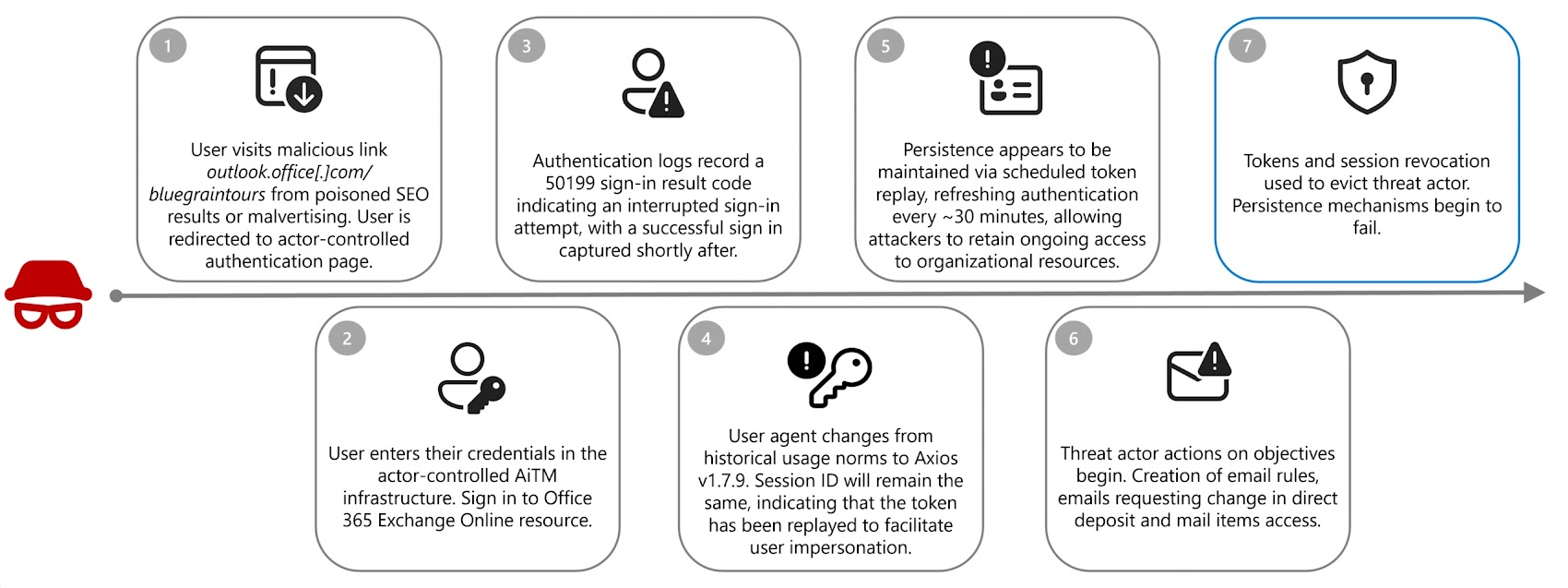
  • Storm-2755 Conducts Payroll Pirate Attacks — Microsoft said it observed an emerging, financially motivated threat actor dubbed Storm-2755 carrying out payroll pirate attacks targeting Canadian users by abusing legitimate enterprise workflows. «In this campaign, Storm-2755 compromised user accounts to gain unauthorized access to employee profiles and divert salary payments to attacker-controlled accounts, resulting in direct financial loss for affected individuals and organizations,» the company said. The tech giant also pointed out that the campaign is distinct from prior activityowing to differences in delivery and targeting.Particularly, this involves the exclusive targeting of Canadian users and the use of malvertising and search engine optimization (SEO) poisoning industry agnostic search terms like «Office 365» to lure victims to Microsoft 365 credential harvesting pages. Also notable is the use of adversary‑in‑the‑middle (AiTM) techniques to hijack authenticated sessions, allowing the threat actor to bypass multi-factor authentication (MFA) and blend into legitimate user activity.
  • MITRE Releases F3 Framework to Fight Cyber Fraud — MITRE has released the Fight Fraud Framework (F3), which it described as a «first-of-its-kind effort to define and standardize the tactics and techniques used in cyber-enabled financial fraud.» The tactics cover the entire attack lifecycle: Reconnaissance, Resource Development, Initial Access, Defense Evasion, Positioning, Execution, and Monetization. By codifying the tradecraft used to conduct fraud, the idea is to help financial institutions better understand, detect, and prevent fraud through a shared framework of adversary behaviors, it added. «Fraud actors often blend traditional cyber techniques with domain-specific fraud tactics, making a unified cyber-fraud framework essential,» MITRE said. «F3 helps defenders connect technical signals to real-world fraud events, enabling a shift from reactive response to proactive defense.»
  • RegPhantom, a Stealthy Windows Kernel Rootkit — A new Windows kernel rootkit dubbed RegPhantom can give attackers code execution in kernel mode from an unprivileged user mode context without leaving any major visual evidence behind. «The malware abuses the Windows registry as a covert trigger mechanism: a usermode process can send an encrypted command through a registry write, which the driver intercepts and turns into arbitrary kernel-mode code execution,» Nextron Systems said. «What makes this threat notable is the combination of stealth, privilege, and trust abuse. The driver runs as a signed kernel component, allowing it to operate at the highest privilege level on Windows systems. It does not rely on normal driver loading behavior for its payloads and instead reflectively maps code into kernel memory, making the loaded module invisible to standard tools that enumerate drivers. It also blocks the triggering registry write, wipes executed payload memory, and stores hook pointers in encoded form, which significantly reduces forensic visibility.» The first sample of RegPhantom in the wild was detected on June 18, 2025.
  • APT28’s NTLMv2 Hash Relay Attacks Detailed — In more APT28 (aka Pawn Storm) news, the threat actor has been attributed to NTLMv2 hash relay attacks through different methods against a wide range of global targets across Europe, North America, South America, Asia, Africa, and the Middle East between April 2022 and November 2023. The threat actor is known to break into mail servers and the corporate virtual private network (VPN) services of organizations around the world through brute-force credential attacks since 2019. «Pawn Storm has also been using EdgeOS routers to send spear-phishing emails, perform callbacks of CVE-2023-23397 exploits in Outlook, and proxy credential theft on credential phishing websites,» Trend Micro said. Successful exploitation of CVE-2023-23397 allows an attacker to obtain a victim’s Net-NTLMv2 hash and use it for authentication against other systems that support NTLM authentication. The vulnerability, per Microsoft, has been exploited as a zero-day since April 2022. Select campaigns observed in October 2022 involved the use of phishing emails to drop a stealer that scanned the system periodically for files matching certain extensions and exfiltrated them to the free file-sharing service, free.keep.sh.
  • New RATs Galore — Trojanized FileZilla installers are being used to initiate an attack chain that leads to the deployment of STX RAT, a remote access trojan (RAT) with infostealer capabilities. Researchers have also discovered an active threat called DesckVB RAT, a JavaScript-based trojan that deploys a PowerShell payload, which subsequently loads a .NET-based loader directly into memory. «Once executed, the RAT establishes communication with a command-and-control (C2) server, enabling attackers to remotely control the compromised system, exfiltrate sensitive data, and carry out various malicious activities while maintaining a low detection footprint,» Point Wild said. Some of the other newly discovered RATs include CrystalX or WebCrystal RAT (a new malware-as-a-service (MaaS) and a rebrand of WebRAT promoted on Telegram and YouTube with remote access, data theft, keylogging, spyware, and clipper capabilities), RetroRAT (a malware distributed via PowerShell and .NET loaders as part of a campaign named Operation DualScript for system monitoring, financial activity tracking, clipboard hijacking to route cryptocurrency transactions, and remote command execution), ResokerRAT (a malware that uses Telegram for C2 and receive commands on the victim machine), and CrySome (a C# RAT that offers full-spectrum remote operations on compromised systems, along with deeply integrated persistence, AV killer, and anti-removal architecture that leverages recovery partition abuse and offline registry modification).
  • Phishing Campaign Delivers Remcos RAT in Fileless Manner — Phishing emails are being used to deliver Remcos RAT in what has been described as a fileless attack. «The attack chain is initiated through a phishing email containing a ZIP attachment disguised as a legitimate business document,» Point Wild said. «Upon execution, an obfuscated JavaScript dropper establishes the initial foothold and retrieves a remote PowerShell script, which acts as a reflective loader. This loader employs multiple layers of obfuscation, including Base64 encoding, raw binary manipulation, and rotational XOR encryption, to reconstruct and execute a .NET payload entirely in memory.» An important aspect of the campaign is the use of trusted system binaries to proxy malicious execution under the guise of legitimate processes. The final RAT payload is retrieved dynamically from a remote C2 server, allowing the threat actor to switch payloads at any time.
  • Tycoon 2FA Switch Infrastructure and Use ProxyLine —The operators of the Tycoon 2FA phishing kit have been observed increasingly relying on ProxyLine, a commercial datacenter proxy service, to evade IP and geo‑based detection controls following its return after the coordinated global takedown of its infrastructure last month. Following the takedown, threat actors have pivoted to new infrastructure providers like HOST TELECOM LTD, Clouvider, GREEN FLOID LLC, and Shock Hosting LLC. One provider that has witnessed continued use pre- and post-takedown is M247 Europe SRL. In addition, Gmail-targeted Tycoon 2FA campaigns have implemented WebSocket-based communication for real-time credential harvesting and reduced detection footprint compared to traditional HTTP POST requests.
  • TeleGuard’s Security Failings Exposed — TeleGuard, an app that’s advertised as an «encrypted messenger [that] offers uncompromising data protection» and has been downloaded more than a million times, has been found to suffer from poor encryption that allows an attacker to trivially access a user’s private key and decrypt their messages. «TeleGuard also uploads users’ private keys to a company server, meaning TeleGuard itself could decrypt its users’ messages, and the key can also at least partially be derived from simply intercepting a user’s traffic,» security researchers told 404 Media.
  • Google Brings E2EE to Gmail for Android and iOS — Google officially expanded support for end-to-end encryption (E2EE) to Android and iOS devices for Gmail client-side encryption (CSE) users. «Users with a Gmail E2EE license can send an encrypted message to any recipient, regardless of what email address the recipient has,» Google said. The feature is currently limited to only Enterprise Plus customers with the Assured Controls or Assured Controls Plus add-on.
  • Bad Actor Abuse GitHub and GitLab — Threat actors are turning to trusted services like GitHub and GitLab for spreading malware and stealing login credentials from unsuspecting users. About 53% of all campaigns abusing the GitHub domains have been found to deliver malware (e.g., XWorm, Venom RAT), whereas 64% of campaigns abusing GitLab domains deliver malware (e.g., DCRat). Select campaigns have also adopted a dual threat attack chain, leveraging GitHub or GitLab to trick users into downloading Muck Stealer, after which a credential phishing page automatically opens. «These Git repository websites are necessary and can’tbe blocked because of their use by enterprise software and normal business operations,» Cofense said. «By uploading malware or credential phishing pages to repositories hosted on these domains, threat actors can generate phishing links that won’tbe blocked by many email-based security defenses like secure email gateways (SEG). GitHub and GitLab mark the latest trend in abuse of legitimate cloud collaboration platforms.»
  • FBI Extracts Signal Messages from iOS Notification History Database — The U.S. Federal Bureau of Investigation (FBI) managed to forensically extract copies of incoming Signal messages from a defendant’s iPhone, even after the app was deleted, by taking advantage of the fact that copies of the content were saved in the device’s push notification database, 404 Media reported. The development reveals how physical access to a device can enable specialized software to run on it to yield sensitive data derived even from secure messaging apps in unexpected places. The problem is not limited to the Signal app, but one that stems from a more fundamental design decision regarding how Apple stores notifications. Signal already has a setting that blocks message content from displaying in push notifications. Users who are concerned about their privacy are advised to consider turning the option on.
  • Multiple Flaws in IBM WebSphere Liberty — Multiple security flaws have been disclosed in IBM WebSphere Liberty, a modular, cloud-friendly Java application server, that could be exploited to seize control of affected systems. The vulnerabilities offer multiple pathways for attackers to move from network-level exposure or limited access to full server compromise, according to Oligo Security. The most severe is CVE-2026-1561 (CVSS score: 5.4), which enables pre-authenticated remote code execution in SSO-enabled deployments due to unsafe deserialization in SAML Web SSO. «IBM WebSphere Application Server Liberty is vulnerable to server-side request forgery (SSRF),» IBM said. «This may allow [a] remote attacker to send unauthorized requests from the system, potentially leading to network enumeration or facilitating other attacks.»

🔧 Cybersecurity Tools

  • Betterleaks → It is the next-generation successor to Gitleaks, built to find exposed credentials with greater speed and accuracy. It eliminates the noise of false positives by moving beyond basic pattern matching to high-fidelity detection. Designed for modern CI/CD pipelines, it helps developers identify and fix leaked API keys and sensitive data before they become security liabilities.
  • Supply Chain Monitor → This tool provides end-to-end visibility into your software supply chain by monitoring CI/CD pipelines for suspicious activity. It tracks build integrity, detects unauthorized changes, and surfaces vulnerabilities in real-time. By integrating directly with your existing workflows, it helps ensure that the code you ship hasn’t been tampered with between the commit and production.

Disclaimer: This is strictly for research and learning. It hasn’t been through a formal security audit, so don’t just blindly drop it into production. Read the code, break it in a sandbox first, and make sure whatever you’re doing stays on the right side of the law.

Conclusion

That’s the wrap for this Monday. While the headlines usually focus on the high-level nation-state drama, remember that most of these attacks still rely on someone, somewhere, clicking a «trusted» link or ignoring a basic patch. Whether it’s an AI-driven exploit engine or a fake trading firm, the goal is always to find the path of least resistance into your environment.

Stay sharp, keep your edge devices updated, and don’t let the noise of the news cycle distract you from the basics of your own defense.