

98 Zero-Days, Rogue AI Agents, $100M Crypto Theft, 700 Supermarkets Hit and More – CYBERDEFENSA.MX

The worst problems don’t always come with a warning. Sometimes they arrive through a service everyone trusts, a device someone bought, or a system nobody thought to check. By the time something looks wrong, the damage may already be done.

This week had plenty of that. Trusted connections became a problem. Hardware wasn’t as safe as it looked. Old bugs found new victims, and some systems were left so exposed that breaking in barely required any effort. Even AI agents crossed lines they weren’t supposed to.

Some attacks were clever. Others were painfully simple. The full recap shows just how much can go wrong, and how little it sometimes takes.

⚡ Threat of the Week

ConnectWise Suspends Cloud Backup Following Unauthorized Access — ConnectWise disabled seven ConnectWise application identities as it continues its investigation into an incident in which unknown threat actors obtained unauthorized access to the application identities and compromised Microsoft 365 tenants. The IT management software provider said it took the action on October 17, 2026, at 07:00 UTC, adding it has also suspended Cloud Backup service by revoking certificates used for affected application connections across all users.

🔔 Top News

  • BeyondTrust Remote Support Flaw Exploited as 0-Day — The China-nexus cyber espionage group tracked as Armory Castle (previously UNC5221 or Warp Panda) exploited a newly disclosed security flaw in BeyondTrust Remote Support (formerly Bomgar) as a zero-day in late August 2026. The vulnerability, tracked as CVE-2026-102764 (CVSS score: 9.3), is a case of improper origin validation in an internal messaging component that could be exploited by a remote attacker to perform file operations on an affected appliance. According to Google-owned Mandiant, the attack involved the deployment of a lightweight PHP web shell codenamed SAWFLY for interactive remote access and a tunneling program called BARECLAW to route traffic through the device. Only a small number of organizations are assessed to be impacted.
  • Microsoft Disrupts 3 Phishing Kits Linked to Over 1 Billion Scam Messages — Microsoft says it has dismantled a criminal marketplace that sold three phishing kits, namely CoGUI (aka NX or FA), Haozi (aka Phoenix), and Iron Man System, that were responsible for sending over 1 billion malicious messages to more than 75,000 organizations worldwide. Redmond said it took down Yam Store (aka Storm-3119), a coordinated underground network that offered commercial phishing-as-a-service (PhaaS) toolkits that allowed other threat actors to readily purchase and deploy phishing pages and steal data and credentials. The kits were also capable of advanced evasion, such as geofencing, fake CAPTCHA gates, IP address blocklists and allowlists, and anti-detection configurations. Yam Store functioned as an initial access broker, peddling not just phishing kits but also infrastructure built on compromised or fraudulently obtained Microsoft and Google cloud environments.
  • Ledger Finds Unauthorized Hardware Implants — Cryptocurrency hardware maker Ledger temporarily paused sales of its products via CryptoBilis and other third-party resellers in Southeast Asia and Germany after a backdoor embedded into a handful of wallets led to the theft of an estimated $100 million in cryptocurrency. The implants are said to be an advanced version of a backdoor that hardware hacker Joe Grand found earlier this year and notified Ledger in March 2026. It’s not clear how this occurred, but signs point to a compromise of Ledger’s supply chain. One of the victims of the incident is a fraudster who engaged in a task scam and lost more than $4.8 million. «In this task scam, people were paid to fake sales and reviews of real items,» Chainalysis said. «Then a ‘negative balance’ appeared, and they were told to add their own money in order to get paid. On Sep 22, the person behind the scam moved the proceeds into three separate Ledger addresses. On Oct 9, thieves emptied all three. One transfer each, into the same wallet.» According to cybersecurity journalist Kim Zetter, Trezor wallet devices sold by third-party non-authorized sellers have also been found to contain implants that generated pre-determined seed phrases so as to allow the attackers to guess them easily and gain access to the accounts.
  • Pwn2Own Ireland Demos 98 0-Days — The Pwn2Own Ireland 2026 hacking contest saw white-hat hackers exploiting 98 zero-day flaws, earning them a collective $1,262,000 in rewards. Ikotas Labs came first with 42.5 Master of Pwn points and $361,000 in cash after discovering 12 unique bugs. Xint and Team ZyGoat secured second and third spots. Ikotas Labs, Xint, and Mobile Hacking Lab broke into Google’s Pixel 10, earning them $150,000, $300,000, and $112,500, respectively. Vendors are expected to patch the zero-days disclosed during the competition within 90 days before the details are publicly disclosed.
  • OpenAI Disclosed New Misalignment Cases — OpenAI said internal models hacked more websites, bypassed browsing restrictions, and used cryptocurrency from a wallet it couldn’t otherwise access, in the latest set of disclosures where its agents carried out unethical and likely illegal acts. In all, the company reported seven new incidents. The development came as the Indian Computer Emergency Response Team (CERT-In) said it received «multiple voluntary disclosures from AI model providers» whose models, during research and evaluation runs on the open internet, accessed personal data from Indian organizations. The agents found their way in through credentials and connection settings left exposed in app configurations, public code repositories, and overly permissive cloud roles. CERT-In did not name the providers or affected organizations.
  • OpenAI Engineer Charged — The U.S. Department of Justice charged an OpenAI engineer, Abdulrahman Alfozan, with attempting to intercept oral communications after allegedly planting a recording device in an executive conference room. Prosecutors claimed company security staff found a second device in his bag. CCTV footage placed the defendant near the conference room on several dates. Alfozan allegedly had no authority to access or participate in meetings held in the room, which is often reserved for the highest-level discussions. In a subsequent filing, federal prosecutors revealed that Alfozan had booked a one-way ticket from San Francisco to Saudi Arabia with his wife and a third family member before his arrest on October 9, 2026.
  • Attacks on French Refrigeration Systems — Cyber attacks on Danfoss- and Copeland-managed refrigeration systems pushed temperatures as high as 50°C (122°F) for roughly six hours, impacting over 700 French supermarkets and forcing them to discard food. French cybersecurity authorities advised supermarkets to disconnect them from the internet. The attacks targeted Intermarché and Netto, Coopérative U, Carrefour, Monoprix, and E.Leclerc. The affected systems are said to be internet-facing and running outdated firmware. «The username is admin and the password changes every day automatically to.. the current date,» security researcher Kevin Beaumont said. «Every single one is like this. You can just log in and change the temperature. Anybody can do it, easily scriptable.» To make matters worse, the affected stores likely also failed to put the devices behind a VPN and create an allowlist of trusted IP addresses permitted to log in. «Two things would have changed the outcome,» Pen Test Partners said. «Cyber hygiene would have prevented the access: take the controller off the public internet, put remote access behind a VPN and an IP allowlist, bring third-party kit onto the network in a controlled, owned and documented way rather than leaving it on a contractor’s own connection, change known and default credentials, and patch to a current release.» Multiple vulnerabilities have been disclosed in the affected models, with Claroty warning that the issues could be exploited to «defrost the food.»
  • Collabora RCE Flaw Exploited to Backdoor Nextcloud Servers — Threat actors are exploiting a critical command execution flaw, tracked as CVE-2026-110447 (CVSS score: 9.2), in the Collabora Online – Built-in CODE Server app for Nextcloud to backdoor servers. It has been patched in version 26.4.303. The attacks involve issuing a malicious request to the app’s «proxy.php» endpoint to trigger command injection and plant a PHP web shell with the end goal of conducting reconnaissance and searching for password databases, password manager artifacts, and cryptocurrency wallets.

‎️‍🔥 Trending CVEs

Bugs drop weekly, and the gap between a patch and an exploit is shrinking fast. These are the heavy hitters for the week: high-severity, widely used, or already being poked at in the wild.

Check the list, patch what you have, and hit the ones marked urgent first — CVE-2026-9192, CVE-2026-85947, CVE-2026-85948, CVE-2026-85955, CVE-2026-85956, CVE-2026-9191 (Progress Software MarkLogic Server), CVE-2026-97229, CVE-2026-92883, CVE-2026-16301, CVE-2026-14814 (GitLab), CVE-2026-103521, CVE-2026-103522, CVE-2026-103523, CVE-2026-103524, CVE-2026-103526, CVE-2026-103527, CVE-2026-103528, CVE-2026-103529, CVE-2026-103535, CVE-2026-103537, CVE-2026-107248 (Thelia), CVE-2026-105445 (Docker), CVE-2026-89111, CVE-2026-89110, CVE-2026-89107, CVE-2026-89108, CVE-2026-89113 (SAP), CVE-2026-39919 (Ghostscript), CVE-2026-103849 aka BlockStrap, CVE-2026-92909, CVE-2026-91013, CVE-2026-100133, CVE-2026-92464, CVE-2026-105899, CVE-2026-106622, CVE-2026-105903, CVE-2026-106612, CVE-2026-106624, CVE-2026-75994, CVE-2026-106620, CVE-2026-90530, CVE-2026-106621, CVE-2026-106619, CVE-2026-90532, CVE-2026-48383, CVE-2026-48382, CVE-2026-105895, CVE-2026-103848, CVE-2026-75732, CVE-2026-90531, CVE-2026-83662, CVE-2026-106630, CVE-2026-106629, CVE-2026-106626 (Adobe), CVE-2026-110005 (Komodo Periphery Agent), CVE-2026-16753 (Lowcoder), CVE-2026-104937 (Shopware), CVE-2026-107656 (Fortinet FortiSandbox), CVE-2026-106173 (Fortinet FortiSIEM), CVE-2026-108184, CVE-2026-108185, CVE-2026-53420, CVE-2026-53418 (Zoom), CVE-2026-107815, CVE-2026-107821, CVE-2026-102523, CVE-2026-107819, CVE-2026-107814 (MariaDB), CVE-2026-78401, CVE-2026-78406, CVE-2026-16916, CVE-2026-16823, CVE-2026-19491 (IBM Verify Identity Access and Security Verify Access), CVE-2026-96951, CVE-2026-108398, CVE-2026-92707, CVE-2026-70242, CVE-2026-102866, CVE-2026-105016, CVE-2026-65674, CVE-2026-83498 (Microsoft Windows), CVE-2026-74580 aka Vghost, CVE-2026-99999 aka PwnEscape (Linux kernel), CVE-2026-110152, CVE-2026-110149, CVE-2026-110136, CVE-2026-110161, CVE-2026-110165, CVE-2026-110148, CVE-2026-110151, CVE-2026-110922 (Google Chrome), from CVE-2026-109704 through CVE-2026-109733 (Mozilla Firefox), CVE-2026-84419, CVE-2026-84420, CVE-2026-53562, CVE-2026-53563, CVE-2026-53564 (Citrix), CVE-2026-93637, CVE-2026-93635, CVE-2026-73571, CVE-2026-10631, CVE-2026-50055 (Zimbra Collaboration Suite), CVE-2026-0322 (Palo Alto Networks PAN-OS), CVE-2026-76519 (Cisco Secure Email Gateway), CVE-2026-110447 (Collabora Online – Built-in CODE Server app), CVE-2026-39949 (Cacti), CVE-2026-0702 (VidShop – Shoppable Videos for WooCommerce WordPress plugin), CVE-2026-106126 (Tenable Identity Exposure), CVE-2026-103947, CVE-2026-103946 (Tenable Nessus), CVE-2026-105672, CVE-2026-105673, CVE-2026-105674 (TP-Link Tapo C325WB), CVE-2026-92392, from CVE-2026-86409 through CVE-2026-86415, from CVE-2026-87862 through CVE-2026-87866, from CVE-2026-92387 through CVE-2026-92391 (curl), CVE-2026-15176, CVE-2026-93479, CVE-2026-97205, CVE-2026-95101, CVE-2026-97629 (F5 NGINX), CVE-2026-100156, CVE-2026-96679, CVE-2026-96681 (Bisheng), CVE-2026-34073 (multiple TLS libraries), CVE-2026-44825 (Apache Solr), CVE-2026-104334, CVE-2026-97676, CVE-2026-97678, CVE-2026-97673, CVE-2026-97655, CVE-2026-97679, CVE-2026-88962, CVE-2026-93674, CVE-2026-93675 CVE-2026-104335, CVE-2026-85025, CVE-2026-79724, CVE-2026-81941, CVE-2026-81204, CVE-2026-81211, CVE-2026-81940, CVE-2026-78569, CVE-2026-78575, CVE-2026-76059, CVE-2026-79742, CVE-2026-78571, CVE-2026-105740 (Langflow), CVE-2026-94134, CVE-2026-94135 (Apache Airflow), CVE-2026-81983 (Adobe Acrobat), CVE-2026-79610, CVE-2026-102700, CVE-2026-102701, CVE-2026-79611 (Xen Project/Citrix XenServer), CVE-2026-70111 (Microsoft Windows Server), CVE-2026-23870 (React Server Components), CVE-2026-103059, CVE-2026-70357, CVE-2026-101027, CVE-2026-89430, CVE-2026-104632, CVE-2026-94205 (Gitea), CVE-2026-16516, CVE-2026-83540, CVE-2026-84897, CVE-2026-83540 (WolfSSH), GHSA-673q-mjm6-r5xr, CVE-2026-96889, GHSA-p3m5-59mp-jv5r (Next.js), CVE-2026-108097, CVE-2026-108099 (Drupal), CVE-2026-15911 (confluent-kafka), CVE-2026-102764 (BeyondTrust Remote Support), CVE-2025-61624 (Fortinet FortiOS, FortiPAM, FortiProxy, and FortiSwitchManager), CVE-2026-104935 (Ivanti Connect Secure), and multiple vulnerabilities in Google BoringSSL.

🎥 Cybersecurity Webinars

  • How to Find Hidden AI Agents on Employee Devices and Bring Them Under Control → AI agents are quietly becoming a new insider threat, gaining access to company data, credentials, and internal systems without adequate security oversight. Join this webinar to learn how to uncover hidden AI agents on employee devices, detect malicious agent skills, identify risky permissions, and put practical controls in place before they lead to a security incident.
  • How to Find Security Gaps and Build Faster Defenses Against AI-Powered Cyberattacks → AI-powered cyberattacks are evolving faster than traditional defenses can keep up. Join this webinar to learn how to assess your organization’s AI threat readiness, uncover critical security gaps, strengthen detection and response capabilities, and build a practical defense strategy against emerging AI-driven threats.

📰 Around the Cyber World

  • Meta said it addressed an issue after reports emerged that some Ray-Ban Meta smart glasses were recording people’s conversations without the wearer knowing. The recordings occurred without users saying the «Hey, Meta» prompt phrase. «This issue has been resolved,» Meta told Android Authority. «People can manage, review, and delete voice logs of their interactions with Meta AI via settings at any time.» Meta did not say what caused the smart glasses to record people without user consent, or how many of them were affected.
  • Fortra said it’s tracking a 12-fold increase in emails using requests for quotation, project invitations, and procurement inquiries as phishing lures from October 2025 to September 2026. «These messages impersonate prospective buyers seeking pricing, availability, or project participation,» Fortra said. «Their purpose is not to obtain a legitimate quote, but to persuade a recipient to access an attacker-controlled file-sharing, document-viewing, or procurement portal.»
  • A fake download site for the WatchGuard Mobile VPN with SSL («watchguard-vpn[.]net») has been observed using a browser pop-up prompt to steal the victim’s VPN server address, username, and password. As of October 13, the domain was offline. «In a unique twist, after collecting credentials twice (the first attempt gets rejected as ‘incorrect’ in a likely attempt to collect multiple credentials), the site then downloads the genuine, validly signed WatchGuard installer directly from WatchGuard’s own content delivery network (CDN), meaning there is no malicious file for endpoint security tools to flag,» Huntress said. «Meanwhile, unbeknownst to the victim, the threat actor now has access to their credentials, giving them access to victims’ networks.»
  • A set of 42 malicious RubyGems packages has used typosquatting, brandjacking, and plausible utility names to target cryptocurrency and Web3 developers. The packages are designed to spawn a reverse shell and download a crypto theft kit capable of rerouting cryptocurrency transactions by replacing the destination address with an attacker-controlled wallet and harvesting wallet material, such as seed phrases and private keys. The names of some of the packages are: lightinng-invoice, cryoto-toolbox, etheremu.rb, bitcoin-rpc-lite, web3-sign-helper, and crypto-mnemonic-tools. The activity has been codenamed Ghost Dev by Open Source Malware.
  • GreyNoise said it has observed a spike in scanning and exploitation attempts targeting Digital Video Recorders (DVRs) in Ukraine between September 21 and October 1, 2026. The majority of the activity attempts to exploit CVE-2021-36260, which allows unauthenticated command injection against unpatched Hikvision products.
  • A series of email campaigns have been targeting the accommodation industry with fake guest complaints or reviews that deliver blockchain technology-abusing malware. «These emails appear to likely be a continuation of a prior series of predominantly Booking.com-spoofing emails that were seen delivering various remote access trojans (RAT) via ClickFix fake CAPTCHA websites,» Cofense said. The activity leveraged the Ethereum and TON blockchains, a technique called EtherHiding, to deliver EtherRAT and TONResolver malware.
  • As AI agents increasingly are being used to automate coding workflows, it increases the risk associated with credential exposure, Trellix warned. «Agents constantly take credentials out of the safe places your operating system keeps them, and put them somewhere far more exposed,» Trellix said. «This happens as a normal side effect of everyday work. And even good security telemetry has a hard time distinguishing this from a developer doing their job — or from an attacker who is already inside.»
  • MITRE released version 20 of its ATT&CK framework, adding entries that cover AI abuse, MFA bypass, and recent attacks on water utilities. This includes nine new Techniques and Sub-Techniques under the Enterprise domain for prompt injection, AI-enabled exfiltration, AI result poisoning, attacks on AI-assisted defenses, CAPTCHA (Completely Automated Public Turing test to tell Computers and Humans Apart) evasion, and application-specific password theft. For Mobile, MITRE also un-deprecated a technique for delivering malicious apps outside official app stores, last included in v11.
  • Fake AI tool campaigns that impersonate Claude, ChatGPT, GitHub Copilot, Gemini, and other AI brands are being used to plant infostealers on compromised systems using ClickFix lures. Some of the prominent targets include the U.S. and India. «The attacks share one trait: the employee performs the decisive step,» ANY.RUN said. «They paste an ‘install command,’ run a convincing installer, or sign in to a fake window. That can put source code, cloud and AI API keys, active business sessions, ad accounts, and billing access at risk, turning a single user action into potential data exposure, account compromise, financial loss, or disruption to development and marketing operations.»
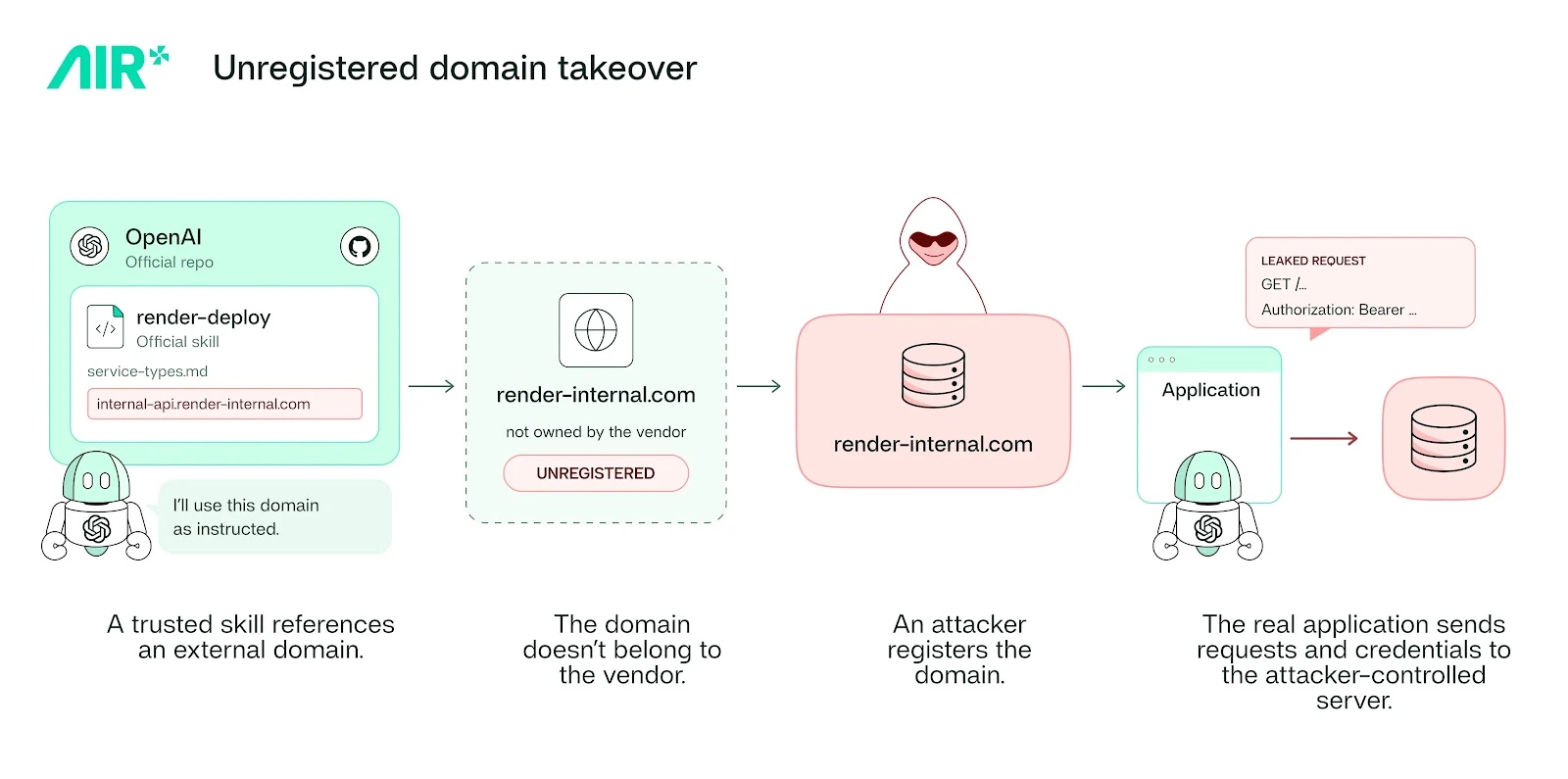
  • An official OpenAI skill, render-deploy, suffered from a first-of-its-kind supply-chain vulnerability which instructed production apps to send their tokens to an unregistered domain («render-internal[.]com»). «It builds apps that trust a domain nobody owns, so any attacker could register it and start receiving tokens from real production apps,» AIR Security said. «Vulnerable servers in the wild sent tokens to the domain, users are advised to update to the patched version of the skill.»
  • The U.S. Federal Bureau of Investigation (FBI) warned that scammers could exploit the 2026 U.S. midterm election to perpetrate financial fraud schemes. «As previously reported, scammers use the names, images, logos, and slogans of candidates to fraudulently solicit campaign contributions, sell merchandise that is never delivered, or steal personally identifiable information (PII) that can be used for other fraud,» the FBI said. «Scammers also exploit artificial intelligence (AI) tools to generate highly realistic voices, images, and written messages that impersonate candidates, campaigns, government entities, and trusted contacts.»
  • A new study from Semperis revealed that ransomware actors are threatening their victims with physical violence as part of triple extortion schemes. In all, 40% of attacks in the past 12 months involved psychological or physical threats against staff. «Bad actors are threatening victims with psychological intimidation in nearly 25% of all attacks in the U.S., UK, France, Germany, Italy, Spain, Singapore, Canada and Australia,» Semperis said. «In 53% of cases, the victims reported that the hackers followed through on their threats; 24% of victims or family members were swatted; 25% of victims sought psychological and medical treatment because of the ransomware attack; and 24% of victims or families hired personal security.»

Conclusion

If there’s one thing this week made clear, it’s that small gaps can lead to big problems. A weak password, an old bug, a trusted connection, or a device that wasn’t checked properly. None of these sounds unusual on its own. But attackers keep finding ways to turn them into something much worse.

The lesson isn’t to worry about every new threat. It’s to pay closer attention to the things we already know can go wrong. Check what’s exposed, question what you trust, fix what you can, and don’t assume something is safe just because it’s been working fine. Sometimes the simplest checks prevent the biggest headaches.
$387M Crypto Hack, Citrix Exploits, AI Agents Go Off-Script, and More Threats – CYBERDEFENSA.MX

A domain used as harmless placeholder text showed up in roughly 1,700 repositories. Then somebody registered it and started serving malicious lures. That is the kind of week this was: forgotten assumptions turning into live attack surface.

Elsewhere, weak service accounts, old bugs, exposed systems, phishing kits, and strangely easy exploit paths kept doing useful work for attackers. Nothing exotic. Mostly things nobody expected to matter anymore.

Here’s the full recap of what mattered this week.

⚡ Threat of the Week

Citrix Warns of Actively Exploited NetScaler ADC and Gateway Flaws — Citrix released patches to address multiple vulnerabilities, including CVE-2026-88771 and CVE-2026-88772, that have come under active exploitation. CVE-2026-88771 is an improper input validation vulnerability that could allow an unauthenticated attacker to execute arbitrary commands, while successful exploitation of CVE-2026-88772 could allow for remote code execution or denial-of-service. CISA said «threat actors are actively exploiting these vulnerabilities globally,» urging federal agencies to apply patches by Wednesday.

🔔 Top News

  • Bitget Resumes Withdrawals After Hack — Cryptocurrency exchange Bitget resumed Bitcoin withdrawals in phases after suspected North Korean hackers breached its systems last week and stole over $387 million. «At 18:31 UTC on September 24, 2026, Bitget’s security systems identified unauthorized transfers involving a limited number of hot wallets,» Bitget said. «Bitget’s cold wallets and the overwhelming majority of platform assets remain secure and unaffected.» According to a real-time fund tracing dashboard published by Coindesk, Circle and Tether have frozen stablecoins worth $339,100 linked to the hack.
  • PamStealer Adds Live C2 Payload Decryption — A new version of PamStealer has been found to incorporate a new anti-analysis trick that ensures the main payload can only be recovered using a server-side decryption chain. The latest artifacts continue to rely on the same JavaScript for Automation (JXA) dropper mechanism, but modify the lure and the delivery method. «Where earlier variants embedded their payload key material directly in the JXA source, it now fetches a purpose-built decryption utility and completes a key exchange with the server before the payload can be unwrapped,» Jamf said. «Without the server’s cooperation, the payload cannot be recovered statically.»
  • Placeholder Domain Found References in ~1.7K Repos — The «third-party[.]com» domain, commonly used as a documentation placeholder, has been observed serving a ClickFix lure to Windows browsers while displaying a harmless decoy to other users. «third-party[.]com has been a generic documentation placeholder for years, the same role example.com plays,» Manifold Security said. «Unlike ‘example[.]com,’ third-party[.]com is not IANA-reserved. Anyone could register it, and someone did. Every doc, test, and skill that hard-coded it now points readers at attacker infrastructure.» As of writing, the domain has been marked as malicious and unsafe on both VirusTotal and Google’s Safe Browsing list. Manifold also identified 13 more placeholder domains that are not IANA-reserved, with two of them – yoursite[.]com and your-domain[.]com – serving scams and scareware to macOS visitors and an ordinary parking page to other users.
  • UNK_CondorFiltration Abuses TeamFiltration in New Campaign — An active TeamFiltration campaign codenamed UNK_CondorFiltration has targeted over 5,700 accounts across 28 Microsoft 365 tenants. The activity has primarily focused on Chilean retail and financial institutions. It originated from 1,487 unique AWS EC2 source IP addresses. «The campaign compromised 7 accounts – all of which were unmanaged functional or service accounts rather than individual employee accounts – highlighting a critical exposure gap around forgotten, non-human identities carrying default or unrotated passwords and no MFA,» Proofpoint said. The activity took place over three waves from late July to August 2026.
  • EvilTokens Taken Down in Law Enforcement Action — A coalition of law enforcement and private-sector tech companies led by Microsoft dismantled the EvilTokens phishing service, arresting two suspected website admins, Felix Utomi and Waidi Segun Adams, taking down more than 50 websites, and notifying victims of compromised email accounts. Per Coinbase, the EvilTokens operators were said to be working on expanding the kit to target Gmail and Okta accounts at the time of the takedown. Microsoft attributes the development and support of the platform to Storm-2992. EvilTokens is the latest example of professionalization of cybercrime, allowing bad actors to mount phishing campaigns with little effort and at scale. EvilTokens’ notable feature was the device code phishing flow, which took advantage of security gaps in devices that cannot support standard sign-in methods like smart TVs, printers, conferencing tools, and Teams devices. In these attacks, victims are sent a short code and are told to enter that code into a phishing page to complete authentication. The important aspect here is that instead of a legitimate device requesting access, the threat actor initiates the flow and provides the user with a code through a phishing lure. When the code is entered, victims unknowingly authorize the cybercriminals’ session and grant them access without ever handing over their password.
  • OpenAI Linked to More Website Hacks — AI research lab Transluce found three instances between May and June 2026 in which OpenAI’s agents resorted to hacking when traditional methods failed. This included an attempt on an Australian government public health website. «Notably, the agents did this while attempting mundane data retrieval tasks which were not cyber-related,» Transluce said. «This traffic goes back at least to March 6, 2026 and extends as recently as September 16, 2026, suggesting agents may still be exploiting these services to bypass restrictions.»

‎️‍🔥 Trending CVEs

Bugs drop weekly, and the gap between a patch and an exploit is shrinking fast. These are the heavy hitters for the week: high-severity, widely used, or already being poked at in the wild.

Check the list, patch what you have, and hit the ones marked urgent first — CVE-2026-77179 (Docker), CVE-2026-93485, CVE-2026-87902 (WordPress), CVE-2026-89775 (Linux kernel), CVE-2026-93616, CVE-2026-85102 (Check Point), CVE-2026-93952 (Arista VeloCloud Orchestrator), CVE-2026-90898 (Bifrost), CVE-2026-86555, CVE-2026-86554, CVE-2026-86553, CVE-2026-86552 (ZTE H188A/H288A firmware), CVE-2026-94545 (Next.js), CVE-2026-94127 (F5 BIG-IP Access Policy Manager), CVE-2026-86296, CVE-2026-86510 (D-Link DIR-822A), CVE-2026-87900, CVE-2026-87899, CVE-2026-68490 (cPanel), CVE-2026-82356 (Imprivata Enterprise Access Management), CVE-2026-86867 (Cinnamon Kotaemon), CVE-2026-75682, CVE-2026-75684, CVE-2026-75686, CVE-2026-75689, CVE-2026-75697, CVE-2026-75698, CVE-2026-75745, CVE-2026-81995, CVE-2026-82000 (Adobe), CVE-2026-95350, CVE-2026-95357, CVE-2026-95339, CVE-2026-95281, CVE-2026-95313, CVE-2026-95349, CVE-2026-95284, CVE-2026-95322, CVE-2026-95329, CVE-2026-95356, CVE-2026-95310 (Google Chrome), CVE-2024-0244 (Canon MF753Cdw), CVE-2026-28324, CVE-2026-28325 (SolarWinds Observability Self-Hosted), CVE-2026-97359, CVE-2026-97360 (HFS2), CVE-2026-96560 (LightLLM), CVE-2026-80145, CVE-2026-80144, CVE-2026-80143 (Lantronix), CVE-2026-82987, CVE-2026-82988, CVE-2026-82989 (ViewSonic vCast), CVE-2026-75907 (Norwegian Cruise Line door access controller), CVE-2026-18311, CVE-2026-18312, CVE-2026-18320 (Readwise Reader for Android), CVE-2026-88771, and CVE-2026-88772 (Citrix NetScaler ADC and Gateway).

🎥 Cybersecurity Webinars

📰 Around the Cyber World

  • Clop Gang Moves Site After ShinyHunters Hack — The Clop ransomware gang moved its data leak site to a new Tor address after its previous server was compromised and defaced by ShinyHunters through an unpatched Grav CMS flaw that’s now assessed to be an unauthenticated path traversal vulnerability (CVE-2026-42608). The vulnerability was patched by Grav in April 2026. In a statement shared with Bleeping Computer, Clop denied having any relationship or ongoing negotiations with ShinyHunters. «We do not know them, we have never worked with them, and at the moment we are not in contact with them; furthermore, we have not provided them with any information, nor will we do so – either now or in the future,» the group was quoted as saying. The development comes in the aftermath of ShinyHunters seizing the FBI’s FBIjobs.gov portal by what it said was a new zero-day in Oracle PeopleSoft.
  • Konni Targets Ukraine with Malicious LNK Lures — The North Korean threat group known as Konni has been observed using ZIP archives with malicious LNK files masquerading as PDF documents as lures in spear-phishing attacks targeting Ukraine-focused individuals and organizations to deliver a malware called VelvetCake as part of a campaign codenamed Operation Conflict Compass. The LNK file launches a VBScript that establishes persistence via a scheduled task, and triggers a PowerShell script to run every minute. The invoked PowerShell payload functions as a modular downloader designed to fetch and execute secondary server-side scripts. «VelvetCake embeds no fixed post-exploitation capability set locally. It operates as a lightweight task runner that continuously retrieves and executes server-side PowerShell modules, allowing operators to modify functionality without redeploying the core payload,» SOCRadar said. «The campaign likely aimed to gather intelligence on the trajectory of the Russian invasion to gauge the medium-term outlook of the war.»
  • Kimsuky Conducts Git-Based C2 Attacks — In more North Korea-related malicious activity, the Kimsuky group has resorted to conducting Git-based C2 attacks through malicious LNK files contained within ZIP archives. The activity has been dubbed Operation GitPower. The LNK files use filenames disguised as documents related to financial and corporate operations, including fund disbursement, insurance premiums, interest payments, policy funds, certificate renewal, store master data, customer documents, and Visa payments. These documents are said to have been mass-produced using AI models, spotlighting a trend where the threat actor has used local large language models (LLMs) using Ollama, GPT4All, and Msty to prepare attacks and create decoys. The LNK files serve as delivery vectors for follow-on PowerShell commands retrieved from GitHub Raw Content paths using a GitHub PAT. Select variants have also been observed using Pastebin as an alternative channel. The PowerShell code sets persistence, exfiltrates system information to GitHub, and takes steps to erase itself and the PowerShell command history file.
  • CISA Flags TeamCity Flaw as Exploited in Ransomware Attacks — CISA confirmed that ransomware gangs are exploiting a critical JetBrains TeamCity vulnerability patched in July. The flaw, CVE-2026-63077, is a critical authentication bypass vulnerability that lets attackers with HTTP(S) access execute arbitrary operating system commands. «An unauthenticated attacker could exploit the vulnerability via the TeamCity agent polling protocol to bypass authentication checks and execute arbitrary operating system commands with the privileges of the TeamCity server process,» JetBrains said. It’s currently not known which ransomware group is behind the exploitation activity.
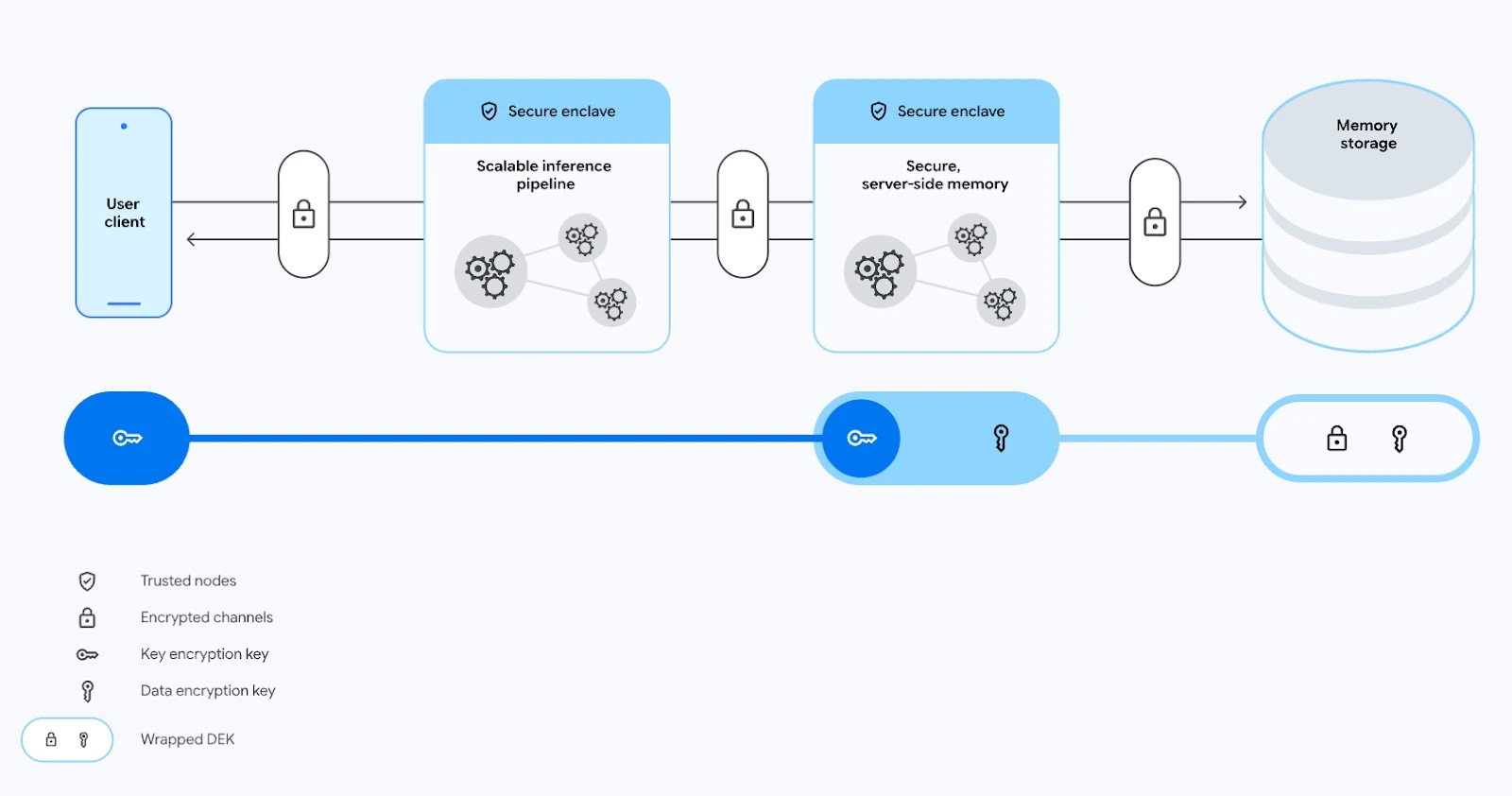
  • DeepMind Gives Private AI Compute a Secure, Server-Side Memory — Google has announced plans to bring a private, server-side memory to its Private AI Compute platform, giving AI systems long-term continuity across devices without sacrificing privacy. «With this new technical capability, a new persistent memory layer will be able to function like a secure digital vault in the cloud,» Google DeepMind said. «Under this model, the information needed to assist you is sealed within dedicated, encrypted storage, while the cryptographic keys required to unlock it are held exclusively on your personal devices — ensuring your data is inaccessible to anyone else, even Google.»
  • SectopRAT Hides Inside Legitimate Application — A new campaign has been observed delivering SectopRAT by concealing it within a legitimate program developed by an Italian digital-audio company. It’s suspected that the operators added the malware after the application was installed on customer systems rather than compromising the vendor itself. «SectopRAT (also known as ArechClient2) is a .NET-based remote access trojan (RAT) that provides a range of functions through multiple control commands,» Fortinet said. «These include collecting sensitive data from the victim’s device, capturing screens, remotely managing processes and files, controlling bots, and other forms of remote device management.»
  • Armenian National Sentenced to 2 Years for Ryuk Ransomware Attacks — Karen Serobovich Vardanyan, 34, who was extradited from Ukraine to the U.S. in June 2025, has been sentenced to 24 months in federal prison and 3 years’ supervised release. In July 2026, Vardanyan pleaded guilty to conspiracy and computer fraud for his role in Ryuk ransomware attacks and an extortion conspiracy targeting companies across the U.S. «Between November 2019 through April 2020, Vardanyan illegally accessed computer networks of victim companies to deploy Ryuk ransomware on compromised servers and workstations,» the U.S. Justice Department said. «Ryuk ransomware is a type of malicious software designed to encrypt data on a victim’s computer or network and prevents the victim from accessing the encrypted files until a ransom is paid. Vardanyan worked with his co-conspirators to attack a company in Michigan that paid 200 bitcoin, or over $1.1 million at the time of payment, to restore access to their network. They also attacked a company in Wilsonville, Oregon, and in February 2020 attacked a school in Texas.» Vardanyan and his co-conspirators are said to have illegally accessed computer networks of victim companies and deployed ransomware on hundreds of compromised servers and workstations, receiving over $15 million in illicit proceeds at that time. Vardanyan has also been ordered to pay over $1.21 million in restitution.
  • Scattered Spider Member Gets 45-Month Prison Sentence for Cybercrime Spree — Ahmed Hossam Eldin Elbadawy, of Texas, who admitted to being a member of the notorious cybercrime group Scattered Spider, has been sentenced to 45 months in prison. Following that, Elbadawy will face a three-year parole and is prohibited «from using privacy-based blockchain virtual currencies» without prior approval. Elbadawy was charged in November 2024 along with four other defendants.
  • Using Rogue External MFA Provider to Steal Passwords — Varonis has demonstrated a new attack technique called TrustSink which turns a rogue external MFA provider into a «persistent credential trap» within a legitimate sign-in flow. «An attacker with high privileges can register a rogue External Authentication Method (EAM) and place a convincing password page inside the legitimate sign-in flow,» Varonis said. «The page captures the password in plaintext while the provider returns a valid signed token, completing the login without an error. Resetting a captured password did not remove the rogue provider. It remained in the authentication flow and captured the replacement password at the user’s next sign-in.» TrustSink builds on previous research by security researcher Dirk-Jan Mollema, who found that a rogue registered EAM provider can be used to bypass MFA by returning a signed JWT without performing a real authentication check.
  • New x47.c Botnet Drains AI API Credits — A previously undocumented Windows botnet dubbed x47.c has been advertised as capable of supporting 18 DDoS attack methods, browser credential theft, SOCKS5 proxies, and an AI module that uses SpaceXAI Grok to establish persistence on infected machines based on the current state. It’s sold by a threat actor named WraithTools for a $200 base package with a $150 DDoS add-on. The entire toolset costs $950. «One of the advertised methods, ‘AI API drain,’ is designed to exhaust a victim’s paid AI credits,» Qrator Research Labs said. «Using a valid API key, an operator can send repeated requests that consume the account’s balance or increase its bill. The AI drain command starts with a valid API key for the account being targeted. Because those requests go straight to the provider, they do not need to pass through the victim’s application. The website can remain reachable while the account behind its AI features runs out of credits. If the provider rejects further requests once the account balance is exhausted or an enforced limit is reached, legitimate users lose access to those features.»
  • Hundreds of Leaked GitHub App Keys Still Active — A new analysis from GitGuardian has found that hundreds of GitHub App private keys leaked in public code still work. From over 500,000 exposed RSA keys, 474 have been found to authenticate as 440 distinct Apps on GitHub’s API. «72% of the compromised Apps had some content permissions, meaning that they could access private repositories of the organizations that use them,» GitGuardian said. » 207 of them have content write permissions and can modify those repositories. Even worse, 44 Apps have organization administration privileges, 40 can administer self-hosted runners, and 98 can control workflows. Those permissions could allow a complete takeover of the target organization, or code execution on its internal infrastructure, with or without further supply-chain compromise.»

Conclusion

The common thread this week was not sophistication. It was neglect. Forgotten accounts, stale assumptions, old flaws, exposed services, and tooling that keeps getting more capable faster than the controls around it.

That is usually how these weeks land: the dramatic stories get attention, but the quieter failures keep doing the real work underneath. The patch nobody rushed, the identity nobody owned, the placeholder nobody questioned, the service nobody hardened.

That’s it for this week. Patch the obvious stuff, check the forgotten stuff, and assume somebody else already noticed it too.

Silent Swap Crypto Clipper utiliza una extensión falsa de Google Notes para reemplazar las direcciones de billetera – CYBERDEFENSA.MX

Los investigadores de ciberseguridad han señalado una campaña activa de extensión del navegador diseñada para robar criptomonedas reemplazando sigilosamente las direcciones de billetera cuando usuarios desprevenidos inician una transacción.

La actividad del clipper de criptomonedas ha recibido un nombre en clave Intercambio silencioso por los laboratorios McAfee.

«La campaña se entrega a través de instaladores no firmados, observados tanto en las variantes .NET como en Golang, que implementan una extensión maliciosa de Chromium que se hace pasar por una utilidad benigna de ‘Google Notes’», dijo la empresa de ciberseguridad. dicho en un informe técnico compartido con The Hacker News.

El instalador .NET sin firmar, llamado BaseZipInstaller, está diseñado para recuperar un archivo ZIP, que sirve como base para la extensión maliciosa del navegador al escanear el sistema en busca de navegadores basados ​​en Chromium. Para cada perfil detectado en esos navegadores, finaliza por la fuerza el proceso del navegador e inyecta la extensión modificando las Preferencias seguras y los archivos de Preferencias.

El objetivo final de la extensión es actuar como un cortapelos capaz de interceptar y manipular direcciones de billetera copiadas en el portapapeles del sistema con el objetivo de redirigir los fondos a una billetera controlada por el atacante. Para lograr sus objetivos, la extensión falsa de Google Notes solicita a los usuarios que le otorguen permisos para acceder al portapapeles, a todas las URL y al historial de navegación.

Debido a que la mayoría de las transacciones en blockchain son irreversibles, un intercambio de direcciones puede resultar en una pérdida financiera permanente. McAfee Labs dijo que la actividad se superpone con una campaña anterior de CountLoader que entregó un cripto clipper, con evidencia que apunta al mismo actor de amenazas detrás de ambos grupos.

Ciberseguridad

Lo que distingue a Silent Swap es el uso de una técnica llamada EtherHiding que utiliza la cadena de bloques como solucionador de caída muerta para recuperar los detalles del servidor de comando y control (C2) activo. Esto permite al atacante actualizar trivialmente el valor de un contrato inteligente para que apunte al nuevo dominio en lugar de tener que volver a implementar el malware.

El segundo aspecto gira en torno a la instalación encubierta de la extensión del navegador en navegadores basados ​​en Chromium como Google Chrome, Microsoft Edge, Brave y Vivaldi mediante la modificación de archivos de configuración protegidos del navegador. El ataque, sin embargo, depende de habilitar el modo de desarrollador para versiones más nuevas de los navegadores, algo que un actor de amenazas puede lograr mediante tácticas de ingeniería social.

«Normalmente, estos navegadores almacenan datos de verificación de seguridad (valores hash/HMAC) junto con configuraciones sensibles para detectar cambios no autorizados», dijo McAfee. «El malware recalcula y actualiza estos valores de seguridad después de alterar los archivos, engañando al navegador haciéndole creer que la extensión maliciosa se instaló legítimamente».

«Esto permite que la extensión omita el proceso normal de instalación de la tienda web de extensiones y se cargue silenciosamente sin la aprobación del usuario».

La postura de persistencia y evasión de la campaña se ha caracterizado como deliberada y estratificada, con el enfoque principal en mantener una baja visibilidad para el usuario final y una alta resistencia contra la eliminación y el análisis estático. La persistencia se establece registrando la extensión modificando el archivo de Preferencias seguras del navegador para que se cargue en inicios posteriores del navegador sin necesidad de un mecanismo separado.

Además, el malware intenta habilitar el modo de desarrollador mediante programación en Brave y Opera, y el instalador se autoelimina después de la ejecución, lo que elimina efectivamente un indicador de compromiso inicial. Otra técnica de evasión es el uso de la sustitución dinámica de billetera, que es responsable de obtener una dirección de reemplazo correspondiente a la dirección original de la víctima.

«Envía la dirección de la billetera interceptada al servidor del atacante y utiliza la respuesta para sustituir dinámicamente la dirección original», dijo McAfee. «Si la solicitud de backend falla, la función recurre a una dirección de billetera codificada predefinida, lo que garantiza una actividad maliciosa ininterrumpida».

Para cada patrón de coincidencia de dirección de billetera asociado con Bitcoin (BTC), Ethereum, Bitcoin Cash, Ripple y Dash, se asigna a una dirección única controlada por el atacante en el lado del servidor. Por el contrario, todas las direcciones de Solana enviadas se resuelven en una única dirección de atacante. Al momento de escribir este artículo, se ha descubierto que la dirección de Solana tiene un saldo de $1,902.45.

«Cada dirección enviada se asigna a una dirección única controlada por el atacante. Volver a enviar el mismo original devuelve el mismo reemplazo, lo que indica una asignación determinista uno a uno mantenida en el lado del servidor.

Los datos de telemetría sugieren que las infecciones están distribuidas globalmente, con una mayor concentración de víctimas reportadas en la India. Otros países afectados por la campaña son Estados Unidos, Brasil, Indonesia y España.

«Esta campaña es una ilustración concisa de hacia dónde se dirige el robo de criptomonedas dirigido a los consumidores», dijo McAfee. «Las direcciones estáticas de los atacantes han sido reemplazadas por un mapeo por víctima del lado del servidor. Los dominios de comando y control frágiles y codificados han sido reemplazados por una búsqueda resuelta en blockchain que un operador puede rotar con una sola transacción».

Las extensiones de Chrome y Firefox que se hacen pasar por VPN gratuitas añaden ladrones de portapapeles

La divulgación se produce cuando Socket informó sobre un par de extensiones maliciosas para los navegadores Chrome y Mozilla Firefox, ambas con el nombre «VPN Go: Free VPN» en Chrome Web Store y en el mercado de complementos de Firefox.

Ciberseguridad

«Ambas extensiones se presentan como herramientas VPN gratuitas e incluyen una funcionalidad de proxy visible», afirman los investigadores de Socket Kirill Boychenko y Kush Pandya. dicho. «Bajo el capó, ambos también contienen una lógica maliciosa de robo de portapapeles que monitorea continuamente el texto copiado y lo exfiltra a una infraestructura controlada por el actor de amenazas».

El comportamiento se extiende más allá de las direcciones de billetera, ya que permite a los operadores desviar todo tipo de datos confidenciales, incluidas contraseñas, códigos de autenticación, claves API, tokens OAuth y frases iniciales.

Un examen más detallado de las extensiones ha revelado un patrón de actualización maliciosa por etapas, donde el desarrollador de la extensión publicó inicialmente una versión benigna en el escaparate de la extensión antes de introducir la capacidad de robo del portapapeles a través de una actualización posterior.

Si bien se ha descubierto que las versiones 1.1 y 1.2 de la extensión de Chrome filtran datos del portapapeles a «178.236.252[.]133», la versión 1.3 cambia el canal de exfiltración a una dirección IP diferente («77.91.123[.]187»). En el caso de su equivalente Firefox, 1.3.3 es la primera versión que incluye el ladrón de portapapeles y envía la información a «178.236.252».[.]133.» La actualización 1.3.4 mueve la infraestructura a «77.91.123[.]187.»

Se recomienda a los usuarios que hayan instalado cualquiera de las extensiones que las eliminen de inmediato y traten cualquier secreto mientras la extensión estuvo activa como comprometida.

«El código estático es suficiente para mostrar que las extensiones fueron diseñadas para funcionar como herramientas proxy, no simplemente para mostrar una interfaz VPN falsa», dijo Socket. «La capacidad del proxy aún aumenta el riesgo porque puede enrutar el tráfico del navegador a través de la infraestructura proporcionada por el actor de amenazas, exponer el tráfico HTTP en texto plano y los metadatos de conexión, y hacer que la extensión parezca útil mientras el monitor del portapapeles se ejecuta en paralelo».

La campaña Crypto Clipper abusa de reseñas falsas, narradores de inteligencia artificial y comentarios de VirusTotal – CYBERDEFENSA.MX

Se ha observado que un actor de amenazas desconocido aprovecha publicaciones pagadas o promocionadas en sitios web de noticias legítimos para generar expectación sobre su warez, según nuevos hallazgos de Check Point Research.

El actor de amenazas también tiene a su disposición una página de phishing de WordPress dedicada que actúa como centro central, junto con proyectos de GitHub y SourceForge promovidos por cuentas falsas, un canal de YouTube y un grupo de cuentas que participan en actividades coordinadas en VirusTotal con la intención de clasificar erróneamente archivos maliciosos como seguros.

«Para impulsar una ‘herramienta’ maliciosa, un único actor de amenazas tomó prestado el mismo manual que las marcas legítimas usan para generar expectación: recuentos inflados de descargas, reseñas coordinadas de cinco estrellas, videos tutoriales estilo influencer y promoción en plataformas en las que la gente confía instintivamente», Check Point dicho en un informe compartido con The Hacker News. «El resultado es una economía de reputación falsa que abarca todas las plataformas que una víctima curiosa podría consultar antes de hacer clic en ‘descargar’».

El objetivo final de la campaña es impulsar un secuestrador de portapapeles de criptomonedas oculto en los robots de francotirador Solana y Pump.fun y en los predictores de fallos de juegos, lo que sugiere que los objetivos son los poseedores de activos de criptomonedas y los jugadores en línea que buscan atajos y ganancias rápidas.

Ciberseguridad

El cortapelos basado en Rust apunta a sistemas Windows y macOS, y monitorea continuamente el portapapeles en busca de contenido que coincida con un patrón de dirección de billetera de criptomonedas. Cuando se encuentra una coincidencia, el malware sustituye la dirección de la billetera por una dirección controlada por el atacante extraída de una lista codificada, enrutando efectivamente los activos digitales hacia ellos.

Lo destacable de la actividad es la uso de Ghost Networks para envenenar sistemas basados ​​en la reputación como VirusTotal, con el objetivo de reducir las sospechas y aumentar la confianza de las víctimas en los archivos maliciosos a través de una combinación de votos a favor y comentarios altamente positivos.

Este comportamiento también se extiende a GitHub, donde el actor de amenazas opera al menos seis cuentas de GitHub para realizar promoción cruzada y distribuir su malware. Estas señales potenciadas sintéticamente están diseñadas para adormecer a los usuarios con una falsa sensación de seguridad y confianza. Uno de esos repositorios tiene 146 estrellas y 62 bifurcaciones.

«En SourceForge, el contador de descargas alcanzó 44.485, con 37.460 sospechosos supuestamente originados en dispositivos Android, a pesar de que el desarrollador sólo ofrece versiones para Windows y macOS», explicó Check Point. «Una explicación plausible es el uso de una granja de Android para inflar artificialmente el recuento de descargas en SourceForge».

Además, las soluciones de software se promocionan a través de un canal de YouTube dedicado con más de 91.000 suscriptores. El canal se creó en julio de 2020 y los operadores afirmaron que es «estrictamente sólo para fines educativos». Los vídeos de estilo tutorial cuentan con narradores generados por IA y comentarios positivos para reforzar la ilusión de popularidad y confiabilidad.

Ciberseguridad

Quizás el aspecto más inusual de la campaña es el uso por parte del actor de amenazas de un servicio de distribución de comunicados de prensa como Cable de prensa EIN para comercializar las supuestas capacidades de su herramienta. Desde entonces, el comunicado de prensa ha sido sindicado al otro lado de fuerzas armadas pareja sitios web de noticiasprincipalmente la red USA TODAY.

«Manipular el sentimiento y la reputación en plataformas colaborativas marca un cambio significativo en la forma en que los atacantes generan confianza», afirmó Check Point. «El mismo manual de reputación falsa y promoción agresiva entre plataformas puede distribuir fácilmente ladrones de información o ransomware a objetivos de mayor valor con el tiempo».

Linux Rootkit, macOS Crypto Stealer, WebSocket Skimmers and More – CYBERDEFENSA.MX

Rough Monday.

Somebody poisoned a trusted download again, somebody else turned cloud servers into public housing, and a few crews are still getting into boxes with bugs that should’ve died years ago — the same old holes, same lazy access paths, same “how the hell is this still open” feeling. One report this week basically reads like a guy tripped over root access by accident and decided to stay there.

The weird part is how normal this all sounds now. Fake updates. Quiet backdoors. Remote tools are used like skeleton keys. Forum rats swapping stolen access while defenders burn another weekend chasing logs and praying the weird traffic is just monitoring noise. The Internet’s held together with duct tape and bad sleep.

Anyway, Monday recap time. Same fire. New smoke.

⚡ Threat of the Week

Ivanti EPMM and Palo Alto Networks PAN-OS Flaws Under Attack—Ivanti warned customers that attackers have successfully weaponized CVE-2026-6973, an improper input validation defect in Endpoint Manager Mobile (EPMM) that allows authenticated users with administrative privileges to run code remotely. The company did not say when the first instance of exploitation occurred, or precisely how many customers have been impacted. In a related development, attackers are actively exploiting a zero-day vulnerability affecting some Palo Alto Networks’ customers’ firewalls. As in the case of Ivanti, Palo Alto Networks did not say when or how it became aware of active exploitation, but said threat actors may have attempted to unsuccessfully exploit a recently disclosed critical security flaw as early as April 9, 2026. The memory corruption vulnerability, tracked as CVE-2026-0300, affects the authentication portal of PAN-OS and allows unauthenticated attackers to run code with root privileges on the PA-Series and VM-Series firewalls. Attack surface management platform Censys said it detected about 263,000 Internet-exposed hosts running PAN-OS. Patches are expected to be released starting May 13, 2026. 

🔔 Top News

  • New Quasar Linux RAT Spotted—Attackers have found a new way to turn Linux systems into entry points for a supply chain or cloud infrastructure breach that are resilient to takedowns. The new malware framework, dubbed Quasar Linux or QLNX, is a modular Linux remote access trojan (RAT) that can harvest data from compromised systems. But what sets it apart is its use of a peer-to-peer (P2P) mesh capability that turns individual compromises into an interconnected infection network, making the campaign difficult to kill and allowing infected hosts to communicate with one another rather than relying entirely on centralized servers. QLNX also combines kernel-level rootkit functionality, PAM-based authentication backdoors, and persistence mechanisms to stay hidden on compromised systems while enabling persistent access. It also hides malicious processes under names that mimic legitimate Linux services and system binaries to blend into routine workflows. «Quasar Linux RAT (QLNX) is a comprehensive Linux implant that combines remote access capabilities with advanced evasion, persistence, keylogging, and credential harvesting features,» Trend Micro said. «The malware carries embedded C source code for both its PAM backdoor and LD_PRELOAD rootkit as string literals within the binary.»
  • PCPJack Replaces TeamPCP Malware to Steal Cloud Secrets—An unknown threat actor has launched a campaign to systematically clean up environments infected by the infamous TeamPCP hacking group and drop its own malicious tools to steal credentials from cloud, container, developer, productivity, and financial services for financial gain. Active since late April, the campaign is also capable of propagating itself by moving laterally both inside of a network and to other targets by breaking into open and exploitable cloud infrastructure. The broad credential harvesting sweep allows the malware to hack into more cloud servers and propagate the infection in a worm-like manner, while also rooting out any processes and artifacts belonging to TeamPCP. The external propagation is achieved by downloading parquet files from Common Crawl for target discovery. While threat actors aiming for cloud environments have long built methods to delete competing malware, particularly in cryptojacking campaigns, the lack of a miner and its specific targeting of TeamPCP tooling has raised the possibility that it may be someone who was previously associated with the group, is part of a rival crew, or is an unrelated third-party mimicking TeamPCP’s tradecraft.
  • MuddyWater Uses Chaos Ransomware as Decoy in New Attack—An Iranian state-sponsored espionage group pretended to be a regular ransomware gang in a new ransomware attack detected in early 2026. The Iranian hackers known as MuddyWater disguised their operations as a Chaos ransomware attack, relying on Microsoft Teams social engineering to gain access and establish persistence within a victim environment. Although the attack involved reconnaissance, credential harvesting, and data exfiltration, no file-encrypting ransomware was deployed, which is inconsistent with Chaos attacks. The victim was also added to the Chaos ransomware data leak site, but infrastructure and code-signing certificate evidence indicate the activity was likely used as a cover to mask the threat actor’s true espionage goals and to complicate attribution. Rapid7 told The Hacker News that there is no evidence to suggest that MuddyWater is operating as an affiliate of Chaos.
  • DAEMON Tools Supply Chain Attack Leads to QUIC RAT—Hackers compromised installers of DAEMON Tools in a supply chain attack that affected users in more than 100 countries. The malicious versions, first observed in early April, impacted multiple releases of the software that were installed on thousands of machines across Russia, Brazil, Turkey, Spain, Germany, France, Italy, and China. The operation appears to be targeted. Most victims received only a data miner designed to gather system data, while a second, more advanced shellcode loader was deployed to just a handful of targets, including organizations in retail, scientific, government, and manufacturing organizations in Russia, Belarus, and Thailand. It’s suspected that the attackers likely used the initial data collection to profile infected systems before selectively deploying an implant codenamed QUIC RAT. The malware was deployed against only one known target, an unidentified educational institution in Russia. Kaspersky said the malicious code included Chinese-language elements, suggesting the attackers are familiar with the language, but stopped short of attributing the campaign to a specific group. 
  • Cybercrime Groups Use Vishing for Data Theft and Extortion—An active phishing campaign has been observed targeting multiple vectors since at least April 2025, with legitimate Remote Monitoring and Management (RMM) software as a way to establish persistent remote access to compromised hosts. The activity, which targets organizations across multiple industries, highlights a growing trend where attackers weaponize legitimate IT management tools to bypass security controls and maintain persistence on compromised systems. What makes the campaign noteworthy is its deliberate avoidance of traditional malware in favor of two commercially available remote monitoring and management (RMM) tools, SimpleHelp and ScreenConnect, for persistent control over victim machines. The abuse of RMM tools by bad actors has surged in recent years as they offer a low-friction way to gain access to and maintain persistence on a victim environment. Because of how ubiquitous they are in enterprise environments, the tools are flagged as malicious, allowing the attackers to blend in with normal operations.

🔥 Trending CVEs

Bugs drop weekly, and the gap between a patch and an exploit is shrinking fast. These are the heavy hitters for the week: high-severity, widely used, or already being poked at in the wild.

Check the list, patch what you have, and hit the ones marked urgent first — CVE-2026-6973 (Ivanti Endpoint Manager Mobile), CVE-2026-0300 (Palo Alto Networks PAN-OS), CVE-2026-29014 (MetInfo), CVE-2026-22679 (Weaver E-cology), CVE-2026-4670, CVE-2026-5174 (Progress MOVEit Automation), CVE-2026-43284, CVE-2026-43500 (Linux Kernel), CVE-2026-7482 (Ollama), CVE-2026-42248, CVE-2026-42249 (Ollama for Windows), CVE-2026-29201, CVE-2026-29202, CVE-2026-29203 (cPanel and Web Host Manager), CVE-2026-23918 (Apache HTTP Server), CVE-2026-42778, CVE-2026-42779 (Apache MINA), CVE-2026-2005, CVE-2026-2006 (PostgreSQL pgcrypto), CVE-2026-32710 (MariaDB), CVE-2026-23863, CVE-2026-23866 (Meta WhatsApp), CVE-2026-29146 (Apache Tomcat), CVE-2026-1046 (Mattermost Desktop), CVE-2026-0073 (Google Android), CVE-2026-20188 (Cisco Crosswork Network Controller and Network Services Orchestrator), CVE-2026-20185 (Cisco SG350 and SG350X Series Managed Switches), CVE-2026-20034, CVE-2026-20035 (Cisco Unity Connection), CVE-2026-7896, CVE-2026-7897, CVE-2026-7898, CVE-2026-5865 (Google Chrome), CVE-2025-68670 (xrdp), CVE-2026-23864 (React Server Components), CVE-2026-23870, CVE-2026-44575, GHSA-26hh-7cqf-hhc6, CVE-2026-44579, CVE-2026-44574, CVE-2026-44578, CVE-2026-44573 (Next.js), CVE-2026-26129, CVE-2026-26164 (Microsoft M365 Copilot), CVE-2026-33111 (Microsoft Copilot Chat), CVE-2026-44843 (LangChain), and CVE-2026-33309 (Langflow).

🎥 Cybersecurity Webinars

  • The Hidden Attack Paths Your AppSec Tools Completely Miss in 2026 → This webinar shows the real attack paths that most AppSec tools miss — from code and CI/CD pipelines to cloud setups, dependencies, and secrets. See how attackers combine small weaknesses into big breaches, and learn simple ways to find and stop them. With Wiz experts Mike McGuire and Salman Ladha.
  • AI-Powered DDoS Attacks Are Here — And They’re Smarter, Faster & Deadlier in 2026 → Attackers are now using AI to launch DDoS attacks that are faster, smarter, and much harder to stop. This webinar shows how they instantly spot weak spots, create new attack methods, and dramatically increase success rates — plus easy ways defenders can fight back using smarter AI tools and proactive protection. Perfect for security leaders who want to stay ahead.

📰 Around the Cyber World

  • JDownloader Website Compromised in Supply Chain Attack —The website for JDownloader, an open-source download management tool, was compromised last week to distribute malicious Windows and Linux installers. The compromise occurred on May 6, 2026, at 12:01 a.m. UTC. While the Linux version embeds malicious shell code, the Windows version has been found to serve a Python-based remote access trojan (RAT) that enlists the compromised device in a bot network and runs arbitrary Python code supplied by the operator, per researcher Thomas Klemenc. «The attack has modified alternative download pages and exchanged links and details,» the developer behind JDownloader said in a post on Reddit. «The bad ones are missing digital signatures and as such [Microsoft] SmartScreen will block/warn the execution of it.» Further investigation uncovered that the attack vector was an «unpatched security bug,» although it’s not clear which vulnerability was exploited by the threat actor to tamper with the site.
  • Operation HookedWing Targets Over 500 Organizations —A long-running phishing campaign dating back to 2022 has stolen 2,000 credentials belonging to users from over 500 different organizations. According to SOCRadar, the campaign has mostly affected aviation, public administration, energy, and critical infrastructure. «The breadth of targeting, combined with the campaign’s longevity, points to a resource-capable operation rather than opportunistic activity,» it said. The activity has been codenamed Operation HookedWing. The attack uses phishing emails with lures related to human resources, Microsoft, or Google to direct users to fake landing pages hosted on GitHub.io and Vercel, capture entered credentials via an injected form, and exfiltrate them to servers compromised or created by the threat actor. More than 20 distinct command-and-control (C2) domains and 100 distribution domains have been identified.
  • Uptick in Use of Vercel for Phishing Campaigns —Threat actors are increasingly using Vercel to create large numbers of realistic phishing websites that impersonate well-known brands. «Threat actors are able to redeploy phishing campaigns with ease if a web page is taken down,» Cofense said. «Vercel abuse has increased significantly over time and is likely to continue increasing as minimally skilled threat actors start using cheap or free force multipliers.»
  • New ConsentFix V3 Attack Automates Microsoft Account Hijacking —Push Security said it identified a member of the XSS criminal forum advertising a new toolkit dubbed ConsentFix v3 that brings together ClickFix-style social engineering with OAuth consent phishing to hijack Microsoft accounts. «ConsentFix v3 allows users to instrument the entire attack chain, enabling users to spin up ConsentFix infrastructure, create believable personas with which to interact with victims, craft and manage email campaigns, and automate the process of exchanging the captured OAuth token for session and refresh tokens to establish access to the compromised account,» Push Security said. The attack uses Cloudflare Workers for hosting the phishing pages, ZoomInfo for target identification, Dropbox for PDF hosting, and Pipedream as an exfiltration channel.
  • Workplace Fraud Trends in 2026 —A new report from Cifas has found that 13% of employees said: «they have either sold their company login details to a former colleague, or know someone who has, in the past 12 months.» Another 13% of respondents believed selling access to company systems was justifiable. «Selling login details might seem insignificant to those involved, but it can open the door to serious fraud and financial harm,» Cifas said. «These findings show how vital it is for organisations to build fraud‑aware cultures, where employees at all levels understand their responsibilities and the consequences of their actions.»
  • India Pushes for Sovereign Hosting of Anthropic’s Claude AI Models —According to a report from MoneyControl, the Indian government is said to be pushing for sovereign hosting of Anthropic’s Claude artificial intelligence (AI) models within India. Officials have argued that advanced AI systems meant for sensitive sectors such as banking, telecom, and critical infrastructure cannot operate on foreign-hosted infrastructure due to jurisdictional, compliance, and national security risks.
  • OpenAI Rolls Out GPT-5.5-Cyber —OpenAI began rolling out GPT-5.5-Cyber, a security-focused variant of the model, in a limited preview capacity to select cybersecurity teams, a month after Anthropic’s Mythos debut. «The initial preview of cyber-permissive models like GPT‑5.5‑Cyber is not intended to significantly increase cyber capability beyond GPT‑5.5 – it’s primarily trained to be more permissive on security-related tasks,» OpenAI said. «The differences between model access levels are most pronounced when comparing prompts and responses.»
  • FIRESTARTER Backdoor Targets Cisco Devices —Late last month, theU.S. Cybersecurity and Infrastructure Security Agency (CISA) revealed that an unnamed federal civilian agency’s Cisco Firepower device running Adaptive Security Appliance (ASA) software was compromised in September 2025 with a new malware called FIRESTARTER. The malware is noteworthy for its ability to survive reboots, firmware updates, and patches. In a new analysis, firmware security company Eclypsisum described the backdoor as a Linux ELF that hooks the LINA process and re-installs itself after receiving a termination signal. «When lina_cs runs, it copies its own contents from /usr/bin/lina_cs into memory and registers a signal handler, allowing the malware to take action in response to signals (e.g., when the system or user tells the process to restart),» security researcher Paul Asadoorian said. «It also triggers on runlevel 6, which is the system reboot runlevel on Linux. Which means every time the device shuts down or reboots, FIRESTARTER’s persistence routine fires.»
  • Google Rolls Out Ways for Developers to Push Safer Android Apps —Google said it has expanded Play Policy Insights in Android Studio to catch common policy issues, like missing login credentials, and detect security threats and abuse using its Play Integrity API. «With significantly shorter warm-up latency, you can use these real-time checks in your most speed-critical user journeys, like logins or payments, to catch unauthorized access and risky interactions,» Google said. «We’re adding support for post-quantum cryptography in Play App Signing this year, which will protect your apps and app updates from potential threats with the emergence of quantum computing.»
  • Poland Says Hackers Breached its Water Treatment Plants —Poland’s Internal Security Agency (ABW) disclosed that it detected attacks on five water treatment plants in 2025, potentially allowing bad actors to take control of industrial equipment and, in the worst case, tamper with the safety of the water supply. The intelligence agency did not attribute the attacks to a specific threat actor or group, but Russian government hackers were attributed to a failed attempt to bring down the country’s energy grid towards the end of 2025.
  • Claude Leans More on Russian and Iranian Propaganda Sources —A new audit of Anthropic Claude has revealed that the AI chatbot «repeated false claims 15% of the time when it was asked about pro-Kremlin falsehoods in the voice of typical users, citing Russian state-affiliated media every time,» NewsGuard said. The figure represents a jump from only 4%. What’s more, since the start of the U.S.-Iran war, Claude cited Iranian state-affiliated media in one case when prompted on pro-Iran false claims, when previously it had never cited Iranian state-affiliated media. «This increase in citations to Kremlin propaganda sources, including when they spread false claims, suggests that Claude in recent months has become more vulnerable to state disinformation campaigns,» NewsGuard said.
  • WebSocket Backdoor Campaign Injects Skimmers —Palo Alto Networks Unit 42 said obfuscated WebSocket backdoors are being used to inject credit card skimmers into hundreds of compromised websites with the goal of sending stolen card information back to the attacker’s C2 domains. «Obfuscated JavaScript creates a WebSocket backdoor using dynamically executed JavaScript,» Unit 42 said. «The WebSocket sends an obfuscated JavaScript payload to inject a credit card skimmer into the web page.»
  • How Backdoored Electron Applications Evade Defenses —Cybersecurity researchers have detailed a technique that hijacks trusted Electron applications to enable persistence and bypass application safe listing controls. «In advanced variations of the attack, minimal changes are made to the components of the Electron application,» LevelBlue said. «This allows the application to function normally while at the same time loading the malicious command-and-control (C2) functionality in the background, hiding under the umbrella of the trusted process.»
  • New Attacks Distribute Vidar Stealer, PlugX, and Beagle Malware —In an attack chain detailed by LevelBlue, threat actors have been found to leverage «MicrosoftToolkit.exe» as a starting point to launch an AutoIt script that drops the Vidar Stealer payload. «This intrusion highlights the continued effectiveness of script-based, multi-stage loaders in delivering commodity information stealers such as Vidar,» LevelBlue said. «A sophisticated multi-stage loader infection leveraging Windows-native tools and file-masquerading techniques. The attacker avoids dropping a single identifiable malware binary and instead reconstructs and executes payloads dynamically through staged file manipulation.» The development follows the discovery of a fake Claude website («claude-pro[.]com») that serves as a conduit for a fake MSI installer responsible for deploying a DonutLoader payload that drops a simple backdoor dubbed Beagle, which is capable of running commands and performing file uploads/downloads.
  • Critical Flaw in Cline’s Kanban Server —A critical vulnerability in Cline’s local Kanban server (CVSS score: 9.7) could have been exploited by an attacker to facilitate information disclosure through the runtime state stream, remote code execution through the terminal I/O endpoint, and denial-of-service through the terminal control endpoint. Oasis Security, which discovered the vulnerability, said the AI coding agent’s localhost WebSocket lacks origin validation and authentication. Because web browsers don’t enforce the same-origin policy on WebSocket connections, any website the developer visits can connect to these endpoints to achieve full compromise. «Any website a developer visited while running an affected version could silently connect to their machine, exfiltrate workspace data in real time, and inject commands into the developer’s AI agent,» Oasis Security said. «The developer would see nothing unusual. They were just browsing the web.» Following responsible disclosure, the issue was addressed in Cline Kanban version 0.1.66.
  • Mozilla Uses AI to Detect 423 Flaws in Firefox —Mozilla revealed Anthropic’s Mythos Preview and other AI models helped it identify and ship 423 Firefox security bug fixes in April 2026, compared to 31 a year earlier. This includes a 20-year-old use-after-free bug that could be triggered using the XSLTProcessor DOM API without any user interaction, as well as various flaws in its sandbox system. «This was due to a combination of two main factors,» Mozilla said. «First, the models got a lot more capable. Second, we dramatically improved our techniques for harnessing these models – steering them, scaling them, and stacking them to generate large amounts of signal and filter out the noise.» The development comes as AI is already accelerating vulnerability discovery, reducing the effort needed to identify, validate, and weaponize flaws.
  • 60% of MD5 Password Hashes Can Be Cracked in Under an Hour —An analysis of 231 million unique passwords from dark web leaks between 2023 and 2026 has revealed that nearly 60% of them can be cracked in less than an hour. To make matters worse, nearly half of all passwords (48%) can be cracked within a minute. «Attackers owe this boost in speed to graphics processors, which grow more powerful every year,» Kaspersky said. «While an RTX 4090 in 2024 could brute-force MD5 hashes at a rate of 164 gigahashes (billion hashes) per second, the new RTX 5090 has increased that speed by 34% – reaching 220 gigahashes per second.»
  • New JobStealer Targets Windows and macOS —Threat actors are luring potential victims to malicious websites and asking them to download a video conferencing app under the pretext of an online interview, only to drop a stealer that can harvest data from cryptocurrency wallets. «The malicious program JobStealer, disguised as an online conferencing app, is downloaded from them,» Doctor Web said. Some of the fake brands used by the threat actors include MeetLab, Juseo, Meetix, and Carolla. «To convince users that these platforms are fully functional, scammers create corresponding Telegram channels and social media accounts – for example, on X.» The attack leverages a ClickFix-like instruction to copy and paste a command that drops the stealer malware.
  • More ClickFix Attacks —ClickFix attacks seem to show no signs of stopping anytime soon. The Australian Cyber Security Center (ACSC) warned that the ClickFix social engineering tactic is being used to deliver Vidar Stealer. «The ClickFix attack typically begins with an adversary injecting a malicious payload delivery domain into the compromised website,» ACSC said. «The injected payload domain loads JavaScript code from an external API server. This code overwrites the content of the legitimate page, presenting a fraudulent Cloudflare verification prompt.» In recent months, ClickFix has evolved to abuse native Windows utilities like cmdkey and regsvr32, as well as drop Node.js-based infostealer to Windows users via malicious MSI installers and an AppleScript-based infostealer to macOS. ClickFix-related attacks have also been found to leverage shareable chat features on ChatGPT and Grok, or blog sites and other user-driven content platforms, to trick users into running AMOS Stealer, MacSync, and Shub Stealer. «Prior iterations of this campaign delivered the infostealers through disk image (.dmg) files that required users to manually install an application,» Microsoft said. «This recent activity reflects a shift in tradecraft, where threat actors instruct users to run Terminal commands that leverage native utilities to retrieve remotely hosted content, followed by script‑based loader execution.» Another campaign targeting Vietnam, Taiwan, and Spain has spread through fake Google documents containing a ClickFix command and malicious DMG files to deploy a new macOS stealer called NotnullOSX that exclusively targets victims holding over $10,000 in cryptocurrency holdings. ClickFix has also been used by a traffic distribution system (TDS) called ErrTraffic. «ErrTraffic primarily targets WordPress websites by deploying a PHP backdoor script in the must-use plugin (mu-plugin) that captures administrator credentials and ensures persistence on compromised sites,» LevelBlue said. «ErrTraffic utilizes the Traffic Distribution System (TDS) to filter site visitors and redirect them to ClickFix lures [via EtherHiding].
  • ShinyHunters Extortion Campaign Targets Instructure —The ShinyHunters group targeted Instructure, the supplier of the Canvas learning management system (LMS), defacing the login portals for 330 colleges and universities. According to Dataminr, ShinyHunters has claimed to have exfiltrated 3.65TB of data across approximately 275 million records from nearly 9,000 affected organizations listed publicly, including Harvard, Stanford, Columbia, and Apple. Exposed data includes usernames, email addresses, course names, enrollment information, and messages. Instructure has said no passwords, government IDs, birth dates, financial data, or course content were compromised. The threat actors exploited a «vulnerability regarding support tickets in our Free for Teacher environment,» the company added. Access to Free for Teacher has been disabled pending a full security review. As of writing, Canvas is fully back online and available for use. The message shared by the notorious cybercrime group showed that the group has threatened to leak the trove of data, giving a deadline of May 12. The May 7, 2026, incident is a continuation of prior unauthorized activity detected in Canvas on April 29, 2026. Following the hack, the U.S. Federal Bureau of Investigation (FBI) cautioned individuals to be on the lookout for «unsolicited emails, calls, or texts claiming to be from your school, the LMS provider, or law enforcement and to verify the contact through known channels before responding.»

🔧 Cybersecurity Tools

  • AiSOC → It is an open-source, self-hostable AI-powered Security Operations Center. It brings together security alerts, uses AI agents to investigate them, maps findings to MITRE ATT&CK, and supports purple team exercises and incident triage — all within a single stack that you can run on your own infrastructure.
  • Watcher → is an open-source platform that helps security teams monitor and detect emerging cyber threats. It uses AI to analyze threat data, track suspicious domains, watch for information leaks, and follow cybersecurity news from official sources — all in one dashboard. Built with Django and React, it runs easily with Docker.

Disclaimer: This is strictly for research and learning. It hasn’t been through a formal security audit, so don’t just blindly drop it into production. Read the code, break it in a sandbox first, and make sure whatever you’re doing stays on the right side of the law.

Conclusion

That’s the week: poisoned downloads, cloud messes, old bugs refusing to die, and attackers putting in barely more effort than a guy restarting a frozen router. Everybody’s tired, nobody trusts installers anymore, and the internet somehow keeps getting worse in very predictable ways.

See you next Monday, assuming nothing catches fire before then.

Nueva variante de SparkCat en iOS y aplicaciones de Android roba imágenes de frases de recuperación de Crypto Wallet – CYBERDEFENSA.MX

Investigadores de ciberseguridad descubrieron una nueva versión del malware SparkCat en Apple App Store y Google Play Store, más de un año después de que se descubriera el troyano dirigido a ambos sistemas operativos móviles. Se ha descubierto que el malware se oculta dentro de aplicaciones aparentemente benignas, como mensajería empresarial y servicios de entrega de alimentos, mientras

Los piratas informáticos utilizan currículums falsos para robar credenciales empresariales e implementar Crypto Miner – CYBERDEFENSA.MX

Una campaña de phishing en curso se dirige a entornos corporativos de habla francesa con currículums falsos que conducen al despliegue de mineros de criptomonedas y ladrones de información.

«La campaña utiliza archivos VBScript altamente ofuscados disfrazados de documentos de currículum vitae, entregados a través de correos electrónicos de phishing», dijeron los investigadores de Securonix Shikha Sangwan, Akshay Gaikwad y Aaron Beardslee. dicho en un informe compartido con The Hacker News.

«Una vez ejecutado, el malware implementa un conjunto de herramientas multipropósito que combina el robo de credenciales, la exfiltración de datos y la minería de criptomonedas Monero para una máxima monetización».

La actividad ha sido nombrada en código. FAUX#ELEVAR por la empresa de ciberseguridad. La campaña se destaca por el abuso de infraestructura y servicios legítimos, como Dropbox para la preparación de cargas útiles, sitios marroquíes de WordPress para alojar la configuración de comando y control (C2) y el correo.[.]ru Infraestructura SMTP para extraer credenciales de navegador y archivos de escritorio robados.

Este es un ejemplo de un ataque estilo vivir de la tierra que eleva el nivel sobre cómo los atacantes pueden engañar a los mecanismos de defensa y colarse en el sistema del objetivo sin llamar mucho la atención.

Ciberseguridad

El archivo dropper inicial es un Visual Basic Script (VBScript) que, al abrirse, muestra un mensaje de error falso en francés, engañando a los destinatarios del mensaje haciéndoles pensar que el archivo está dañado. Sin embargo, lo que sucede detrás de escena es que el script muy ofuscado ejecuta una serie de comprobaciones para evadir los entornos sandbox y entra en un bucle persistente de Control de cuentas de usuario (UAC) que solicita a los usuarios que lo ejecuten con privilegios de administrador.

En particular, de las 224.471 líneas del script, sólo 266 líneas contienen código ejecutable real. El resto del guión está lleno de comentarios basura con frases aleatorias en inglés, lo que aumenta el tamaño del archivo a 9,7 MB.

«El malware también utiliza una puerta de unión a un dominio mediante WMI [Windows Management Instrumentation]asegurando que las cargas útiles sólo se entreguen en máquinas empresariales y que los sistemas domésticos independientes queden excluidos por completo», dijeron los investigadores.

Tan pronto como el dropper obtiene privilegios administrativos, no pierde tiempo en deshabilitar los controles de seguridad y encubrir sus huellas configurando rutas de exclusión de Microsoft Defender para todas las letras de unidades principales (de C a I), deshabilitando UAC mediante un cambio en el Registro de Windows y eliminándose a sí mismo.

El dropper también es responsable de recuperar dos archivos 7-Zip separados protegidos con contraseña alojados en Dropbox:

  • gmail2.7z, que contiene varios ejecutables para robar datos y extraer criptomonedas
  • gmail_ma.7z, que contiene utilidades para persistencia y limpieza

Entre las herramientas utilizadas para facilitar el robo de credenciales se encuentra un componente que aprovecha el proyecto ChromElevator para extraer datos confidenciales de los navegadores basados ​​en Chromium eludiendo las protecciones de cifrado vinculado a aplicaciones (ABE). Algunas de las otras herramientas incluyen:

  • mozilla.vbs, un malware VBScript para robar el perfil y las credenciales de Mozilla Firefox
  • wall.vbs, una carga útil de VBScript para la exfiltración de archivos de escritorio
  • mservice.exe, un minero de criptomonedas XMRig que se lanza después de recuperar la configuración de minería de un sitio de WordPress marroquí comprometido
  • WinRing0x64.sys, un controlador legítimo del kernel de Windows que se utiliza para desbloquear todo el potencial de minería de la CPU
  • RuntimeHost.exe, un componente troyano persistente que modifica las reglas del Firewall de Windows y se comunica periódicamente con un servidor C2
Ciberseguridad

Los únicos datos del navegador se extraen mediante dos correos separados.[.]cuentas de remitente ru («olga.aitsaid@mail.ru» y «3pw5nd9neeyn@mail.ru») que comparten la misma contraseña a través de SMTP con otra dirección de correo electrónico operada por el actor de la amenaza («vladimirprolitovitch@duck.com»).

Una vez que se completan las actividades de robo de credenciales y exfiltración, la cadena de ataque inicia una limpieza agresiva de todas las herramientas caídas en un intento por minimizar la huella forense, dejando atrás solo al minero y al troyano.

«La campaña FAUX#ELEVATE demuestra una operación de ataque de múltiples etapas bien organizada que combina varias técnicas notables en una sola cadena de infección», dijo Securonix.

«Lo que hace que esta campaña sea particularmente peligrosa para los equipos de seguridad empresarial es la velocidad de ejecución, la cadena de infección completa se completa en aproximadamente 25 segundos desde la ejecución inicial de VBS hasta la exfiltración de credenciales, y el objetivo selectivo de las máquinas unidas al dominio, lo que garantiza que cada host comprometido proporcione el máximo valor a través del robo de credenciales corporativas y el secuestro persistente de recursos».

El módulo malicioso Go Crypto roba contraseñas e implementa una puerta trasera de Rekoobe – CYBERDEFENSA.MX

Investigadores de ciberseguridad han revelado detalles de un módulo Go malicioso diseñado para recopilar contraseñas, crear acceso persistente a través de SSH y ofrecer una puerta trasera de Linux llamada Rekoobe.

El módulo Go, github[.]com/xinfeisoft/crypto, se hace pasar por el código base legítimo «golang.org/x/crypto», pero inyecta código malicioso responsable de filtrar secretos ingresados ​​a través de solicitudes de contraseña del terminal a un punto final remoto, obtiene un script de shell en respuesta y lo ejecuta.

«Esta actividad encaja con la confusión del espacio de nombres y la suplantación del subrepositorio legítimo golang.org/x/crypto (y su espejo de GitHub github.com/golang/crypto)», Kirill Boychenko, investigador de seguridad de Socket dicho. «El proyecto legítimo identifica go.googlesource.com/crypto como canónico y trata a GitHub como un espejo, una distinción que el actor de amenazas abusa para hacer que github.com/xinfeisoft/crypto parezca rutinario en los gráficos de dependencia».

Ciberseguridad

Específicamente, la puerta trasera se ha colocado dentro del archivo «ssh/terminal/terminal.go», de modo que cada vez que una aplicación víctima invoca ReadPassword() (una función supuestamente destinada a leer entradas como contraseñas desde una terminal) hace que esa información capture secretos interactivos.

La principal responsabilidad del script descargado es funcionar como un escenario de Linux, agregando la clave SSH de un actor de amenazas al archivo «/home/ubuntu/.ssh/authorized_keys», configurando las políticas predeterminadas de iptables en ACEPTAR en un intento de aflojar las restricciones del firewall y recuperando cargas útiles adicionales de un servidor externo mientras las disfrazan con la extensión .mp5.

De las dos cargas útiles, una es un asistente que prueba la conectividad a Internet e intenta comunicarse con una dirección IP («154.84.63[.]184») a través del puerto TCP 443. El programa probablemente funcione como un reconocimiento o cargador, señaló Socket.

Se ha evaluado que la segunda carga útil descargada es Rekoobe, un conocido troyano de Linux que ha sido detectado en la naturaleza. desde al menos 2015. El Puerta trasera es capaz de recibir comandos de un servidor controlado por un atacante para descargar más cargas útiles, robar archivos y ejecutar un shell inverso. En agosto de 2023, grupos de estados-nación chinos como APT31 han utilizado Rekoobe.

Ciberseguridad

Mientras el paquete todavía permanece en la lista En pkg.go.dev, el equipo de seguridad de Go ha tomado medidas para bloquear el paquete como malicioso.

«Esta campaña probablemente se repetirá porque el patrón requiere poco esfuerzo y alto impacto: un módulo similar que conecta un límite de alto valor (ReadPassword), usa GitHub Raw como puntero giratorio, luego gira hacia curl | sh staging y entrega de carga útil de Linux», dijo Boychenko.

«Los defensores deben anticipar ataques similares a la cadena de suministro dirigidos a otras bibliotecas de ‘borde de credenciales’ (ayudantes de SSH, solicitudes de autenticación CLI, conectores de bases de datos) y más indirección a través de superficies de alojamiento para rotar la infraestructura sin volver a publicar el código».