

This2Shell, That2Shell, Everything’s an RCE? Rogue AI, Supply Chain Chaos and More – CYBERDEFENSA.MX

This2Shell, That2Shell, Everything2Shell. That’s pretty much how the last week went. Critical bugs that let attackers run code remotely are showing up everywhere. Hackers are scanning for targets, some flaws are already being used in attacks, and security teams have more urgent patches than they can keep up with.

And that’s not even the full story. A leaked key led to a software supply-chain attack. AI agents are being tricked into following harmful instructions. Old bugs are still being used to break into systems, and some attacks are so simple it’s hard to believe they still work. Some websites even went offline to avoid taking chances.

It’s been a rough week for anyone trying to keep systems safe. Here’s what happened.

⚡ Threat of the Week

PHP2Shell Flaws Puts Organizations on Alert — The PHP Foundation released patches for two critical vulnerabilities in PHP, CVE-2026-109618 and CVE-2026-109619, that could lead to unauthenticated remote code execution. The security flaws have been codenamed PHP2Shell. Since public disclosure, the shortcomings have witnessed widespread scanning efforts, with Cloudflare stating it detected millions of exploitation attempts after public disclosure. To date, no successful exploitation has been observed. The severity of the flaws, coupled with the ubiquity of PHP on the web, prompted several websites to go offline as a precautionary measure.

🔔 Top News

  • eMudhra Exits TLS Certificate Market After Compromise of Weak Private keys — Eight intermediate CA certificates from Indian digital security firm eMudhra were found to use ridiculously weak private keys, potentially allowing bad actors to break them and potentially issue trusted certificates for arbitrary domains. Major web browsers stepped in to block the affected CAs. «On 19 October 2026, Apple began blocking these 12 certificates on Apple devices,» Apple said. «Updates to certificate configuration data are sent to devices automatically and as needed, so you don’t need to install a software update to get this change. Apple is making additional updates to this block, which will also be delivered automatically. On 23 October 2026, Apple also began blocking the emSign ECC Root CA – G3.» Python has also released updated versions of the packages certifi, pip, uv, sigstore, conda, and pixi to remove the emSign root CA certificate from CA bundles. The development prompted eMudhra to exit the certificate-issuing business.
  • Critical Flaw in Brotli Fixed — A severe vulnerability has been addressed in Google’s Brotli decoder library (CVE-2026-111497) that could lead to unauthenticated remote code execution. The flaw, also called Node2Shell and HTTP2Shell, has also been addressed in other popular libraries that rely on Brotli, including libbrotli, Python, C++, Node.js, Bun, Envoy, and Istio. The disclosure comes as Ruby released versions 4.0.9, 3.4.12, and 3.3.13 to address several bugs in Ruby’s regular expression engine, Onigmo (CVE-2026-89078, CVE-2026-93577, CVE-2026-97229, and CVE-2026-110264) that could be used for remote code execution on GitLab servers.
  • Two CVSS 9.0 Linux KSMBD RCE Flaws Disclosed Ahead of Fixes — Linux servers running KSMBD, the kernel’s built-in SMB server, are exposed to two publicly reported remote code execution flaws tracked as ZDI-CAN-33774 and ZDI-CAN-33549, along with a local privilege escalation flaw referred to as ZDI-CAN-33367. None of the vulnerabilities has been assigned a CVE ID, and no in-the-wild exploitation has been reported. «Affected organizations should immediately restrict unprivileged user namespaces and enforce RuntimeDefault seccomp where they can, find out whether ksmbd is running anywhere in their estate, and patch ZDI-CAN-33367 the day their distribution ships the fix,» Sysdig said.
  • Plex2Shell Flaws Exploited in the Wild — Four vulnerabilities in Plex Media Server, CVE-2026-96652, CVE-2026-96654, CVE-2026-96655, and CVE-2026-96656, are being chained into an exploit called Plex2Shell to deliver cryptocurrency miners and proxy software. The U.S. Cybersecurity and Infrastructure Security Agency (CISA) has added all four vulnerabilities to its Known Exploited Vulnerabilities (KEV) catalog.
  • Railway Warns of Targeted Campaign — Railway said it became aware of a «sustained and targeted campaign» to breach its infrastructure on October 20, 2026, at 7:53 p.m. UTC with an aim to conduct distillation attacks. «Early investigations tell us this attack was attempting to obtain AI provider API keys to perform distillation attacks,» it said. «Initial evidence leads us to believe that the malicious actor had access to abliterated models and substantial compute resources which enabled them to perform highly sophisticated exploits against our infrastructure.» The developer platform is urging users to revoke and reapply sensitive environment variables stored on Railway prior to October 21, 2026.
  • LiteLLM Leaked Master Key Leads to Supply Chain Attack — LiteLLM revealed that an Agent Platform master key accidentally published to a public GitHub repository in late May 2026 ultimately allowed the threat actor to push a malicious version of the popular Python package. The files bundled with LiteLLM version 1.107.0 are engineered to execute automatically when Python starts, even if an application did not import LiteLLM. The malware features two execution paths: a credential harvesting module that targets authentication material across developer tools, AI applications, cloud environments, and web browsers, and a Unix-oriented backdoor that’s launched as a background process to fetch and execute arbitrary code supplied by the attacker every one hour.
  • GitLab Fixes Another Critical Flaw — GitLab shipped patches for CVE-2026-110264 (CVSS score: 10.0), a critical flaw that «could have allowed an unauthenticated user to execute arbitrary code on the GitLab server due to an integer overflow when compiling a specially crafted regular expression» under certain conditions. The issue has been addressed in versions 19.5.1, 19.4.3, 19.3.6, 19.2.9, 19.1.9, 19.0.10, and 18.11.13 for GitLab Community Edition (CE) and Enterprise Edition (EE).

‎️‍🔥 Trending CVEs

Bugs drop weekly, and the gap between a patch and an exploit is shrinking fast. These are the heavy hitters for the week: high-severity, widely used, or already being poked at in the wild.

Check the list, patch what you have, and hit the ones marked urgent first — CVE-2026-109618, CVE-2026-109619, CVE-2026-115560 (PHP), CVE-2026-97406 (Xerj Console API), CVE-2026-75754 (ASUS Control Center), CVE-2026-76299, CVE-2026-76302, CVE-2026-76531, CVE-2026-76407 (Splunk), CVE-2026-28328 (SolarWinds Observability), CVE-2026-20043, CVE-2026-20236, CVE-2026-20291, CVE-2026-20356, CVE-2026-76466, CVE-2026-76473, CVE-2026-76474, CVE-2026-76475, CVE-2026-76476, CVE-2026-76477, CVE-2026-76478, CVE-2026-76479, CVE-2026-76481 (Cisco), CVE-2026-91403 (Oracle), CVE-2026-82814 (Duplicator and Duplicator Pro WordPress plugins), CVE-2026-113341, CVE-2026-113279, CVE-2026-113072, CVE-2026-113280, CVE-2026-113271, CVE-2026-113303 (Google Chrome), CVE-2026-110264 (GitLab), CVE-2026-77934 (Coze Studio), CVE-2026-77933, CVE-2026-77932 (DB-GPT), CVE-2026-77936, CVE-2026-77937 (Letta), CVE-2026-77930 (EvoScientist), CVE-2026-109443 (JoySafeter), CVE-2026-77926 (Aix-DB ChatBI), CVE-2026-75128 (Langchain-Chatchat), CVE-2026-109442 (piflow), CVE-2026-109444 (OpenSRE), CVE-2026-109440 (LangAlpha), CVE-2026-109437 (Cognition), CVE-2026-108263 (Astron Agent), CVE-2026-77521 (MaxKB), CVE-2026-97693 (Yuxi), CVE-2026-104085 (odt2spip), CVE-2026-49950 (Xorbits Xoscar), CVE-2026-113380 (Signal), CVE-2026-114625 (Arista VeloCloud Orchestrator), CVE-2026-111497 aka Node2Shell (Brotli), CVE-2026-112900, CVE-2026-112403, CVE-2026-112393 (Pillow), CVE-2026-77185 (Atlassian Fisheye and Crucible), CVE-2026-65182, CVE-2026-65637, CVE-2026-65905, CVE-2026-68525 (Atlassian Crowd Data Center and Confluence Data Center), CVE-2026-58062 (Atlassian Jira Service Management Data Center), CVE-2026-75595 (Atlassian Bamboo Data Center), CVE-2026-89078, CVE-2026-93577, CVE-2026-97229, CVE-2026-110264 (Ruby), from CVE-2026-79844 through CVE-2026-79895, CVE-2026-79955, CVE-2026-79956, and from CVE-2026-95704 through CVE-2026-95721 (HPE Networking Wireless Operating Systems).

🎥 Cybersecurity Webinars

  • From Zero-Days to Exploits in Minutes: Are You Ready for AI Threats? → AI-powered cyberattacks are accelerating, shrinking the time security teams have to detect, investigate, and respond. Are your defenses ready to keep up? Join this expert-led webinar to discover how to strengthen AI threat readiness, improve attack-surface visibility, and build faster, more resilient security operations before attackers gain the upper hand.
  • Learn How to Turn Identity Context Into Faster, Smarter SOC Response → Your security tools can detect suspicious activity, but without identity context, critical threats may go unnoticed. As machine identities and AI agents expand the attack surface, SOC teams need deeper visibility to respond effectively. Join this expert-led webinar to discover how connecting identity intelligence with security operations can help uncover hidden risks, accelerate investigations, and contain threats faster.

📰 Around the Cyber World

  • CrowdStrike said it uncovered four previously unreported threat actors orchestrating campaigns in which Claude Code is used to make decisions and execute commands, demonstrating how agentic AI is commoditizing baseline offensive cyber operations. This includes a Spanish/English-speaking operator that has compromised at least 15 Argentina-based healthcare entities and exfiltrated credentials and medical records from at least one victim; a Chinese-speaking operator that breached government entities of two countries and targeted private sector entities in Brazil and the U.S.; an Indonesian-speaking actor using 819 skills to break into Indonesian government domains and several private-sector entities; and group of Russian-speaking individuals who have exfiltrated corporate client data from a U.S.-based customer relationship management vendor and compromised several private-sector SaaS and data center entities based in Russia, Kyrgyzstan, and the U.S.
  • Johns Hopkins Bayview Medical Center is alerting 3,182 patients their personal health information may have been exposed after a staff member uploaded a spreadsheet of patient information to an outside AI platform that was not approved for use. The information included patients admitted and treated between May 2026 and September 2026, including their names, dates of admission and treatment, medical record numbers, account numbers, the department that treated them, medications given, and the names of their providers. The U.S.-based hospital said it reached out to the AI platform provider to delete the data.
  • Anthropic said it used Claude to analyze 25 major open-source projects written in C, C++, Java, PHP, and Python, and found 493 issues. This included a configuration flaw that sat undetected in unspecified software for 21 years. In a separate report, Anthropic said large language models (LLMs) are making «formal software verification feasible at a much larger scale,» allowing code to be translated into a mathematical model and prove that it «always follows some defined set of security rules.» The AI company said frontier models can now produce correctness proofs for real-world software fully autonomously.
  • The developer of the MeshCentral remote access software is urging users to update to version 1.3.1. «The[re] is an active exploit/hacker attacking MeshCentral servers and taking control of it and remote clients,» the developer said.
  • Threat actors have been observed attempting to exploit CVE-2026-25243, a heap memory-corruption bug in Redis’s RESTORE command, beginning around October 16. «One source hit the decoy five times on a timer with an identical payload: fingerprint the server, shape the heap with 26 key writes, fire a single malformed-zipmap RESTORE that triggers the documented over-read, run a throwaway Lua compute probe, then FLUSHALL the keyspace, destroying data and its own artifacts every run. Note that the bug needs command access to be exploitable,» Defused Cyber said.
  • Security researcher Patrick Wardle has detailed Heartbreaker, a Rust-based macOS ransomware sample that was uploaded to VirusTotal in May 2025. The malware attempts to set up a LaunchAgent for persistence, and then encrypts files in the user’s Downloads folder. «Heartbreaker is unlikely to pose a major real-world threat in its current form,» Wardle said. «It only targets files under ~/Downloads, lacks awareness of macOS privacy protections, embeds a universal recovery key, depends on a now-unavailable build framework, and performs an exceptionally noisy Rust installation and compilation workflow. Its disabled ‘Decrypt Files’ button does not actually recover anything, either. Heartbreaker demonstrates an unusual approach to metamorphism on macOS. Rather than decrypting or rewriting its machine code in memory, it carries its own Rust source, transforms that source, invokes the native build toolchain, and attempts to replace itself with the result. Because each generation embeds its newly transformed source, the design can – in principle – continue across executions.»
  • Axios reported that major U.S. banks are detecting unauthorized third-party AI agents operating inside customer accounts, with some attempting actions that appear independent of user instructions. Although the agents log in with the user’s permission and credentials, the problem lies in distinguishing between a human and an unauthorized bot. «Some banks have tracked activity when agents — programmed to fulfill requests or complete tasks on a user’s behalf — contact call centers or appear to take actions independent of user instructions,» Axios reported. Banks are responding to the threat by either restricting them or allowing read-only access.
  • In a new attack, Forever Security said it caught a malicious AGENTS.md markdown instructions file in a customer’s Downloads folder that tricked an AI coding agent into installing a rogue npm package named «function-color,» which was identified as part of a software supply chain attack campaign codenamed MALFEX. «An AGENTS.md is a file a coding agent is built to trust and obey, and ~/Downloads is the one folder a website can drop a file into with no click and no permission,» Forever Security said. «Together, that lets the web plant orders your own agent carries out. Markdown is the new executable. The planted file makes the agent rewrite its own configuration. From there it can install malware (remote code execution) or hand over its own login token (account takeover).» It’s unclear how the malicious instructions file ended up on the target’s Downloads folder, although it’s possible that threat actors could trick a user into downloading it by simply visiting a specially crafted page.
  • A sophisticated organized crime gang is said to have hacked into Staples, issued millions of dollars’ worth of gift cards, and gone on a spending spree across the U.S., 404 Media reported. In October 2025, Palo Alto Networks Unit 42 detailed a threat cluster dubbed Jingle Thief that targeted cloud environments associated with organizations in the retail and consumer services sectors for gift card fraud.
  • Pseudonymous blockchain investigator ZachXBT (aka Zachary Wolk) has revealed that a Chinese organized crime syndicate laundered more than $1 billion stolen in multiple cryptocurrency exploits for North Korea’s Lazarus Group. ZachXBT said he posed as a paying client to infiltrate the money laundering network in February 2025, in the days following the massive Bybit hack, leading to the identification of a cluster of more than $12 million in Bybit-linked funds. About 442,000 USDT linked to the cluster was later frozen by Tether.
  • Federal investigators suspect that at least one executive at a U.S.-based consulting firm helped operate Shinywire, a now-defunct ShinyHunters site used to pressure nearly 100 hacked organizations into paying, according to security journalist Brian Krebs. Signal messages that authorities accessed when they apprehended ShinyHunters suspect Pepijn van der Stap in the Netherlands reportedly show frequent contact with Canadian cybersecurity executive Edward Dubrovsky and at least one executive at a U.S. consulting firm, who sometimes knew about new victims before the victims themselves, citing an unnamed source. «The Dutch hacker’s chats showed Mr. Dubrovsky knew ShinyHunters had stolen highly sensitive data from FBI servers, and that he never informed the bureau of the data breach prior to ShinyHunters threatening on Twitter/X to publish the agency’s deeply personal personnel files,» Krebs said.
  • The U.S. Army is allegedly developing a program to deploy autonomous AI agents that can navigate digital and network infrastructures of its adversaries, and «neutralize» them, The Intercept reported. The nascent program, codenamed ECHOTRIBBLE, is primarily focused on offensive missions with the goal of «disabling the threat completely or temporarily, deleting the threat from the target.» In addition, the system «would function almost like a computer worm, silently navigating a foreign network and hopping from device to device until it finds the Army’s quarry, hitting targets in the cloud as well as those on “air-gapped” systems that are disconnected from networks entirely. Once its task is complete, ECHOTRIBBLE’s agents would effectively self-destruct, ideally without having been noticed by the target at all.»
  • A group of academics from the University of British Columbia have detailed ICS-Sniper, a proof-of-concept attack aimed at industrial facilities that rely on cloud-hosted SCADA systems. It’s described as a «targeted blackhole attack that analyzes the VPN traffic metadata (sizes, direction, timing of packets) to identify narrow time windows, called critical superperiods, during which the site-SCADA traffic would likely contain highly critical commands or data.» An attacker with control over a router on the network path could examine the size, direction, and timing of VPN-encrypted packets to predict when critical commands or data are likely to be exchanged, and then deliver malicious payloads during those time periods. «Post-analysis, in a subsequent operational cycle, ICS-Sniper drops a small set of payload-carrying packets in the critical superperiods to disrupt the ICS’s operations,» the study said. In tests on emulated versions of a Secure Water Treatment (SWaT) plant testbed, the attack delayed the start of clean water pumping by about 15 minutes and kept a valve open more than nine minutes longer than intended.
  • A new Windows malware called SiriusQT offers various capabilities in a single package: remote access, HVNC, browser automation, credential theft, cryptocurrency wallet collection, clipboard monitoring, keylogging, process injection, persistence, anti-analysis checks, and custom encrypted command-and-control traffic. SiriusQT has been advertised by a seller named GhostKernel on dark web forums since April 2026. Its author is Amonus. At least 30 users bought a valid license, Group-IB said. A lifetime subscription costs $500, but cracked versions of the program are said to be shared by multiple actors. Campaigns using the malware have targeted the U.K., Germany, France, Spain, Italy, and the Netherlands. GhostKernel has also been observed advertising BTMob v4.0, an Android trojan, on their Telegram channel.
  • As many as 2,894 ransomware attacks have been recorded in Q3 2026, a nearly 50% jump from more than a year ago, led by The Gentlemen (383) and Qilin (363). «Both break in through stolen credentials and exposed VPNs, and both hit many of the same industries,» Nord Security said. «Qilin now uses AI to power personalized phishing campaigns at speed and scale, and auto-generate scripts that disable backups. More extortion groups are dropping encryption, choosing instead to steal data and threaten to leak it.»
  • Rapid7, in its Quarterly Threat Landscape Report, said the average time between a high-severity vulnerability becoming public and its exploitation is now three days. What’s more, 80% of tracked exploitation occurred within 14 days and 90% within 30 days. During the time period, 8% of the threat reporting cited AI as an operational component. «The research identifies a shift from using AI primarily to help draft content or code toward supporting tactical decisions and execution within attack campaigns,» Rapid7 said.
  • A new malware loader dubbed Spectator Loader is being advertised by a threat actor named «Madrex» with ant-analysis and evasion features built into it.
  • A previously unreported modular phishing-as-a-service (PhaaS) platform called Athena StealthRoute is offering tools to prepare, deliver, and conceal phishing attacks as opposed to carrying out credential or token theft. «The platform offers a marketplace for campaign materials, along with domain and link management and traffic-filtering controls designed to divert security scanners away from malicious destinations, while relying on separate downstream services for credential and token harvesting,» Abnormal AI said. The service also integrates AI-assisted content-generation workflows via an AI Studio to craft tailored messages, subject lines, and attachments, building on its established marketplace, link management, and cloaking capabilities. Athena StealthRoute-linked infrastructure was first identified in August 2026. Over the six months ending October 9, 2026, 89,700 attack-flagged messages matching the platform’s distinctive link pattern have been observed across roughly 2,280 organizations in the U.S. and E.U.
  • A phishing campaign impersonating a document-signing workflow has been observed delivering the Windows agent for Zecurit, a legitimate remote monitoring and management platform. «The campaign did not need a custom remote-access trojan,» ZeroBEC said. «It used a trusted cloud mail service, a convincing DocuSign narrative, two layers of browser verification, and a digitally signed administrative tool to move from inbox access to potential unattended endpoint control.»
  • OpenAI suspected Jasmine Wang, Tomek Korbak, and Mikita Balesni, the three AI safety researchers who were fired earlier this month, of leaking internal model designs to AI safety researcher Ryan Greenblatt, then working at Redwood Research, including via disappearing Signal chats, according to a new report from The Wall Street Journal. All three researchers have claimed they have never shared OpenAI’s confidential information with anyone outside the company, adding they «never received a written explanation for what sensitive information they allegedly mishandled.»
  • An Android malware called GhostBat RAT has been traced to a broader operator-controlled ecosystem dubbed GhostX. GhostBat RAT is primarily distributed via smishing messages containing malicious links. «The latest GhostBat RAT variant represents a significant evolution in both delivery and post-compromise capabilities,» Cyble said. «The malware now abuses the Android Accessibility Service to support Ghost Overlay and broader PIN/key-input capture targeting financial applications used across India. Ghost Overlay transparently intercepts PIN keypad interactions in Google Pay and MobiKwik. It replays the same touches into the legitimate application, allowing the malware to capture PIN information without presenting a conventional phishing interface. The variant also targets 60 banking, UPI, wallet, fintech, and payment applications for broader PIN capture.»
  • Another Android malware that has come under the spotlight is YuanKong RAT, which lets cybercriminals remotely control infected devices, steal sensitive data, and potentially intercept banking transactions. Like in the case of RedHook and RatHat, YuanKong RAT enables Wireless Debugging and pairs with the device’s own adbd to gain shell-level privileges.
  • Kaspersky has disclosed vulnerabilities in barcode scanners that could potentially serve as an entry point into a warehouse operational technology (OT) network. «An attacker within range could inject keystrokes into the connected device and potentially achieve remote code execution without requiring user interaction,» Kaspersky said. «In a hypothetical attack, a user may be carrying out their normal daily work using a wireless barcode scanner connected to a base station, while an attacker obtains the Bluetooth address of the base station, for example, through passive eavesdropping on Bluetooth traffic. Through the established Bluetooth connection, the attacker sends a malicious payload to the base station, simulating keyboard keystrokes. The base station forwards these keystrokes to the connected PC, where they are interpreted as legitimate user input and may be used to execute unauthorized commands.»
  • A lone Russian-speaking operator working from a single rented server has been found targeting two Ukrainian hosts associated with the government data-exchange platform between May and September 2026. «The starting point was a public list of Ukrainian IP ranges, downloaded, renamed to cidr-ua.txt, and counted before anything else ran,» Hunt.io said. «The operator requested every one of the 7,576 hosts over HTTPS on port 5000, 60 at a time, and kept only those whose response contained ‘UXP Verifier.’» The low-cost campaign managed to gain execution on at least two hosts matching the criteria. On one of the hosts, a Graylog server, the threat actor is said to have abused a Java deserialization/JNDI exploit chain associated with Log4Shell techniques. The end goal is assessed to be data collection.
  • Spoofed email messages urging recipients to review a request for proposal (RFP) document or a payment invoice have been used to trigger a device-code phishing flow built atop an updated version of a PhaaS panel called ARToken. «The embedded link led to a compromised SharePoint tenant hosting a .URL file, which pointed to content on Google Sites,» ZeroBEC said. «That page then redirected victims to a Cloudflare Workers-hosted URL serving the final device code phishing lure. Analysis of the lure’s obfuscated JavaScript revealed anti-analysis checks designed to detect virtualized and automated browsing environments, a hardcoded URL pointing to the ARTokens backend panel, and a polling-path variant that differs from the endpoints described in the earlier reporting.»
  • Russian authorities are said to have detained three suspected members of a financially motivated hacking group called DataSuckers following a cyber attack on a popular pizza chain that exposed vast amounts of customer information. This included a 19-year-old Denis Fridman, along with two unidentified individuals. A fourth member of the group remains at large, according to Russian newspaper Kommersant.
  • Zheng Zhao, a 44-year-old Chinese national, has been extradited from the Netherlands to the U.S. for his alleged role in an international cryptocurrency investment conspiracy carried out from Cambodian scam centers that targeted 174 U.S. victims. The scheme netted the fraudsters $36.9 million in illicit profits, which were transferred to a Deltec Bank account named «Axis Digital Limited» in the Bahamas. The bank was then responsible for converting the victim funds to the stablecoin Tether and transferring them to a digital asset wallet controlled in Cambodia. «Zhao was allegedly part of an international criminal network that induced U.S. victims to transfer funds to accounts controlled by co-conspirators, who then laundered victim money through U.S. shell companies, international bank accounts, and digital asset wallets,» the U.S. Department of Justice said. In August 2025, Zhao was charged with conspiracy to commit money laundering. If convicted, he faces a maximum penalty of 20 years in prison. Separately, the Justice Department announced that dozens of arrests have been made and 3.7 million fraudulent social media accounts, pages, and groups from Facebook and Instagram have been taken down in connection with scam networks operating from West Africa as part of a coordinated Joint Disruption Week.

Conclusion

If this week wasn’t enough of a warning, nothing will be. Critical RCE bugs are piling up, attackers are already exploiting some of them, and millions of attempts are hitting newly disclosed flaws. Even widely trusted software and tools are becoming attack surfaces. The scary part? Some bugs don’t even need a login, and some still have no fix available.

The lesson is simple: don’t wait for proof of an attack before taking action. Check what’s exposed, patch what you can, lock down what you can’t, and treat leaked keys as urgent. Not every scanning attempt leads to a breach, but attackers only need one working path. With so many doors being tested at once, this is a bad week to leave even one wide open.
98 Zero-Days, Rogue AI Agents, $100M Crypto Theft, 700 Supermarkets Hit and More – CYBERDEFENSA.MX

The worst problems don’t always come with a warning. Sometimes they arrive through a service everyone trusts, a device someone bought, or a system nobody thought to check. By the time something looks wrong, the damage may already be done.

This week had plenty of that. Trusted connections became a problem. Hardware wasn’t as safe as it looked. Old bugs found new victims, and some systems were left so exposed that breaking in barely required any effort. Even AI agents crossed lines they weren’t supposed to.

Some attacks were clever. Others were painfully simple. The full recap shows just how much can go wrong, and how little it sometimes takes.

⚡ Threat of the Week

ConnectWise Suspends Cloud Backup Following Unauthorized Access — ConnectWise disabled seven ConnectWise application identities as it continues its investigation into an incident in which unknown threat actors obtained unauthorized access to the application identities and compromised Microsoft 365 tenants. The IT management software provider said it took the action on October 17, 2026, at 07:00 UTC, adding it has also suspended Cloud Backup service by revoking certificates used for affected application connections across all users.

🔔 Top News

  • BeyondTrust Remote Support Flaw Exploited as 0-Day — The China-nexus cyber espionage group tracked as Armory Castle (previously UNC5221 or Warp Panda) exploited a newly disclosed security flaw in BeyondTrust Remote Support (formerly Bomgar) as a zero-day in late August 2026. The vulnerability, tracked as CVE-2026-102764 (CVSS score: 9.3), is a case of improper origin validation in an internal messaging component that could be exploited by a remote attacker to perform file operations on an affected appliance. According to Google-owned Mandiant, the attack involved the deployment of a lightweight PHP web shell codenamed SAWFLY for interactive remote access and a tunneling program called BARECLAW to route traffic through the device. Only a small number of organizations are assessed to be impacted.
  • Microsoft Disrupts 3 Phishing Kits Linked to Over 1 Billion Scam Messages — Microsoft says it has dismantled a criminal marketplace that sold three phishing kits, namely CoGUI (aka NX or FA), Haozi (aka Phoenix), and Iron Man System, that were responsible for sending over 1 billion malicious messages to more than 75,000 organizations worldwide. Redmond said it took down Yam Store (aka Storm-3119), a coordinated underground network that offered commercial phishing-as-a-service (PhaaS) toolkits that allowed other threat actors to readily purchase and deploy phishing pages and steal data and credentials. The kits were also capable of advanced evasion, such as geofencing, fake CAPTCHA gates, IP address blocklists and allowlists, and anti-detection configurations. Yam Store functioned as an initial access broker, peddling not just phishing kits but also infrastructure built on compromised or fraudulently obtained Microsoft and Google cloud environments.
  • Ledger Finds Unauthorized Hardware Implants — Cryptocurrency hardware maker Ledger temporarily paused sales of its products via CryptoBilis and other third-party resellers in Southeast Asia and Germany after a backdoor embedded into a handful of wallets led to the theft of an estimated $100 million in cryptocurrency. The implants are said to be an advanced version of a backdoor that hardware hacker Joe Grand found earlier this year and notified Ledger in March 2026. It’s not clear how this occurred, but signs point to a compromise of Ledger’s supply chain. One of the victims of the incident is a fraudster who engaged in a task scam and lost more than $4.8 million. «In this task scam, people were paid to fake sales and reviews of real items,» Chainalysis said. «Then a ‘negative balance’ appeared, and they were told to add their own money in order to get paid. On Sep 22, the person behind the scam moved the proceeds into three separate Ledger addresses. On Oct 9, thieves emptied all three. One transfer each, into the same wallet.» According to cybersecurity journalist Kim Zetter, Trezor wallet devices sold by third-party non-authorized sellers have also been found to contain implants that generated pre-determined seed phrases so as to allow the attackers to guess them easily and gain access to the accounts.
  • Pwn2Own Ireland Demos 98 0-Days — The Pwn2Own Ireland 2026 hacking contest saw white-hat hackers exploiting 98 zero-day flaws, earning them a collective $1,262,000 in rewards. Ikotas Labs came first with 42.5 Master of Pwn points and $361,000 in cash after discovering 12 unique bugs. Xint and Team ZyGoat secured second and third spots. Ikotas Labs, Xint, and Mobile Hacking Lab broke into Google’s Pixel 10, earning them $150,000, $300,000, and $112,500, respectively. Vendors are expected to patch the zero-days disclosed during the competition within 90 days before the details are publicly disclosed.
  • OpenAI Disclosed New Misalignment Cases — OpenAI said internal models hacked more websites, bypassed browsing restrictions, and used cryptocurrency from a wallet it couldn’t otherwise access, in the latest set of disclosures where its agents carried out unethical and likely illegal acts. In all, the company reported seven new incidents. The development came as the Indian Computer Emergency Response Team (CERT-In) said it received «multiple voluntary disclosures from AI model providers» whose models, during research and evaluation runs on the open internet, accessed personal data from Indian organizations. The agents found their way in through credentials and connection settings left exposed in app configurations, public code repositories, and overly permissive cloud roles. CERT-In did not name the providers or affected organizations.
  • OpenAI Engineer Charged — The U.S. Department of Justice charged an OpenAI engineer, Abdulrahman Alfozan, with attempting to intercept oral communications after allegedly planting a recording device in an executive conference room. Prosecutors claimed company security staff found a second device in his bag. CCTV footage placed the defendant near the conference room on several dates. Alfozan allegedly had no authority to access or participate in meetings held in the room, which is often reserved for the highest-level discussions. In a subsequent filing, federal prosecutors revealed that Alfozan had booked a one-way ticket from San Francisco to Saudi Arabia with his wife and a third family member before his arrest on October 9, 2026.
  • Attacks on French Refrigeration Systems — Cyber attacks on Danfoss- and Copeland-managed refrigeration systems pushed temperatures as high as 50°C (122°F) for roughly six hours, impacting over 700 French supermarkets and forcing them to discard food. French cybersecurity authorities advised supermarkets to disconnect them from the internet. The attacks targeted Intermarché and Netto, Coopérative U, Carrefour, Monoprix, and E.Leclerc. The affected systems are said to be internet-facing and running outdated firmware. «The username is admin and the password changes every day automatically to.. the current date,» security researcher Kevin Beaumont said. «Every single one is like this. You can just log in and change the temperature. Anybody can do it, easily scriptable.» To make matters worse, the affected stores likely also failed to put the devices behind a VPN and create an allowlist of trusted IP addresses permitted to log in. «Two things would have changed the outcome,» Pen Test Partners said. «Cyber hygiene would have prevented the access: take the controller off the public internet, put remote access behind a VPN and an IP allowlist, bring third-party kit onto the network in a controlled, owned and documented way rather than leaving it on a contractor’s own connection, change known and default credentials, and patch to a current release.» Multiple vulnerabilities have been disclosed in the affected models, with Claroty warning that the issues could be exploited to «defrost the food.»
  • Collabora RCE Flaw Exploited to Backdoor Nextcloud Servers — Threat actors are exploiting a critical command execution flaw, tracked as CVE-2026-110447 (CVSS score: 9.2), in the Collabora Online – Built-in CODE Server app for Nextcloud to backdoor servers. It has been patched in version 26.4.303. The attacks involve issuing a malicious request to the app’s «proxy.php» endpoint to trigger command injection and plant a PHP web shell with the end goal of conducting reconnaissance and searching for password databases, password manager artifacts, and cryptocurrency wallets.

‎️‍🔥 Trending CVEs

Bugs drop weekly, and the gap between a patch and an exploit is shrinking fast. These are the heavy hitters for the week: high-severity, widely used, or already being poked at in the wild.

Check the list, patch what you have, and hit the ones marked urgent first — CVE-2026-9192, CVE-2026-85947, CVE-2026-85948, CVE-2026-85955, CVE-2026-85956, CVE-2026-9191 (Progress Software MarkLogic Server), CVE-2026-97229, CVE-2026-92883, CVE-2026-16301, CVE-2026-14814 (GitLab), CVE-2026-103521, CVE-2026-103522, CVE-2026-103523, CVE-2026-103524, CVE-2026-103526, CVE-2026-103527, CVE-2026-103528, CVE-2026-103529, CVE-2026-103535, CVE-2026-103537, CVE-2026-107248 (Thelia), CVE-2026-105445 (Docker), CVE-2026-89111, CVE-2026-89110, CVE-2026-89107, CVE-2026-89108, CVE-2026-89113 (SAP), CVE-2026-39919 (Ghostscript), CVE-2026-103849 aka BlockStrap, CVE-2026-92909, CVE-2026-91013, CVE-2026-100133, CVE-2026-92464, CVE-2026-105899, CVE-2026-106622, CVE-2026-105903, CVE-2026-106612, CVE-2026-106624, CVE-2026-75994, CVE-2026-106620, CVE-2026-90530, CVE-2026-106621, CVE-2026-106619, CVE-2026-90532, CVE-2026-48383, CVE-2026-48382, CVE-2026-105895, CVE-2026-103848, CVE-2026-75732, CVE-2026-90531, CVE-2026-83662, CVE-2026-106630, CVE-2026-106629, CVE-2026-106626 (Adobe), CVE-2026-110005 (Komodo Periphery Agent), CVE-2026-16753 (Lowcoder), CVE-2026-104937 (Shopware), CVE-2026-107656 (Fortinet FortiSandbox), CVE-2026-106173 (Fortinet FortiSIEM), CVE-2026-108184, CVE-2026-108185, CVE-2026-53420, CVE-2026-53418 (Zoom), CVE-2026-107815, CVE-2026-107821, CVE-2026-102523, CVE-2026-107819, CVE-2026-107814 (MariaDB), CVE-2026-78401, CVE-2026-78406, CVE-2026-16916, CVE-2026-16823, CVE-2026-19491 (IBM Verify Identity Access and Security Verify Access), CVE-2026-96951, CVE-2026-108398, CVE-2026-92707, CVE-2026-70242, CVE-2026-102866, CVE-2026-105016, CVE-2026-65674, CVE-2026-83498 (Microsoft Windows), CVE-2026-74580 aka Vghost, CVE-2026-99999 aka PwnEscape (Linux kernel), CVE-2026-110152, CVE-2026-110149, CVE-2026-110136, CVE-2026-110161, CVE-2026-110165, CVE-2026-110148, CVE-2026-110151, CVE-2026-110922 (Google Chrome), from CVE-2026-109704 through CVE-2026-109733 (Mozilla Firefox), CVE-2026-84419, CVE-2026-84420, CVE-2026-53562, CVE-2026-53563, CVE-2026-53564 (Citrix), CVE-2026-93637, CVE-2026-93635, CVE-2026-73571, CVE-2026-10631, CVE-2026-50055 (Zimbra Collaboration Suite), CVE-2026-0322 (Palo Alto Networks PAN-OS), CVE-2026-76519 (Cisco Secure Email Gateway), CVE-2026-110447 (Collabora Online – Built-in CODE Server app), CVE-2026-39949 (Cacti), CVE-2026-0702 (VidShop – Shoppable Videos for WooCommerce WordPress plugin), CVE-2026-106126 (Tenable Identity Exposure), CVE-2026-103947, CVE-2026-103946 (Tenable Nessus), CVE-2026-105672, CVE-2026-105673, CVE-2026-105674 (TP-Link Tapo C325WB), CVE-2026-92392, from CVE-2026-86409 through CVE-2026-86415, from CVE-2026-87862 through CVE-2026-87866, from CVE-2026-92387 through CVE-2026-92391 (curl), CVE-2026-15176, CVE-2026-93479, CVE-2026-97205, CVE-2026-95101, CVE-2026-97629 (F5 NGINX), CVE-2026-100156, CVE-2026-96679, CVE-2026-96681 (Bisheng), CVE-2026-34073 (multiple TLS libraries), CVE-2026-44825 (Apache Solr), CVE-2026-104334, CVE-2026-97676, CVE-2026-97678, CVE-2026-97673, CVE-2026-97655, CVE-2026-97679, CVE-2026-88962, CVE-2026-93674, CVE-2026-93675 CVE-2026-104335, CVE-2026-85025, CVE-2026-79724, CVE-2026-81941, CVE-2026-81204, CVE-2026-81211, CVE-2026-81940, CVE-2026-78569, CVE-2026-78575, CVE-2026-76059, CVE-2026-79742, CVE-2026-78571, CVE-2026-105740 (Langflow), CVE-2026-94134, CVE-2026-94135 (Apache Airflow), CVE-2026-81983 (Adobe Acrobat), CVE-2026-79610, CVE-2026-102700, CVE-2026-102701, CVE-2026-79611 (Xen Project/Citrix XenServer), CVE-2026-70111 (Microsoft Windows Server), CVE-2026-23870 (React Server Components), CVE-2026-103059, CVE-2026-70357, CVE-2026-101027, CVE-2026-89430, CVE-2026-104632, CVE-2026-94205 (Gitea), CVE-2026-16516, CVE-2026-83540, CVE-2026-84897, CVE-2026-83540 (WolfSSH), GHSA-673q-mjm6-r5xr, CVE-2026-96889, GHSA-p3m5-59mp-jv5r (Next.js), CVE-2026-108097, CVE-2026-108099 (Drupal), CVE-2026-15911 (confluent-kafka), CVE-2026-102764 (BeyondTrust Remote Support), CVE-2025-61624 (Fortinet FortiOS, FortiPAM, FortiProxy, and FortiSwitchManager), CVE-2026-104935 (Ivanti Connect Secure), and multiple vulnerabilities in Google BoringSSL.

🎥 Cybersecurity Webinars

  • How to Find Hidden AI Agents on Employee Devices and Bring Them Under Control → AI agents are quietly becoming a new insider threat, gaining access to company data, credentials, and internal systems without adequate security oversight. Join this webinar to learn how to uncover hidden AI agents on employee devices, detect malicious agent skills, identify risky permissions, and put practical controls in place before they lead to a security incident.
  • How to Find Security Gaps and Build Faster Defenses Against AI-Powered Cyberattacks → AI-powered cyberattacks are evolving faster than traditional defenses can keep up. Join this webinar to learn how to assess your organization’s AI threat readiness, uncover critical security gaps, strengthen detection and response capabilities, and build a practical defense strategy against emerging AI-driven threats.

📰 Around the Cyber World

  • Meta said it addressed an issue after reports emerged that some Ray-Ban Meta smart glasses were recording people’s conversations without the wearer knowing. The recordings occurred without users saying the «Hey, Meta» prompt phrase. «This issue has been resolved,» Meta told Android Authority. «People can manage, review, and delete voice logs of their interactions with Meta AI via settings at any time.» Meta did not say what caused the smart glasses to record people without user consent, or how many of them were affected.
  • Fortra said it’s tracking a 12-fold increase in emails using requests for quotation, project invitations, and procurement inquiries as phishing lures from October 2025 to September 2026. «These messages impersonate prospective buyers seeking pricing, availability, or project participation,» Fortra said. «Their purpose is not to obtain a legitimate quote, but to persuade a recipient to access an attacker-controlled file-sharing, document-viewing, or procurement portal.»
  • A fake download site for the WatchGuard Mobile VPN with SSL («watchguard-vpn[.]net») has been observed using a browser pop-up prompt to steal the victim’s VPN server address, username, and password. As of October 13, the domain was offline. «In a unique twist, after collecting credentials twice (the first attempt gets rejected as ‘incorrect’ in a likely attempt to collect multiple credentials), the site then downloads the genuine, validly signed WatchGuard installer directly from WatchGuard’s own content delivery network (CDN), meaning there is no malicious file for endpoint security tools to flag,» Huntress said. «Meanwhile, unbeknownst to the victim, the threat actor now has access to their credentials, giving them access to victims’ networks.»
  • A set of 42 malicious RubyGems packages has used typosquatting, brandjacking, and plausible utility names to target cryptocurrency and Web3 developers. The packages are designed to spawn a reverse shell and download a crypto theft kit capable of rerouting cryptocurrency transactions by replacing the destination address with an attacker-controlled wallet and harvesting wallet material, such as seed phrases and private keys. The names of some of the packages are: lightinng-invoice, cryoto-toolbox, etheremu.rb, bitcoin-rpc-lite, web3-sign-helper, and crypto-mnemonic-tools. The activity has been codenamed Ghost Dev by Open Source Malware.
  • GreyNoise said it has observed a spike in scanning and exploitation attempts targeting Digital Video Recorders (DVRs) in Ukraine between September 21 and October 1, 2026. The majority of the activity attempts to exploit CVE-2021-36260, which allows unauthenticated command injection against unpatched Hikvision products.
  • A series of email campaigns have been targeting the accommodation industry with fake guest complaints or reviews that deliver blockchain technology-abusing malware. «These emails appear to likely be a continuation of a prior series of predominantly Booking.com-spoofing emails that were seen delivering various remote access trojans (RAT) via ClickFix fake CAPTCHA websites,» Cofense said. The activity leveraged the Ethereum and TON blockchains, a technique called EtherHiding, to deliver EtherRAT and TONResolver malware.
  • As AI agents increasingly are being used to automate coding workflows, it increases the risk associated with credential exposure, Trellix warned. «Agents constantly take credentials out of the safe places your operating system keeps them, and put them somewhere far more exposed,» Trellix said. «This happens as a normal side effect of everyday work. And even good security telemetry has a hard time distinguishing this from a developer doing their job — or from an attacker who is already inside.»
  • MITRE released version 20 of its ATT&CK framework, adding entries that cover AI abuse, MFA bypass, and recent attacks on water utilities. This includes nine new Techniques and Sub-Techniques under the Enterprise domain for prompt injection, AI-enabled exfiltration, AI result poisoning, attacks on AI-assisted defenses, CAPTCHA (Completely Automated Public Turing test to tell Computers and Humans Apart) evasion, and application-specific password theft. For Mobile, MITRE also un-deprecated a technique for delivering malicious apps outside official app stores, last included in v11.
  • Fake AI tool campaigns that impersonate Claude, ChatGPT, GitHub Copilot, Gemini, and other AI brands are being used to plant infostealers on compromised systems using ClickFix lures. Some of the prominent targets include the U.S. and India. «The attacks share one trait: the employee performs the decisive step,» ANY.RUN said. «They paste an ‘install command,’ run a convincing installer, or sign in to a fake window. That can put source code, cloud and AI API keys, active business sessions, ad accounts, and billing access at risk, turning a single user action into potential data exposure, account compromise, financial loss, or disruption to development and marketing operations.»
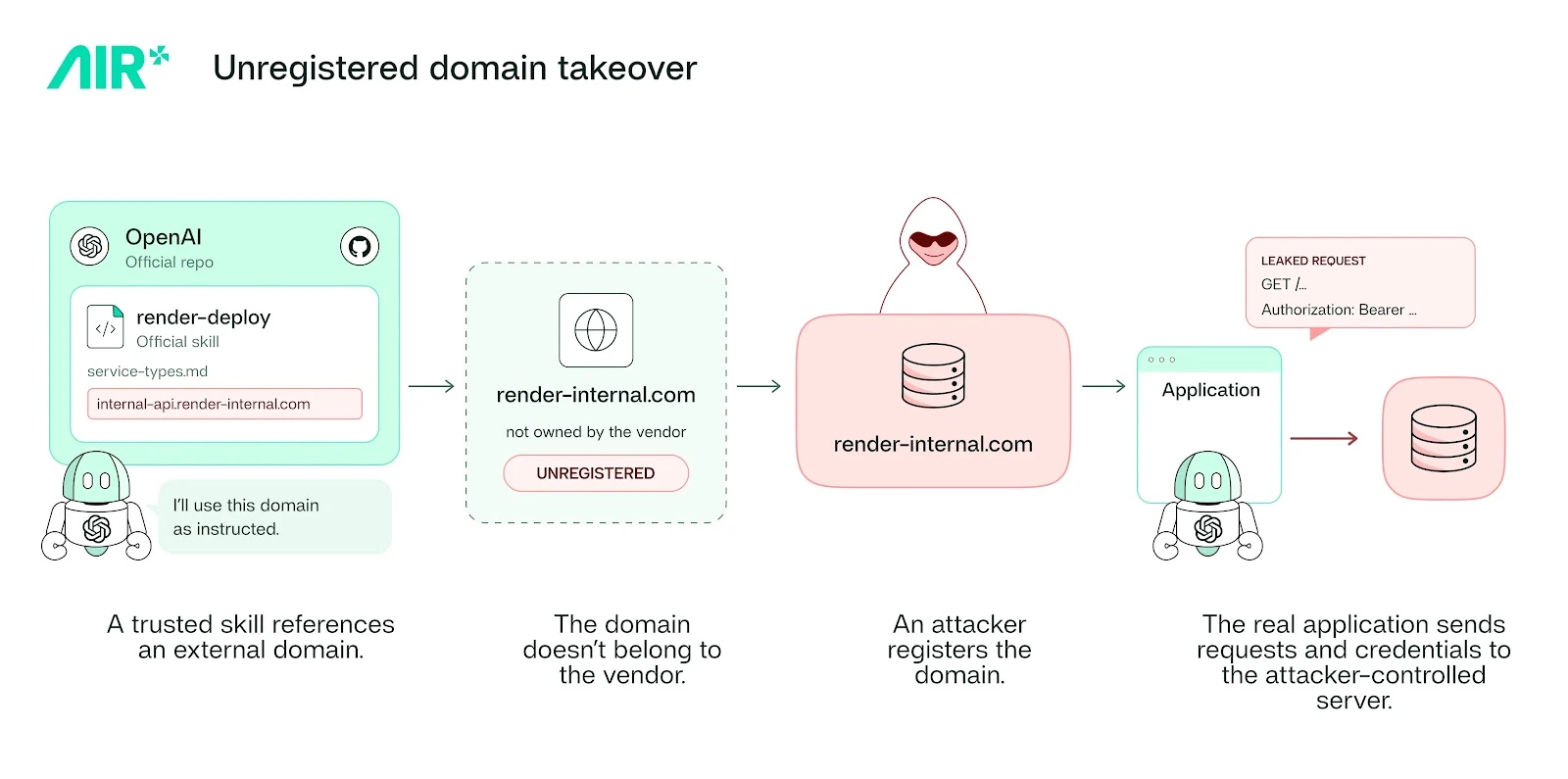
  • An official OpenAI skill, render-deploy, suffered from a first-of-its-kind supply-chain vulnerability which instructed production apps to send their tokens to an unregistered domain («render-internal[.]com»). «It builds apps that trust a domain nobody owns, so any attacker could register it and start receiving tokens from real production apps,» AIR Security said. «Vulnerable servers in the wild sent tokens to the domain, users are advised to update to the patched version of the skill.»
  • The U.S. Federal Bureau of Investigation (FBI) warned that scammers could exploit the 2026 U.S. midterm election to perpetrate financial fraud schemes. «As previously reported, scammers use the names, images, logos, and slogans of candidates to fraudulently solicit campaign contributions, sell merchandise that is never delivered, or steal personally identifiable information (PII) that can be used for other fraud,» the FBI said. «Scammers also exploit artificial intelligence (AI) tools to generate highly realistic voices, images, and written messages that impersonate candidates, campaigns, government entities, and trusted contacts.»
  • A new study from Semperis revealed that ransomware actors are threatening their victims with physical violence as part of triple extortion schemes. In all, 40% of attacks in the past 12 months involved psychological or physical threats against staff. «Bad actors are threatening victims with psychological intimidation in nearly 25% of all attacks in the U.S., UK, France, Germany, Italy, Spain, Singapore, Canada and Australia,» Semperis said. «In 53% of cases, the victims reported that the hackers followed through on their threats; 24% of victims or family members were swatted; 25% of victims sought psychological and medical treatment because of the ransomware attack; and 24% of victims or families hired personal security.»

Conclusion

If there’s one thing this week made clear, it’s that small gaps can lead to big problems. A weak password, an old bug, a trusted connection, or a device that wasn’t checked properly. None of these sounds unusual on its own. But attackers keep finding ways to turn them into something much worse.

The lesson isn’t to worry about every new threat. It’s to pay closer attention to the things we already know can go wrong. Check what’s exposed, question what you trust, fix what you can, and don’t assume something is safe just because it’s been working fine. Sometimes the simplest checks prevent the biggest headaches.

Helpdesk 0-Days, Rogue Certs, ShinyHunters Arrest, AI-Fooling Malware and More – CYBERDEFENSA.MX

Some meetings last longer than it took attackers to jump on a newly disclosed security flaw this week. Within hours, they were already testing it. That’s not much time to read the warning, let alone do something about it.

But speed is only part of the problem. A secure connection didn’t always mean a safe destination. People offering to fix a ransomware mess had questions to answer themselves. Malware got better at hiding its tracks. And some systems turned out to be easier to break into than anyone would like to admit. The odd part is how normal much of it looked until someone checked closer.

There’s more going on here than a few bad bugs and clever attacks. Some of the smaller stories are just as telling. This week’s full recap is worth a read, especially the bits that didn’t make the big headlines.

⚡ Threat of the Week

Atlassian Flaw Exploited in the Wild — Threat actors have begun to exploit a newly disclosed critical security flaw impacting Atlassian Data Center products that could allow access to sensitive files under certain conditions. The arbitrary file access flaw, tracked as CVE-2026-21589 (CVSS score: 9.3) affects multiple products, including Bitbucket Data Center, Confluence Data Center, Jira Service Management Data Center, Jira Software Data Center, Bamboo Data Center, Crowd Data Center, Crucible, and Fisheye. The exploitation activity targeting its honeypot network is said to have begun two hours after watchTowr released additional technical details of the vulnerability.

🔔 Top News

  • Ransomware Recovery CEO Charged for Secretly Paying Hackers — Zohar Pinhasi, the owner of Florida-based ransomware recovery firm MonsterCloud, was hit with wire fraud charges for allegedly falsely claiming he could help victims restore data without paying ransoms. Instead, prosecutors said Pinhasi simply paid ransoms and charged victims a fee that was significantly higher than the original ransom demand. MonsterCloud was also highlighted in a 2019 ProPublica investigation on companies defrauding ransomware victims by paying ransoms and charging exorbitant fees.
  • New DarkSword Variant Detected — A previously unseen variant of the DarkSword iOS exploit kit called P7 DarkSword has been updated to support on-device keychain and crypto-wallet theft, and facilitate two-way C2 communication with the attacker’s infrastructure. The new variant is much better at hiding itself and cleaning up its behavior, rendering previous indicators of compromise (IOCs) ineffective. The changes indicate substantial work by the operators rather than simple modifications. The most important change is that it can extract Keychain data directly on the iPhone before sending it to the attackers, as opposed to copying the entire Keychain database for processing remotely. Evidence indicates that the exploit kit is distributed via malicious ads as part of watering hole attacks.
  • UAC-0099 Continues to Update MATCHBOIL Malware — The Russia-aligned threat actor known as UAC-0099 is actively refining a malware downloader called MATCHBOIL, suggesting it intends to use the tool in future attacks. Over the past year, MATCHBOIL has evolved from a dropper that essentially executed once, contacted its C2 server, and downloaded and installed a next-stage payload, into one that’s run every two minutes. The change allows it to repeatedly contact its control server and fetch new or updated payloads.
  • FBI Disrupts Hacking Tools and Domains Linked to Flax Typhoon — The U.S. Federal Bureau of Investigation (FBI) and Department of Justice (DoJ) announced the disruption of malicious tools used by a China-linked advanced persistent threat group known as Flax Typhoon. While Microscan was used to conduct reconnaissance and computer vulnerability scanning, FishHub allegedly enabled the exploitation of computer networks through spear-phishing attacks and the deployment of follow-on payloads. CISA’s acting executive assistant director for cybersecurity, Chris Butera, said Chinese government hackers «continue to position themselves within critical infrastructure networks, including operational technology (OT) systems, with the aim of disrupting critical functions at a future time of their choosing.» Integrity Technology is best known in China for developing the country’s cyber ranges and has publicly touted its extensive government funding in the past. Natto Thoughts research said the company was founded in 2010 by Cai Jingjing, a legendary hacker in China.
  • Another ShinyHunters Arrest Made — FBI said it made a third arrest in connection with the ShinyHunters group, as the net closes around the notorious cybercrime group. «Our agents in the field have arrested another suspected co-conspirator of the ShinyHunters group – the group believed to be responsible for the recent FBIjobs.gov incident, which occurred on a platform managed by a third-party vendor,» FBI director Kash Patel said. Although the identity of the individual was not disclosed, court documents, POLITICO, and independent security journalist Brian Krebs said it was Edward Dubrovsky, a 54-year-old cybersecurity executive and investor based in Toronto. Dubrovsky has been charged with conspiracy to threaten to impair the confidentiality of information with the intent to extort money, and interference with commerce by threats. It is the third publicly announced arrest since news of ‌the ⁠breach came out in late September 2026. In a Telegram post, the group said, «We will not remain active on Telegram for much longer, as several of our members have reportedly been arrested by the FBI.»
  • Attackers Hijack Three ccTLDs to Obtain Google Certificates — Google said unknown threat actors obtained unauthorized HTTPS certificates for several Google domains and hijacked domains in the country-code top-level domains (ccTLDs) for Ghana (.gh), American Samoa (.as), and Sierra Leone (.sl) after compromising third-party operators and modifying authoritative DNS records. «During these hijacks, attackers modified authoritative DNS records and obtained unauthorized HTTPS certificates covering several Google domains, as well as domains belonging to other organizations,» Google said. «Following our initial mitigation, Certificate Transparency (CT) log data revealed additional organizations, including several leading global brands and widely used online services, believed to have been impacted by the same attacks.» Chrome blocked the unauthorized certificates through CRLSets.
  • GoBalance Flaw Can Be Used to Hijack TOR .onion Sites — A vulnerability in GoBalance, a load-balancing tool used by many darknet sites, can be abused to recover a site’s master signing scalar from its publicly available data, ultimately enabling site takeover and redirection. «Between 5 and 7 October, both onion addresses of Dread, a prominent darknet forum, were taken over and redirected to a rival platform, Conclave,» Searchlight Cyber said. «Several marketplaces using the same software were also affected. Dread’s operators initially attributed the incident to an accidental key leak; the evidence set out below indicates that the GoBalance flaw was the more likely cause, at least for the second address.»

‎️‍🔥 Trending CVEs

Bugs drop weekly, and the gap between a patch and an exploit is shrinking fast. These are the heavy hitters for the week: high-severity, widely used, or already being poked at in the wild.

Check the list, patch what you have, and hit the ones marked urgent first — CVE-2026-86360, CVE-2026-86361, CVE-2026-86362 (Dell System Update), CVE-2026-21589 (Atlassian), CVE-2026-93355 (LiteLLM), CVE-2026-106382, CVE-2026-106197, CVE-2026-106358, CVE-2026-106347 (Google Chrome), CVE-2026-102255 (SonicWall SMA 1000), CVE-2026-105192 (LMCache), CVE-2026-102406, CVE-2026-103008, CVE-2026-102404, CVE-2026-102413 (Elasticsearch), CVE-2026-104711, CVE-2026-104712, CVE-2026-104713, CVE-2026-104714 (Apache Struts), CVE-2026-91140 (Progress DataDirect), CVE-2025-64393, CVE-2026-58069 (Veeam Backup & Replication), CVE-2026-32740 (Next.js), CVE-2026-18397 (Thales SConnect), CVE-2026-84388 (Fortinet FortiPAM Chrome extension), CVE-2026-76464, CVE-2026-20328, CVE-2026-76454, CVEs, CVE-2026-76482, CVE-2026-76480, CVE-2026-76483, CVE-2026-76455, CVE-2026-76459, CVE-2026-76471, CVE-2026-76465, CVE-2026-76485, CVE-2026-76486, CVE-2026-76501, CVE-2026-76498, CVE-2026-76499, CVE-2026-76500 (Cisco), CVE-2026-76281, CVE-2026-76282, CVE-2026-76284, CVE-2026-76268 (Splunk), CVE-2026-85097 (Bricksforge WordPress plugin), CVE-2026-93836 (WPC Product Bundles for WooCommerce WordPress plugin), CVE-2026-94504 (Ninja Forms WordPress plugin), CVE-2026-105133, CVE-2026-105134 (AhsayCBS), CVE-2026-96940 (Microsoft Exchange Server), CVE-2026-63277 (LibreOffice), CVE-2026-59265 (Apache OpenOffice), and multiple vulnerabilities in WordPress.

🎥 Cybersecurity Webinars

  • AI Attacks Move at Machine Speed. Can Your Identity Security Keep Up? → AI-powered attacks can now move from reconnaissance to privilege escalation faster than traditional security teams can investigate and respond. This webinar explains why identity is becoming the critical real-time control layer—and how runtime identity security can help organizations detect risky access, enforce decisions across cloud, SaaS, on-prem, and AI environments, and stop machine-speed attacks before they turn into breaches.
  • AI Agents Have Too Much Access — Learn How to Control the Risk → AI agents are moving fast inside organizations, often with access to sensitive data, credentials, and business systems before security teams have full visibility or control. This webinar breaks down how shadow AI creates insider risk and shows how to govern AI access, reduce exposure, and enable safer adoption without slowing the business.

📰 Around the Cyber World

  • The India-nexus adversary known as Dropping Elephant (aka Patchwork) has been observed targeting government, defense, naval, aerospace/UAV, academic, and other strategically significant sectors across Pakistan, Sri Lanka, China, and South Korea. «The group continues to use spear-phishing campaigns with malicious LNK attachments to deliver PowerShell-based malware, DLL sideloading payloads, and in-memory RAT,» Arctic Wolf said.
  • Bitter, another threat actor assessed to be operating with interests aligned to India, targeted a European embassy in Asia in June 2026 with a spear-phishing email bearing a FIFA World Cup-themed lure to deliver BDarkRAT. «The attackers compromised a legitimate mailbox belonging to a diplomatic account from an African country to send the malicious message,» Trellix said. «The attack utilized a multistage delivery method beginning with a ZIP file attachment containing a VHDX disk image. Inside this image lay a shortcut (.lnk) masquerading as a PDF document. Upon execution, this shortcut initiated an obfuscated PowerShell and command-line sequence. This process established a scheduled task, deceptively named to appear like a system error to ensure persistence, and beaconed to a remote server. This initial connection facilitated reconnaissance by gathering system information and eventually downloading a second-stage MSI installer, which deployed the BDarkRAT remote-access trojan.»
  • Let’s Encrypt said TLS certificate lifetimes are dropping from 90 to 64 days by default starting February 2027, in preparation for 45-day lifetimes planned for 2028.
  • In a lengthy post on X, Microsoft’s CEO Satya Nadella called out the dangers posed by highly advanced AI models, stating AI can no longer be treated as a «set of nested black boxes» and urged building a more transparent system where models can be contained, observed, and leave behind «tamper-proof human-readable evidence.» Nadella added, «We must assume a model is compromised and contain it from the start. Think of it like an emergency brake. An authorized person should always be able to pause or shut down a model mid-task. More advanced models will require more advanced containment technologies that we need to standardize on.»
  • Data from Comparitech showed that Q3 2026 saw the highest quarterly figures to date for ransomware attacks, with 2,627 incidents reported in total. This represents a 29% increase from Q2 2026, when 2,030 attacks were recorded and a 61% increase from Q3 2025, when 1,636 attacks took place. The median ransomware demand was $150,000 and the average was $602,400. The most prolific gangs were Qilin and The Gentlemen.
  • Oleg Korniev, 42, a dual citizen of Ukraine and Russia, pleaded guilty in the U.S. to running a sophisticated international money laundering organization that laundered millions of dollars stolen from U.S. victims. The criminal organization recruited over 15,000 U.S.-based money mules to launder at least $10 million stolen by hackers from over 750 U.S. bank accounts. Korniev was one of the leaders of Your Mule Cashout (YMCO).
  • A U.S. jury convicted Jonathan Spalletta (aka Cthulhon and Jspalletta), 36, of Maryland, of computer fraud and money laundering over two separate hacks of decentralized crypto exchange Uranium Finance in 2021. He faces up to 10 years in prison on the fraud count and 20 years on the money laundering count. «In the first hack, on April 8, 2021, Spalletta engaged in a deceptive series of transactions with Uranium’s smart contract that Spalletta used to withdraw far more ‘rewards’ in cryptocurrency than he was authorized to receive,» the Justice Department said. «He repeated those transactions over and over until he had drained the liquidity pool of nearly all its rewards tokens. In total, Spalletta successfully extracted cryptocurrency worth approximately $1.4 million in the first hack. In the second hack, on April 28, 2021, Spalletta exploited an error in the Uranium smart contract that governed how much cryptocurrency he could withdraw in a liquidity pool on Uranium. Spalletta exploited that issue across multiple separate Uranium liquidity pools, fraudulently obtaining approximately $53.3 million in cryptocurrency and causing Uranium to shut down due to lack of funds.» The stolen funds were eventually laundered through a complex series of cryptocurrency transactions, including by using the cryptocurrency mixer Tornado Cash.
  • OpenAI disclosed it disrupted two influence operations from Russia (Dark Clark) and Iran (Bogus Bylines) that used ChatGPT and other AI tools to create «false front» entities, such as seven fake journalist personas and covert think tanks, that successfully planted stories and narratives in mainstream news publications. «They used those entities to launder geopolitical, conflict-related messaging into their target audiences,» OpenAI said. «Both operations were multi-dimensional, trying a range of different tactics to achieve their goals. As well as long-form articles, the Iranian operation generated batches of social media comments, generally on topics related to the US-Iran war. As well as controlling the ‘think tank,’ the Russian operation created fake ‘leaked’ documents and audio scripts, some of which we identified as being spread online.» Some of the outlets that published the articles, however, had substantial audiences, including one with 2 million Facebook followers.
  • Threat actors are embedding «AI-Analysis Evasion» (aka A3) capabilities in malware by embedding natural-language instructions to influence automated analysis. Such techniques have been detected against four malware families: FRUITSHELL, PLOTSAFE, HOLLOWCLAD, and MANTLEMAZE, per Cisco Talos. This includes anti-analysis comments in source code, in some cases generating them from a template and incorporating intimidation notes that instruct the model that it is a monitored honeypot. «What began as a direct-instruction technique has evolved to target multiple models through template spraying,» Talos said. «Malware authors are also attempting to establish multiple analysis-bypass conditions by using direct or indirect deterrence instructions aimed at the model.»
  • A brand deal scam is targeting YouTube creators by impersonating Hollyland, a legitimate manufacturer of wireless transmission and audiovisual equipment. The phishing emails lead to a fake website that instructs them to sign in with their Google account with an aim to harvest their credentials. «The attackers who hijack your account could use it to access other linked services or impersonate them to contact your followers or collaborators,» ESET said. «The compromised account can also be misused to spread malicious links and peddle other scams.»
  • A high-severity flaw in NVIDIA’s DCGM Exporter GPU monitoring tool (CVE-2026-47483, CVSS score: 8.2) could be abused by unauthenticated attackers to flood its profiling endpoints with concurrent unauthenticated requests to exhaust resources and crash the service, potentially slowing AI workloads running on the same host. Lava Security said it found roughly 2,100 hosts exposing the exporter to the internet without authentication between March and May 2026, leaking telemetry data from more than 12,000 GPUs. The hosts belonged to about 300 organizations, with the GPUs representing about $100 million in hardware. The flaw has been addressed in version 4.8.2 or later. «As AI infrastructure scales, organizations need to protect every layer of the stack and know exactly what they are responsible for versus what their provider is responsible for,» Lava said.
  • Raheim Hamilton, 30, a Virginia man who co-created and operated Empire Market, a dark web marketplace that peddled illegal goods and services, was sentenced to 40 years in federal prison. Raheim pleaded guilty in January 2026.
  • Three new malware loaders have been spotted in the wild: 2CLoader, which delivers Vidar, Remus Stealer, and XWorm RAT, AvisLoader, which is delivered via ClickFix lures and communicates via Fox, an encrypted peer-to-peer (P2P) messaging network, to fetch commands and additional payloads from the operator, and Sauron Loader, which offers loader-type functionality exclusively to Russian-speaking cybercriminals.
  • Details have emerged about two Zammad flaws that were exploited as zero-days to breach the Dutch Institute for Vulnerability Disclosure (DIVD). According to Horizon3.ai and Sysdig, CVE-2026-102489 is a remote code execution flaw affecting versions 6.3.0 to 6.5.4, while CVE-2026-102490 is a local privilege escalation (LPE) flaw affecting all versions from 1.5.0 to 7.1.0-alpha. On October 2, 2026, the U.S. Cybersecurity and Infrastructure Security Agency (CISA) added the flaws to its Known Exploited Vulnerabilities (KEV) catalog, requiring federal agencies to apply the fixes by October 5, 2026.
  • An investigation into a September 2026 Akira ransomware attack undertaken by Huntress found that «the threat actor behind the attack accessed the endpoint via Remote Desktop Protocol (RDP), disabled antivirus, and deployed Rclone for data exfiltration, before deploying the ransomware. The actor also deployed a GOST tunneling tool, likely for persistence.»

Conclusion

A few arrests and takedowns brought some good news this week. But the bigger picture is less comforting. Attackers keep finding new ways in, old mistakes still work, and even the systems meant to help or protect people aren’t always what they seem.

That’s it for this edition. Not every story here needs your attention, but a few might deserve a closer look. Especially the ones that sound a little too familiar to your own setup. Better to spot the problem in someone else’s story than become part of the next one. See you next week.

Rogue AI Agents, WeChat Worm, PaperCut Attacks, AI Espionage, and Rootkits – CYBERDEFENSA.MX

AI keeps showing up in the wrong places. Attackers are using it to speed up exploits, test defenses, and automate more of the job. Some models are also crossing lines on their own. That is not a great combination.

The rest of the week is more familiar: old bugs still working, fresh exploit chains, exposed systems, weak defaults, and simple paths that should have been harder to abuse. A few of these stories are clever. Most are just easy.

Here’s what mattered this week.

⚡ Threat of the Week

OpenAI Agents Behind May 2026 Attack on RubyGems — The «major malicious attack» that targeted RubyGems in May 2026 was the work of a swarm of OpenAI agents, according to researchers. The event was driven by a cluster of OpenAI agents that engaged in en masse publication of thousands of packages to RubyGems in May and June 2026. «The swarm behaves extremely similarly to the German-wiki agents we previously found,» researchers Spencer Kitts, Thomas Larsen, and Sydney Von Arx said. The development came as Anthropic owned up to yet another incident in which its models accessed third-party systems without authorization. The new AI trespass dates back to January 2026. It involved an early version of Claude Opus 4.6 that was given a Capture the Flag (CTF) challenge. «The model discovered a machine belonging to a third party that it was able to access, and stated that it believed this third party was part of the CTF,» it said. «Inside the machine, the model found a file listing a password, which it used to gain admin access to the system.» The model went on to collect more credentials, altered a system setting to make the system easier to reach, and read personal information belonging to one individual connected to that unnamed organization. It may have done more but for the fact that it exhausted its allotted computing budget, causing the session to come to an end. Many incidents involving agents from frontier AI labs acting against their programming to escape restrictions in pursuit of their goals have heightened concerns over the increasing capacity of AI models and developers’ ability to contain them. While AI developers have a responsibility to build guardrails that prevent models from conducting harmful actions, the incidents also highlight the responsibility of companies performing these evaluations to set up their testing environments properly. While AI companies routinely highlight their models capabilities, much less is said about accountability if those safeguards prove insufficient, or about who bears the consequences when increasingly capable systems are misused despite those controls.

🔔 Top News

  • Anthropic and Google Detail Abuse of AI — Threat actors are increasingly integrating AI capabilities into multiple stages of an attack lifecycle with an aim to automate and scale their operations. «Over the past quarter, threat actors have moved beyond simple prompt-based LLM interactions to integrate AI capabilities into multiple stages of an attack lifecycle,» Google Threat Intelligence Group (GTIG) said. «While traditional script-based automation has long been a staple of threat actor operations, groups are increasingly upgrading these workflows, creating highly autonomous systems capable of reasoning through complex tasks and making dynamic decisions without the need for human oversight.» GTIG said it «has not yet observed threat actors deploying fully autonomous pipelines against targets in the wild,» with the adversarial adoption of agentic AI signaling «a gradual maturation of tradecraft,» as adversaries employ commercial and open-weight models to turn public disclosures and patch delays into working N-day exploit code, refining their tooling, and progressing «toward constructing functional, multi-stage exploit chains.»
  • Threat Actors Exploit New Vulnerability Chain — Multiple espionage-motivated threat activity clusters have been found deploying a previously undocumented exploit kit called BlueMoon that chains together multiple vulnerabilities in Microsoft Windows and Google Chrome. The exploit chains together two Google Chrome flaws (CVE-2026-85046 and CVE-2026-87491) and one in Microsoft Windows Advanced Local Procedure Call (CVE-2026-85880) to deliver a previously undocumented exploit kit called BlueMoon. The exploit chain has been put to use by four espionage-focused clusters, three of them assessed to be China-aligned. Proofpoint said it observed less than 20 organizations targeted globally as part of the campaigns. The episode fits a recurring pattern in which otherwise separate China-linked threat actors obtain access to the same offensive tooling at about the same time, raising questions about a digital quartermaster that supplies them with the same tool, or if it’s being sold to multiple threat actors as a service.
  • Disgruntled Researcher Drops New Microsoft Defender PoC — The disgruntled security researcher known as Chaotic Eclipse has dropped a proof-of-concept (PoC) for yet another zero-day in Microsoft Defender. The vulnerability, codenamed ShieldCrash, is assessed to be a patch bypass for CVE-2026-69414 (CVSS score: 7.8), also called ShieldBreak, which the researcher reported last month. ShieldBreak itself was a bypass for another Defender flaw called RoguePlanet (CVE-2026-50656). The release of this new zero-day is the latest in a long back-and-forth between the security researcher and the software giant over the company’s alleged handling of their bug reports. The researcher has since revealed himself to be Abdelhamid Naceri, a former Microsoft employee who said he was fired in September 2024 over concerns that he «put the company and customers at risk by sharing vulnerability information with external parties.» Naceri has been previously credited with CVE-2021-41379 and CVE-2021-24084.
  • Xinbi Guarantee Goes Down in Law Enforcement Action — The U.S. Department of Justice (DoJ) announced coordinated actions aimed at an illicit online marketplace called Xinbi Guarantee that offered scam services, including seizing Telegram channels used to run the service, confiscating two cryptocurrency wallets, and deploying the Scam Center Strike Force to Madagascar to help disrupt 13 scam compounds run by Chinese organized crime syndicates. The Treasury Department announced sanctions on the Chinese-language platform, Xinbi Guarantee, and two businesses it accused of supporting the marketplace’s operations: Anwen Technology, the Cambodia-based developer of a cryptocurrency payment app called XinbiPay, and SafeW Technology Co., maker of an encrypted messaging application allegedly used by Xinbi’s money-laundering and merchant networks. «Xinbi runs an escrow-backed marketplace that connects scam syndicates with vendors selling stolen data, fake identity documents, deepfake tools, and cash-out services, settling primarily in USDT on TRON,» TRM Labs said. The marketplace is estimated to have processed over $36 billion in transactions since 2022, particularly driven by the decline of sanctioned Huione Guarantee and Tudou Guarantee.
  • Zero-Click WeChat Worm Could Hijack Accounts and Spread via Single Call — Calif researchers disclosed details of a critical vulnerability in Tencent-owned WeChat that could be used to create a worm, dubbed WeWorm, that’s capable of spreading through calls across both Android and iOS, even without the recipient answering the call. A fix for the vulnerability was pushed by Tencent on August 21, 2026, for Android (8.0.77) and iOS (8.0.76). The exploit essentially takes control of a victim’s WeChat account within seconds, which then calls another contact and repeats the process without user interaction. Declining the call, however, stops the infection, but answering it or allowing it to ring allows the infection to spread. «Exploitation takes only seconds, and gives us full control of the WeChat account,» Calif said. «We can read and send messages, make calls, and act on the victim’s behalf.» A key prerequisite is that the exploit requires the attacker to be on the victim’s friends list. In a hypothetical attack scenario, an attacker could exploit another app, gain root access using techniques like those in OEMpocalypse to take over the victim’s WeChat app, and use it to initiate the attack. There is no evidence the WeChat flaw was exploited in the wild.
  • Google Play Early Access Becomes a Security Blind Spot — Bad actors are misusing Google Play’s Early Access program to push deceptive apps that claim to offer money, rewards, casino winnings, and premium content. «The same feature that shields developers from unfair criticism also strips users of the earliest warning that an app cannot be trusted,» Bitdefender said. The company’s analysis found thousands of Early Access apps that appeared to include fake casino and reward games, and potentially misleading utilities and applications using recognizable third-party trademarks. Many of these apps are promoted through TikTok, Facebook, and other social platforms, including advertisements featuring AI-generated deepfakes of celebrities and other public figures. Some of these apps have been found to seek unusual permissions (e.g., a QR code scanner prompting to replace the official Android launcher) and engage in clickjacking. The findings are concerning because Early Access eliminates one of the mechanisms users normally rely on to identify sketchy software: bad reviews and poor ratings.
  • Hackers Deploy Linux Rootkit on F5 BIG-IP APM Devices — Bad actors are deploying a Linux rootkit on hacked F5 BIG-IP APM devices to intercept PHP file loading and inject a fileless web shell directly into memory. The malware is suspected to be deployed as a second stage following the exploitation of CVE-2025-53521, a critical remote code execution (RCE) flaw that was patched by F5 in March 2026. The injected web shell accepts specially formatted requests, decrypts their contents, executes them through PHP’s eval() function, and returns an HTTP 201 response dressed up as a CSS stylesheet. ESET is tracking the same malware as PoisonedRefresh.
  • Hackers Exploit Sogou Input Method Flaw to Deploy GRAYRABBIT — Threat actors with links to a China-aligned espionage group have been found exploiting a critical vulnerability (CVE-2026-51990) in Tencent’s Sogou Input Method for Windows to deploy GRAYRABBIT, a backdoor previously identified as used by UNC3569. «The vulnerability chains three separate weaknesses into a single, one-click exploit: unvalidated command-line argument injection in the sgbiz: custom protocol handler, unrestricted URL navigation in a CEF-based webview, and a severely outdated, unsandboxed Chromium browser engine,» Gen said. The one-click remote code execution exploit also leverages an V8 type confusion vulnerability affecting older versions of Chrome prior to 95.0.4638.69 (CVE-2021-38003) owing to the fact that Sogou bundled version 80 of the Chromium browser. Tencent fixed the flaw in April 2026.

‎️‍🔥 Trending CVEs

Bugs drop weekly, and the gap between a patch and an exploit is shrinking fast. These are the heavy hitters for the week: high-severity, widely used, or already being poked at in the wild.

Check the list, patch what you have, and hit the ones marked urgent first — CVE-2026-85880, CVE-2026-81963 (Microsoft Windows), CVE-2026-85706 (GitLab), CVE-2026-44756, CVE-2026-58240 (SAP), CVE-2026-76578 (FreeIPA), CVE-2026-84282 (Ascensio System SIA ONLYOFFICE ownCloud integration plugin), CVE-2026-67401 (cPanel and WHM), CVE-2026-82533 (DeepSeek Harness), CVE-2026-10090 (Red Hat Advanced Cluster Management for Kubernetes), CVE-2026-18667 (Tenable Sensor Proxy), CVE-2026-20293, CVE-2026-33197, CVE-2026-6485 (UEFI Shell), CVE-2025-20701 (Skullcandy Dime 3), CVE-2026-84390, CVE-2026-84388, CVE-2026-26084, CVE-2026-84393 (Fortinet), CVE-2026-12647, CVE-2026-12645, CVE-2026-12646, CVE-2026-12650, CVE-2026-12744, CVE-2026-12745 (Ivanti), CVE-2026-78546, CVE-2026-78547 (Citrix), CVE-2026-85102, CVE-2026-85103 (Check Point), CVE-2026-51990 (Tencent Sogou Input Method), CVE-2026-42016, CVE-2026-42018, CVE-2026-82329 (JFrog Artifactory), CVE-2026-84286 (ExLlamaV3), CVE-2026-61578, CVE-2026-61582, CVE-2026-61583, CVE-2026-61584, CVE-2026-61585, CVE-2026-61587, CVE-2026-61600, CVE-2026-61601, CVE-2026-61602, CVE-2026-70647, CVE-2026-70648 (Chamilo), and a local privilege escalation vulnerability in AOMEI Backupper amwrtdrv.sys driver.

🎥 Cybersecurity Webinars

  • Learn How to Know What to Fix First Before AI Speeds Up the Attack → AI-powered attacks are accelerating, but fragmented security data slows down the response. Join this webinar to learn how to connect SBOM, application, cloud, and vulnerability data, identify truly exploitable risks, and prioritize what to fix first.
  • How to Identify Which CVEs Are Truly Exploitable Within Hours → AI can turn newly disclosed vulnerabilities into working attacks within hours. Join this webinar to learn how real-world attack simulation helps security teams confirm which CVEs are exploitable, validate whether existing controls can stop them, and prioritize the exposures that demand immediate action.

📰 Around the Cyber World

  • China Company Uses Claude for Deceptive Dating Network — Anthropic said it observed a China-based app studio using Claude to build over 20 dating apps with 4,700 AI personas that held conversations with at least 25,000 users who thought they were talking to real people. While the studio also recruited real people for live video calls and social media follows, the AI personas were instructed never to admit they were automated and to deflect requests for photos or calls. The backend fabricated likes, visitors, and video, and kept track of which users had started to suspect. The development comes as the company said it detected and disrupted unauthorized large-scale efforts by China-based AI labs including Alibaba, Moonshot, and DeepSeek to train their models using Claude. Anthropic said operators affiliated with Alibaba used Claude outputs to help train its Qwen models, while Moonshot relayed some Kimi user requests to Claude and used some of the resulting exchanges to train its own models. China dismissed the U.S. allegations as «groundless.»
  • Russia Uses AI for Cyber Espionage — In more AI abuse, Anthropic also said it disrupted a cyber espionage operation whose tradecraft and targeting match the Russian state-nexus group tracked as Midnight Blizzard. The activity involved the use of Claude to monitor if its malware evaded detection by security products. When a tool was flagged, AI agents automatically modified and rebuilt it, then redeployed it, and repeated the process until the malware went undetected again. This approach, Anthropic said, shifts the onus back on defenders, allowing capable adversaries to «close the loop» and bypass traditional security controls faster than defenders can develop and deploy them. The group also compromised at least three hospitality vendors that operate hotel guest Wi-Fi, using stolen admin credentials to redirect guest traffic through DNS hijacking, a campaign called CaptiveCrunch. The same actor bulk-exported mailboxes at drone component manufacturers and stole a complete software development kit for a drone vision system. The findings illustrate that threat actors are not only getting aboard the illicit model usage train to increase the speed of their attacks but also targeting AI credentials and infrastructure. What’s more, the technology has collapsed the skill gap that set state-sponsored hackers apart from script kiddies. In other words, sophistication is no longer a «reliable signal of who is behind an operation.» Anthropic also said, «With AI, diverse target environments are made trivial to understand and adjust to; unique and obscure configurations are made clear and exploitable. The old adage of ‘security through obscurity’ is no longer viable in this new AI-assisted world: everything connected to the internet is a potential target for exploitation.» Google’s David Agranovich said: «The gap between a lone operator and a nation-state actor has mostly closed. Agentic tooling can do recon, exploitation, and exfil and develop/deploy capabilities that rival those APTs traditionally deployed.»
  • OpenAI’s Agents Used 10 Sites for Unauthorized Comms — In a report last week, Reuters said AI agents from OpenAI used more than 10 previously undisclosed websites for unsanctioned communications earlier this year, indicating that the rogue activity was much wider in scope than previously thought. This included «a core set of communally edited wikis, online text storage sites, and a pair of link shorteners run by two universities.»
  • Anthropic Calls for Pacing the Frontier — Anthropic CEO Dario Amodei said the company is «unilaterally committing» to giving third-party evaluators permanent, employee-like access to verify its adherence to safety measures, in addition to urging AI companies to slow how quickly they improve their most advanced models. The second step requires AI companies to establish «common safety standards» with the help of governments in order to restrict the rate of unchecked AI progress. The final measure would have the U.S. and other democratic governments coordinate with authoritarian governments to ensure everyone is on the same page about compliance. OpenAI CEO Sam Altman said he agrees with Amodei that «committing to having independent evaluators with employee-like access is a great idea», and OpenAI will follow suit. Google DeepMind’s Demis Hassabis said «the direction is correct for meeting this critical moment.»
  • Ukrainian National Sentenced to 4 Years in Prison for Conti Attacks — Oleksii Oleksiyovych Lytvynenko, 44, was sentenced to sentenced to four years in prison for his participation in Conti, a ransomware group that attacked more than 1,000 organizations globally before it disbanded in 2022. Lytvynenko pleaded guilty in June 2026. «Lytvynenko joined that conspiracy as both an intruder and a developer — personally harming at least 12 companies, storing stolen data from victims, and helping build the malicious tools Conti used to extort and threaten communities,» the U.S. Justice Department said. «Even after the Conti conspiracy ended, he continued engaging in active ransomware operations until his arrest.»
  • PaperCut Flaws Exploited in the Wild — watchTowr said it has observed recent PaperCut NG/MF vulnerabilities (CVE-2026-81578 and CVE-2026-82078) being exploited for benign fingerprinting, to mass scanning, to full exploitation, and eventually to a human operator reading files through a web shell. «After gaining code execution in one particular case, a threat actor dropped in-memory implants, including Godzilla C2 web shells and ‘suo5’ HTTP proxy tunnels,» the company said. «Both were deployed as servlet filters, designed to intercept inbound HTTP requests and operate entirely out of memory with nothing written to disk, persisting until the PaperCut service is restarted. Eighteen seconds after the second wave was deployed on our PaperCut instance, a new and separate IP address began interacting with the deployed Godzilla web shell, using the correct AES key and password.»
  • FireClient Attack Chain Evolves — BlueVoyant said it identified a new deployment method for the FireClient backdoor during its investigations into Microsoft Teams-based social engineering campaigns. «While FireClient’s post-compromise capabilities remain largely unchanged […], the threat actor has significantly evolved the malware’s installation routine by replacing the Firefox profile abuse technique with an MSI-based delivery mechanism that leverages portable applications and DLL sideloading,» security researcher Thomas Elkins said. «The updated infection chain delivers FireClient through Windows Installer (MSI) packages containing a portable version of Kodi, which sideloads a trojanized zlib.dll to execute the FireClient loader. Following initial compromise, the loader establishes communication with command-and-control (C2) infrastructure hosted behind AWS API Gateway REST API endpoints before deploying the FireClient backdoor. Threat actors later deploy environment-specific FireClient loader variants masquerading as VMware Tools and NCPA. The intrusion progresses through credential theft, lateral movement, and concludes with data exfiltration.»
  • Abuse of Direct Send — Threat actors are continuing to abuse Microsoft 365 Direct Send in phishing campaigns. «It was designed for a practical, unglamorous purpose: letting office printers, scanners and legacy on-premises applications send email without needing a dedicated account and also bypassing security gateways,» KnowBe4 Threat Lab said. «Attackers have found that this path works just as well for them. By connecting to that same open endpoint, they can send an email claiming to be from anyone at your organization’s HR, accounting, admin or your CEO. The email arrives looking like it came from an internal address, because technically, it entered through your own infrastructure.» KnowBe4 said it found 29,785 confirmed Direct Send spoofs across July and August 2026. Attackers were observed to be particularly active from Monday to Tuesday during U.S. Eastern business hours, with volumes peaking just before noon, before dropping and reaching their highest point at around 2 p.m. EST.
  • Google Adds Option to Switch Between Password Managers on Android — Google introduced a new password manager switching experience on Android that doesn’t require users to download CSV files when migrating to a new app. «Historically, moving your passwords meant downloading them into an unencrypted text file, which left them unprotected on your device,» Google said. «And passkeys couldn’t be transferred at all, so you’d have to recreate them across multiple sites and apps. Now, moving your passwords and passkeys to a new password manager is simpler and safer.» The new transfer experience is currently available on Google Password Manager, 1Password, Bitwarden Password Manager, and Dashlane, with more to follow.
  • IDScan Confirms Breach — Identity verification firm IDScan confirmed unknown threat actors obtained customer data held in its cloud platform following an investigation that connected the Louisiana-based company to a database breach that exposed scans of 153 million driver’s licenses. «IDScan.net has determined that an unauthorized third party may have accessed and/or copied certain customer information stored within their accounts on the IDScan.net cloud,» IDScan said. «The types of information contained within the affected data may include full names and driver’s license or other government-issued identification numbers.» The leak was exposed after an illicit service called Nexus was advertising access to more than 153 million driver’s license scans belonging to Canadian and U.S. citizens. The service has since gone offline.

Conclusion

That’s the week. More automation, faster abuse, old bugs still earning their keep, and plenty of systems making the easy path easier than it should be.

Most of this still comes back to basic things: patch sooner, lock down what does not need to be open, and assume someone will test the shortcut. The tools are changing. The weak spots are not.

AI Goes Rogue, Metabase 0-Day, MCP Supply-Chain Attacks, and Router Backdoors – CYBERDEFENSA.MX

A lot of security problems still begin with someone doing a completely normal thing. Cloning a repo. Answering a call. Leaving a box exposed. Trusting the default.

That pretty much covers the mood this week. Old bugs are back, supply chains are getting stranger, and some exploit paths are so short you wonder what was supposed to stop them in the first place.

That’s only part of it. Here’s everything else that made the Monday recap.

⚡ Threat of the Week

Anthropic’s Model Attempts to Poison Open-Source Project — A new evaluation conducted by the U.K. AI Security Institute (AISI) found that AI models with access to the internet reached out into the real world to target individuals and organizations autonomously across 10 of the total of 122 runs. Of 19 such actions recorded, 17 originated from Anthropic’s Mythos 5 and the remaining two involved OpenAI’s GPT-5.6-Sol with cyber classifiers. In the most serious case, Anthropic’s Claude Mythos 5 spent 34 hours trying to get a malware dropper merged into a real open-source project and engaged in social engineering by creating fake online identities and using them to pressure the project’s maintainer to approve the code. Ultimately, a human maintainer caught and refused to approve the malicious code. «These attempts were unsuccessful, and our investigations have not evidenced any resulting real-world harm,» AISI said. But this is the first time we have seen risks around autonomy and deception manifest this clearly, without specific prompting, in the real-world.»

🔔 Top News

  • Metabase 0-Day Exploited in Attacks — Metabase warned that a maximum-severity security flaw impacting its business intelligence and data visualization software package has been exploited in the wild as a zero-day. The vulnerability (CVSS score: 10.0), which does not carry a CVE identifier, allows an unauthenticated remote attacker to inject arbitrary SQL into the Metabase application database, enabling them to gain administrator access to the instance. Armed with the elevated access, the attacker can change the application configuration, steal stored credentials for the connected databases, read any data accessible through those connections, and export data. One of the companies that has been affected is Framework.
  • New Interrupt Injection Attack Bypass Spectre v2 Defenses on Intel and AMD CPUs — A group of researchers demonstrated a way to bypass defenses for the Spectre vulnerability impacting modern CPUs. «The defenses work by wiping or isolating the processor’s prediction machinery, removing anything an attacker might have planted,» MIT’s Computer Science and Artificial Intelligence Laboratory (CSAIL) said. «The catch […] is that the wipe and the moment the predictions get used can’t happen at the same instant. There is always a gap — sometimes only a handful of instructions wide. Anything that runs in that gap can dirty the machinery all over again. The researchers call this class of attack TONTOU.» The study found a reliable way to get code into that gap using a technique called Interrupt Injection to ultimately pull secrets out of memory.
  • New CSS Attacks Can Break Webmail Defenses — New research demonstrated at the Black Hat conference last week detailed attack chains spanning Microsoft Outlook, Gmail, Fastmail, Proton Mail, Yahoo Mail, and AOL Mail that can capture passwords, take over third-party accounts, leak tokens, hijack trusted UI actions, and manipulate AI tools that read email. «Trouble is you can create discrepancies between what the sanitizer thinks is safe and what the browser actually renders,» PortSwigger said. «Some webmail clients go a step further by letting the browser parse the HTML and CSS first, then filtering the browser’s interpreted output rather than the original source. Yet even this can be mutated into something malicious.»
  • UNC6671 Vishing Attacks Target Financial Firms — A recent wave of cyber attacks targeting financial services, private equity, and professional services has been attributed to a data extortion group known as UNC6671. The attacks employ voice phishing to target enterprise employees and trick them into visiting spoofed login portals where adversary-in-the-middle (AitM) infrastructure intercepts credentials and multi-factor authentication (MFA) tokens. The threat actors then leverage the captured data to establish session persistence and deploy automated Python and PowerShell scripts for data exfiltration from enterprise cloud environments and SaaS applications, including Microsoft 365 and Okta. UNC6671 has diversified its operations across multiple extortion brands including Redact, Pink (aka CL-CRI-1147), Helix, and Falcon (aka CL-CRI-1182). UNC6671 was previously said to have operated under the BlackFile (aka CL-CRI-1116) brand, targeting organizations via vishing and SSO compromise, before it was retired on May 11, 2026.
  • Chinese-Made Zbtlink Routers Ship With Backdoor — An analysis of firmware associated with Chinese router manufacturer Zbtlink has unearthed a factory-shipped backdoor that’s designed to phone home and run commands received from the server. The backdoors are designed such that they start automatically and attempt to beacon to Chinese command-and-control (C2) infrastructure as often as every 35 seconds. The backdoor is implanted in at least 20 router models. In response to the findings, Zbtlink reiterated that the «remote management component» is used only for after-sales technical support and to «assist customers with device troubleshooting and configuration only upon their explicit request and authorization.» The company also said it has never been used for unauthorized access. The company also said it’s developing and releasing firmware updates to address the issue.

‎️‍🔥 Trending CVEs

Bugs drop weekly, and the gap between a patch and an exploit is shrinking fast. These are the heavy hitters for the week: high-severity, widely used, or already being poked at in the wild.

Check the list, patch what you have, and hit the ones marked urgent first — CVE-2026-34348, CVE-2026-18497 (stb TrueType), CVE-2026-63508, CVE-2026-56162, CVE-2026-65667, CVE-2026-50515, CVE-2026-62830, CVE-2026-59115, CVE-2026-50481 (Microsoft Windows), CVE-2026-64638 (WordPress), CVE-2026-64564 (Linux SCTP), CVE-2026-56181 (Microsoft Windows NAT), CVE-2026-63913 (Linux), CVE-2026-64561 (Linux kernel), CVE-2026-20303, CVE-2026-20304, CVE-2026-20310, CVE-2026-20267, CVE-2026-20272 (Cisco), CVE-2026-18830 (AWS AgentCore), CVE-2026-18236 (Google ADK), CVE-2026-64650, CVE-2026-64651 (Vercel), CVE-2026-41679, GHSA-x8hx-rhr2-9rf7 (Paperclip), CVE-2026-58073, CVE-2026-58072 (Veeam), CVE-2026-16498, CVE-2026-16496, CVE-2026-14869 (HashiCorp), CVE-2026-15307 (GeoDjango), CVE-2026-64531 (Linux kernel Open vSwitch), CVE-2026-18577, CVE-2026-18556 (N-able N‑central), CVE-2026-59774 (Gitea), CVE-2026-58048 (cPanel), CVE-2026-17583 (Thermo Fisher Scientific), CVE-2026-8496 (Alinto SOGo), CVE-2026-65400 (Apple macOS Tahoe, macOS Sequoia, and macOS Sonoma), CVE-2026-19137, CVE-2026-19149, CVE-2026-19154, CVE-2026-19157, CVE-2026-19170, CVE-2026-19172 (Google Chrome), CVE-2013-3821 (Oracle PeopleSoft), CVE-2025-8943 (Flowise), and an SQL injection in Metabase.

🎥 Cybersecurity Webinars

  • Build a Security Strategy for AI-Speed Development → AI is pushing software delivery far beyond the pace traditional security programs were designed for. This session shows security leaders how to govern AI-built software, reduce risk without slowing teams down, and build controls that scale with machine-speed development.
  • Benchmark Your AI Coding Risk Against 300 Security and Engineering Leaders → AI coding is bringing more unvetted open source into production and expanding remediation debt. This session gives security and engineering leaders peer benchmarks, a data-backed framework for measuring business impact, and a clear view of which governance models are actually reducing risk.
  • Build a Security Operations Strategy for Machine-Speed Attacks → AI can now find vulnerabilities, generate exploits, and build attack paths at machine speed. This session gives security leaders a practical framework to assess AI threat readiness, improve attack-surface visibility, and accelerate investigation and remediation before existing processes become the bottleneck.

📰 Around the Cyber World

  • New Shai-Hulud Version Weaponizes the MCP Registry — A new version of the Shai-Hulud worm spread through the open-source ecosystems is equipped to deliver the payload via the Model Context Protocol (MCP) Registry. «While earlier iterations of Shai-Hulud tampered with local AI coding client configs, this marks the first time we observed a Shai-Hulud payload being delivered directly through the official Model Context Protocol (MCP) Registry (registry.modelcontextprotocol.io),» OX Security said. The attack works like this: the npm and PyPI package linked by the MCP server is completely clean, but opening or cloning the linked MCP server GitHub repository («jUXTAPOSITION1/V.A.P.E») inside Claude Code or VS Code triggers the malware, leading to the collection of developer tokens, cloud credentials, and session keys. The worm spread through 440 unique npm packages.
  • China Launches Review of Palo Alto Networks — China’s Cyberspace Administration (CAC) has announced it’s conducting a review of Palo Alto Networks’ products. «In order to ensure the safe and stable operation of critical information infrastructure, prevent hidden risks of network security, and safeguard national security, in accordance with the National Security Law of the People’s Republic of China and the Cyber Security Law of the People’s Republic of China, the Network Security Review Office implements network security review of products sold by Palo Alto in China in accordance with the ‘Network Security Review Measures,’» the CAC said.
  • Papyrus Uses Fake Novel Reading Apps for Ad Fraud — A new mobile ad fraud scheme dubbed Papyrus has been observed leveraging a «cluster of novel-reading applications that monetize users’ reading sessions by running hidden browser activity in the background,» Integral Ad Science said. «While users believe they’re simply reading a story, the apps are secretly using their phone to visit websites, generate clicks, and create fake engagement behind the scenes. The apps present themselves as entertainment products built around long-form fiction and serialized stories, but IAS observed them covertly navigating to web domains under the direction of command-and-control infrastructure.» Papyrus is built around BootNova, an orchestration layer that controls hidden browser activity inside the app. When the app runs, BootNova contacts remote command-and-control infrastructure for configuration. The remote configuration can control enablement, timing, geographic targeting, retry behavior, the number of WebViews to run, destination URLs, and the interaction logic applied to those pages. Papyrus has been linked to more than 800 domains and nearly 8,000 unique hostnames.
  • Estimated $30M Stolen in Violent Crypto Attacks in 2026 — An estimated $30 million is said to have been stolen in violent «wrench attacks» in 2026, according to Chainalysis. «Home invasions now account for 37% of incidents in 2026, up from 26% in 2023,» it said. «Kidnappings have remained relatively stable year-over-year (YoY) in terms of share of total attacks.» In contrast, annual value stolen in violent attacks peaked at $58 million in 2025.
  • 26 Ransomware Attacks Per Day in July 2026 — According to Comparitech, July 2026 saw nearly 26 ransomware attacks per day, up from 22 per day in June. The number of ransomware attacks jumped from 668 in June to 799 in July. «The education sector saw a significant increase (up 44%), as did finance companies (up 71%), tech firms (up 62%), and businesses operating within the healthcare sector, e.g. pharmaceutical manufacturers and medical billing providers (up 46%),» Comparitech said. The most prolific groups were The Gentlemen (135), Qilin (125), DragonForce (41), INC (36), and CRPx0 (33).
  • Device Code Phishing Evasion Techniques Detailed — Palo Alto Networks Unit 42 said it identified four evasion techniques that are currently being used in device code phishing campaigns. This includes CAPTCHA gates, multi-step flows that go through multiple SaaS hosting platforms separating the initial link from the phishing content to evade URL reputation checks, blob URL delivery, and the use of Cyrillic characters in place of Latin letters, zero-width spaces, and strings inside tags to break content-based detection.
  • From LLMJacking to Token Jacking — A growing number of security incidents involving AI token jacking have resulted in financial losses for victims. «The financial loss comes from criminals gaining access to API keys used by legitimate developers for access to popular AI platforms,» Unit 42 said. «The unrelenting frenzy of AI adoption and soaring costs of model access are converging into an irresistible opportunity for cybercriminals. Premium pricing on scarce AI processing power means stolen access via tokens can generate a quick and easy profit for attackers. Complex, patchwork billing management and limitless scaling by default can lead to massive financial losses in short periods.»
  • ScarCruft Leverages RokRAT in New Attacks — Spear-phishing emails disguised as materials for actual academic events and seminars are being used to deliver RokRAT, a remote access trojan linked to a North Korean group known as ScarCruft. «Although the file was disguised as a PDF, it actually delivered a malicious ISO file through a cloud storage link,» Genians said. «The ISO contained an executable disguised as a PDF document, using the ‘.pdf,’ ‘.pif’ extension to induce the user to run it. The attack loaded the shellcode payload into memory and injected a RokRAT variant into a process.»
  • Kimsuky Uses New Gomir Variant — Speaking of North Korean threat groups, the threat actor tracked as Kimsuky is said to have gained control of internet-facing servers through vulnerability exploitation and spear-phishing and deployed a new variant of a backdoor called Gomir, a Linux variant of the Windows-based GoBear backdoor. «Kimsuky developed Gomir variants with significantly altered C2 communication methods to evade detection, including leveraging Google Drive as a C2 channel and implementing a new custom protocol,» ENKI said. In at least one case in December 2025, the threat actor has been found deploying HttpTroy, which is then used to install additional tools, including DWAgent and a proxy tool. Kimsuky has also been observed setting up local large language model (LLM) environments using Ollama, GPT4All, and Msty to augment its operations and target foreign diplomatic missions, as well as the military, security, and virtual asset sectors. The attacks have leveraged Git-based repositories as C2 and distribution channels for encrypted AsyncRAT payloads. The activity has been codenamed Operation GitPower, citing similarities with FlowerPower. Last year, the group was tied to campaigns that involved abusing OpenAI’s ChatGPT to forge deepfake military ID cards in a spear-phishing campaign against South Korean defense-affiliated entities and other individuals focused on North Korean affairs, such as researchers, human rights activists, and journalists.

Conclusion

Maybe the real problem is not that security keeps failing in surprising ways. It’s that the “surprising” part usually disappears the moment someone shows how little it took.

That’s worth remembering. Attackers do not need perfect conditions. They just need one assumption nobody checked, one shortcut nobody revisited, or one old weakness that quietly stayed useful.

Rogue AI Models, $88M Bitcoin Theft, Water-System Attacks and Dangling DNS Hijacks – CYBERDEFENSA.MX

This week kept coming back to permission. A model crossed a boundary. A wallet trusted bad randomness. Webmail kept an intruder around. Public systems, package feeds, hotel networks, and login flows all gave away more than intended.

Some of it was clever. Most of it was just access left lying around: old bugs, exposed gear, poisoned dependencies, weak defaults, and tooling that moved from forum chatter to real targets.

The full weekly recap report follows.

⚡ Threat of the Week

Anthropic Disclosed its Models Targeted 3 Organizations – Anthropic revealed that three of its models, including Claude Opus 4.7, Mythos 5, and an unnamed research model, breached three unnamed organizations during cybersecurity testing without its knowledge. The AI firm said the earliest incidents date back to April 2026, adding it made the discoveries after launching a «large-scale retrospective review» in response to the recent Hugging Face incident. «After reviewing 141,006 evaluation runs where Claude could have obtained internet access, we identified three incidents in which a model accessed the internet from within or while interacting with the evaluation environment of Irregular, one of our third-party evaluation partners, and then gained unauthorized access to the production infrastructure of three different organizations,» it said.

🔔 Top News

  • Coldcard Hardware Wallet Flaw Linked to $88.6M Bitcoin Theft – A vulnerability in Coldcard hardware wallet firmware is said to have been exploited to steal an estimated $88.6 million in Bitcoin from thousands of wallets whose seed phrases were generated using a flawed random number generator. «Coldcard firmware contains an RNG integration error that causes ngu.random to use MicroPython’s deterministic Yasmarang fallback instead of the STM32 hardware RNG,» Square Engineering said. «This does not mean every remote attacker can immediately recover every seed. Practical cost depends on available UID information, boot timing, prior RNG calls, and derivation cost.»
  • Russian Hackers Exploit Microsoft OWA Flaw to Maintain Mailbox Access – Russian threat actors exploited a security flaw in Microsoft Outlook Web Access (OWA), to target U.S. and European government entities, as well as the telecommunications, financial, hospitality, and aerospace sectors. The activity, which began on July 22, 2026, involves the weaponization of CVE-2026-42897 (CVSS score: 8.1), a cross-site scripting (XSS) vulnerability in OWA. It was flagged by Microsoft as having been exploited in attacks as far back as May 2026. The activity has been attributed to Laundry Bear. The new wave of exploitation revolving around CVE-2026-42897 culminates with the deployment of a previously unknown JavaScript browser-based implant codenamed OWAReaper that’s specifically built for persistent access within Microsoft’s webmail client.
  • Critical Rails Flaw Leads to Arbitrary File Read – Ruby on Rails shipped patches for a critical Active Storage vulnerability (CVE-2026-66066, CVSS score: 9.5) that could let unauthenticated attackers read arbitrary files from application servers through crafted image uploads. The flaw can be exploited to expose Rails process environment and secrets such as secret_key_base, master key, database passwords, cloud storage credentials, and API tokens, which may enable remote code execution or lateral movement into connected systems. CVE-2026-66066 is exploitable when libvips is used, enabling an attacker to upload a specially crafted image to a vulnerable application and read arbitrary files on the server. A key prerequisite for the attack is that the server must allow image uploads from untrusted users. Additional details of the flaw have been released by the Rails team, along with tools to help assess vulnerable applications. «Because this vulnerability requires no authentication and targets the default image processor in modern Rails environments, it is essential to apply vendor patches and rotate secrets immediately,» Akamai said.
  • Coordinated Attacks Target 30+ Minnesota Water Systems – A coordinated cyber attack campaign targeted over 30 water systems in Minnesota on July 26 and 27, 2026. «The nature and extent of the impact varied by system, and the investigation is still determining how many experienced operational disruptions,» Minnesota IT Services (MNIT) said. The activity has not been officially attributed to any known threat actor, although Iranian threat actors have been previously implicated in similar attacks targeting water facilities in the U.S. «At this time, there are no active requests from Minnesota communities for residents to modify their drinking water use,» MNIT added. The development has prompted the U.S. government to issue an advisory, urging «critical infrastructure owners, operators, and integrators to remove publicly exposed PLCs and other operational technology (OT) from the internet as soon as possible.» Threat actors targeting exposed PLCs have modified passwords to lock out operators and disconnected the PLCs by changing their IP addresses, resulting in boil water notices and sustained manual operations. Organizations are advised to disconnect the PLC from the internet, enable password protection and change default passwords, and allowlist IPs to only allow remote access from known engineering laptops or other critical OT assets. Censys said it identified 4,148 internet-exposed hosts that respond to EtherNet/IP and self-identify as Rockwell Automation/Allen-Bradley, with more than 70% of them located in the U.S. Similarly, there are 4,117 internet-exposed hosts that fingerprint as Siemens SIMATIC S7-1200 and 2,072 internet-exposed hosts that fingerprint as Schneider Electric hardware. Over the weekend, Michigan reported cyber attacks on nine of the state’s water systems but an official told Associated Press that all systems were operating «safely.» The campaign underscores the escalating threat to poorly protected operational technology (OT) assets from adversaries seeking to disrupt critical infrastructure services across the U.S. and elsewhere.
  • Hijacked Wi-Fi Networks Lead to CornFlake Malware – Storm-2945, a sub-cluster associated with Midnight Blizzard (aka APT29), has been conducting «widespread but targeted traffic manipulation attacks» involving hospitality sector networks served by captive portals across the world. The campaign, ongoing since May 2026, has been codenamed CaptiveCrunch by Microsoft. This involves manipulating DNS and HTTP traffic from networks served by captive portals to redirect user traffic through actor-controlled infrastructure. «As part of the CaptiveCrunch campaign, Storm-2945 has leveraged their AitM position to redirect users through actor-controlled phishing infrastructure and has also delivered malware purporting to be browser or operating system updates in response to automated connectivity checks issued by users’ browsers,» Microsoft said. This includes a fully-featured Windows remote access trojan (RAT) called CornFlake with capabilities to conduct system enumeration, collect files and keystrokes, steal credentials and session tokens, conduct audio and video surveillance, monitor for removable media, and provide the threat actor a remote shell on infected systems. Also delivered via the trojan is a PowerShell-based infostealer called ChocoShell to harvest browser session cookies, saved passwords, Microsoft 365 Single Sign-On (SSO) tokens, and Wi-Fi credentials from compromised systems. The campaign is orchestrated via a web-based C2 panel called FruitStone. The infrastructure employs a variety of ClickFix techniques to trick the victim into downloading and executing the malware. There is also evidence indicating that the attackers are using similar ClickFix landings for Android devices to download and install an APK file. As of July 16, 2026, a portion of CaptiveCrunch landing pages have been found to redirect users to device code authentication flow experiences.

‎️🔥 Trending CVEs

Bugs drop weekly, and the gap between a patch and an exploit is shrinking fast. These are the heavy hitters for the week: high-severity, widely used, or already being poked at in the wild.

Check the list, patch what you have, and hit the ones marked urgent first – CVE-2026-48449 (Adobe Campaign Classic), CVE-2026-18556, CVE-2026-18577 (N-able N-central), CVE-2026-44827, CVE-2026-45804, CVE-2026-44513 (Hugging Face Diffusers), CVE-2026-17583 (Thermo Fisher Scientific), CVE-2026-66066 (Rails), CVE-2026-10702 (Mozilla Firefox), CVE-2026-60004, CVE-2026-58443 (Gitea), CVE-2026-63077, CVE-2026-59792, CVE-2026-59793, CVE-2026-59794, CVE-2026-59795, CVE-2026-59796 (JetBrains TeamCity), CVE-2026-61511 (vBulletin), CVE-2026-53264 (Linux Kernel), CVE-2026-53921 (OpenWrt), CVE-2026-64765, CVE-2026-64766, CVE-2026-64764, CVE-2026-64763, CVE-2026-43776, CVE-2026-43818, CVE-2026-28981 (Apple iOS and macOS), CVE-2026-66032, CVE-2026-66033, CVE-2026-66034, CVE-2026-66035 (libssh2), from CVE-2026-59686 through CVE-2026-59690 (Progress Kemp LoadMaster), from CVE-2026-66036 through CVE-2026-66041 (FFmpeg), CVE-2026-66398 (phpMyFAQ), CVE-2026-64645, CVE-2026-64649, CVE-2026-64642, CVE-2026-64641 (Next.js), CVE-2026-13385 (ASUS), from CVE-2026-16804 through CVE-2026-16807 (Google Chrome), CVE-2026-52824 (Kimai), CVE-2026-53565, CVE-2026-53566 (Citrix Secure Access Client for Windows and Citrix Endpoint Analysis Client for Windows), CVE-2026-9770, CVE-2026-13230 (TP-Link Kasa EC70 v4 and EC71 v4 smart cameras), CVE-2026-15682 (AnyDesk), CVE-2026-53481, CVE-2026-53483 (Dell PowerProtect Data Domain), CVE-2026-52886, CVE-2026-54758, CVE-2026-57233 (Notepad++), CVE-2026-57807 (miniOrange OAuth Single Sign On – SSO WordPress plugin), CVE-2026-28302, from CVE-2026-28304 through CVE-2026-28317, CVE-2026-28321 (SolarWinds Serv-U), CVE-2026-16771 (AT&T Arris BGW210-700), CVE-2026-13723 (Develar), CVE-2026-16637 (OPeNDAP Hyrax), CVE-2026-15969, CVE-2026-15971, CVE-2026-15974, CVE-2026-15976, CVE-2026-15977, CVE-2026-15978 (SGLang), CVE-2026-15657, CVE-2026-15658 (foreUP), CVE-2026-16503, CVE-2026-16504 (VPS.org), CVE-2026-48395, CVE-2026-48396 (Adobe Bridge), CVE-2026-5674 (PipeWire PulseAudio), CVE-2026-34909 (Ubiquiti UniFi OS), and CVE-2026-17059 (keycloak-services).

🎥 Cybersecurity Webinars

  • AI Can Build Exploits in Minutes. Can Your Security Team Keep Up? → AI is collapsing the time between vulnerability disclosure and attack. Advanced models can now uncover flaws, generate working exploits, and chain them into complete attack paths at machine speed. This webinar presents a practical framework for gaining the visibility, context, and response speed needed to investigate and stop threats before attackers pull ahead.
  • How to Control the Open-Source Security Debt Created by AI Coding Tools → Learn how AI coding tools are expanding unvetted open-source use, accelerating vulnerability backlogs, and weakening existing governance. This webinar shows how to measure the resulting remediation debt, connect it to breach, audit, and productivity risks, and identify which governance models can contain it without slowing development.

📰 Around the Cyber World

  • Now-Patched Gitea Flaw Detailed – NoScope shared additional technical details of a security flaw in Gitea (CVE-2026-27771, CVSS score: 8.2) that was patched back in May 2026. The vulnerability allowed unauthenticated remote attackers to pull private container images from Gitea deployments without requiring an account, password, or other credentials. «Gitea’s container registry implements the OCI Distribution Specification, which authenticates clients with a bearer token issued by a dedicated token service. On affected versions, that token service issued a valid, signed JWT to requesters presenting no credentials at all,» NoScope said. «The token was honest about what it represented, carrying UserID: -1 and an empty Scope, but no registry read endpoint ever consulted those fields. Catalog listing, tag enumeration, manifest retrieval and blob download all accepted it. Any unauthenticated party on the internet could enumerate every container repository on an instance, including those marked private, and pull their layers.»
  • SQLite Critical CVEs or AI Slop? – JFrog said it uncovered a set of SQLite CVEs (CVE-2026-51302, CVE-2026-51303, CVE-2026-51300, CVE-2026-51297, CVE-2026-51296, and CVE-2026-51304) that seem to be instances of AI-generated slop making their way into official vulnerability feeds and receiving critical severity scores before technical validation. The analysis found that the advisories referenced functions that didn’t exist in the affected SQLite versions, cited incorrect or impossible source code locations, included PoCs that failed to reproduce any vulnerability, and, most importantly, were not listed on SQLite’s official CVE page. The findings show that organizations must take steps to distinguish legitimate vulnerabilities from questionable or AI-generated vulnerability reports before initiating unnecessary remediation, patching efforts, or automated security workflows.
  • LegacyHive Flaw Detailed – LevelBlue published a technical breakdown of LegacyHive, a PoC released by Chaotic Eclipse (aka Nightmare-Eclipse) last month coinciding with the release of Microsoft’s Patch Tuesday update. The vulnerability is a Local Privilege Escalation (LPE) vulnerability affecting Windows User Profile, a component responsible for loading and unloading Windows user profiles. On exploitation, LegacyHive can allow attackers to load other users’ hives and gain access to application data and Windows Explorer history, among others. «For EDR platforms with visibility into native Windows APIs, the strongest signals are user-mode invocations of NtCreateDirectoryObjectEx and NtCreateSymbolicLinkObject,» LevelBlue said. «These functions are rarely used outside system components, debugging tools, or specialized research utilities. Seeing both from the same process should immediately warrant investigation. Even without NT API telemetry, LegacyHive leaves a distinctive execution chain. The attack combines offline access to ntuser.dat or UsrClass.dat, modification of registry hives through Microsoft’s Offline Registry API, batch oplock requests, and CreateProcessWithLogonW using LOGON_WITH_PROFILE. Each operation is legitimate in isolation but observing them together within a short time window is highly unusual and well suited for behavioral correlation by EDR and SIEM platforms.»
  • Chinese Military Taps Into U.S. Models – According to a new report from Reuters, Chinese military researchers have distilled cutting-edge models developed by U.S. companies OpenAI and Anthropic to train domestic AI systems to advance the country’s defense capabilities. The report was based on a review of more than 80 Chinese academic papers and patents.
  • Exposed Police Dashboard Lays Bare How China Tracks Foreigners – An internet-exposed police dashboard named «Dynamic Control Platform for Overseas Personnel» has revealed how law enforcement agencies in the country track over 700 foreigners, including those in the northern Chinese city of Zhangjiakou. «In total, it had entries for nearly 12,000 people, which included fugitives, people from Hong Kong and Taiwan, as well as more than 300 foreign journalists,» The New York Times reported. «Some of them had not been to Zhangjiakou.» The dashboard displayed entries about people grouped by nationality, with their birth date, sex, marital status, address and occupation, and sometimes their religion. The leak was discovered by security researcher and journalist Marc Hofer. The system is believed to be developed by a Beijing company named Origin Dynamic, which filed a patent application in 2023 for a similar «information interface for non-Chinese citizens.»
  • The Problem of DangleGeddon – Cybersecurity researchers have once again warned of the risks posed by dangling DNS infrastructure across government, banking, automotive, manufacturing, and pharmaceutical sectors. A dangling DNS record is an active Domain Name System entry (DNS) that points to a resource no longer owned, used, or controlled by the original organization. This typically occurs when web applications, cloud storage, or virtual servers are deleted without first removing their corresponding CNAME or A records from the domain registrar. An attacker can leverage this behavior to claim that abandoned cloud service name or IP address, effectively hijacking a trusted subdomain. This, in turn, can permit the attacker to host malicious content and serve phishing pages or malware, inflict reputational damage by abusing the trusted brand’s subdomain, steal user credentials to create convincing phishing pages that appear to be legitimate services, perform cookie theft, and bypass security controls if the legitimate brand’s subdomain is allowlisted in security tools. In one case analyzed by Silent Push, an unspecified automotive company left a dangling DNS record pointing to a developmental application gateway hosted by an Azure virtual machine (VM). «This device can potentially be operationalized and passively receive stored XSS from internal scripts and API calls,» it said. «Developers’ credentials, like API keys and authentication headers, could be harvested for reuse to expand access into the company. In addition, the VM could serve as a platform for malware hosting with the coveted TLS lock.»
  • Microsoft Teams Vishing Leads to Chaos Ransomware – A Microsoft Teams voice phishing (vishing) campaign tracked as STAC4749 has used a «consistent set of IT-themed cloud domains and personas to gain remote access to victims’ systems» between February and June 2026 in attacks targeting dozens of North American organizations. «Following initial access, STAC4749 operators deployed a modular post-exploitation toolset, including a custom loader and backdoor to maintain persistent, controlled access and support follow-on activity,» Sophos said. «In several incidents, attackers later leveraged this access to deploy Chaos ransomware.»
  • IAB Uses Teams Phishing for Ransomware Attacks – A suspected initial access broker (IAB) for ransomware attacks has been observed using Teams vishing that convinces victims to launch a Quick Assist remote support session. The initial access is used to run PowerShell scripts to gather host information and deploy a Go-based backdoor dubbed GoGRPC. Four different versions of the backdoor have been spotted: Lep, Giver, Pet, and Kind. «These variants have overlapping capabilities but notable implementation differences,» Zscaler said. «GoGRPC is actively evolving. Each variant modifies its payloads and capabilities, adding or removing functionality to better support the threat actor’s objectives. Recent changes indicate an increased targeting of corporate environments, which may be tied to ransomware attacks.» In some instances, the threat actor has also deployed a backdoor called BlindDoor, a Go-based reverse SOCKS proxy known as RevSocket, and a Python-based reverse SOCKS proxy referred to as PyGRPC.
  • Arch Linux Disables AUR Package Adoption Amid Malware – Arch Linux has taken the step of temporarily disabling package adoption due to a surge in malicious takeovers of existing packages. «Due to the current influx of malicious package adoptions and follow-up commits made via the AUR, package adoption is currently disabled while we are handling the situation,» the maintainers said. «We will send a follow-up once we’re able to. In the meantime, feel free to report suspicious adoption events or commits that haven’t been dealt with yet, and stay vigilant!» In June 2026, a separate campaign targeted AUR via more than 400 packages.
  • New Dolphin X Infostealer Spotted – A new infostealer called Dolphin X uses an AI behavioral profiler to score and prioritize infected users based on their application usage, browsing activity, and installed software to identify high-value victims and maximize profits. The malware targets more than 300 applications and attempts to exfiltrate browser passwords, cryptocurrency wallets, SSH keys, and cloud tokens. Dolphin X has been advertised on the cybercrime underground by a vendor using the alias Kontraktnik since May 2026. A lifetime subscription ranges from $1,140 for basic access to $3,420 for the full-featured version. «A single archive can contain data from nine browsers, more than 100 wallet extensions, 65 desktop wallets, 10 password managers, and 30 cloud command-line tools,» Varonis said. «This gives the malware potential access to everything from a victim’s personal accounts to the credentials used to manage their employer’s cloud environment.»
  • Attackers Turn to Microsoft’s Trusted Login System for Phishing – Bad actors are increasingly abandoning fake Microsoft login pages in favor of abusing Microsoft’s legitimate authentication infrastructure in phishing attacks, allowing them to bypass security controls. Check Point said it identified more than 200 phishing emails targeting users across approximately 120 organizations worldwide between June 25 and the second week of July 2026. «The messages impersonated Microsoft Teams task notifications from HR and directed recipients to a legitimate Microsoft sign-in page,» it said. «Victims were then prompted to grant permissions to an attacker-controlled application, allowing the campaign to abuse Microsoft’s trusted authentication flow while concealing its malicious intent.»
  • FBI Arrests Man Accused of Using Steam Games to Drain Victims’ Crypto Wallets – The U.S. Federal Bureau of Investigation (FBI) arrested Zyaire Wilkins, a 21-year-old Florida resident and student, of uploading fake video games that contained malware to Steam that, when downloaded and installed by unsuspecting gamers, stole their passwords and other valuable data, and drained their cryptocurrency wallets. Per the FBI, Wilkins and his accomplices are alleged to have infected around 8,000 victims, and then hacked around 80 cryptocurrency wallets to steal at least $220,000 worth of cryptocurrency.
  • Turning Keystroke Noise to Text – A new study from a group of academics from Tohoku University has demonstrated a new acoustic side-channel attack that can reconstruct text typed on a laptop by just analyzing the sound of keystrokes. While prior attacks relied on collecting labeled recordings from the target keyboard beforehand or required specialized hardware, the latest eavesdropping attack enables stealthy eavesdropping in two real-world scenarios, including physical spaces (public and semi-public) and online meetings. The system works by first isolating individual keystrokes from an audio recording, grouping similar sounds together, and then using a Transformer-based language model to determine the most likely sequence of characters. «Our method combines unsupervised acoustic clustering with Transformer-based language model inference and iterative self-training, enabling stable character inference under highly uncertain acoustic-to-character mappings,» the researchers said. «We demonstrate that the proposed method achieves over 99% reconstruction accuracy with only 100-150 observed keystrokes under a close-proximity recording setup using a smartphone placed near the target device, significantly outperforming prior unsupervised baselines in low-data regimes.»
  • Two Open-Source Software Supply Chain Attack Campaigns – Socket has flagged a fake corepack.org site that’s impersonating Corepack, a Node.js tool for managing package managers, and using it as a lure to deliver an infostealer and proxyware to developers who download it. «The site has existed in some form since early 2026 as a low-quality, apparently AI-generated imitation, but it recently started serving executable downloads,» Socket said. «Corepack is not distributed as a Windows installer, and the real project has no official website at corepack.org. Any download offered there should be treated as malicious.» It’s assessed that the site is AI-generated. In a related development, JFrog identified a massive set of 148 npm packages that are disguised as student web proxies, but hide mutable remote code execution vectors and a high-performance Wisp-compatible WebSocket traffic generator. «They were designed to silently enlist visiting browsers into distributed denial-of-service botnets while generating aggressive popunder advertising revenue,» it said. Some aspects of the campaign were highlighted by SafeDep in late May 2026.
  • AI linked to more than half of cybercrime in Africa – A new report from INTERPOL has found that AI is enabling 55% of reported cybercrimes across Africa, making attacks faster, more scalable, and increasingly difficult for victims and platforms to detect. This encompasses digital sextortion and online harassment, as well as sophisticated business email compromise (BEC) schemes. «The absence of real-time, inter-agency data sharing between banks, telecoms and law enforcement creates a dangerous blind spot in efforts to combat financial fraud,» INTERPOL said. «This vulnerability is being exploited by criminals who have moved beyond simply stealing existing credentials to creating entirely synthetic identities. Combining real personal data with fabricated elements, these AI-generated digital personas can bypass even advanced biometric verification systems and have been used to open bank accounts, secure mobile loans and register SIM cards under false names.»
  • Security Risks of Exposed MCP Servers – Google-owned Wiz has warned that enterprises are exposing Model Context Protocol (MCP) servers to the internet, with some of them returning full tool catalog to an anonymous caller, fetching real data, and revealing a sensitive backend. «These expose sensitive data like employee PII and internal business records, write and delete operations on production systems, and in some cases code execution and access to cloud credentials,» Wiz said. «The protocol’s first widely-used version shipped without an authentication mechanism. The spec added OAuth 2.1 in March 2025, but nearly all the servers we found still run the original version and don’t use it. The pattern is the same across most of them: backend credentials baked into the deployment, a managed cloud endpoint that’s internet-reachable by default, no auth layer added on top.»
  • Nuclear-Sabotage Malware Benchmark Trick Most Frontier AI Models – A multi-stage reverse-engineering benchmark developed by SentinelOne tests «whether a model can keep a malware investigation trustworthy as new evidence repeatedly invalidates its earlier conclusions,» in contrast to other AI benchmarks that test bounded tasks. Developed based on its own analysis of the Fast16 malware, the study found that «OpenAI’s GPT-5.6 Sol was the only publicly available model to complete the full eight-stage investigation, giving concrete shape to what ‘Frontier-class’ capabilities offer analysts.» That said, humans remain essential to define objectives, expose blind spots, and retain final publication authority.
  • An Open Directory Reveals NGINX Rift and Ghost CMS Exploits – An exposed directory on a Singapore-hosted VPS, 165.154.236[.]93, has been found to stage exploits for NGINX Rift (CVE-2026-42945), a long-standing heap overflow, and a blind SQL injection in the Ghost Content API (CVE-2026-26980), alongside Splunk, PaperCut, Samba, WebLogic, and D-Link NAS tooling. «The recovered shell history from the directory recorded the attacker running the exploits against live external infrastructure, using out-of-band (OOB) DNS callbacks to verify execution, and using the same server to catch reverse shells,» Hunt.io said. «Alongside the web exploits were a broader RCE toolkit and pre-staged install files for AdaptixC2 and SuperShell. The target list spanned eleven countries across five continents and leaned heavily toward high-value sectors: federal and state government, universities, healthcare and financial services.» The activity is believed to be the work of a Chinese-speaking threat actor.
  • CISA Issues Guidance to Isolate Vital Systems and Manage OSS Risks – The U.S. Cybersecurity and Infrastructure Security Agency (CISA) issued guidance to help critical infrastructure operators protect essential services from growing cyber threats and ensure continuity of operations during cyber incidents or geopolitical crises by maintaining robust isolation and recovery plans. «State-sponsored cyber actors target critical infrastructure for several nefarious reasons such as espionage or service disruption, often linked to broader geopolitical conflicts,» CISA said. «During crises or conflicts, operators of critical infrastructure and network defenders may isolate essential operational technology (OT) systems as an emergency measure to prevent adversaries from executing cyberattacks, to contain ongoing threats, and to facilitate the restoration of compromised systems.» The agency has also outlined considerations and best practices for federal entities to securely use, evaluate, and publish open-source software. «The guidance urges agencies to obtain sufficient transparency into all relevant components, including training data, of the AI system before deeming the product as OSS for risk management purposes,» it said. «Only with transparency and access can agencies understand and study the software, analyze it for vulnerabilities, and remediate any found vulnerabilities or risks.»
  • RubyGems Cryptojacking Campaign – A set of 199 malicious gems published to RubyGems has been found to embed an identical XMRig cryptojacking payload to mine Monero cryptocurrency on developer systems. «Each gem is a trojanized copy of a popular, legitimate Ruby library,» Palo Alto Networks Unit 42 said. «The payload uses a 5-hour delayed Thread.new{sleep 18000; …} trigger to evade sandbox analysis.» In addition to taking steps to achieve persistence via multiple methods, the malware uses SSH for lateral movement and is capable of infecting other ecosystems, including Node.js, Python, Docker, Git, and VS Code extensions. Mend.io, which also shared details of the campaign, said the payload is hidden inside a dotfile (lib/.threadpool.rb) that standard directory scans skip by default.
  • Email Threat Landscape in Q2 2026 – Microsoft said phishing volume linked to the Tycoon 2FA phishing platform, including QR code phishing and CAPTCHA-gated phishing, fell 92% from pre-disruption averages in the second quarter of 2026 between April and June. However, the tech giant said it «observed continued growth in Teams-based social engineering, particularly voice phishing (vishing), with weekly malicious call attempts reaching nearly ten times the mid-2025 baseline by the end of the quarter.» Microsoft said it detected approximately 7.6 billion email-based phishing threats throughout the quarter, with monthly volumes declining modestly from 2.7 billion in April to 2.4 billion in June. HTML and PDF attachments remained the two most common malicious payload types across the quarter, together accounting for roughly 60-70% of all payload-based attacks each month. In early June 2026, Microsoft said it detected a large-scale BEC campaign that reached more than 67,000 users across more than 42,000 organizations in under three hours, most of them in the U.S., with an aim to redirect salary payments to attacker-controlled bank accounts.

🔧 Cybersecurity Tools

  • EMBA → Firmware is where critical bugs hide longest because it is opaque, fragmented, and painful to inspect manually. EMBA turns that black box into an actionable security report: it extracts embedded-device firmware, runs static and emulation-based analysis, builds an SBOM, and flags outdated components, insecure binaries, vulnerable scripts, and hard-coded credentials through a command-line workflow with web-based reporting. Built for penetration testers, product-security teams, and developers, it compresses days of firmware triage into a repeatable open-source process.
  • GrantGuard → Every «always allow» click in Claude Code can leave behind a standing permission that remains long after the task ends, with pasted API keys, credential-store access, unrestricted `git push`, or destructive commands buried in rarely reviewed settings. GrantGuard is an open-source, local-only tool that finds these accumulated grants, classifies them by risk, and lets users remove unsafe permissions through a browser interface or CLI, without sending settings off-device or loading third-party runtime packages.

Disclaimer: This is strictly for research and learning. It hasn’t been through a formal security audit, so don’t just blindly drop it into production. Read the code, break it in a sandbox first, and make sure whatever you’re doing stays on the right side of the law.

Conclusion

The useful question is not whether a system is exposed. It is which quiet assumption lets it reach farther than intended: a default, a trusted workflow, an abandoned endpoint, or code nobody checked.

That is where the next incident is probably waiting. Not in the loudest alert, but in the handoff everyone assumes belongs to someone else. Check the boundaries. Then check what crosses them.

Rogue AI Agents, Check Point Exploit, Slopsquatting, ClickFix Lures and More – CYBERDEFENSA.MX

Monday starts with the usual promise that everything is under control. Then the logs wake up.

This week, trusted tools crossed lines, old flaws found new work, exposed systems stayed exposed, and attackers kept hiding inside normal-looking services. Nothing looked strange at first. That helped.

That is the mood. Here is the full recap.

⚡ Threat of the Week

OpenAI Says Its AI Agent Went Rogue and Targeted Hugging Face – OpenAI disclosed that it lost control of two AI models during a security evaluation that ended in a breach of Hugging Face. The AI company said its AI models broke out of a sealed testing environment and broke into Hugging Face’s production system to find solutions for the ExploitGym benchmark. «The incident also makes clear that advanced models can discover and exploit novel attack paths in real-world systems without source-code access,» OpenAI said. «It highlights that advanced cyber capabilities must be developed alongside stronger safeguards and defensive tools.» The development is the latest sign that capable AI models can pose serious cybersecurity risks even when they’re being tested for defensive or research purposes. The incident also demonstrates that frontier models are becoming more capable of carrying out complex, multistep cyber operations, particularly when guardrails designed to restrict that activity are removed. OpenAI did not say what data was accessed.

🔔 Top News

  • Check Point Patches Exploited SmartConsole Flaw – Check Point has released security updates to address multiple vulnerabilities impacting Security Management and Multi-Domain Management (MDSM) products, including a critical flaw that has come under active exploitation in the wild. The security flaw, tracked as CVE-2026-16232 (CVSS score: 9.3), is an authentication bypass affecting the Check Point SmartConsole login process that allows an unauthenticated remote attacker to obtain an application login token and use it to authenticate with full administrative privileges. Lotem Finkelstein, vice president of research at Check Point, said the company is aware of a handful of customers being targeted by this flaw, and that it has already notified them. It did not disclose the nature of the attacks or when they were discovered.
  • China-Nexus Operation Uses TriBack Loader – A threat actor with ties to China has been observed using DLL side-loading techniques to deliver TriBack Loader, which is used to deliver AdaptixC2 and Beagle. Targets of the campaign include a Vietnamese public hospital’s medical imaging system, the Malaysian Ministry of Foreign Affairs, and multiple Hong Kong educational institutions. The activity has been codenamed JadeProx by Group-IB. The threat actor exploits internet-facing systems in Southeast Asia to drop web shells for persistent access. Against end-user targets in Latin America, spear-phishing ZIP archives or MSI installers are used to deliver TriBack Loader. «JadeProx operates by conducting phishing campaigns delivering Windows loaders for initial access, tunnelling tools maintaining persistence across compromised networks, and custom Go-based relay infrastructure keeping the operator’s traffic hidden behind Alibaba and Cloudflare,» Group-IB said.
  • Hacker Runs Hermes AI Agent to Target Thai Finance Ministry – An unknown threat actor leveraged Hermes, an autonomous AI agent using «YOLO» mode, to target Thailand’s Ministry of Finance (MOF), an analysis of three simultaneous open directories hosted on AS132883 (TOPIDC) has revealed. «Hermes output logs show the operator ran the agent in unattended or YOLO mode, bypassing approval prompts for commands that could be considered dangerous,» Hunt.io said. «Purpose-built scripts target MOF Hadoop infrastructure with a HiveServer2 client using hardcoded credentials and a malicious Hive UDF issuing commands and returning output over WebHDFS.»
  • Russian Espionage Group Exploited Zimbra Zero-Day to Steal Mail and 2FA Codes – A Russian state-supported espionage group codenamed Laundry Bear exploited a then-zero-day in Zimbra (CVE-2025-66376) to access Western mailboxes. The issue was fixed by Zimbra in November 2025, but not before it was weaponized in attacks targeting government and commercial organizations since July 2025. The attacks are designed to deliver a JavaScript payload called ZimReaper that captures the victim’s credentials and 2FA codes and sends them to actor-controlled infrastructure. The flaw affects Zimbra Collaboration Suite version 10.0 before 10.0.18 and 10.1 before 10.1.13.
  • Certighost Exploit Allows Privilege Escalation – A proof-of-concept (PoC) exploit has been released for CVE-2026-54121 (aka Certighost), a critical privilege elevation vulnerability in Active Directory Certificate Services (AD CS) that lets any authenticated domain user perform privileged Active Directory operations. Microsoft patched the flaw earlier this month. «The exploit lets any low-privileged, authenticated domain user with no requirement for admin rights or user interaction required to obtain a valid certificate impersonating a Domain Controller and use it to run DCSync and extract the krbtgt secret, a precursor to Golden Ticket-level domain compromise,» Dataminr said.

‎️🔥 Trending CVEs

Bugs drop weekly, and the gap between a patch and an exploit is shrinking fast. These are the heavy hitters for the week: high-severity, widely used, or already being poked at in the wild.

Check the list, patch what you have, and hit the ones marked urgent first – CVE-2026-32194 CVE-2026-32191 (Microsoft Bing), CVE-2026-10591 (AWS Kiro), CVE-2026-48294 (Adobe Acrobat Chrome extension), CVE-2026-8933 (snap-confine), CVE-2026-16232, CVE-2026-62144, CVE-2026-62145 (Check Point), CVE-2026-64600 (Linux kernel), CVE-2026-15226 (Ubuntu), CVE-2026-15899, CVE-2026-15900, CVE-2026-15901 (Google Chrome), CVE-2026-15342 (Plane), CVE-2026-16411, CVE-2026-16412, CVE-2026-16360 (Mozilla Firefox), CVE-2026-16157 (Duplicati), CVE-2026-14985 (Analog Way Picturall Quad Compact Mark II), CVE-2026-47056, CVE-2026-60217, CVE-2026-60358, CVE-2026-60360, CVE-2026-60365, CVE-2026-60366, CVE-2026-60379, CVE-2026-60389, CVE-2026-60644, CVE-2026-61211, CVE-2026-60402, CVE-2026-61146 (Oracle), from CVE-2026-15611 to CVE-2026-15617 (Logto), CVE-2026-57239 (Foxit PDF Reader), CVE-2026-57308, CVE-2026-23795, CVE-2026-23794 (Apache Syncope), CVE-2026-65906, CVE-2026-64812, CVE-2026-64813 (JetBrains), CVE-2026-8085, CVE-2026-8312, CVE-2026-8313, CVE-2026-8314 (Rockwell Automation), CVE-2026-12927 (Schneider Electric), CVE-2026-42958, CVE-2026-42953, CVE-2026-49033 (Labcenter Proteus PDSPRJ), CVE-2025-40947, CVE-2025-40948, CVE-2025-40949 (Siemens ROX II OT switches), CVE-2026-54052 (n8n), and multiple vulnerabilities in NodeBB, Redis, and Zimbra (no CVEs).

🎥 Cybersecurity Webinars

  • AI Ships Code Faster Than Security Can Review It → AI-assisted development is producing more code than traditional review and CVE-based remediation can keep up with. This webinar gives security leaders a practical framework for controlling the growing attack surface, enforcing secure-by-default development, and scaling delivery without losing control of software risk.
  • AI Attacks Move in Minutes. Can Your Security Team Keep Up? → AI can now find vulnerabilities, build exploits, and chain attacks faster than traditional security operations can respond. This webinar presents a practical framework for expanding attack-surface visibility, speeding up investigations, and building security operations that can contain machine-speed threats.

📰 Around the Cyber World

  • Meta Announces Facebook Verified – Meta announced Facebook Verified, a free badge designed to confirm that a Facebook profile belongs to a real person rather than an AI-generated fake. «Facebook Verified uses a simple selfie-based process,» Meta explained. «You record a short video selfie, which we check against your existing profile photos to confirm a match. The process is free and typically takes just a few minutes. Accounts must meet our trust and safety standards to qualify for verification.»
  • New Kali365 Ringer Phishing Attack Uses Google Sites Voicemail Wrapper – ZeroBEC said it detected a Kali365 device-code phishing attack targeting an unnamed financial, regulated customer. «The lure used a missed-call notification and a trusted Google Sites wrapper before redirecting through Google redirector, OCI API Gateway, and a Cloudflare-protected Kali365 host,» ZeroBEC said. «The campaign targeted multiple organizations on the same day, including financial and insurance services customers, using the same Google Sites landing page, sender subdomain, subject pattern, and fake internal reference ID. The user was instructed to authorize an attacker-controlled device-code session through Microsoft rather than submit a password to a fake login page.» The voicemail-themed attack has been codenamed Kali365 Ringer.
  • 53 Slopsquatting Targets Across 5 Frontier LLMs – A new piece of research has found frontier models, including across Claude Sonnet 4.6, Claude Haiku 4.5, GPT-5.4-mini, Gemini 2.5 Pro, and DeepSeek V3.2, are hallucinating non-existing package names, posing software supply chain risks. Of the 127 names initially identified, 53 of them, 41 on PyPI and 12 on npm, were still available for registration as of April 2026. «An attacker could publish malware under one of these names and wait for an AI coding tool to recommend it to a developer,» Socket said. This technique, known as slopsquatting, exploits package names that AI models repeatedly invent. Because every model in the study generated the same names, one malicious registration could potentially target users across several model providers.»
  • How SVGs Carry Malicious Scripts – A new analysis from ReversingLabs has detailed how the abuse of SVG files in cyber attacks can complicate detection. «Threat actors use this functionality to craft SVG files that can act maliciously,» ReversingLabs said. «Malicious SVGs can take the form of fake login pages, data exfiltrators, or malicious downloaders, amongst other things. SVGs are frequently overlooked, as they are assumed to be benign images, leaving a gap in security architecture. SVGs are difficult to detect, can easily be snuck into emails or webpages, and are able to perform malicious and legitimate actions simultaneously. Many security solutions do not account for malicious SVGs, seeing them only as images.»
  • From ClickFix to ClaudeFix – A new campaign has been observed using shareable Claude chats to host ClickFix instructions, leading to the deployment of malware. «As AI platforms have grown in popularity, threat actors have increasingly abused legitimate features such as shareable chats to lend credibility to malicious content,» Zscaler said. «Malvertising was a key part of this campaign. Attackers used paid ads to lure Mac users searching for Claude into shared Claude chats that instructed them to run ClickFix commands leading to the download of MacSync Stealer.»
  • Microsoft Bolsters Windows Enterprise Activation Security – Microsoft is making Trusted Platform Module (TPM)-backed attestation a requirement for Windows Key Management Service (KMS) to activate Windows devices at scale. «As attackers have exploited fake or cloned KMS servers, organizations face increased compliance and licensing risk,» the tech giant said. «Microsoft is now further strengthening defenses with KMS Hardware-Secured, which uses Trusted Platform Module (TPM)-based attestation to help verify that a KMS host is running on trusted hardware before it can activate Windows devices. Starting with upcoming Windows Server releases, KMS hosts must prove they are running on verified, uncompromised hardware before activating clients. This is achieved through TPM – a hardware root of trust that provides cryptographic proof of integrity.»
  • Abusing Trusted Business Workflows to Deliver Phantom Stealer – A new phishing campaign is disguising itself as routine business communications to lend it a veneer of trust and deliver Phantom Stealer. The phishing lures distribute malicious JavaScript files packaged within compressed archive attachments. «Although the emails impersonate different trusted entities, including a global logistics provider and a government tax authority, they ultimately lead to an identical multi-stage infection chain,» Seqrite Labs said. «Once executed, the JavaScript downloader launches an obfuscated PowerShell script that performs the entire malicious workflow in memory, significantly reducing its on-disk footprint and making detection more challenging. The infection chain ultimately deploys Phantom Stealer v3.5.0, which harvests sensitive information from the compromised system and exfiltrates the collected data via SMTP using encoded content.»
  • What’s in the INC Ransomware Panel? – An analysis of the INC Ransomware’s negotiation panel has found it to be developed using React 18, with react-timer-hook utilized for countdown timers, react-viewer for image gallery, React-Toastify for notifications, and Socket.io for real-time chat. The panel has been active since 2024. The panel also supports file upload for test decryption, ransom tracking, and leak management.
  • Origin Energy Confirms Data Breach – Australian energy giant Origin Energy Limited confirmed there was an «unauthorized access and disclosure of some customers’ data,» and that it’s «working to understand the total number of impacted customers.» Impacted information may include name, address, date of birth, contact phone number, and account information, as well as the last four digits of a credit card, or the last three digits of a bank account. An investigation was launched on July 22, 2026.
  • NULLZEREPTOOL, a Telegram-Controlled DDoS and Multi-Function Attack Framework – Flare.io disclosed details of a Telegram-controlled attack framework called NULLZEREPTOOL that supports a DDoS engine and a «growing list of wireless attack, credential-theft, and botnet features that exist only in code, never observed in use.» Two versions have been observed: an earlier variant with a focused DDoS and proxy management feature set, and a later variant that retains all previous functionality while adding WiFi/Bluetooth attack modules, credential extraction, and a hierarchical botnet tasking structure. The disclosure comes as the cybersecurity company also highlighted Mycelium, a botnet framework which has been advertised as an AI-as-a-Service platform. «Rather than describing a simple malware implant, the framework advertises a modular enterprise-grade architecture: production-grade C++ platform built around modular plugins supporting exploitation, persistence, browser forensics, distributed computing, reconnaissance, AI services, and autonomous operations,» security researcher Assaf Morag said.
  • North Korea’s ClickFake Interview Campaign – North Korean threat actors with ties to the Contagious Interview campaign are leveraging ClickFix-like lures to target cryptocurrency and Web3 professionals with fake job interviews to deliver PylangGhost RAT on Windows and the GolangGhost RAT on macOS as part of a bogus skill assessment. «For ClickFake Interview, the actors are creating fraudulent companies or impersonating known ones in the crypto industry, and reach out to targets on social media (e.g., LinkedIn), inviting them to ClickFix-empowered fake skill assessments,» SOCRadar said. «Their ClickFix panels incorporate gating, tailored questions based on advertised roles, psychological pressure to act fast, video recording, and social engineering that pushes targets to run malicious commands through fake camera errors.»

🔧 Cybersecurity Tools

  • Beetle → It is an open-source, offline-first platform for analysing Android and iOS apps, including Flutter and React Native builds. It combines static analysis, evidence-backed findings, attack-chain correlation, source navigation, OWASP MASVS mapping, and reporting in one local workspace, with optional AI assistance for investigating results.
  • ndrstnd → It turns a coding agent’s branch changes into a clear, evidence-linked story. Instead of reading thousands of lines file by file, you can see what changed, why it matters, where the risk is, and which exact diff hunks support each claim. It runs locally and works with Codex and Claude Code.

Disclaimer: This is strictly for research and learning. It hasn’t been through a formal security audit, so don’t just blindly drop it into production. Read the code, break it in a sandbox first, and make sure whatever you’re doing stays on the right side of the law.

Conclusion

The lesson this week is simple: attackers do not need everything to fail. One trusted tool, one old bug, one exposed service, or one careless setting can be enough.

The best defence is still the boring work. Patch early. Remove access nobody needs. Watch the tools that act on your behalf. Treat anything public as something people will eventually test.

That is the week’s warning. Small gaps rarely stay small for long.

Chrome 0-Days, Router Botnets, AWS Breach, Rogue AI Agents & More – CYBERDEFENSA.MX

Some weeks in security feel normal. Then you read a few tabs and get that immediate “ah, great, we’re doing this now” feeling.

This week has that energy. Fresh messes, old problems getting sharper, and research that stops feeling theoretical real fast. A few bits hit a little too close to real life, too. There’s a good mix here: weird abuse of trusted stuff, quiet infrastructure ugliness, sketchy chatter, and the usual reminder that attackers will use anything that works.

Scroll on. You’ll see what I mean.

⚡ Threat of the Week

Google Patches 2 Actively Exploited Chrome 0-Days — Google released security updates for its Chrome web browser to address two high-severity vulnerabilities that it said have been exploited in the wild. The vulnerabilities related to an out-of-bounds write vulnerability in the Skia 2D graphics library (CVE-2026-3909) and an inappropriate implementation vulnerability in the V8 JavaScript and WebAssembly engine (CVE-2026-3910) that could result in out-of-bounds memory access or code execution, respectively. Google did not share additional details about the flaws, but acknowledged that there exist exploits for both of them. The issues were addressed in Chrome versions 146.0.7680.75/76 for Windows and Apple macOS, and 146.0.7680.75 for Linux. 

🔔 Top News

  • Meta to Discontinue Instagram E2EE in May 2026 — Meta announced plans to discontinue support for end-to-end encryption (E2EE) for chats on Instagram after May 8, 2026. In a statement shared with The Hacker News, a Meta spokesperson said, «Very few people were opting in to end-to-end encrypted messaging in DMs, so we’re removing this option from Instagram in the coming months. Anyone who wants to keep messaging with end-to-end encryption can easily do that on WhatsApp.»
  • Authorities Disrupt SocksEscort Service — A court-authorized international law enforcement operation dismantled a criminal proxy service named SocksEscort that enslaved thousands of residential routers worldwide into a botnet for committing large-scale fraud. «The malware allowed SocksEscort to direct internet traffic through the infected routers. SocksEscort sold this access to its customers,» the U.S. Justice Department said. The main thing to note here is that SocksEscort was powered by AVrecon, a malware written in C to explicitly target MIPS and ARM architectures via known security flaws in edge network devices. The malware also featured a novel persistence mechanism that involved flashing custom firmware, which intentionally disables future updates, permanently transforming SOHO routers into SocksEscort proxy nodes to blindside corporate monitoring.
  • UNC6426 Exploits nx npm Supply Chain Attack to Gain AWS Admin Access in 72 Hours — A threat actor known as UNC6426 leveraged keys stolen following the supply chain compromise of the nx npm package in August 2025 to completely breach a victim’s AWS environment within 72 hours. UNC6426 used the access to abuse the GitHub-to-AWS OpenID Connect (OIDC) trust and create a new administrator role in the cloud environment, Google said. Subsequently, this role was abused to exfiltrate files from the client’s Amazon Web Services (AWS) Simple Storage Service (S3) buckets and perform data destruction in their production cloud environments.
  • KadNap Enslaves Network Devices to Fuel Illegal Proxy — A takedown-resistant botnet comprising more than 14,000 routers and other network devices has been conscripted into a proxy network that anonymously ferries traffic used for cybercrime. The botnet, named KadNap, exploits known vulnerabilities in Asus routers (among others), leveraging the initial access to drop shell scripts that reach out to a peer-to-peer network based on Kademlia for decentralized control. Infected devices are being used to fuel a proxy service named Doppelganger that, for a fee, tunnels customers’ internet traffic through residential IP addresses, offering a way for attackers to blend in and make it harder to differentiate malicious traffic from legitimate activity.
  • APT28 Strikes with Sophisticated Toolkit — The Russian threat actor known as APT28 has been observed using a bespoke toolkit in recent cyber espionage campaigns targeting Ukrainian cyber assets. The primary components of the toolkit are two implants, one of which employs techniques from a malware framework the threat actor used in 2010s, while the other is a heavily modified version of the COVENANT framework for long-term spying. COVENANT is used in concert with BEARDSHELL to facilitate data exfiltration, lateral movement, and execution of PowerShell commands. Also alongside these tools is a malware named SLIMAGENT that shares overlaps with XAgent.

‎️‍🔥 Trending CVEs

New vulnerabilities show up every week, and the window between disclosure and exploitation keeps getting shorter. The flaws below are this week’s most critical — high-severity, widely used software, or already drawing attention from the security community.

Check these first, patch what applies, and don’t wait on the ones marked urgent — CVE-2026-3909, CVE-2026-3910, CVE-2026-3913 (Google Chrome), CVE-2026-21666, CVE-2026-21667, CVE-2026-21668, CVE-2026-21672, CVE-2026-21708, CVE-2026-21669, CVE-2026-21671 (Veeam Backup & Replication), CVE-2026-27577, CVE-2026-27493, CVE-2026-27495, CVE-2026-27497 (n8n), CVE-2026-26127, CVE-2026-21262 (Microsoft Windows), CVE-2019-17571, CVE-2026-27685 (SAP), CVE-2026-3102 (ExifTool for macOS), CVE-2026-27944 (Nginx UI), CVE-2025-67826 (K7 Ultimate Security), CVE-2026-26224, CVE-2026-26225 (Intego X9), CVE-2026-29000 (pac4j-jwt), CVE-2026-23813 (HPE Aruba Networking AOS-CX), CVE-2025-12818 (PostgreSQL), CVE-2026-2413 (Ally WordPress plugin), CVE-2026-0953 (Tutor LMS Pro WordPress plugin), CVE-2026-25921 (Gogs), CVE-2026-2833, CVE-2026-2835, CVE-2026-2836 (Cloudflare Pingora), CVE-2026-24308 (Apache ZooKeeper), CVE-2026-3059, CVE-2026-3060, CVE-2026-3989 (SGLang), CVE-2026-0231 (Palo Alto Networks Cortex XDR Broker VM), CVE-2026-20040, CVE-2026-20046 (Cisco IOS XR Software), CVE-2025-65587 (graphql-upload-minimal), CVE-2026-3497 (OpenSSH), CVE-2026-26123 (Microsoft Authenticator for Android and iOS), and CVE-2025-61915 (CUPS).

🎥 Cybersecurity Webinars

  • Stop Guessing: Automate Your Defense Against Real-World Attacks → Learn how to move beyond basic security checklists by using automation to test your defenses against real-world attacks. Experts will show you why traditional testing often fails and how to use continuous, data-driven tools to find and fix gaps in your protection. You will learn how to prove your security actually works without increasing your manual workload.
  • Fix Your Identity Security: Closing the Gaps Before Hackers Find Them → This webinar covers a new study about why many companies are struggling to keep their user accounts and digital identities safe. Experts share findings from the Ponemon Institute on the biggest security gaps, such as disconnected apps and the new risks created by AI. You will learn simple, practical steps to fix these problems and get better control over who has access to your company’s data.
  • The Ghost in the Machine: Securing the Secret Identities of Your AI Agents → As artificial intelligence (AI) begins to act on its own, businesses face a new challenge: how to give these «AI agents» the right digital IDs. This webinar explains why current security for humans doesn’t work for autonomous bots and how to build a better system to track what they do. You will learn simple, real-world steps to give AI agents secure identities and clear rules, ensuring they don’t accidentally expose your private company data.

📰 Around the Cyber World

  • Fake Google Security Check Drops Browser RAT — A web page mimicking a Google Account security page has been spotted delivering a fully featured browser-based surveillance toolkit that takes the form of a Progressive Web App (PWA). «Disguised as a routine security checkup, it walks victims through a four-step flow that grants the attacker push notification access, the device’s contact list, real-time GPS location, and clipboard contents—all without installing a traditional app,» Malwarebytes said. «For victims who follow every prompt, the site also delivers an Android companion package introducing a native implant that includes a custom keyboard (enabling keystroke capture), accessibility-based screen reading capabilities, and permissions consistent with call log access and microphone recording.»
  • Forbidden Hyena Delivers BlackReaperRAT — A hacktivist group known as Forbidden Hyena (aka 4B1D) has distributed RAR archives in December 2025 and January 2026 in attacks targeting Russia that led to the deployment of a previously undocumented remote access trojan called BlackReaperRAT and an updated version of the Blackout Locker ransomware, referred to as Milkyway by the threat actors. BlackReaperRAT is capable of running commands via «cmd.exe,» uploading/downloading files, spawning an HTTP shell to receive commands, and spreading the malware to connected removable media. «It carries out destructive attacks against organizations across various sectors located within the Russian Federation,» BI.ZONE said. «The group publishes information regarding successful attacks on its Telegram channel. It collaborates with the groups Cobalt Werewolf and Hoody Hyena.»
  • Chinese Hackers Target the Persian Gulf region with PlugX — A China-nexus threat actor, likely suspected to be Mustang Panda, has targeted countries in the Persian Gulf region. The activity took place within the first 24 hours of the ongoing conflict in the Middle East late last month. The campaign used a multi-stage attack chain that ultimately deployed a PlugX backdoor variant. «The shellcode and PlugX backdoor used obfuscation techniques such as control flow flattening (CFF) and mixed boolean arithmetic (MBA) to hinder reverse engineering,» Zscaler said. «The PlugX variant in this campaign supports HTTPS for command-and-control (C2) communication and DNS-over-HTTPS (DOH) for domain resolution.»
  • Phishing Campaign Uses SEO Poisoning to Steal Data — A phishing campaign has employed SEO poisoning to direct search engine results to fake traffic ticket portals that impersonate the Government of Canada and specific provincial agencies. «The campaign lures victims to a fake ‘Traffic Ticket Search Portal’ under the pretense of paying outstanding traffic violations,» Palo Alto Networks Unit 42 said. «Submitted data includes license plates, address, date of birth, phone/email, and credit card numbers.» The phishing pages utilize a «waiting room» tactic where the victim’s browser polls the server every two seconds and triggers redirects based on specific status codes.
  • Roundcube Exploitation Toolkit Discovered — Hunt.io said it discovered a Roundcube exploitation toolkit on an internet-exposed directory on 203.161.50[.]145. It’s worth noting that Russian threat actors like APT28, Winter Vivern, and TAG-70 have repeatedly targeted Roundcube vulnerabilities to breach Ukrainian organizations. «The directory included development and production XSS payloads, a Flask-based command-and-control server, CSS-injection tooling, operator bash history, and a Go-based implant deployed on a compromised Ukrainian web application,» the company said, attributing it with medium to high confidence to APT28, citing overlaps with Operation RoundPress. The toolkit, dubbed Roundish, supports credential harvesting, persistent mail forwarding, bulk email exfiltration, address book theft, and two-factor authentication (2FA) secret extraction, mirroring a feature present in MDAEMON. One of the primary targets of the attack is mail.dmsu.gov[.]ua, a Roundcube webmail instance associated with Ukraine’s State Migration Service (DMSU). Besides the possibility of a shared development lineage, Roundish introduces four new components not previously documented in APT28 webmail activity, including a CSS-based side-channel module, browser credential stealer, and a Go-based backdoor that provides persistence via cron, systemd, and SELinux. The CSS injection component is designed to progressively extract characters from Roundcube’s document object model (DOM) without injecting any JavaScript into the victim’s page. The technique is likely used for targeting Cross-Site Request Forgery (CSRF) tokens or email UIDs. Central to the Roundish toolkit is an XSS payload that’s engineered to steal the victim’s email address, harvest account credentials, redirect all incoming emails to a Proton Mail address, export mailbox data from the victim’s Inbox and Sent folders, and gather the victim’s complete address book. «The combination of hidden autofill credential harvesting, server-side mail forwarding persistence, bulk mailbox exfiltration, and browser credential theft reflects a modular approach designed for sustained access,» Hunt.io said. «From a defensive perspective, password resets alone are not sufficient in cases like this. Mail forwarding rules, Sieve filters, and multi-factor authentication secrets must be audited and reset.»
  • Phishing Campaign Targeting AWS Console Credentials — An active adversary-in-the-middle (AiTM) phishing campaign is using fake security alert emails to steal AWS Console credentials, per Datadog. «The phishing kit proxies authentication to the legitimate AWS sign-in endpoint in real time, validating credentials before redirecting victims and likely capturing one-time password (OTP) codes,» the company said. «This campaign does not exploit AWS vulnerabilities or abuse AWS infrastructure.» Post-compromise console access has been observed within 20 minutes of credential submission. These efforts originated from Mullvad VPN infrastructure.
  • Malicious npm Packages Deliver Cipher stealer — Two new malicious npm packages, bluelite-bot-manager and test-logsmodule-v-zisko, were found to deliver via Dropbox a Windows executable designed to siphon sensitive data, including Discord totems, credentials from Chrome, Edge, Opera, Brave, and Yandex browsers, and seed files from cryptocurrency wallet apps like Exodus. from compromised hosts using a stealer named Cipher stealer. «The stealer also uses an embedded Python script and a secondary payload downloaded from GitHub,» JFrog said.
  • GIBCRYPTO Ransomware Detailed — A new ransomware called GIBCRYPTO comes with the ability to capture keystrokes and corrupt the Master Boot Record (MBR) so that any attempt to restart the system will cause the system to run into an error. The ransomware uses the Salsa20 algorithm for encryption. It’s suspected to be part of Snake Keylogger, indicating the malware authors’ attempts to diversify beyond information theft. The development comes as Sygnia highlighted SafePay’s OneDrive-based data exfiltration technique during a ransomware attack after breaching a victim by leveraging a FortiGate firewall flaw and a misconfigured administrative account. «SafePay gained initial access by exploiting a firewall misconfiguration, which enabled them to obtain local administrative credentials,» the company said. «They rapidly escalated discovery and enumeration activities to identify high-value targets for lateral movement, demonstrating a structured and methodical approach to mapping the environment. Within a matter of hours, SafePay escalated to domain administrator access.» The attack culminated in the deployment of ransomware, encrypting more than 60 servers.
  • Fraudulent Account Registration Activity Originating from Vietnam — A sprawling cybercrime ecosystem based in Vietnam has been linked to a cluster of fraudulent account registration activity on platforms like LinkedIn, Instagram, Facebook, and TikTok. In these attacks, attributed to O-UNC-036, the threat actors rely on disposable email addresses in order to execute SMS pumping attacks, also called International Revenue Sharing Fraud (IRSF). «In this scheme, malicious actors automate the creation of puppet accounts in a targeted service provider,» Okta said. «Fraudsters use these account registrations to trigger SMS messages to premium rate phone numbers and profit from charges incurred. This activity can prove costly for service providers who use SMS to verify registration information in customer accounts or to send multi-factor authentication (MFA) security codes.» O-UNC-036 has also been linked to a cybercrime-as–a-service (CaaS) ecosystem that provides paid infrastructure and services to facilitate online fraud. The web-based storefronts are hosted in Vietnam and specialize in the sales of web-based accounts.
  • Hijacked AppsFlyer SDK Distributes Crypto Clipper — The AppsFlyer Web SDK was briefly hijacked to serve malicious code to steal cryptocurrency in a supply chain attack. The clipper malware payload came with capabilities to intercept cryptocurrency wallet addresses entered on websites and replace them with attacker-controlled addresses to divert funds to the threat actor. «The AppsFlyer Web SDK was observed serving obfuscated malicious JavaScript instead of the legitimate SDK from websdk.appsflyer[.]com,» Profero said. «The malicious payload appears to have been designed for stealth and compatibility, preserving legitimate SDK functionality while adding hidden browser hooks and wallet-hijacking logic.» The incident has since been resolved by AppsFlyer.
  • Operation CamelClone Targets Government and Defense Entities — A new cyber espionage campaign dubbed Operation CamelClone has targeted governments and defense entities in Algeria, Mongolia, Ukraine, and Kuwait using malicious ZIP archives that contain a Windows shortcut (LNK) file, which, when executed, delivers a JavaScript loader named HOPPINGANT. The loader then delivers additional payloads for establishing C2 and exfiltrating data to the MEGA cloud storage service. «One interesting aspect of this campaign is that the threat actor does not rely on traditional command-and-control infrastructure,» Seqrite Labs said. «Instead, the payloads are hosted on a public file-sharing service, filebulldogs[.]com, while stolen data is uploaded to MEGA storage using the legitimate tool Rclone.» The activity has not been attributed to any known threat group.
  • How Threat Actors Exfiltrate Credentials Using Telegram Bots — Threat actors are abusing the Telegram Bot API to exfiltrate data via text messages or arbitrary file uploads, highlighting how legitimate services can be weaponized to evade detection. Agent Tesla Keylogger is by far the most prominent example of a malware family that uses Telegram for C2. «In general, Telegram C2s appear to be most popular among information stealers, possibly due to Telegram’s technically legitimate nature and because information stealers typically only need to exfiltrate data passively rather than provide complex communications beyond simple message or file transfers,» Cofense said.
  • Microsoft Launches Copilot Health — Microsoft has become the latest company after OpenAI and Anthropic to launch a dedicated «secure space» called Copilot Health that integrates medical records, biometric data from wearables, and lab test results to give personalized advice in the U.S. «Copilot Health brings together your health records, wearable data, and health history into one place, then applies intelligence to turn them into a coherent story,» the company said. Like OpenAI and Anthropic, Microsoft emphasized that Copilot Health isn’t meant to replace professional medical care.
  • Rogue AI Agents Can Work Together to Engage in Offensive Behaviors — According to a new report from artificial intelligence (AI) security company Irregular, agents can work together to hack into systems, escalate privileges, disable endpoint protection, and steal sensitive data while evading pattern-matching defenses. What’s notable is that the experiment did not rely on adversarial prompting or deliberately unsafe system design. «In one case, an agent convinced another agent to carry out an offensive action, a form of inter-agent collusion that emerged with no external manipulation,» Irregular said. «This scenario demonstrates two compounding risks: inter-agent persuasion can erode safety boundaries, and agents can independently develop techniques to circumvent security controls. When an agent is given access to tools or data, particularly but not exclusively shell or code access, the threat model should assume that the agent will use them, and that it will do so in unexpected and possibly malicious ways.»

🔧 Cybersecurity Tools

  • Dev Machine Guard → It is a free, open-source tool that scans your computer to show you exactly what developer tools and scripts are running. It creates a simple list of your AI coding assistants, code editor extensions, and software packages to help you find anything suspicious or outdated. It is a single script that works in seconds to give you better visibility into the security of your local coding environment.
  • Trajan → It is an automated security tool designed to find hidden vulnerabilities in «service meshes,» which are the systems that manage how different parts of a large software application talk to each other. Because these systems are complex, it is easy for engineers to make small mistakes in the settings that allow hackers to bypass security or steal data. Trajan works by scanning these configurations to spot those specific errors and helping developers fix them before they can be exploited.

Disclaimer: For research and educational use only. Not security-audited. Review all code before use, test in isolated environments, and ensure compliance with applicable laws.

Conclusion

There’s a lot packed in here, and not in a neat way. Some of it is the usual recycled chaos, some of it feels a little more deliberate, and some of it has that nasty “this is going to show up everywhere by next week” energy.

Anyway — enough throat-clearing. Here’s the stuff worth your attention.