


VMware Exploits, Windows 0-Day, MCP Attacks, Browser Hijacks and More – CYBERDEFENSA.MX

The expensive attacks are not always the clever ones.

This week had plenty of proof. Exposed services got hit, old bugs found fresh use, browser sessions became attack paths, and supply-chain problems kept spreading farther than the original compromise. A lot of it came down to access that was already there and defenses that assumed nobody would look too closely.

So, nothing magical. Just a lot of small openings turning into bigger problems. Here’s what stood out.

⚡ Threat of the Week

Suspected China APT Behind Exploitation of New VMware Flaw — A suspected China-nexus APT is assessed to be behind the exploitation of a newly patched security flaw in VMware vCenter. The attacks involve the exploitation of CVE-2026-59310 (CVSS score: 9.8), a severe directory-traversal vulnerability in the VMware vCenter server that could be weaponized by a malicious actor to execute arbitrary code. In at least one compromised instance, the attacks led to the deployment of a backdoor and. a reverse SSH binary, with the attack ultimately leading to the deployment of Babuk-derived ransomware. «Based on the case we investigated, however, we do not believe ransomware was necessarily the primary objective,» QUIRSO said. «To us, its deployment looks more like a smoke screen intended to distract from the underlying intrusion and, importantly, hinder subsequent forensic analysis by encrypting evidence. We therefore see the ransomware activity in this case as potentially serving the broader intrusion rather than being its ultimate objective.»

🔔 Top News

  • Apple macOS Flaw Exploited to Drop Crypto Miner — A recently patched security flaw in Apple macOS has come under active exploitation in the wild to deploy a cryptocurrency miner. The vulnerability in question is CVE-2026-65400 (CVSS score: 9.8), a critical authentication issue impacting the Screen Sharing component that could allow an attacker already on the network to authenticate to the built-in remote desktop feature service without valid credentials. The shortcoming was addressed as part of an emergency update in macOS Tahoe 26.6.1, macOS Sequoia 15.7.9, and macOS Sonoma 14.8.9 earlier this month. The Netherlands National Cyber Security Center (NCSC-NL) said it received a report indicating active abuse of the vulnerability across multiple systems on which port 5900 was accessible from the internet. «In all these cases, root had gained access to the affected system and placed a Monero crypto miner,» the agency said.
  • Lazarus Exploits New Windows 0-Day — The North Korean threat actor known as Lazarus Group has been attributed to the zero-day exploitation of a newly patched security flaw impacting Microsoft Windows to deliver a never-before-seen backdoor targeting defense and aerospace companies across France, Germany, Brazil, and India. The activity is part of Operation Dream Job, a long-running cyber espionage and social engineering campaign orchestrated by Pyongyang-backed hackers to target professionals worldwide with fake-but-compelling job offers to steal sensitive data and install malware. The attacks have been found to exploit CVE-2026-68820 (CVSS score: 7.0), a privilege escalation flaw affecting Windows Ancillary Function Driver for WinSock («AFD.sys») that was patched by Microsoft as part of its Patch Tuesday updates for August 2026. The attacks have been observed to deliver ForestTiger and a new backdoor called Troy.
  • GeoServer Patches Critical Flaw Under Attack — GeoServer has released patches for a critical SQL injection vulnerability that can lead to remote code execution (RCE). The issue, which has yet to be assigned a CVE identifier, has been patched in versions 3.0.1, 2.28.5, and 2.27.6. Per watchTowr, the vulnerability witnessed active exploitation within hours of public disclosure and that it has seen hundreds of attempts originating from a small pool of IP addresses. GeoServer project maintainers told The Hacker News that the flaw was responsibly disclosed and was scheduled to be addressed in their regular release cycle, when details of the flaw became public knowledge last week.
  • Amnesia Stealer Goes Beyond Data Theft — A newly discovered macOS stealer family called Amnesia Stealer has been found to target macOS users via ClickFix attacks. The malware, besides stealing data from 16 Chromium-based web browsers as well as other sensitive information, such as passwords, cryptocurrency wallets, Apple Notes, documents, and iCloud Keychain data, includes a streaming module that allows the attacker to interactively control the victim’s web browser. One notable aspect of the stealer is its ability to copy the victim’s Chromium profile, including its authentication state, and load it into a headless browser on the infected system to access the authenticated sessions. The streaming module can duplicate user profiles in Chromium-based browsers, including Google Chrome, Microsoft Edge, Vivaldi, Arc, Opera, and Brave, and establish a WebSocket channel that connects to the operator’s relay and receives commands, such as navigation and mouse clicks. The remote-control component is built using the Chrome DevTools Protocol (CDP). A second WebSocket channel connects to the local headless Chromium instance. «The operator receives a live screencast of the session at around 3fps and can drive it with a full input set: keyboard, mouse, scroll, navigation and tab management,» Jamf said. «In effect, the remote_stream command turns an infected host into a live, operator-driven browser running the victim’s authenticated sessions, which is a materially different level of access from file collection.» Amnesia Stealer is the first documented macOS malware to combine a cloned Chromium profile with CDP-based, real-time remote control to allow interactive access.
  • From GhostCommit to GhostSplice — A new attack technique called GhostSplice can sidestep guardrails built around AI coding assistants and parse malicious requests that are split and hidden in a different channel, such as an MCP tool description, a tool result, and a sampling message. Each of these requests is perfectly benign on its own and processed by the assistant without refusing them. «The entire attack rests on the following fact: All three of the tool channels discussed above, together with your files and your own chat, pour into one block of the assistant’s memory,» ASSET Group said. «There does not exist any marking that separates the content based on its respective source. Therefore, the assistant reads it all as a single page.» The attack has been described as a case of cross-channel trust fragmentation. «Due to the absence of a wall between content received from different sources (e.g., different tool channels), the attacker never needs any single one of this content to look dangerous. Instead, the idea is to embed a harmless piece in each source, and the assistant stitches them back into one instruction.»
  • Using Chrome DevTools Protocol for Data Theft — New research from SpecterOps detailed a post-exploitation technique that allows Chromium’s CDP protocol to be enabled inside a live Google Chrome or Microsoft Edge process on Windows with an end goal to steal cookies, saved data, and authenticated browser sessions provided an attacker already has code execution permissions on the compromised host. «Cookie protections like ABE and device-bound session cookies make it harder to steal and replay session material, but they do not remove the value of an authenticated browser to adversaries,» SpecterOps said. «Once CDP is enabled inside a Chromium browser, an operator can use the browser context to sidestep those replay protections, access authenticated applications, and collect saved data. Enabling CDP is a reminder that the next evolution of cookie theft may not require stealing the cookie DB and ABE key at all.»

‎️‍🔥 Trending CVEs

Bugs drop weekly, and the gap between a patch and an exploit is shrinking fast. These are the heavy hitters for the week: high-severity, widely used, or already being poked at in the wild.

Check the list, patch what you have, and hit the ones marked urgent first — CVE-2026-68820 (Microsoft Windows), CVE-2026-58231 (SAP Commerce Cloud), CVE-2026-48362, CVE-2026-71398, CVE-2026-27302 (Adobe), CVE-2026-20349 (Cisco Secure Firewall Adaptive Security Appliance Software and Secure Firewall Threat Defense), CVE-2026-53413, CVE-2026-53414, CVE-2026-53415 (Zoom), CVE-2026-65400 (Apple macOS), CVE-2026-20337, CVE-2026-20338, CVE-2026-20339, CVE-2026-20345, CVE-2026-20346, CVE-2026-20347, CVE-2026-20348 (ClamAV), CVE-2026-18412 (OpenCart), CVE-2026-66147, CVE-2026-66145 (SonicWall), CVE-2026-6726, CVE-2026-6727 (Trusted Platform Module 2.0 reference implementation), CVE-2026-26035, CVE-2026-70468, CVE-2026-70465 (Fortinet), CVE-2026-65640 (WordPress), CVE-2026-65321 (PyAthena), CVE-2026-43637 (Cornac), CVE-2026-63720 (datamodel-code-generator), an SQL injection vulnerability in GeoServer, and multiple vulnerabilities in WireShark..

🎥 Cybersecurity Webinars

  • How to Control the Open-Source Security Debt Created by AI Coding Tools → Learn how AI coding tools are expanding unvetted open-source use, accelerating vulnerability backlogs, and weakening existing governance. This webinar shows how to measure the resulting remediation debt, connect it to breach, audit, and productivity risks, and identify which governance models can contain it without slowing development.
  • AI Can Build Exploits in Minutes. Can Your Security Team Keep Up? → AI is collapsing the time between vulnerability disclosure and attack. Advanced models can now uncover flaws, generate working exploits, and chain them into complete attack paths at machine speed. This webinar presents a practical framework for gaining the visibility, context, and response speed needed to investigate and stop threats before attackers pull ahead.

📰 Around the Cyber World

  • Security Flaw in FileRun — VulnCheck disclosed details of CVE-2026-14863 (CVSS score: 8.7), a high-severity operating system command injection flaw in FileRun that could lead to remote code execution. «FileRun’s thumbnail extractors build shell commands by pasting the uploaded file path into a double-quoted string and handing it to exec(), and the filename sanitizer lets $() through, so a file named $(payload).mp4 runs its payload the moment a thumbnail is generated,» security researcher Valentin Lobstein said. «Any authenticated user with upload permission gets code execution; when a public file request weblink exists, so does anyone who knows its token, no account required.» The issue, which affects versions up to and including 2026.2.0, has been fixed in 2026.2.1.
  • ClickFix Leads to ACR stealer and GhostPipe — ThreatLocker disclosed an attempted ClickFix attack that employs embedded scripts, steganographic payload extraction, and obfuscation to deploy an advanced iteration of ACR stealer and a secondary payload dubbed GhostPipe. The ClickFix attack originated from a fake CAPTCHA prompt being served on a compromised domain, resulting in the execution of a PowerShell command that downloads an MP3 file, which is then executed using MSHTA to launch a VBScript that’s responsible for running intermediate payloads designed to gather system information and extract from a remotely hosted JPG file a PowerShell script. The script serves as an in-memory module shellcode launcher to deploy ACR Stealer. The malware also contacts a C2 server to fetch secondary payloads, including a PowerShell script called GhostPipe. «This seemingly unknown script performs a proxy-based AiTM attack with the sole purpose of stealing Google logins,» ThreatLocker said. «The methods used are comprehensive and inherently support relaying MFA to successfully capture credentials.»
  • Flaw in Citrix NetScaler — Citrix appears to have silently addressed a heap overflow vulnerability in NetScaler that can be exploited to achieve remote code execution. The issue was patched as part of updates released towards the end of June 2026. watchTowr said the vulnerability likely corresponds to CVE-2026-8452, which has been described as a memory overflow vulnerability that could lead to unpredictable or erroneous behavior and denial-of-service when the appliance is configured as a Gateway or an AAA virtual server. The vulnerability, per the threat intelligence company, can be turned into code execution to drop a PHP web shell that can survive the NetScaler packet engine being respawned, and ultimately execute commands with root privileges. Shortly after details of the flaw became public, Defused Cyber said it observed active in-the-wild exploitation efforts two calendar days later.
  • Ethereum Malware Loader Goes After Portuguese-Speaking Users — Portuguese-speaking users are the target of a malware loader that uses the EtherHiding technique to dynamically locate attacker infrastructure and distribute additional payloads. «The multi-stage infection chain combines obfuscated JavaScript, Node.js, DLL side-loading, and a malicious Chromium browser extension capable of targeting Chrome and Microsoft Edge to collect cookies and web storage, capture screenshots, monitor browser activity, and receive remote commands,» WatchGuard Threat Lab said. The Israel National Digital Agency (INDA), in its own analysis of EtherHiding, said the technique has been used as a delivery backend, a C2 channel, a victim database, and skimming infrastructure. In another interesting twist, attackers have been found to shift to the BNB Smart Chain testnet, essentially eliminating gas fees and making the whole operation free. «Because writes there are free, unlimited, and leave no financial trail, recent reporting has found malware command-and-control backends running entirely on a testnet,» INDA said.
  • Thousands of Exposed Fuel Gauges Dropped from the Internet — BitSight said it observed a dramatic drop in internet-exposed Automatic Tank Gauge (ATG) systems in the U.S., with the number declining by more than half. «From March to June, there was over a 55% drop in exposed IP addresses,» it said. «Globally, exposure fell 49% from that same March peak, with the U.S. accounting for most of the decline. For ten months, from June 2025 through March 2026, the U.S. held a band of roughly 4,300 to 5,300 unique exposed IPs, averaging 4,815 across 2025. Then April fell 27.6% in a single month, May fell another 31.8%, and June continued down. By June, the exposed population was 56% below the March peak.»
  • Phantom Enigma Campaign Targets Brazil — An active PhantomEnigma campaign has been observed abusing compromised government infrastructure and fake police-themed documents to target banking and public-sector organizations in Brazil. The phishing messages are presented as official notices and bypass email security filters to deliver a modular Node.js backdoor that collects system data, sets up persistence, and connects to rotating C2 infrastructure. It can also execute JavaScript or deliver stealers, loaders, RMM software, and other malware. Some aspects of the activity overlap with prior reports from Positive Technologies.
  • F.B.I. Agent Charged With Unauthorized Crypto Withdrawals — An F.B.I. counterintelligence agent has been charged with illicitly obtaining about $1 million worth of cryptocurrency, largely through unauthorized withdrawals from a criminal target overseas. According to The New York Times, the agent claimed he had begun taking the money in late 2024 or early 2025, and made 10 or 12 withdrawals altogether by making use of a seed phrase to the suspect’s account that the F.B.I. had obtained during its investigation of the individual.
  • Ukraine Dismantles Fraudulent Call Centers — Ukrainian authorities disrupted 94 fraudulent call centers during a nationwide operation that involved more than 400 searches and the seizure of thousands of computers, phones, and SIM cards. Per the Ukrainian police, the call centers were associated with schemes relating to callers impersonating bank employees, fraudulent investment services, cryptocurrency platforms, and attempts to gain remote access to victims’ devices or trick them into handing over sensitive data under the guise of suspicious transactions. Some cybercriminals collected personal information about prospective victims and shared or sold those records to other operations. «Call centers were staffed by administrators, operators, and other participants in the schemes, and ready-made conversation scripts, databases of potential victims, special software, and tools for hiding and further withdrawing funds were used,» the police said. During the probe, 3,336 pieces of computer equipment, 1,346 phones, over 5,200 SIM cards, 90 bank cards, access to 20 crypto wallets, and 22 cars were seized. About $2 million, €64,000, cash in hryvnias, a kilogram of bank gold in bars, and jewelry were also confiscated.
  • North Carolina Man Sentenced for Cyber Extortion Scheme — Cameron Curry, 27, of Charlotte, North Carolina, was sentenced to 24 months in prison for carrying out an «extensive cyber extortion scheme» against an unnamed D.C.-based international technology company. In March 2026, Curry was convicted of six counts of transmitting or willfully causing interstate communications with the intent to extort a victim company. «Curry misused his position to access the victim company’s personnel and other sensitive corporate records, which he then used to carry out the cyber extortion scheme,» the U.S. Justice Department said. «Curry hatched his extortion scheme after he learned that his contract was not going to be renewed and that he would no longer be employed by the company.»
  • ExfilSquad’s Access to Data from 13 Organizations — A new analysis of data samples published by the ExfilSquad data extortion group has confirmed «they have access to sensitive data.» Fortra said the breaches were most likely limited to unauthorized access of D365 instances. «The leading theory on the initial attack vector that enabled exfiltration is misconfigured Microsoft Power Page portals that allowed for public read access,» it said. «The observed leaked data formats are consistent with Microsoft Dataverse exports, suggesting unauthorized read access may have been achieved, and victims found by crawling for misconfigured Microsoft Power Portals or other enumeration techniques.»
  • OpenAI Rolls Out Computer History in ChatGPT — OpenAI replaced Chronicle, which builds memories from screen captures to make ChatGPT and Codex more aware of context, with Computer History. «Computer History turns your activity across apps and websites into memories and a timeline that ChatGPT and Codex can reference,» OpenAI said. «You can ask natural questions about recent work, pick up where you left off, understand patterns in how you work, and turn repeated workflows into skills or automations.» Computer History is off by default for ChatGPT Pro, Business, and Enterprise users in the ChatGPT desktop app on macOS. The feature is reminiscent of Microsoft’s controversial Recall, which attracted scrutiny for relying on periodic screenshots to capture and index relevant information. Unlike Chronicle, which also used screenshots, Computer History relies on capturing interactions (e.g., clicks, typing, keyboard shortcuts, app switches, and context) to allow the AI to understand user workflows. «Computer History records interaction events and does not capture your screen or audio,» OpenAI said. «You control which apps and websites contribute, can see and pause collection from the macOS menu bar, and can inspect or delete your history at any time.» That said, it’s worth emphasizing that Computer History files can contain sensitive information. «They are not encrypted by Computer History, and other programs running as your macOS user may be able to access them,» OpenAI cautions. «Protect your Mac account and exclude sources you do not want included.» OpenAI also warned that Computer History increases the risk of prompt injection from content in apps and websites, as the AI system can follow instructions when visiting a website containing malicious instructions. Temporary interaction event files are retained for up to 48 hours before they are deleted. However, they can be used to create memory files that can remain for extended periods of time until users explicitly delete or clear them.
  • China-linked LightSpy Activity Detected in Over 13 Countries — The modular implant known as LightSpy has evolved into a broader surveillance tool that’s in use in more than 13 countries and regions, including Singapore, Hong Kong, the Netherlands, Pakistan, Japan, China, Malaysia, Germany, the U.S., Thailand, Indonesia, South Korea, Austria and Turkey, Arctic Wolf Labs said. This includes previously unreported router-focused capabilities along with live router implants in Europe and Africa. «The findings expand the potential impact of the surveillance framework beyond individual devices: router access can provide visibility into every device connected to a home or office network and may persist after phones are replaced, devices are factory-reset, or operating systems are upgraded,» a spokesperson for the company said. LightSpy infrastructure spans several countries, including 117 servers and 35 domains impersonating Asian electronics manufacturers and router-management services. Evidence indicates that LightSpy functions as a commercialized surveillance platform, with customer branding, billing functionality, and a demonstration environment used to market the framework to prospective buyers. The platform is assessed to be the work of a Chinese contractor after one of the operators used the LightSpy administrator’s panel to place an order with KFC using their real name and office address.
  • Trivy Supply Chain Attack Exposed 2,500+ Companies — A new analysis from SOCRadar has revealed that 95% of organizations impacted by the LiteLLM supply chain attack earlier this year were exposed before, coinciding with the compromise of the Trivy scanner. «Organizations did not need to install LiteLLM directly to be exposed,» the cybersecurity company said. «The package could arrive through frameworks such as DSPy, MLflow, CrewAI, OpenHands, and Arize Phoenix, while its payload executed at Python startup without requiring a LiteLLM import.» The incident was attributed to a threat actor known as TeamPCP.
  • Massive Azure Exfiltration Campaign Exposes Millions of Enterprise Records — An active Microsoft Azure exfiltration campaign is being driven by a threat actor named «TheHatman,» who has «flooded» cybercrime forums with enterprise employee databases. The data is said to have been downloaded directly from the organizations’ Azure/Entra portals using compromised credentials, although the exact intrusion vector remains unknown. The campaign impacts multiple global enterprises across IT services, hospitality, telecommunications, retail, and logistics. Some of them include McDonald’s, TCS, Vodafone, HCL Technologies, Kyndryl, Gap, Hexaware, and Wyndham Hotels. «Judging by the massive size of the organizations impacted, it appears highly likely that this campaign originates from targeted exploitation of Infostealer infections rather than a systemic zero-day vulnerability in Azure,» Hudson Rock said.

Conclusion

That’s the week. Some attacks needed a real exploit. Others just needed an exposed system, a stolen login, or one weak link buried in the stack.

The useful part is knowing which kind you’re dealing with before it becomes your problem. Patch what matters, close what should not be public, and keep an eye on the boring stuff. It keeps winning.
Rogue AI Models, $88M Bitcoin Theft, Water-System Attacks and Dangling DNS Hijacks – CYBERDEFENSA.MX

This week kept coming back to permission. A model crossed a boundary. A wallet trusted bad randomness. Webmail kept an intruder around. Public systems, package feeds, hotel networks, and login flows all gave away more than intended.

Some of it was clever. Most of it was just access left lying around: old bugs, exposed gear, poisoned dependencies, weak defaults, and tooling that moved from forum chatter to real targets.

The full weekly recap report follows.

⚡ Threat of the Week

Anthropic Disclosed its Models Targeted 3 Organizations – Anthropic revealed that three of its models, including Claude Opus 4.7, Mythos 5, and an unnamed research model, breached three unnamed organizations during cybersecurity testing without its knowledge. The AI firm said the earliest incidents date back to April 2026, adding it made the discoveries after launching a «large-scale retrospective review» in response to the recent Hugging Face incident. «After reviewing 141,006 evaluation runs where Claude could have obtained internet access, we identified three incidents in which a model accessed the internet from within or while interacting with the evaluation environment of Irregular, one of our third-party evaluation partners, and then gained unauthorized access to the production infrastructure of three different organizations,» it said.

🔔 Top News

  • Coldcard Hardware Wallet Flaw Linked to $88.6M Bitcoin Theft – A vulnerability in Coldcard hardware wallet firmware is said to have been exploited to steal an estimated $88.6 million in Bitcoin from thousands of wallets whose seed phrases were generated using a flawed random number generator. «Coldcard firmware contains an RNG integration error that causes ngu.random to use MicroPython’s deterministic Yasmarang fallback instead of the STM32 hardware RNG,» Square Engineering said. «This does not mean every remote attacker can immediately recover every seed. Practical cost depends on available UID information, boot timing, prior RNG calls, and derivation cost.»
  • Russian Hackers Exploit Microsoft OWA Flaw to Maintain Mailbox Access – Russian threat actors exploited a security flaw in Microsoft Outlook Web Access (OWA), to target U.S. and European government entities, as well as the telecommunications, financial, hospitality, and aerospace sectors. The activity, which began on July 22, 2026, involves the weaponization of CVE-2026-42897 (CVSS score: 8.1), a cross-site scripting (XSS) vulnerability in OWA. It was flagged by Microsoft as having been exploited in attacks as far back as May 2026. The activity has been attributed to Laundry Bear. The new wave of exploitation revolving around CVE-2026-42897 culminates with the deployment of a previously unknown JavaScript browser-based implant codenamed OWAReaper that’s specifically built for persistent access within Microsoft’s webmail client.
  • Critical Rails Flaw Leads to Arbitrary File Read – Ruby on Rails shipped patches for a critical Active Storage vulnerability (CVE-2026-66066, CVSS score: 9.5) that could let unauthenticated attackers read arbitrary files from application servers through crafted image uploads. The flaw can be exploited to expose Rails process environment and secrets such as secret_key_base, master key, database passwords, cloud storage credentials, and API tokens, which may enable remote code execution or lateral movement into connected systems. CVE-2026-66066 is exploitable when libvips is used, enabling an attacker to upload a specially crafted image to a vulnerable application and read arbitrary files on the server. A key prerequisite for the attack is that the server must allow image uploads from untrusted users. Additional details of the flaw have been released by the Rails team, along with tools to help assess vulnerable applications. «Because this vulnerability requires no authentication and targets the default image processor in modern Rails environments, it is essential to apply vendor patches and rotate secrets immediately,» Akamai said.
  • Coordinated Attacks Target 30+ Minnesota Water Systems – A coordinated cyber attack campaign targeted over 30 water systems in Minnesota on July 26 and 27, 2026. «The nature and extent of the impact varied by system, and the investigation is still determining how many experienced operational disruptions,» Minnesota IT Services (MNIT) said. The activity has not been officially attributed to any known threat actor, although Iranian threat actors have been previously implicated in similar attacks targeting water facilities in the U.S. «At this time, there are no active requests from Minnesota communities for residents to modify their drinking water use,» MNIT added. The development has prompted the U.S. government to issue an advisory, urging «critical infrastructure owners, operators, and integrators to remove publicly exposed PLCs and other operational technology (OT) from the internet as soon as possible.» Threat actors targeting exposed PLCs have modified passwords to lock out operators and disconnected the PLCs by changing their IP addresses, resulting in boil water notices and sustained manual operations. Organizations are advised to disconnect the PLC from the internet, enable password protection and change default passwords, and allowlist IPs to only allow remote access from known engineering laptops or other critical OT assets. Censys said it identified 4,148 internet-exposed hosts that respond to EtherNet/IP and self-identify as Rockwell Automation/Allen-Bradley, with more than 70% of them located in the U.S. Similarly, there are 4,117 internet-exposed hosts that fingerprint as Siemens SIMATIC S7-1200 and 2,072 internet-exposed hosts that fingerprint as Schneider Electric hardware. Over the weekend, Michigan reported cyber attacks on nine of the state’s water systems but an official told Associated Press that all systems were operating «safely.» The campaign underscores the escalating threat to poorly protected operational technology (OT) assets from adversaries seeking to disrupt critical infrastructure services across the U.S. and elsewhere.
  • Hijacked Wi-Fi Networks Lead to CornFlake Malware – Storm-2945, a sub-cluster associated with Midnight Blizzard (aka APT29), has been conducting «widespread but targeted traffic manipulation attacks» involving hospitality sector networks served by captive portals across the world. The campaign, ongoing since May 2026, has been codenamed CaptiveCrunch by Microsoft. This involves manipulating DNS and HTTP traffic from networks served by captive portals to redirect user traffic through actor-controlled infrastructure. «As part of the CaptiveCrunch campaign, Storm-2945 has leveraged their AitM position to redirect users through actor-controlled phishing infrastructure and has also delivered malware purporting to be browser or operating system updates in response to automated connectivity checks issued by users’ browsers,» Microsoft said. This includes a fully-featured Windows remote access trojan (RAT) called CornFlake with capabilities to conduct system enumeration, collect files and keystrokes, steal credentials and session tokens, conduct audio and video surveillance, monitor for removable media, and provide the threat actor a remote shell on infected systems. Also delivered via the trojan is a PowerShell-based infostealer called ChocoShell to harvest browser session cookies, saved passwords, Microsoft 365 Single Sign-On (SSO) tokens, and Wi-Fi credentials from compromised systems. The campaign is orchestrated via a web-based C2 panel called FruitStone. The infrastructure employs a variety of ClickFix techniques to trick the victim into downloading and executing the malware. There is also evidence indicating that the attackers are using similar ClickFix landings for Android devices to download and install an APK file. As of July 16, 2026, a portion of CaptiveCrunch landing pages have been found to redirect users to device code authentication flow experiences.

‎️🔥 Trending CVEs

Bugs drop weekly, and the gap between a patch and an exploit is shrinking fast. These are the heavy hitters for the week: high-severity, widely used, or already being poked at in the wild.

Check the list, patch what you have, and hit the ones marked urgent first – CVE-2026-48449 (Adobe Campaign Classic), CVE-2026-18556, CVE-2026-18577 (N-able N-central), CVE-2026-44827, CVE-2026-45804, CVE-2026-44513 (Hugging Face Diffusers), CVE-2026-17583 (Thermo Fisher Scientific), CVE-2026-66066 (Rails), CVE-2026-10702 (Mozilla Firefox), CVE-2026-60004, CVE-2026-58443 (Gitea), CVE-2026-63077, CVE-2026-59792, CVE-2026-59793, CVE-2026-59794, CVE-2026-59795, CVE-2026-59796 (JetBrains TeamCity), CVE-2026-61511 (vBulletin), CVE-2026-53264 (Linux Kernel), CVE-2026-53921 (OpenWrt), CVE-2026-64765, CVE-2026-64766, CVE-2026-64764, CVE-2026-64763, CVE-2026-43776, CVE-2026-43818, CVE-2026-28981 (Apple iOS and macOS), CVE-2026-66032, CVE-2026-66033, CVE-2026-66034, CVE-2026-66035 (libssh2), from CVE-2026-59686 through CVE-2026-59690 (Progress Kemp LoadMaster), from CVE-2026-66036 through CVE-2026-66041 (FFmpeg), CVE-2026-66398 (phpMyFAQ), CVE-2026-64645, CVE-2026-64649, CVE-2026-64642, CVE-2026-64641 (Next.js), CVE-2026-13385 (ASUS), from CVE-2026-16804 through CVE-2026-16807 (Google Chrome), CVE-2026-52824 (Kimai), CVE-2026-53565, CVE-2026-53566 (Citrix Secure Access Client for Windows and Citrix Endpoint Analysis Client for Windows), CVE-2026-9770, CVE-2026-13230 (TP-Link Kasa EC70 v4 and EC71 v4 smart cameras), CVE-2026-15682 (AnyDesk), CVE-2026-53481, CVE-2026-53483 (Dell PowerProtect Data Domain), CVE-2026-52886, CVE-2026-54758, CVE-2026-57233 (Notepad++), CVE-2026-57807 (miniOrange OAuth Single Sign On – SSO WordPress plugin), CVE-2026-28302, from CVE-2026-28304 through CVE-2026-28317, CVE-2026-28321 (SolarWinds Serv-U), CVE-2026-16771 (AT&T Arris BGW210-700), CVE-2026-13723 (Develar), CVE-2026-16637 (OPeNDAP Hyrax), CVE-2026-15969, CVE-2026-15971, CVE-2026-15974, CVE-2026-15976, CVE-2026-15977, CVE-2026-15978 (SGLang), CVE-2026-15657, CVE-2026-15658 (foreUP), CVE-2026-16503, CVE-2026-16504 (VPS.org), CVE-2026-48395, CVE-2026-48396 (Adobe Bridge), CVE-2026-5674 (PipeWire PulseAudio), CVE-2026-34909 (Ubiquiti UniFi OS), and CVE-2026-17059 (keycloak-services).

🎥 Cybersecurity Webinars

  • AI Can Build Exploits in Minutes. Can Your Security Team Keep Up? → AI is collapsing the time between vulnerability disclosure and attack. Advanced models can now uncover flaws, generate working exploits, and chain them into complete attack paths at machine speed. This webinar presents a practical framework for gaining the visibility, context, and response speed needed to investigate and stop threats before attackers pull ahead.
  • How to Control the Open-Source Security Debt Created by AI Coding Tools → Learn how AI coding tools are expanding unvetted open-source use, accelerating vulnerability backlogs, and weakening existing governance. This webinar shows how to measure the resulting remediation debt, connect it to breach, audit, and productivity risks, and identify which governance models can contain it without slowing development.

📰 Around the Cyber World

  • Now-Patched Gitea Flaw Detailed – NoScope shared additional technical details of a security flaw in Gitea (CVE-2026-27771, CVSS score: 8.2) that was patched back in May 2026. The vulnerability allowed unauthenticated remote attackers to pull private container images from Gitea deployments without requiring an account, password, or other credentials. «Gitea’s container registry implements the OCI Distribution Specification, which authenticates clients with a bearer token issued by a dedicated token service. On affected versions, that token service issued a valid, signed JWT to requesters presenting no credentials at all,» NoScope said. «The token was honest about what it represented, carrying UserID: -1 and an empty Scope, but no registry read endpoint ever consulted those fields. Catalog listing, tag enumeration, manifest retrieval and blob download all accepted it. Any unauthenticated party on the internet could enumerate every container repository on an instance, including those marked private, and pull their layers.»
  • SQLite Critical CVEs or AI Slop? – JFrog said it uncovered a set of SQLite CVEs (CVE-2026-51302, CVE-2026-51303, CVE-2026-51300, CVE-2026-51297, CVE-2026-51296, and CVE-2026-51304) that seem to be instances of AI-generated slop making their way into official vulnerability feeds and receiving critical severity scores before technical validation. The analysis found that the advisories referenced functions that didn’t exist in the affected SQLite versions, cited incorrect or impossible source code locations, included PoCs that failed to reproduce any vulnerability, and, most importantly, were not listed on SQLite’s official CVE page. The findings show that organizations must take steps to distinguish legitimate vulnerabilities from questionable or AI-generated vulnerability reports before initiating unnecessary remediation, patching efforts, or automated security workflows.
  • LegacyHive Flaw Detailed – LevelBlue published a technical breakdown of LegacyHive, a PoC released by Chaotic Eclipse (aka Nightmare-Eclipse) last month coinciding with the release of Microsoft’s Patch Tuesday update. The vulnerability is a Local Privilege Escalation (LPE) vulnerability affecting Windows User Profile, a component responsible for loading and unloading Windows user profiles. On exploitation, LegacyHive can allow attackers to load other users’ hives and gain access to application data and Windows Explorer history, among others. «For EDR platforms with visibility into native Windows APIs, the strongest signals are user-mode invocations of NtCreateDirectoryObjectEx and NtCreateSymbolicLinkObject,» LevelBlue said. «These functions are rarely used outside system components, debugging tools, or specialized research utilities. Seeing both from the same process should immediately warrant investigation. Even without NT API telemetry, LegacyHive leaves a distinctive execution chain. The attack combines offline access to ntuser.dat or UsrClass.dat, modification of registry hives through Microsoft’s Offline Registry API, batch oplock requests, and CreateProcessWithLogonW using LOGON_WITH_PROFILE. Each operation is legitimate in isolation but observing them together within a short time window is highly unusual and well suited for behavioral correlation by EDR and SIEM platforms.»
  • Chinese Military Taps Into U.S. Models – According to a new report from Reuters, Chinese military researchers have distilled cutting-edge models developed by U.S. companies OpenAI and Anthropic to train domestic AI systems to advance the country’s defense capabilities. The report was based on a review of more than 80 Chinese academic papers and patents.
  • Exposed Police Dashboard Lays Bare How China Tracks Foreigners – An internet-exposed police dashboard named «Dynamic Control Platform for Overseas Personnel» has revealed how law enforcement agencies in the country track over 700 foreigners, including those in the northern Chinese city of Zhangjiakou. «In total, it had entries for nearly 12,000 people, which included fugitives, people from Hong Kong and Taiwan, as well as more than 300 foreign journalists,» The New York Times reported. «Some of them had not been to Zhangjiakou.» The dashboard displayed entries about people grouped by nationality, with their birth date, sex, marital status, address and occupation, and sometimes their religion. The leak was discovered by security researcher and journalist Marc Hofer. The system is believed to be developed by a Beijing company named Origin Dynamic, which filed a patent application in 2023 for a similar «information interface for non-Chinese citizens.»
  • The Problem of DangleGeddon – Cybersecurity researchers have once again warned of the risks posed by dangling DNS infrastructure across government, banking, automotive, manufacturing, and pharmaceutical sectors. A dangling DNS record is an active Domain Name System entry (DNS) that points to a resource no longer owned, used, or controlled by the original organization. This typically occurs when web applications, cloud storage, or virtual servers are deleted without first removing their corresponding CNAME or A records from the domain registrar. An attacker can leverage this behavior to claim that abandoned cloud service name or IP address, effectively hijacking a trusted subdomain. This, in turn, can permit the attacker to host malicious content and serve phishing pages or malware, inflict reputational damage by abusing the trusted brand’s subdomain, steal user credentials to create convincing phishing pages that appear to be legitimate services, perform cookie theft, and bypass security controls if the legitimate brand’s subdomain is allowlisted in security tools. In one case analyzed by Silent Push, an unspecified automotive company left a dangling DNS record pointing to a developmental application gateway hosted by an Azure virtual machine (VM). «This device can potentially be operationalized and passively receive stored XSS from internal scripts and API calls,» it said. «Developers’ credentials, like API keys and authentication headers, could be harvested for reuse to expand access into the company. In addition, the VM could serve as a platform for malware hosting with the coveted TLS lock.»
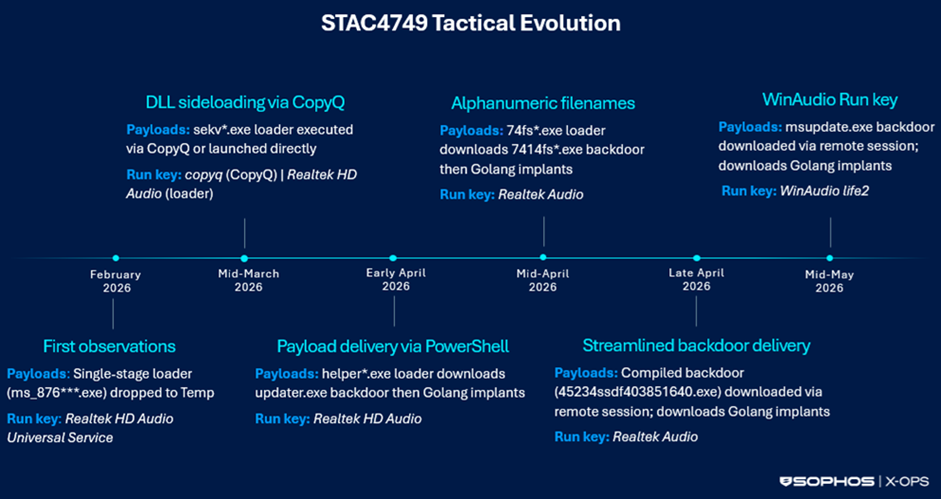
  • Microsoft Teams Vishing Leads to Chaos Ransomware – A Microsoft Teams voice phishing (vishing) campaign tracked as STAC4749 has used a «consistent set of IT-themed cloud domains and personas to gain remote access to victims’ systems» between February and June 2026 in attacks targeting dozens of North American organizations. «Following initial access, STAC4749 operators deployed a modular post-exploitation toolset, including a custom loader and backdoor to maintain persistent, controlled access and support follow-on activity,» Sophos said. «In several incidents, attackers later leveraged this access to deploy Chaos ransomware.»
  • IAB Uses Teams Phishing for Ransomware Attacks – A suspected initial access broker (IAB) for ransomware attacks has been observed using Teams vishing that convinces victims to launch a Quick Assist remote support session. The initial access is used to run PowerShell scripts to gather host information and deploy a Go-based backdoor dubbed GoGRPC. Four different versions of the backdoor have been spotted: Lep, Giver, Pet, and Kind. «These variants have overlapping capabilities but notable implementation differences,» Zscaler said. «GoGRPC is actively evolving. Each variant modifies its payloads and capabilities, adding or removing functionality to better support the threat actor’s objectives. Recent changes indicate an increased targeting of corporate environments, which may be tied to ransomware attacks.» In some instances, the threat actor has also deployed a backdoor called BlindDoor, a Go-based reverse SOCKS proxy known as RevSocket, and a Python-based reverse SOCKS proxy referred to as PyGRPC.
  • Arch Linux Disables AUR Package Adoption Amid Malware – Arch Linux has taken the step of temporarily disabling package adoption due to a surge in malicious takeovers of existing packages. «Due to the current influx of malicious package adoptions and follow-up commits made via the AUR, package adoption is currently disabled while we are handling the situation,» the maintainers said. «We will send a follow-up once we’re able to. In the meantime, feel free to report suspicious adoption events or commits that haven’t been dealt with yet, and stay vigilant!» In June 2026, a separate campaign targeted AUR via more than 400 packages.
  • New Dolphin X Infostealer Spotted – A new infostealer called Dolphin X uses an AI behavioral profiler to score and prioritize infected users based on their application usage, browsing activity, and installed software to identify high-value victims and maximize profits. The malware targets more than 300 applications and attempts to exfiltrate browser passwords, cryptocurrency wallets, SSH keys, and cloud tokens. Dolphin X has been advertised on the cybercrime underground by a vendor using the alias Kontraktnik since May 2026. A lifetime subscription ranges from $1,140 for basic access to $3,420 for the full-featured version. «A single archive can contain data from nine browsers, more than 100 wallet extensions, 65 desktop wallets, 10 password managers, and 30 cloud command-line tools,» Varonis said. «This gives the malware potential access to everything from a victim’s personal accounts to the credentials used to manage their employer’s cloud environment.»
  • Attackers Turn to Microsoft’s Trusted Login System for Phishing – Bad actors are increasingly abandoning fake Microsoft login pages in favor of abusing Microsoft’s legitimate authentication infrastructure in phishing attacks, allowing them to bypass security controls. Check Point said it identified more than 200 phishing emails targeting users across approximately 120 organizations worldwide between June 25 and the second week of July 2026. «The messages impersonated Microsoft Teams task notifications from HR and directed recipients to a legitimate Microsoft sign-in page,» it said. «Victims were then prompted to grant permissions to an attacker-controlled application, allowing the campaign to abuse Microsoft’s trusted authentication flow while concealing its malicious intent.»
  • FBI Arrests Man Accused of Using Steam Games to Drain Victims’ Crypto Wallets – The U.S. Federal Bureau of Investigation (FBI) arrested Zyaire Wilkins, a 21-year-old Florida resident and student, of uploading fake video games that contained malware to Steam that, when downloaded and installed by unsuspecting gamers, stole their passwords and other valuable data, and drained their cryptocurrency wallets. Per the FBI, Wilkins and his accomplices are alleged to have infected around 8,000 victims, and then hacked around 80 cryptocurrency wallets to steal at least $220,000 worth of cryptocurrency.
  • Turning Keystroke Noise to Text – A new study from a group of academics from Tohoku University has demonstrated a new acoustic side-channel attack that can reconstruct text typed on a laptop by just analyzing the sound of keystrokes. While prior attacks relied on collecting labeled recordings from the target keyboard beforehand or required specialized hardware, the latest eavesdropping attack enables stealthy eavesdropping in two real-world scenarios, including physical spaces (public and semi-public) and online meetings. The system works by first isolating individual keystrokes from an audio recording, grouping similar sounds together, and then using a Transformer-based language model to determine the most likely sequence of characters. «Our method combines unsupervised acoustic clustering with Transformer-based language model inference and iterative self-training, enabling stable character inference under highly uncertain acoustic-to-character mappings,» the researchers said. «We demonstrate that the proposed method achieves over 99% reconstruction accuracy with only 100-150 observed keystrokes under a close-proximity recording setup using a smartphone placed near the target device, significantly outperforming prior unsupervised baselines in low-data regimes.»
  • Two Open-Source Software Supply Chain Attack Campaigns – Socket has flagged a fake corepack.org site that’s impersonating Corepack, a Node.js tool for managing package managers, and using it as a lure to deliver an infostealer and proxyware to developers who download it. «The site has existed in some form since early 2026 as a low-quality, apparently AI-generated imitation, but it recently started serving executable downloads,» Socket said. «Corepack is not distributed as a Windows installer, and the real project has no official website at corepack.org. Any download offered there should be treated as malicious.» It’s assessed that the site is AI-generated. In a related development, JFrog identified a massive set of 148 npm packages that are disguised as student web proxies, but hide mutable remote code execution vectors and a high-performance Wisp-compatible WebSocket traffic generator. «They were designed to silently enlist visiting browsers into distributed denial-of-service botnets while generating aggressive popunder advertising revenue,» it said. Some aspects of the campaign were highlighted by SafeDep in late May 2026.
  • AI linked to more than half of cybercrime in Africa – A new report from INTERPOL has found that AI is enabling 55% of reported cybercrimes across Africa, making attacks faster, more scalable, and increasingly difficult for victims and platforms to detect. This encompasses digital sextortion and online harassment, as well as sophisticated business email compromise (BEC) schemes. «The absence of real-time, inter-agency data sharing between banks, telecoms and law enforcement creates a dangerous blind spot in efforts to combat financial fraud,» INTERPOL said. «This vulnerability is being exploited by criminals who have moved beyond simply stealing existing credentials to creating entirely synthetic identities. Combining real personal data with fabricated elements, these AI-generated digital personas can bypass even advanced biometric verification systems and have been used to open bank accounts, secure mobile loans and register SIM cards under false names.»
  • Security Risks of Exposed MCP Servers – Google-owned Wiz has warned that enterprises are exposing Model Context Protocol (MCP) servers to the internet, with some of them returning full tool catalog to an anonymous caller, fetching real data, and revealing a sensitive backend. «These expose sensitive data like employee PII and internal business records, write and delete operations on production systems, and in some cases code execution and access to cloud credentials,» Wiz said. «The protocol’s first widely-used version shipped without an authentication mechanism. The spec added OAuth 2.1 in March 2025, but nearly all the servers we found still run the original version and don’t use it. The pattern is the same across most of them: backend credentials baked into the deployment, a managed cloud endpoint that’s internet-reachable by default, no auth layer added on top.»
  • Nuclear-Sabotage Malware Benchmark Trick Most Frontier AI Models – A multi-stage reverse-engineering benchmark developed by SentinelOne tests «whether a model can keep a malware investigation trustworthy as new evidence repeatedly invalidates its earlier conclusions,» in contrast to other AI benchmarks that test bounded tasks. Developed based on its own analysis of the Fast16 malware, the study found that «OpenAI’s GPT-5.6 Sol was the only publicly available model to complete the full eight-stage investigation, giving concrete shape to what ‘Frontier-class’ capabilities offer analysts.» That said, humans remain essential to define objectives, expose blind spots, and retain final publication authority.
  • An Open Directory Reveals NGINX Rift and Ghost CMS Exploits – An exposed directory on a Singapore-hosted VPS, 165.154.236[.]93, has been found to stage exploits for NGINX Rift (CVE-2026-42945), a long-standing heap overflow, and a blind SQL injection in the Ghost Content API (CVE-2026-26980), alongside Splunk, PaperCut, Samba, WebLogic, and D-Link NAS tooling. «The recovered shell history from the directory recorded the attacker running the exploits against live external infrastructure, using out-of-band (OOB) DNS callbacks to verify execution, and using the same server to catch reverse shells,» Hunt.io said. «Alongside the web exploits were a broader RCE toolkit and pre-staged install files for AdaptixC2 and SuperShell. The target list spanned eleven countries across five continents and leaned heavily toward high-value sectors: federal and state government, universities, healthcare and financial services.» The activity is believed to be the work of a Chinese-speaking threat actor.
  • CISA Issues Guidance to Isolate Vital Systems and Manage OSS Risks – The U.S. Cybersecurity and Infrastructure Security Agency (CISA) issued guidance to help critical infrastructure operators protect essential services from growing cyber threats and ensure continuity of operations during cyber incidents or geopolitical crises by maintaining robust isolation and recovery plans. «State-sponsored cyber actors target critical infrastructure for several nefarious reasons such as espionage or service disruption, often linked to broader geopolitical conflicts,» CISA said. «During crises or conflicts, operators of critical infrastructure and network defenders may isolate essential operational technology (OT) systems as an emergency measure to prevent adversaries from executing cyberattacks, to contain ongoing threats, and to facilitate the restoration of compromised systems.» The agency has also outlined considerations and best practices for federal entities to securely use, evaluate, and publish open-source software. «The guidance urges agencies to obtain sufficient transparency into all relevant components, including training data, of the AI system before deeming the product as OSS for risk management purposes,» it said. «Only with transparency and access can agencies understand and study the software, analyze it for vulnerabilities, and remediate any found vulnerabilities or risks.»
  • RubyGems Cryptojacking Campaign – A set of 199 malicious gems published to RubyGems has been found to embed an identical XMRig cryptojacking payload to mine Monero cryptocurrency on developer systems. «Each gem is a trojanized copy of a popular, legitimate Ruby library,» Palo Alto Networks Unit 42 said. «The payload uses a 5-hour delayed Thread.new{sleep 18000; …} trigger to evade sandbox analysis.» In addition to taking steps to achieve persistence via multiple methods, the malware uses SSH for lateral movement and is capable of infecting other ecosystems, including Node.js, Python, Docker, Git, and VS Code extensions. Mend.io, which also shared details of the campaign, said the payload is hidden inside a dotfile (lib/.threadpool.rb) that standard directory scans skip by default.
  • Email Threat Landscape in Q2 2026 – Microsoft said phishing volume linked to the Tycoon 2FA phishing platform, including QR code phishing and CAPTCHA-gated phishing, fell 92% from pre-disruption averages in the second quarter of 2026 between April and June. However, the tech giant said it «observed continued growth in Teams-based social engineering, particularly voice phishing (vishing), with weekly malicious call attempts reaching nearly ten times the mid-2025 baseline by the end of the quarter.» Microsoft said it detected approximately 7.6 billion email-based phishing threats throughout the quarter, with monthly volumes declining modestly from 2.7 billion in April to 2.4 billion in June. HTML and PDF attachments remained the two most common malicious payload types across the quarter, together accounting for roughly 60-70% of all payload-based attacks each month. In early June 2026, Microsoft said it detected a large-scale BEC campaign that reached more than 67,000 users across more than 42,000 organizations in under three hours, most of them in the U.S., with an aim to redirect salary payments to attacker-controlled bank accounts.

🔧 Cybersecurity Tools

  • EMBA → Firmware is where critical bugs hide longest because it is opaque, fragmented, and painful to inspect manually. EMBA turns that black box into an actionable security report: it extracts embedded-device firmware, runs static and emulation-based analysis, builds an SBOM, and flags outdated components, insecure binaries, vulnerable scripts, and hard-coded credentials through a command-line workflow with web-based reporting. Built for penetration testers, product-security teams, and developers, it compresses days of firmware triage into a repeatable open-source process.
  • GrantGuard → Every «always allow» click in Claude Code can leave behind a standing permission that remains long after the task ends, with pasted API keys, credential-store access, unrestricted `git push`, or destructive commands buried in rarely reviewed settings. GrantGuard is an open-source, local-only tool that finds these accumulated grants, classifies them by risk, and lets users remove unsafe permissions through a browser interface or CLI, without sending settings off-device or loading third-party runtime packages.

Disclaimer: This is strictly for research and learning. It hasn’t been through a formal security audit, so don’t just blindly drop it into production. Read the code, break it in a sandbox first, and make sure whatever you’re doing stays on the right side of the law.

Conclusion

The useful question is not whether a system is exposed. It is which quiet assumption lets it reach farther than intended: a default, a trusted workflow, an abandoned endpoint, or code nobody checked.

That is where the next incident is probably waiting. Not in the loudest alert, but in the handoff everyone assumes belongs to someone else. Check the boundaries. Then check what crosses them.