
CISA agrega fallas de Cisco, Chrome y Arista al catálogo KEV en medio de una explotación activa – CYBERDEFENSA.MX

La Agencia de Seguridad de Infraestructura y Ciberseguridad de EE. UU. (CISA) el martes agregado tres nuevas vulnerabilidades en sus vulnerabilidades explotadas conocidas (KEV) catálogo, tras informes de explotación activa.

La lista de vulnerabilidades es la siguiente:

  • CVE-2026-20245 (Puntuación CVSS: 7,8): una codificación inadecuada o una vulnerabilidad de escape de salida en Cisco Catalyst SD-WAN Manager que podría permitir a un atacante local autenticado ejecutar comandos arbitrarios como root suministrando un archivo manipulado al sistema afectado.
  • CVE-2026-11645 (Puntuación CVSS: 8,8): una vulnerabilidad de lectura y escritura fuera de límites en Google Chrome V8 que podría permitir a un atacante remoto ejecutar código arbitrario dentro de un entorno limitado a través de una página HTML diseñada.
  • CVE-2026-7473 (Puntuación CVSS: 6,9): una comparación incompleta con la vulnerabilidad de factores faltantes en el sistema operativo extensible (EOS) Arista que podría explotarse para procesar el tráfico de túnel no configurado.

No se planea ningún parche para la falla explotada de Arista EOS

«En las plataformas afectadas que ejecutan Arista EOS donde hay una configuración de decapsulación de túnel, como VXLAN (LAN extensible virtual), grupos decap o una interfaz de túnel GRE (encapsulación de enrutamiento genérico), el conmutador decapsulará y reenviará incorrectamente otros paquetes tunelizados inesperados con una IP de destino que coincida con su IP de decapsulación configurada», dijo Arista.

«Esto ocurre porque el conmutador no verifica el tipo de protocolo del túnel, lo que podría provocar un procesamiento inesperado del tráfico del túnel no configurado».

Ciberseguridad

El defecto de seguridad afecta principalmente a los productos de las series 7020R, 7280R/R2 y 7500R/R2. Sin embargo, para que se produzca una explotación exitosa, el dispositivo debe configurarse como un punto final de túnel con una IP de decapsulación, como un VXLAN VTEP, un punto final de túnel GRE o con un grupo de decapsulación de IP.

La compañía de equipos de red reconoció que la vulnerabilidad ha sido «informada como explotada en la naturaleza», y le dio crédito a Scott Christiansen, Lukas Peitz, Rich Compton y Jonathan Davis de Comcast por revelarla responsablemente.

A pesar de esto, Arista dijo que no se planean parches para abordar CVE-2026-7473, citando riesgos de que hacerlo podría romper las configuraciones existentes en las implementaciones. La compañía ha descrito mitigaciones para abordar el problema.

«Hay dos enfoques amplios para mitigar este problema: (1) aplicar ACL en dispositivos ascendentes o (2) aplicar ACL en los dispositivos donde se produce la decapsulación inesperada», dijo Arista. «En ambos casos, la idea es permitir selectivamente sólo el tráfico de túnel legítimo o bloquear selectivamente el tráfico de túnel malicioso».

Se ordenó a las agencias del Poder Ejecutivo Civil Federal (FCEB) que apliquen las correcciones o mitigaciones necesarias antes del 23 de junio de 2026 para contrarrestar la amenaza planteada por las tres vulnerabilidades.

Chrome V8 Zero-Day CVE-2026-11645 explotado en la naturaleza – CYBERDEFENSA.MX

Google ha publicado actualizaciones de seguridad para abordar 74 vulnerabilidades, incluida una que ha sido objeto de explotación activa en la naturaleza.

La vulnerabilidad de alta gravedad, rastreada como CVE-2026-11645 (Puntuación CVSS: 8,8), se ha descrito como un acceso a memoria fuera de los límites en V8, el motor JavaScript y WebAssembly de Chrome.

«La lectura y escritura fuera de límites en V8 en Google Chrome anterior a 149.0.7827.103 permitía a un atacante remoto ejecutar código arbitrario dentro de una zona de pruebas a través de una página HTML diseñada», se lee en un descripción de la falla en la Base de Datos Nacional de Vulnerabilidad (NVD) del NIST.

A un investigador de seguridad llamado «303f06e3» se le atribuye el descubrimiento y el informe de la falla el 27 de abril de 2026. El investigador recibió una recompensa de 55.000 dólares por la divulgación responsable.

Ciberseguridad

Como es habitual en estos casos, Google reconoció que «existe un exploit para CVE-2026-11645», pero no compartió detalles adicionales para garantizar que la mayoría de los usuarios estén actualizados con una solución y evitar una mayor explotación.

Con el último desarrollo, Google ha abordado un total de cinco días cero de Chrome explotados activamente desde principios de año. Esto incluye CVE-2026-2441, CVE-2026-3909, CVE-2026-3910 y CVE-2026-5281.

Para una protección óptima, se recomienda a los usuarios actualizar su navegador Chrome a las versiones 149.0.7827.102/.103 para Windows y Apple macOS, y 149.0.7827.102 para Linux. Para asegurarse de que estén instaladas las últimas actualizaciones, los usuarios pueden navegar a Más > Ayuda > Acerca de Google Chrome y seleccionar Reiniciar.

También se recomienda a los usuarios de otros navegadores basados ​​en Chromium, como Microsoft Edge, Brave, Opera y Vivaldi, que apliquen las correcciones cuando estén disponibles.

Un agente de IA descubre 21 días cero en FFmpeg; Los parches de Chrome registran 429 errores – CYBERDEFENSA.MX

Dos cosas aterrizaron con unos días de diferencia esta semana. Una startup de seguridad informó de 21 vulnerabilidades previamente desconocidas en FFmpeg, la biblioteca multimedia que se encuentra dentro de casi todo lo relacionado con el vídeo, todas ellas encontradas por un agente autónomo de IA.

La misma semana, Google envió Cromo 149 con parches para 429 errores de seguridad, la mayor cantidad jamás realizada en una sola versión.

La IA solo encontró los errores de FFmpeg. El récord de Chrome llegó después de que Google revisara su programa de recompensas para hacer frente a una avalancha de informes generados por IA. Los mecanismos difieren, pero la presión es la misma: la IA está poniendo más vulnerabilidades ante las personas que tienen que lidiar con ellas, y más rápido que antes.

Los hallazgos de FFmpeg provienen de profundidad primerocuyo agente de seguridad autónomo escaneó aproximadamente 1,5 millones de líneas de C del proyecto y produjo 21 días cero confirmados, cada uno con una entrada de prueba de concepto reproducible.

La empresa calcula el coste de la ejecución en unos 1.000 dólares. Varios de los errores habían estado latentes durante 15 a 20 años; un desbordamiento de pila en el código de la tabla de descripción de servicios data de 2003 y permaneció intacto durante 23 años.

Ciberseguridad

La mayoría son desbordamientos de pila o montón en analizadores y demuxers, que abarcan componentes desde el demuxer TS hasta el decodificador VP9. Depthfirst dice que algunos ya llevan identificadores CVE; su informe enumera nueve, CVE-2026-39210 a CVE-2026-39218, y señala que el resto están arreglados pero aún no numerados. También publicó un PoC.

En noticias separadas, Chrome 149 corrige 429 vulnerabilidades, un récord para una sola versión. Más de 100 son críticos o de alta gravedad, en su mayoría de uso después de la liberación y validación de entrada insuficiente.

Lo peor, CVE-2026-10881 (CVSS 9.6), es una lectura y escritura fuera de límites en el motor gráfico ANGLE que permite que una página diseñada escape del entorno limitado y ejecute código en el host. Google pagó 97.000 dólares por él.

Los errores de mayor gravedad fueron en su mayoría hallazgos internos: de aproximadamente 90 errores de alta gravedad, sólo 10 provinieron de investigadores externos y 19 de los 22 críticos fueron del propio Google. La conexión con la IA tiene más que ver con el volumen que con la autoría.

Google no ha vinculado el 429 a la IA; la señal grabada es la revisión de recompensas lo hizo en abril, motivado por una avalancha de envíos generados por IA y ahora solicita un reproductor conciso de los largos artículos que produce la IA.

El agente Big Sleep de Google informó una serie de errores de FFmpeg el año pasado, ahora visibles en la página del proyecto. pagina de seguridad etiquetado como BIGSLEEP, y el modelo Mythos de Anthropic sacó un defecto H.264 de 16 años de antigüedad y otros de FFmpeg por alrededor de $10,000, tres de los cuales se enviaron en FFmpeg 8.1, según su propia redacción.

Hace días, otra herramienta autónoma encontró un RCE autenticado en Redis que había estado presente desde la versión 7.2.0, desapercibido durante más de dos años. La investigación apunta en la misma dirección: en un estudio de febrero, un agente reprodujo PoC en funcionamiento durante más de la mitad de los casos. 100 errores reales del kernel de Linux de N díassuperando la pelusa.

Ciberseguridad

Para FFmpeg, extraiga la compilación ascendente fija o la actualización de seguridad de su distribución tan pronto como llegue, y priorice cualquier cosa que ingiera RTSP o AV1-over-RTP que no sea de confianza. FFmpeg se incluye ampliamente en canalizaciones de medios, ruedas de Python, imágenes de contenedores y dispositivos, por lo que no se detenga en los paquetes del sistema; esas copias incrustadas también necesitan parches.

Para Chrome, actualice a 149.0.7827.53 en Linux o 149.0.7827.53/54 en Windows y macOS, o confirme que se haya ejecutado la actualización automática.

La respuesta tiene que adaptarse al nuevo ritmo: ciclos de parches más cortos, actualización automática dondequiera que exista y aumentos de dependencia que conllevan correcciones CVE tratadas como trabajo de seguridad, no como mantenimiento de rutina.

Sin embargo, lo difícil es cambiar. Encontrar estos errores se ha vuelto barato; clasificar los informes, enviar las correcciones e instalarlas no lo ha hecho, y gran parte de ese trabajo aún recae en voluntarios y una delgada capa de evaluadores humanos que ahora se espera que sigan el ritmo de las máquinas.

Una falla en la extensión de Chrome de Claude permitió que «cualquier» otro complemento secuestrara la IA de las víctimas

A medida que las empresas y los gobiernos recurren a agentes de inteligencia artificial para acceder a Internet y realizar tareas de nivel superior, los investigadores continúan encontrando fallas graves en grandes modelos de lenguaje que pueden ser explotadas por malos actores.

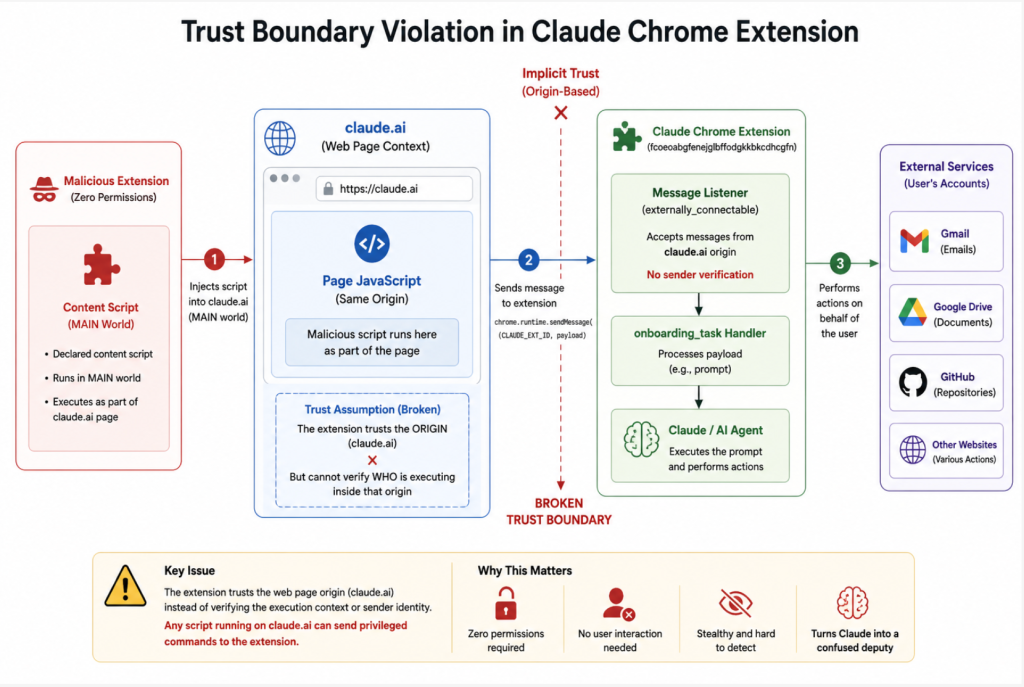
lo último descubrimiento proviene de la firma de seguridad de navegadores LayerX, e involucra un error en la extensión de Chrome para el modelo Claude AI de Anthropic que permite que cualquier otro complemento, incluso aquellos sin permisos especiales, incruste instrucciones ocultas que pueden hacerse cargo del agente.

«La falla surge de una instrucción en el código de la extensión que permite que cualquier script que se ejecute en el navegador de origen se comunique con el LLM de Claude, pero no verifica quién está ejecutando el script», escribió el investigador principal de LayerX, Aviad Gispan. «Como resultado, cualquier extensión puede invocar un script de contenido (que no requiere ningún permiso especial) y emitir comandos a la extensión Claude».

Gispan dijo que podía ejecutar cualquier mensaje que quisiera, superar las barreras de seguridad de Claude, evadir la confirmación del usuario y realizar acciones entre sitios a través de múltiples herramientas de Google. Como prueba de concepto, LayerX pudo explotar la falla para extraer archivos de las carpetas de Google Drive y compartirlos con partes no autorizadas, monitorear la actividad reciente del correo electrónico y enviar correos electrónicos en nombre de un usuario, y robar código fuente privado de un repositorio de GitHub conectado.

La vulnerabilidad «rompe efectivamente la seguridad de las extensiones de Chrome» al crear «una escalada de privilegios primitiva entre extensiones, algo que el modelo de seguridad de Chrome está diseñado explícitamente para evitar», escribió Gispan.

Un gráfico que muestra cómo una vulnerabilidad explota los límites de confianza en la extensión de Clade Chrome. (Fuente: LayerX)

Claude se basa en el texto, la semántica de la interfaz de usuario y la interpretación de capturas de pantalla para tomar decisiones, todo lo cual un atacante puede controlar en el lado de entrada. Los investigadores modificaron la interfaz de usuario de Claude para eliminar etiquetas e indicadores relacionados con información confidencial, como contraseñas y comentarios compartidos, y luego le solicitaron a Claude que compartiera los archivos con un servidor externo.

Eso significa que los defensores de la ciberseguridad a menudo no tienen nada obviamente malicioso que detectar. Cuando hay actividad visible, se puede pedir al modelo que cubra sus huellas eliminando correos electrónicos y otras evidencias de sus acciones.

Ax Sharma, jefe de investigación de Manifold Security, calificó la vulnerabilidad como «una demostración útil de por qué monitorear los agentes de IA en la capa de aviso es fundamentalmente insuficiente».

«La parte más sofisticada de este ataque no es la inyección, sino que el entorno percibido por el agente fue manipulado para producir acciones que parecían legítimas desde adentro», dijo Sharma. «Ese es el tipo de amenaza para la que la industria necesita construir defensas».

Gispan dijo que LayerX informó la falla a Anthropic el 27 de abril, pero afirmó que la compañía solo emitió una solución «parcial» al problema. Según LayerX, Anthropic respondió un día después para decir que el error era un duplicado de otra vulnerabilidad que ya se estaba abordando en una actualización futura.

Si bien esa solución, emitida el 6 de mayo, introdujo nuevos flujos de aprobación para acciones privilegiadas que hicieron más difícil explotar la misma falla, Gispan dijo que aún podía hacerse cargo del agente de Claude en algunos escenarios.

«Cambiar al modo 'privilegiado', incluso sin la notificación o el consentimiento del usuario, permitió eludir estos controles de seguridad e inyectar mensajes en la extensión Claude, como antes», escribió Gispan.

Anthropic no respondió a una solicitud de comentarios de CyberScoop sobre los esfuerzos de investigación y mitigación.

Derek B. Johnson

Escrito por Derek B. Johnson

Derek B. Johnson es reportero de CyberScoop, donde su área incluye la ciberseguridad, las elecciones y el gobierno federal. Antes de eso, ha brindado una cobertura galardonada de noticias sobre ciberseguridad en los sectores público y privado para varias publicaciones desde 2017. Derek tiene una licenciatura en periodismo impreso de la Universidad de Hofstra en Nueva York y una maestría en políticas públicas de la Universidad George Mason en Virginia.

108 extensiones maliciosas de Chrome roban datos de Google y Telegram y afectan a 20.000 usuarios – CYBERDEFENSA.MX

Investigadores de ciberseguridad han descubierto una nueva campaña en la que se ha descubierto que un grupo de 108 extensiones de Google Chrome se comunican con la misma infraestructura de comando y control (C2) con el objetivo de recopilar datos del usuario y permitir el abuso a nivel del navegador mediante la inyección de anuncios y código JavaScript arbitrario en cada página web visitada.

Según Socket, las extensiones se publican bajo cinco identidades de editor distintas (Yana Project, GameGen, SideGames, Rodeo Games e InterAlt) y en conjunto han acumulado alrededor de 20.000 instalaciones en Chrome Web Store.

«Los 108 enrutan credenciales robadas, identidades de usuario y datos de navegación a servidores controlados por el mismo operador», investigador de seguridad Kush Pandya. dicho en un análisis.

Ciberseguridad

De estos, 54 complementos roban la identidad de la cuenta de Google a través de OAuth2, 45 extensiones contienen una puerta trasera universal que abre URL arbitrarias tan pronto como se inicia el navegador, y las restantes participan en una variedad de comportamientos maliciosos.

  • Exfiltrar sesiones web de Telegram cada 15 segundos
  • Elimina los encabezados de seguridad de YouTube y TikTok (es decir, Política de seguridad de contenido, X-Frame-Options y CORS) e inyecta superposiciones y anuncios de juegos de azar.
  • Inyecte scripts de contenido en cada página que visita el usuario.
  • Proxy todas las solicitudes de traducción a través del servidor del actor de amenazas

En un intento de dar una apariencia de legitimidad, las extensiones identificadas se hacen pasar por clientes de la barra lateral de Telegram, máquinas tragamonedas y juegos de Keno, potenciadores de YouTube y TikTok, herramientas de traducción de texto y utilidades de páginas. La funcionalidad anunciada es diversa y tiene como objetivo lanzar una red amplia, mientras comparte el mismo backend.

Sin embargo, sin que los usuarios lo sepan, el código malicioso que se ejecuta en segundo plano captura información de la sesión, inyecta scripts arbitrarios y abre URL elegidas por el atacante.

Algunas de las extensiones identificadas se enumeran a continuación:

  • Cuenta múltiple de Telegram (ID: obifanppcpchlehkjipahhphbcbjekfa), que extrae el token de autenticación de usuario utilizado por Telegram Web y filtra los datos a un servidor remoto. También puede sobrescribir localStorage con datos de sesión proporcionados por el actor de amenazas y forzar la carga de la aplicación de mensajería, reemplazando efectivamente la sesión activa de Telegram de la víctima con la sesión elegida por el actor de amenazas.
  • Cliente web para Telegram: Teleside (ID: mdcfennpfgkngnibjbpnpaafcjnhcjno), que elimina los encabezados de seguridad de Telegram e inyecta scripts para robar sesiones de Telegram.
  • Formula Rush Racing Game (ID: akebbllmckjphjiojeioooidhnddnplj), que roba la identidad de la cuenta de Google del usuario la primera vez que la víctima hace clic en el botón de inicio de sesión. Esto incluye detalles como correo electrónico, nombre completo, URL de la imagen de perfil e identificador de cuenta de Google.
Ciberseguridad

«Cinco extensiones utilizan la API declarativeNetRequest de Chrome para eliminar los encabezados de seguridad de los sitios de destino antes de que se cargue la página», dijo Socket. «Las 108 extensiones maliciosas comparten el mismo backend, alojado en 144.126.135[.]238.»

Actualmente no se sabe quién está detrás de las extensiones que violan la política. Sin embargo, un análisis del código fuente ha descubierto comentarios en ruso en varios complementos.

Se recomienda a los usuarios que hayan instalado cualquiera de las extensiones que las eliminen con efecto inmediato y cierren sesión en todas las sesiones web de Telegram desde la aplicación móvil de Telegram.

Google implementa DBSC en Chrome 146 para bloquear el robo de sesiones en Windows – CYBERDEFENSA.MX

Google ha hecho Credenciales de sesión vinculadas al dispositivo (DBSC) generalmente disponible para todos los usuarios de Windows de su navegador web Chrome, meses después de que comenzara a probar la función de seguridad en versión beta abierta.

La disponibilidad pública está actualmente limitada a usuarios de Windows en Chrome 146, y la expansión de macOS está planificada en una próxima versión de Chrome.

«Este proyecto representa un importante paso adelante en nuestros esfuerzos continuos para combatir el robo de sesiones, que sigue siendo una amenaza frecuente en el panorama de seguridad moderno», dijeron los equipos de seguridad de cuentas y Chrome de Google. dicho en una publicación del jueves.

El robo de sesión implica la filtración encubierta de cookies de sesión del navegador web, ya sea reuniendo las existentes o esperando a que la víctima inicie sesión en una cuenta en un servidor controlado por un atacante.

Ciberseguridad

Normalmente, esto sucede cuando los usuarios descargan inadvertidamente malware para robar información en sus sistemas. Estas familias de malware ladrón (de las cuales hay muchas, como Atomic, Lumma y Vidar Stealer) tienen capacidades para recopilar una amplia gama de información de los sistemas comprometidos, incluidas las cookies.

Debido a que las cookies de sesión suelen tener una vida útil más prolongada, los atacantes pueden aprovecharlas para obtener acceso no autorizado a las cuentas en línea de las víctimas sin tener que conocer sus contraseñas. Una vez recolectados, estos tokens se empaquetan y venden a otros actores de amenazas para obtener ganancias financieras. Los ciberdelincuentes que los adquieran pueden realizar sus propios ataques.

DBSC, anunciado por primera vez por Google en abril de 2024, tiene como objetivo contrarrestar este abuso vinculando criptográficamente la sesión de autenticación a un dispositivo específico. Al hacerlo, la idea es hacer que las cookies pierdan su valor incluso si son robadas por malware.

«Lo hace utilizando módulos de seguridad respaldados por hardware, como el Módulo de plataforma segura (TPM) en Windows y Secure Enclave en macOS, para generar un par de claves pública/privada único que no se puede exportar desde la máquina», explicó Google.

«La emisión de nuevas cookies de sesión de corta duración depende de que Chrome demuestre la posesión de la clave privada correspondiente al servidor. Debido a que los atacantes no pueden robar esta clave, cualquier cookie exfiltrada caducará rápidamente y se volverá inútil para esos atacantes».

En caso de que el dispositivo de un usuario no admita el almacenamiento seguro de claves, DBSC vuelve elegantemente al comportamiento estándar sin interrumpir el flujo de autenticación, Google dicho en su documentación para desarrolladores.

Ciberseguridad

El gigante tecnológico dijo que ha observado una reducción significativa en el robo de sesiones desde su lanzamiento, una indicación temprana del éxito de la contramedida. El lanzamiento oficial es solo el comienzo, ya que la compañía planea llevar DBSC a una gama más amplia de dispositivos e introducir capacidades avanzadas para integrarse mejor con entornos empresariales.

Google, que trabajó con Microsoft para diseñar el estándar con el objetivo de convertirlo en un estándar web abierto, también enfatizó que la arquitectura DBSC es privada por diseño y que el enfoque de clave distinta garantiza que los sitios web no puedan usar las credenciales de sesión para correlacionar la actividad de un usuario en diferentes sesiones o sitios en el mismo dispositivo.

«Además, el protocolo está diseñado para ser sencillo: no filtra identificadores de dispositivos ni datos de certificación al servidor más allá de la clave pública por sesión requerida para certificar la prueba de posesión», añadió. «Este intercambio mínimo de información garantiza que DBSC ayude a proteger las sesiones sin permitir el seguimiento entre sitios ni actuar como un mecanismo de toma de huellas digitales del dispositivo».

Axios Hack, Chrome 0-Day, Fortinet Exploits, Paragon Spyware and More – CYBERDEFENSA.MX

This week had real hits. The key software got tampered with. Active bugs showed up in the tools people use every day. Some attacks didn’t even need much effort because the path was already there.

One weak spot now spreads wider than before. What starts small can reach a lot of systems fast. New bugs, faster use, less time to react.

That’s this week. Read through it.

⚡ Threat of the Week

Axios npm Package Compromised by N. Korean Hackers—Threat actors with ties to North Korea seized control of the npm account belonging to the lead maintainer of Axios, a popular npm package with nearly 100 million weekly downloads, to push malicious versions containing a cross-platform malware dubbed WAVESHAPER.V2. The activity has been attributed to a financially motivated threat actor known as UNC1069. The incident demonstrates how quickly the compromise of a popular npm package can have ripple effects through the ecosystem. The malware’s self-deleting anti-forensic cleanup points to a deliberate, planned operation. «The build pipeline is becoming the new front line. Attackers know that if they can compromise the systems that build and distribute software, they can inherit trust at scale,» Avital Harel, Security Researcher at Upwind, said. «That’s what makes these attacks so dangerous — they’re not just targeting one application, they’re targeting the process behind many of them. Organizations should be looking much more closely at CI/CD systems, package dependencies, and developer environments, because that’s increasingly where attackers are placing their bets.» Ismael Valenzuela, vice president of Labs, Threat Research, and Intelligence at Arctic Wolf, said the Axios npm compromise reflects a broader trend where attackers infiltrate trusted, widely used software components to obtain access to downstream customers at scale. «Even though the malicious versions were available for only a few hours, Axios is so deeply embedded across enterprise applications that organizations may have unknowingly pulled the compromised code into their environments through build pipelines or downstream dependencies,» Valenzuela added. «That downstream exposure is what makes these incidents particularly difficult to spot and contain, especially for teams that never directly chose to install Axios themselves. This incident reinforces that security teams need to treat build‑time tools and dependencies as part of the attack surface and not just trust tools by default.»

🔔 Top News

  • Google Patches Actively Exploited Chrome 0-Day—Google released security updates for its Chrome web browser to address 21 vulnerabilities, including a zero-day flaw that it said has been exploited in the wild. The high-severity vulnerability, CVE-2026-5281 (CVSS score: N/A), concerns a use-after-free bug in Dawn, an open-source and cross-platform implementation of the WebGPU standard. Users are advised to update their Chrome browser to versions 146.0.7680.177/178 for Windows and Apple macOS, and 146.0.7680.177 for Linux. Google did not reveal how the vulnerability is being exploited and who is behind the exploitation effort.
  • TrueConf 0-Day Exploited in Attacks Targeting Government Entities in Southeast Asia—Chinese hackers have exploited a zero-day vulnerability in the TrueConf video conferencing software in attacks against government entities in Southeast Asia. The exploited flaw, tracked as CVE-2026-3502 (CVSS score of 7.8), exists because of a lack of integrity checks when fetching application update code, allowing an attacker to distribute a tampered update. «The compromised TrueConf on-premises server was operated by the governmental IT department and served as a video conferencing platform for dozens of government entities across the country, which were all supplied with the same malicious update,» Check Point said. The activity, which began in January 2026, involved the deployment of the Havoc framework. Most infections likely began with a link sent to the victims. TrueConf is used widely across organizations in Asia, Europe, and the Americas, serving about 100,000 organizations globally.
  • Fortinet FortiClient EMS Flaw Under Attack—Fortinet released out-of-band patches for a critical security flaw impacting FortiClient EMS (CVE-2026-35616) that it said has been exploited in the wild. The vulnerability has been described as a pre-authentication API access bypass leading to privilege escalation. Exploitation efforts against CVE-2026-35616 were first recorded against its honeypots on March 31, 2026, per watchTowr. The development comes days after another recently patched, critical vulnerability in FortiClient EMS (CVE-2026-21643) came under active exploitation.
  • Apple Backports DarkSword Fixes to More Devices—Apple expanded the availability of iOS 18.7.7 and iPadOS 18.7.7 to a broader range of devices to protect users from the risk posed by a recently disclosed exploit kit known as DarkSword. The update targets customers whose devices are capable of upgrading to the newest operating system (iOS 26), but have chosen to remain on iOS 18. Apple has taken the unprecedented step to counter risks posed by an exploit kit called DarkSword. The broader availability of the patches underscores the level of threat that malware like DarkSword poses. The fact that a large number of users were still using iOS 18, combined with the leak of a new version of DarkSword on GitHub, has pushed Apple towards releasing the fix so that they can stay protected without the need for updating to iOS 26. The leak is significant as it puts it within reach of less technically savvy cybercriminals out there.
  • ClickFix Attack Leads to DeepLoad Malware—The ClickFix technique is being used to deliver a stealthy malware named DeepLoad that’s capable of stealing credentials and intercepting browser interactions. The malware first emerged on a dark web cybercrime forum in early February 2026, when a threat actor, using the alias «MysteryHack,» advertised it as a «centralized panel for multiple types of malware.» According to ZeroFox, «DeepLoad’s design is explicitly focused on actively facilitating real-time cryptocurrency theft, which almost certainly makes it an attractive malware suite in the cybercrime-as-a-service (CaaS) environment.» The malware has since been distributed to Windows systems through ClickFix under the guise of resolving fake browser error messages. Besides stealing credentials, the malware drops a rogue browser extension to intercept sensitive data and spreads via removable USB drives. DeepLoad’s actual attack logic is buried under layers of obfuscation, raising the possibility that some parts of the malware were developed using an artificial intelligence (AI) model.
  • Claude Code Source Code Leaks—Anthropic acknowledged that internal code for its popular artificial intelligence (AI) coding assistant, Claude Code, had been inadvertently released due to a human error. Essentially, what happened was this: When Anthropic pushed out version 2.1.88 of its Claude Code npm package, it accidentally included a map file that exposed nearly 2,000 source code files and more than 512,000 lines of code. The source code leak has since revealed various features the company appears to be working on or that are built into the service, including an Undercover mode to hide AI authorship from contributions to public code repositories, a persistent background agent called KAIROS, combat distillation attacks, and active monitoring of words and phrases that show signs of user frustration. The leak also quickly escalated into a cybersecurity threat, as attackers pounced on the surge in interest to lure developers into downloading stealer malware.

🔥 Trending CVEs

New vulnerabilities show up every week, and the window between disclosure and exploitation keeps getting shorter. The flaws below are this week’s most critical — high-severity, widely used software, or already drawing attention from the security community.

Check these first, patch what applies, and don’t wait on the ones marked urgent — CVE-2026-35616 (Fortinet FortiClient EMS), CVE-2026-20093 (Cisco Integrated Management Controller), CVE-2026-20160 (Cisco Smart Software Manager On-Prem), CVE-2026-5281 (Google Chrome), CVE-2026-3502 (TrueConf), CVE-2026-27876, CVE-2026-27880 (Grafana), CVE-2026-4789 (Kyverno), CVE-2026-2275, CVE-2026-2285, CVE-2026-2286, CVE-2026-2287 (CrewAI), CVE-2025-14819 (Notepad++), CVE-2026-34714, CVE-2026-34982 (Vim), CVE-2026-33660, CVE-2026-33696 (n8n), CVE-2026-25639 (Axios), CVE-2026-25075 (strongSwan), CVE-2026-34156 (NocoBase), CVE-2026-3308 (Artifex MuPDF), CVE-2026-1579 (PX4 Autopilot), CVE-2026-3991 (Symantec Data Loss Prevention Agent for Windows), CVE-2026-33026 (nginx-ui), CVE-2026-33416, CVE-2026-33636 (libpng), CVE-2026-3775, CVE-2026-3779 (Foxit PDF Editor), CVE-2026-34980, CVE-2026-34990 (CUPS), and CVE-2026-34121 (TP-Link).

🎥 Cybersecurity Webinars

  • Learn How to Close Identity Gaps Using Insights from IT Leaders → Identity programs face rising risk from disconnected apps, manual credentials, and expanding AI access. Based on 2026 insights from 600+ IT and security leaders, this session shows what to measure, fix, and do now to close identity gaps and regain control.
  • Learn How to Build Secure AI Agents Using Identity, Visibility, and Control → AI agents are already being used, but most teams don’t know how to secure them properly. This session shows a clear, practical way to do it using three key ideas: identity, visibility, and control.You will see what real deployment looks like, how to track what agents do, and how to manage their behavior safely.It also explains how to secure AI systems today without waiting for standards to settle.

📰 Around the Cyber World

  • Device Code Phishing Attacks Surge —Device code phishing attacks, which abuse the OAuth device authorization grant flow to hijack accounts, have surged more than 37.5x this year. Push Security said it detected a 15x increase in device code phishing pages at the start of March 2026, indicating that the technique has finally entered mainstream adoption. «The technique tricks a user into issuing access tokens for an attacker-controlled application (not a device, confusingly),» the company said. «Any app that supports device code logins can be a target. Popular examples include Microsoft, Google, Salesforce, GitHub, and AWS. That said, Microsoft is, as always, much more heavily targeted at scale now than any other app.» This has been fueled by the emergence of EvilTokens (aka ANTIBOT), the first reported criminal PhaaS (Phishing-as-a-Service) toolkit that supports device code pushing. EvilTokens features a Cloudflare Workers frontend and a Railway backend for authentication. Early iterations of the PhaaS kit emerged in January 2026. Another closed-source PhaaS kit called Venom offers device code phishing capabilities similar to EvilTokens. Some of the other PhaaS kits that have incorporated this technique include SHAREFILE, CLURE, LINKID, AUTHOV, DOCUPOLL, FLOW_TOKEN, PAPRIKA, DCSTATUS, and DOLCE.
  • LinkedIn Comes Under Scanner for BrowserGate —A newly published report called BrowserGate alleged that Microsoft’s LinkedIn is using hidden JavaScript scripts on its website to scan visitors’ browsers for thousands of installed Google Chrome extensions and collect device data without users’ consent. «LinkedIn scans for over 200 products that directly compete with its own sales tools, including Apollo, Lusha, and ZoomInfo,» the report said. «Because LinkedIn knows each user’s employer, it can map which companies use which competitor products. It is extracting the customer lists of thousands of software companies from their users’ browsers without anyone’s knowledge. Then it uses what it finds. LinkedIn has already sent enforcement threats to users of third-party tools, using data obtained through this covert scanning to identify its targets.» The report also claimed LinkedIn loads an invisible tracking pixel from HUMAN Security, along with a separate fingerprinting script that runs from LinkedIn’s servers and a third script from Google that runs silently on every page load. In response to the findings, LinkedIn told Bleeping Computer it scans for certain extensions that scrape data without members’ consent in violation of its terms of service. The company also claimed the report is from an individual who is «subject to an account restriction for scraping and other violations of LinkedIn’s Terms of Service.»
  • ICE Confirms Use of Paragon Spyware —The U.S. Immigration and Customs Enforcement (ICE) confirmed it uses spyware developed by Paragon to «identify, disrupt, and dismantle Foreign Terrorist Organizations, addressing the escalating fentanyl epidemic and safeguarding national security.» Paragon’s Graphite spyware has been found on the phones of journalists. WhatsApp last year said it disrupted a campaign that deployed the spyware against its users. The governments of Australia, Canada, Cyprus, Denmark, Israel, and Singapore are suspected to be customers of the Israeli company.
  • Ex-Engineer Pleads Guilty to Extortion Campaign —Daniel Rhyne, 59, of Kansas City, Missouri, pleaded guilty to a failed data extortion campaign that targeted his former employer. Rhyne was arrested in September 2024. According to court documents, Rhyne worked as a core infrastructure engineer at a U.S.-based industrial company headquartered in New Jersey. In November 2023, the defendant executed a ransomware attack against the company and sent an extortion email to its employees, threatening to continue shutting down the firm’s servers unless he was paid about 20 Bitcoin, which was valued at $750,000 at the time. Last month, the U.S. Justice Department (DoJ) announced the conviction of Cameron Curry (aka Loot), a 27-year-old from Charlotte, North Carolina, for carrying out a cyber extortion scheme against a D.C.-based international technology company called Brightly Software. «Trial evidence established that Curry misused his position to access the victim company’s personnel and other sensitive corporate records, which he then used to carry out the cyber extortion scheme after he learned that his contract was not going to be renewed and that he would no longer be employed by the company,» the DoJ said. Between December 11, 2023, and January 24, 2024, Curry sent more than 60 emails to company executives and employees, stating he would disclose sensitive information unless he was paid $2.5 million in cryptocurrency. Brightly ended up paying $7,540 in Bitcoin.
  • Residential Proxies Bypass Reputation Systems —Threat intelligence firm GreyNoise’s analysis of 4 billion sessions targeting the edge over a 90-day period from November 29, 2025, to February 27, 2026, found that 39% of unique IP addresses targeting the edge originated from home internet connections, and that 78% vanish before any reputation system can flag them. «78% of residential IPs appear in only 1–2 sessions and are never observed again,» it said. «IP reputation is structurally broken against residential proxies. The rotation rate exceeds the update cycle of any feed-based defense.» This behavior also makes source IPs indistinguishable from a legitimate user’s connection. The data also showed that 0.1% of residential sessions carry exploitation payloads, in contrast to 1.0% from hosting infrastructure, indicating that they are primarily used for network scanning and reconnaissance. The residential proxy traffic is generated by IoT botnets and infected computers, with the networks also resilient against takedown efforts. «After IPIDEA lost 40% of its nodes, operators backfilled within weeks,» GreyNoise said. «Every major takedown produces the same result — temporary disruption, then regeneration.» The company also recommended that «Detection must shift from ‘where is the traffic from?’ to ‘what is the traffic doing?» Device fingerprinting provides more durable detection because fingerprints survive IP rotation.»
  • Suspected N. Korea Campaign Targets Cryptocurrency Companies Using React2Shell —A new campaign has been observed systematically compromising cryptocurrency organizations by exploiting web application vulnerabilities such as React2Shell (CVE-2025-55182), pillaging AWS tenants with valid credentials, and exfiltrating proprietary exchange software containing hardcoded secrets. «Their targeting spans the crypto supply chain, from staking platforms, to exchange software providers, to the exchanges themselves,» Ctrl-Alt-Intel said. The threat intelligence firm has assessed the activity with moderate confidence to be aligned with North Korean cryptocurrency theft operations.
  • India Extends SIM-Binding Mandate —The Indian government has extended its SIM-binding mandate through December 31, 2026, while shelving plans to require messaging apps to forcibly log out web-based sessions like WhatsApp Web every six hours. The decision comes after the Broadband India Forum, which represents Meta and Google, warned the Department of Telecommunications (DoT) that the directions were unconstitutional. Under the framework announced in November 2025, a messaging app account would be tied exclusively to the physical SIM card during registration. This meant that the users could access the messages and other content only when that SIM is present in the device. Companies were given 90 days (i.e., until the end of February 2026) to comply. While SIM binding has been proposed as a way to combat spammers and conduct cross‑border fraud, the move has raised feasibility and user experience concerns. According to Moneycontrol, WhatsApp is said to be beta testing SIM binding on Android.
  • Russian Threat Actors Looking to Regain Access Through Compromised Infrastructure —Russian threat actors like APT28 and Void Blizzard are attempting to regain access to computer systems they previously compromised to check if access is still available and whether the obtained credentials remain valid, CERT-UA has warned. «Unfortunately, these attempts sometimes succeed if the root cause of the initial incident has not been completely eliminated,» the agency said.
  • OkCupid Settles with FTC for Privacy Violations —OkCupid and its owner, Match Group, reached a settlement with the U.S. Federal Trade Commission over allegations that it did not inform its customers that nearly three million user photos were shared with Clarifai, a company that develops AI systems to identify and analyze images and videos. The complaint also accused the dating site of sharing users’ location information and other details without their consent. As part of the settlement, OkCupid and Match did not admit or deny the allegations but agreed to a permanent prohibition that prevents them from misrepresenting how they use and share personal data.
  • New Android Malware Mirax Advertised —A sophisticated new Android banking trojan named Mirax is being advertised as a private malware-as-a-service (MaaS) offering for up to $2,500 per month. The malware enables customers to gain remote control over devices and includes specialized overlays for more than 700 different financial applications to steal credentials and other sensitive information. It can also capture keystrokes, intercept SMS messages, record lock screen patterns, and use the infected device as a SOCKS5 proxy.
  • Venom Stealer Spreads via ClickFix —A new malware-as-a-service (MaaS) platform dubbed Venom Stealer is being sold on cybercrime forums as a subscription ($250/month to $1,800 for lifetime access). It’s marketed as «the Apex Predator of Wallet Extraction.» Unlike other stealers, it automates credential theft and enables continuous data exfiltration. «It builds ClickFix social engineering directly into the operator panel, automates every step after initial access, and creates a continuous exfiltration pipeline that does not end when the initial payload finishes running,» BlackFog said. The development coincides with a new ClickFix variant that replaces PowerShell with a «rundll32.exe» command to download a DLL from an attacker-controlled WebDAV resource. The attack leads to the execution of a secondary loader called SkimokKeep, which then downloads additional payloads, while incorporating anti-sandboxing and anti-debugging mechanisms. In the meantime, recent ClickFix campaigns have also leveraged searches for installation tutorials for OpenClaw, Claude, and other AI tools, as well as for common macOS issues to push stealer malware like MacSync.
  • More Information Stealers Spotted —Speaking of stealers, recent campaigns have also been observed using procurement-themed email lures and fake Homebrew install guides served via sponsored search results to deliver Phantom Stealer and SHub Stealer. Some other newly discovered infostealer malware families include Storm, MioLab, and Torg Grabber. In a related development, CyberProof said it observed a surge in PXA Stealer activity targeting global financial institutions during Q1 2026. Another malware that has gained notoriety is BlankGrabber, which is distributed through social engineering and phishing campaigns. Data gathered by Flare shows that a single stealer log can be devastating, with individual logs containing up to 1,381 pieces of personally identifiable information. In an analysis published by Whiteintel last month, the company found that a single careless download of cracked software by one employee can hand criminal groups direct access to an entire corporate network in under two days. «An employee downloads cracked software on Tuesday afternoon,» it said. «By Thursday morning, their credentials are listed on the Russian Market for $15. Corporate VPN access, AWS credentials, session tokens that bypass MFA – all packaged and ready for purchase.»
  • Phishing Campaign Targets Philippine Banking Users —An ongoing phishing campaign targeting major banks in the Philippines is using email phishing via compromised accounts as the initial vector to harvest online banking credentials and one-time passwords (OTPs) for financial fraud. According to Group-IB, the campaign began in early 2024, distributing over 900 malicious links as part of the coordinated scheme. Clicking on the link embedded in the email message triggers a redirection chain that uses trusted services like Google Business, AMP CDN, Cloudflare Workers, and URL shorteners before taking the victims to the final landing page. «The campaign enables real-time financial fraud by bypassing MFA mechanisms through the theft of valid One-Time Passwords (OTP), allowing attackers to perform unauthorized fund transfers,» the company said. «Telegram bots were used as exfiltration channels, enabling threat actors to automatically collect victims’ login information in real time.» The activity has been attributed to a threat group called PHISLES.
  • Chrome Extensions Harvests ChatGPT Conversations —A malicious Chrome extension, named «ChatGPT Ad Blocker» (ID: ipmmidjikiklckbngllogmggoofbhjikgb), found on the Chrome Web Store masquerades as an ad-blocking tool for the AI chatbot, but contains functionality to «steal the user’s ChatGPT conversations data by systematically copying the HTML page and sending to it to a webhook on a private Discord channel,» DomainTools said.
  • Iran Conflict Triggers Espionage Activity in Middle East —In the aftermath of the U.S.-Israel-Iran conflict, Proofpoint said it has recorded an increase in campaigns from state-sponsored threat actors likely affiliated with China (UNK_InnerAmbush, which uses phishing emails to deliver Cobalt Strike payload), Belarus (TA473, which has used HTML attachments in emails for reconnaissance), Pakistan (UNK_RobotDreams, which has sent spear-phishing emails to India-based offices of Middle East government entities to deliver a Rust backdoor), and Hamas (TA402, which has used compromised Iraq government email addresses to conduct Microsoft account credential harvesting) targeting Middle East government organizations. The enterprise security company said it also identified the Charming Kitten actor targeting a think tank in the U.S. to trick recipients into entering their Microsoft account credentials. One activity cluster that remains unattributed is UNK_NightOwl. The email messages include a domain that spoofed Microsoft OneDrive, leading the victim to a credential harvesting page. If the user enters credentials and clicks the sign-in button, the target is redirected to «hxxps://iran.liveuamap[.]com/,» a legitimate open-source platform called Liveuamap with news updates on the Middle East conflict.
  • U.K. Warns of Messaging App Targeting —The U.K. National Cyber Security Centre (NCSC) became the latest cybersecurity agency to warn of malicious activity from messaging apps like WhatsApp, Messenger, and Signal, where threat actors could trick high-risk individuals into sharing their login or account recovery codes, or linking an attacker-controlled device under their accounts.

🔧 Cybersecurity Tools

  • Dev Machine Guard → It is an open-source script that scans a developer machine to list installed tools and detect security risks across IDEs, AI agents, extensions, and configurations, without accessing source code or secrets, helping expose gaps traditional tools miss in developer environments.
  • Pius → It is an open-source tool that maps a company’s external attack surface by discovering and cataloging internet-facing assets, helping security teams identify exposure and reconnaissance risks that could be targeted by attackers.

Disclaimer: For research and educational use only. Not security-audited. Review all code before use, test in isolated environments, and ensure compliance with applicable laws.

Conclusion

The lesson is simple. Small things matter. Most issues now start from normal parts of the system, not big, obvious gaps.

Don’t trust anything just because it looks routine. Updates, tools, and background systems can all be used in the wrong way. If it seems low risk, check it again. That’s where the problems are starting now.

Nuevo Chrome Zero-Day CVE-2026-5281 en explotación activa: parche lanzado – CYBERDEFENSA.MX

Google el jueves liberado actualizaciones de seguridad para su navegador web Chrome para abordar 21 vulnerabilidades, incluida una falla de día cero que, según dijo, ha sido explotada en la naturaleza.

La vulnerabilidad de alta gravedad, CVE-2026-5281 (Puntuación CVSS: N/A), se refiere a un error de uso después de la liberación en Amaneceruna implementación de código abierto y multiplataforma del estándar WebGPU.

«El uso después de la liberación en Dawn en Google Chrome antes de 146.0.7680.178 permitió a un atacante remoto que había comprometido el proceso de renderizado ejecutar código arbitrario a través de una página HTML diseñada», según una descripción de la falla en la Base de datos nacional de vulnerabilidad (NVD) del NIST.

Como es habitual en estas alertas, Google no proporcionó más detalles sobre cómo se está explotando la deficiencia y quién puede estar detrás del esfuerzo. Por lo general, esto se hace para garantizar que la mayoría de los usuarios estén actualizados con una solución y evitar que otros actores se unan al tren de la explotación.

Ciberseguridad

«Google es consciente de que existe un exploit para CVE-2026-5281», reconoció la empresa.

El desarrollo llega apenas después de que Google enviara correcciones para dos fallas de alta gravedad (CVE-2026-3909 y CVE-2026-3910) que fueron explotadas como de día cero. En febrero, el gigante tecnológico también abordó un error de uso después de la liberación activamente explotado en el componente CSS de Chrome (CVE-2026-2441). En total, Google ha parcheado un total de cuatro días cero de Chrome activamente armados desde principios de año.

Para una protección óptima, se recomienda a los usuarios actualizar su navegador Chrome a las versiones 146.0.7680.177/178 para Windows y Apple macOS, y 146.0.7680.177 para Linux. Para asegurarse de que estén instaladas las últimas actualizaciones, los usuarios pueden navegar a Más > Ayuda > Acerca de Google Chrome y seleccionar Reiniciar.

También se recomienda a los usuarios de otros navegadores basados ​​en Chromium, como Microsoft Edge, Brave, Opera y Vivaldi, que apliquen las correcciones cuando estén disponibles.

Chrome 0-Days, Router Botnets, AWS Breach, Rogue AI Agents & More – CYBERDEFENSA.MX

Some weeks in security feel normal. Then you read a few tabs and get that immediate “ah, great, we’re doing this now” feeling.

This week has that energy. Fresh messes, old problems getting sharper, and research that stops feeling theoretical real fast. A few bits hit a little too close to real life, too. There’s a good mix here: weird abuse of trusted stuff, quiet infrastructure ugliness, sketchy chatter, and the usual reminder that attackers will use anything that works.

Scroll on. You’ll see what I mean.

⚡ Threat of the Week

Google Patches 2 Actively Exploited Chrome 0-Days — Google released security updates for its Chrome web browser to address two high-severity vulnerabilities that it said have been exploited in the wild. The vulnerabilities related to an out-of-bounds write vulnerability in the Skia 2D graphics library (CVE-2026-3909) and an inappropriate implementation vulnerability in the V8 JavaScript and WebAssembly engine (CVE-2026-3910) that could result in out-of-bounds memory access or code execution, respectively. Google did not share additional details about the flaws, but acknowledged that there exist exploits for both of them. The issues were addressed in Chrome versions 146.0.7680.75/76 for Windows and Apple macOS, and 146.0.7680.75 for Linux. 

🔔 Top News

  • Meta to Discontinue Instagram E2EE in May 2026 — Meta announced plans to discontinue support for end-to-end encryption (E2EE) for chats on Instagram after May 8, 2026. In a statement shared with The Hacker News, a Meta spokesperson said, «Very few people were opting in to end-to-end encrypted messaging in DMs, so we’re removing this option from Instagram in the coming months. Anyone who wants to keep messaging with end-to-end encryption can easily do that on WhatsApp.»
  • Authorities Disrupt SocksEscort Service — A court-authorized international law enforcement operation dismantled a criminal proxy service named SocksEscort that enslaved thousands of residential routers worldwide into a botnet for committing large-scale fraud. «The malware allowed SocksEscort to direct internet traffic through the infected routers. SocksEscort sold this access to its customers,» the U.S. Justice Department said. The main thing to note here is that SocksEscort was powered by AVrecon, a malware written in C to explicitly target MIPS and ARM architectures via known security flaws in edge network devices. The malware also featured a novel persistence mechanism that involved flashing custom firmware, which intentionally disables future updates, permanently transforming SOHO routers into SocksEscort proxy nodes to blindside corporate monitoring.
  • UNC6426 Exploits nx npm Supply Chain Attack to Gain AWS Admin Access in 72 Hours — A threat actor known as UNC6426 leveraged keys stolen following the supply chain compromise of the nx npm package in August 2025 to completely breach a victim’s AWS environment within 72 hours. UNC6426 used the access to abuse the GitHub-to-AWS OpenID Connect (OIDC) trust and create a new administrator role in the cloud environment, Google said. Subsequently, this role was abused to exfiltrate files from the client’s Amazon Web Services (AWS) Simple Storage Service (S3) buckets and perform data destruction in their production cloud environments.
  • KadNap Enslaves Network Devices to Fuel Illegal Proxy — A takedown-resistant botnet comprising more than 14,000 routers and other network devices has been conscripted into a proxy network that anonymously ferries traffic used for cybercrime. The botnet, named KadNap, exploits known vulnerabilities in Asus routers (among others), leveraging the initial access to drop shell scripts that reach out to a peer-to-peer network based on Kademlia for decentralized control. Infected devices are being used to fuel a proxy service named Doppelganger that, for a fee, tunnels customers’ internet traffic through residential IP addresses, offering a way for attackers to blend in and make it harder to differentiate malicious traffic from legitimate activity.
  • APT28 Strikes with Sophisticated Toolkit — The Russian threat actor known as APT28 has been observed using a bespoke toolkit in recent cyber espionage campaigns targeting Ukrainian cyber assets. The primary components of the toolkit are two implants, one of which employs techniques from a malware framework the threat actor used in 2010s, while the other is a heavily modified version of the COVENANT framework for long-term spying. COVENANT is used in concert with BEARDSHELL to facilitate data exfiltration, lateral movement, and execution of PowerShell commands. Also alongside these tools is a malware named SLIMAGENT that shares overlaps with XAgent.

‎️‍🔥 Trending CVEs

New vulnerabilities show up every week, and the window between disclosure and exploitation keeps getting shorter. The flaws below are this week’s most critical — high-severity, widely used software, or already drawing attention from the security community.

Check these first, patch what applies, and don’t wait on the ones marked urgent — CVE-2026-3909, CVE-2026-3910, CVE-2026-3913 (Google Chrome), CVE-2026-21666, CVE-2026-21667, CVE-2026-21668, CVE-2026-21672, CVE-2026-21708, CVE-2026-21669, CVE-2026-21671 (Veeam Backup & Replication), CVE-2026-27577, CVE-2026-27493, CVE-2026-27495, CVE-2026-27497 (n8n), CVE-2026-26127, CVE-2026-21262 (Microsoft Windows), CVE-2019-17571, CVE-2026-27685 (SAP), CVE-2026-3102 (ExifTool for macOS), CVE-2026-27944 (Nginx UI), CVE-2025-67826 (K7 Ultimate Security), CVE-2026-26224, CVE-2026-26225 (Intego X9), CVE-2026-29000 (pac4j-jwt), CVE-2026-23813 (HPE Aruba Networking AOS-CX), CVE-2025-12818 (PostgreSQL), CVE-2026-2413 (Ally WordPress plugin), CVE-2026-0953 (Tutor LMS Pro WordPress plugin), CVE-2026-25921 (Gogs), CVE-2026-2833, CVE-2026-2835, CVE-2026-2836 (Cloudflare Pingora), CVE-2026-24308 (Apache ZooKeeper), CVE-2026-3059, CVE-2026-3060, CVE-2026-3989 (SGLang), CVE-2026-0231 (Palo Alto Networks Cortex XDR Broker VM), CVE-2026-20040, CVE-2026-20046 (Cisco IOS XR Software), CVE-2025-65587 (graphql-upload-minimal), CVE-2026-3497 (OpenSSH), CVE-2026-26123 (Microsoft Authenticator for Android and iOS), and CVE-2025-61915 (CUPS).

🎥 Cybersecurity Webinars

  • Stop Guessing: Automate Your Defense Against Real-World Attacks → Learn how to move beyond basic security checklists by using automation to test your defenses against real-world attacks. Experts will show you why traditional testing often fails and how to use continuous, data-driven tools to find and fix gaps in your protection. You will learn how to prove your security actually works without increasing your manual workload.
  • Fix Your Identity Security: Closing the Gaps Before Hackers Find Them → This webinar covers a new study about why many companies are struggling to keep their user accounts and digital identities safe. Experts share findings from the Ponemon Institute on the biggest security gaps, such as disconnected apps and the new risks created by AI. You will learn simple, practical steps to fix these problems and get better control over who has access to your company’s data.
  • The Ghost in the Machine: Securing the Secret Identities of Your AI Agents → As artificial intelligence (AI) begins to act on its own, businesses face a new challenge: how to give these «AI agents» the right digital IDs. This webinar explains why current security for humans doesn’t work for autonomous bots and how to build a better system to track what they do. You will learn simple, real-world steps to give AI agents secure identities and clear rules, ensuring they don’t accidentally expose your private company data.

📰 Around the Cyber World

  • Fake Google Security Check Drops Browser RAT — A web page mimicking a Google Account security page has been spotted delivering a fully featured browser-based surveillance toolkit that takes the form of a Progressive Web App (PWA). «Disguised as a routine security checkup, it walks victims through a four-step flow that grants the attacker push notification access, the device’s contact list, real-time GPS location, and clipboard contents—all without installing a traditional app,» Malwarebytes said. «For victims who follow every prompt, the site also delivers an Android companion package introducing a native implant that includes a custom keyboard (enabling keystroke capture), accessibility-based screen reading capabilities, and permissions consistent with call log access and microphone recording.»
  • Forbidden Hyena Delivers BlackReaperRAT — A hacktivist group known as Forbidden Hyena (aka 4B1D) has distributed RAR archives in December 2025 and January 2026 in attacks targeting Russia that led to the deployment of a previously undocumented remote access trojan called BlackReaperRAT and an updated version of the Blackout Locker ransomware, referred to as Milkyway by the threat actors. BlackReaperRAT is capable of running commands via «cmd.exe,» uploading/downloading files, spawning an HTTP shell to receive commands, and spreading the malware to connected removable media. «It carries out destructive attacks against organizations across various sectors located within the Russian Federation,» BI.ZONE said. «The group publishes information regarding successful attacks on its Telegram channel. It collaborates with the groups Cobalt Werewolf and Hoody Hyena.»
  • Chinese Hackers Target the Persian Gulf region with PlugX — A China-nexus threat actor, likely suspected to be Mustang Panda, has targeted countries in the Persian Gulf region. The activity took place within the first 24 hours of the ongoing conflict in the Middle East late last month. The campaign used a multi-stage attack chain that ultimately deployed a PlugX backdoor variant. «The shellcode and PlugX backdoor used obfuscation techniques such as control flow flattening (CFF) and mixed boolean arithmetic (MBA) to hinder reverse engineering,» Zscaler said. «The PlugX variant in this campaign supports HTTPS for command-and-control (C2) communication and DNS-over-HTTPS (DOH) for domain resolution.»
  • Phishing Campaign Uses SEO Poisoning to Steal Data — A phishing campaign has employed SEO poisoning to direct search engine results to fake traffic ticket portals that impersonate the Government of Canada and specific provincial agencies. «The campaign lures victims to a fake ‘Traffic Ticket Search Portal’ under the pretense of paying outstanding traffic violations,» Palo Alto Networks Unit 42 said. «Submitted data includes license plates, address, date of birth, phone/email, and credit card numbers.» The phishing pages utilize a «waiting room» tactic where the victim’s browser polls the server every two seconds and triggers redirects based on specific status codes.
  • Roundcube Exploitation Toolkit Discovered — Hunt.io said it discovered a Roundcube exploitation toolkit on an internet-exposed directory on 203.161.50[.]145. It’s worth noting that Russian threat actors like APT28, Winter Vivern, and TAG-70 have repeatedly targeted Roundcube vulnerabilities to breach Ukrainian organizations. «The directory included development and production XSS payloads, a Flask-based command-and-control server, CSS-injection tooling, operator bash history, and a Go-based implant deployed on a compromised Ukrainian web application,» the company said, attributing it with medium to high confidence to APT28, citing overlaps with Operation RoundPress. The toolkit, dubbed Roundish, supports credential harvesting, persistent mail forwarding, bulk email exfiltration, address book theft, and two-factor authentication (2FA) secret extraction, mirroring a feature present in MDAEMON. One of the primary targets of the attack is mail.dmsu.gov[.]ua, a Roundcube webmail instance associated with Ukraine’s State Migration Service (DMSU). Besides the possibility of a shared development lineage, Roundish introduces four new components not previously documented in APT28 webmail activity, including a CSS-based side-channel module, browser credential stealer, and a Go-based backdoor that provides persistence via cron, systemd, and SELinux. The CSS injection component is designed to progressively extract characters from Roundcube’s document object model (DOM) without injecting any JavaScript into the victim’s page. The technique is likely used for targeting Cross-Site Request Forgery (CSRF) tokens or email UIDs. Central to the Roundish toolkit is an XSS payload that’s engineered to steal the victim’s email address, harvest account credentials, redirect all incoming emails to a Proton Mail address, export mailbox data from the victim’s Inbox and Sent folders, and gather the victim’s complete address book. «The combination of hidden autofill credential harvesting, server-side mail forwarding persistence, bulk mailbox exfiltration, and browser credential theft reflects a modular approach designed for sustained access,» Hunt.io said. «From a defensive perspective, password resets alone are not sufficient in cases like this. Mail forwarding rules, Sieve filters, and multi-factor authentication secrets must be audited and reset.»
  • Phishing Campaign Targeting AWS Console Credentials — An active adversary-in-the-middle (AiTM) phishing campaign is using fake security alert emails to steal AWS Console credentials, per Datadog. «The phishing kit proxies authentication to the legitimate AWS sign-in endpoint in real time, validating credentials before redirecting victims and likely capturing one-time password (OTP) codes,» the company said. «This campaign does not exploit AWS vulnerabilities or abuse AWS infrastructure.» Post-compromise console access has been observed within 20 minutes of credential submission. These efforts originated from Mullvad VPN infrastructure.
  • Malicious npm Packages Deliver Cipher stealer — Two new malicious npm packages, bluelite-bot-manager and test-logsmodule-v-zisko, were found to deliver via Dropbox a Windows executable designed to siphon sensitive data, including Discord totems, credentials from Chrome, Edge, Opera, Brave, and Yandex browsers, and seed files from cryptocurrency wallet apps like Exodus. from compromised hosts using a stealer named Cipher stealer. «The stealer also uses an embedded Python script and a secondary payload downloaded from GitHub,» JFrog said.
  • GIBCRYPTO Ransomware Detailed — A new ransomware called GIBCRYPTO comes with the ability to capture keystrokes and corrupt the Master Boot Record (MBR) so that any attempt to restart the system will cause the system to run into an error. The ransomware uses the Salsa20 algorithm for encryption. It’s suspected to be part of Snake Keylogger, indicating the malware authors’ attempts to diversify beyond information theft. The development comes as Sygnia highlighted SafePay’s OneDrive-based data exfiltration technique during a ransomware attack after breaching a victim by leveraging a FortiGate firewall flaw and a misconfigured administrative account. «SafePay gained initial access by exploiting a firewall misconfiguration, which enabled them to obtain local administrative credentials,» the company said. «They rapidly escalated discovery and enumeration activities to identify high-value targets for lateral movement, demonstrating a structured and methodical approach to mapping the environment. Within a matter of hours, SafePay escalated to domain administrator access.» The attack culminated in the deployment of ransomware, encrypting more than 60 servers.
  • Fraudulent Account Registration Activity Originating from Vietnam — A sprawling cybercrime ecosystem based in Vietnam has been linked to a cluster of fraudulent account registration activity on platforms like LinkedIn, Instagram, Facebook, and TikTok. In these attacks, attributed to O-UNC-036, the threat actors rely on disposable email addresses in order to execute SMS pumping attacks, also called International Revenue Sharing Fraud (IRSF). «In this scheme, malicious actors automate the creation of puppet accounts in a targeted service provider,» Okta said. «Fraudsters use these account registrations to trigger SMS messages to premium rate phone numbers and profit from charges incurred. This activity can prove costly for service providers who use SMS to verify registration information in customer accounts or to send multi-factor authentication (MFA) security codes.» O-UNC-036 has also been linked to a cybercrime-as–a-service (CaaS) ecosystem that provides paid infrastructure and services to facilitate online fraud. The web-based storefronts are hosted in Vietnam and specialize in the sales of web-based accounts.
  • Hijacked AppsFlyer SDK Distributes Crypto Clipper — The AppsFlyer Web SDK was briefly hijacked to serve malicious code to steal cryptocurrency in a supply chain attack. The clipper malware payload came with capabilities to intercept cryptocurrency wallet addresses entered on websites and replace them with attacker-controlled addresses to divert funds to the threat actor. «The AppsFlyer Web SDK was observed serving obfuscated malicious JavaScript instead of the legitimate SDK from websdk.appsflyer[.]com,» Profero said. «The malicious payload appears to have been designed for stealth and compatibility, preserving legitimate SDK functionality while adding hidden browser hooks and wallet-hijacking logic.» The incident has since been resolved by AppsFlyer.
  • Operation CamelClone Targets Government and Defense Entities — A new cyber espionage campaign dubbed Operation CamelClone has targeted governments and defense entities in Algeria, Mongolia, Ukraine, and Kuwait using malicious ZIP archives that contain a Windows shortcut (LNK) file, which, when executed, delivers a JavaScript loader named HOPPINGANT. The loader then delivers additional payloads for establishing C2 and exfiltrating data to the MEGA cloud storage service. «One interesting aspect of this campaign is that the threat actor does not rely on traditional command-and-control infrastructure,» Seqrite Labs said. «Instead, the payloads are hosted on a public file-sharing service, filebulldogs[.]com, while stolen data is uploaded to MEGA storage using the legitimate tool Rclone.» The activity has not been attributed to any known threat group.
  • How Threat Actors Exfiltrate Credentials Using Telegram Bots — Threat actors are abusing the Telegram Bot API to exfiltrate data via text messages or arbitrary file uploads, highlighting how legitimate services can be weaponized to evade detection. Agent Tesla Keylogger is by far the most prominent example of a malware family that uses Telegram for C2. «In general, Telegram C2s appear to be most popular among information stealers, possibly due to Telegram’s technically legitimate nature and because information stealers typically only need to exfiltrate data passively rather than provide complex communications beyond simple message or file transfers,» Cofense said.
  • Microsoft Launches Copilot Health — Microsoft has become the latest company after OpenAI and Anthropic to launch a dedicated «secure space» called Copilot Health that integrates medical records, biometric data from wearables, and lab test results to give personalized advice in the U.S. «Copilot Health brings together your health records, wearable data, and health history into one place, then applies intelligence to turn them into a coherent story,» the company said. Like OpenAI and Anthropic, Microsoft emphasized that Copilot Health isn’t meant to replace professional medical care.
  • Rogue AI Agents Can Work Together to Engage in Offensive Behaviors — According to a new report from artificial intelligence (AI) security company Irregular, agents can work together to hack into systems, escalate privileges, disable endpoint protection, and steal sensitive data while evading pattern-matching defenses. What’s notable is that the experiment did not rely on adversarial prompting or deliberately unsafe system design. «In one case, an agent convinced another agent to carry out an offensive action, a form of inter-agent collusion that emerged with no external manipulation,» Irregular said. «This scenario demonstrates two compounding risks: inter-agent persuasion can erode safety boundaries, and agents can independently develop techniques to circumvent security controls. When an agent is given access to tools or data, particularly but not exclusively shell or code access, the threat model should assume that the agent will use them, and that it will do so in unexpected and possibly malicious ways.»

🔧 Cybersecurity Tools

  • Dev Machine Guard → It is a free, open-source tool that scans your computer to show you exactly what developer tools and scripts are running. It creates a simple list of your AI coding assistants, code editor extensions, and software packages to help you find anything suspicious or outdated. It is a single script that works in seconds to give you better visibility into the security of your local coding environment.
  • Trajan → It is an automated security tool designed to find hidden vulnerabilities in «service meshes,» which are the systems that manage how different parts of a large software application talk to each other. Because these systems are complex, it is easy for engineers to make small mistakes in the settings that allow hackers to bypass security or steal data. Trajan works by scanning these configurations to spot those specific errors and helping developers fix them before they can be exploited.

Disclaimer: For research and educational use only. Not security-audited. Review all code before use, test in isolated environments, and ensure compliance with applicable laws.

Conclusion

There’s a lot packed in here, and not in a neat way. Some of it is the usual recycled chaos, some of it feels a little more deliberate, and some of it has that nasty “this is going to show up everywhere by next week” energy.

Anyway — enough throat-clearing. Here’s the stuff worth your attention.

Google corrige dos Chrome Zero-Day explotados en estado salvaje que afectan a Skia y V8 – CYBERDEFENSA.MX

Google lanzó el jueves actualizaciones de seguridad para su navegador web Chrome para abordar dos vulnerabilidades de alta gravedad que, según dijo, han sido explotadas en la naturaleza.

La lista de vulnerabilidades es la siguiente:

  • CVE-2026-3909 (Puntuación CVSS: 8,8): una vulnerabilidad de escritura fuera de límites en la biblioteca de gráficos Skia 2D que permite a un atacante remoto realizar acceso a memoria fuera de límites a través de una página HTML diseñada.
  • CVE-2026-3910 (Puntuación CVSS: 8,8): una vulnerabilidad de implementación inapropiada en el motor V8 JavaScript y WebAssembly que permite a un atacante remoto ejecutar código arbitrario dentro de un entorno limitado a través de una página HTML diseñada.

Ambas vulnerabilidades fueron descubiertas y reportadas por el propio Google el 10 de marzo de 2026. Como es habitual en estos casos, no hay detalles disponibles sobre cómo se está abusando de los problemas en la naturaleza y quién está detrás de los esfuerzos. Esto se hace para evitar que otros actores de amenazas exploten los problemas.

Ciberseguridad

«Google es consciente de que existen exploits tanto para CVE-2026-3909 como para CVE-2026-3910», dijo la empresa. anotado.

El desarrollo se produce menos de un mes después de que Google enviara correcciones para un error de uso después de la liberación de alta gravedad en el componente CSS de Chrome (CVE-2026-2441, puntuación CVSS: 8.8) que también había sido explotado como un día cero. Google ha parcheado un total de tres días cero de Chrome activamente armados desde principios de año.

Para una protección óptima, se recomienda a los usuarios actualizar su navegador Chrome a las versiones 146.0.7680.75/76 para Windows y Apple macOS, y 146.0.7680.75 para Linux. Para asegurarse de que estén instaladas las últimas actualizaciones, los usuarios pueden navegar a Más > Ayuda > Acerca de Google Chrome y seleccionar Reiniciar.

También se recomienda a los usuarios de otros navegadores basados ​​en Chromium, como Microsoft Edge, Brave, Opera y Vivaldi, que apliquen las correcciones cuando estén disponibles.