Nueva campaña de vishing en España que suplanta a Amazon y reclama entre 100 y 190 euros de suscripción

Kaspersy ha detectado una campaña de vishing en España que suplanta a Amazon y reclama entre 100 y 190 euros de suscripción. Se trata de una técnica que traslada al teléfono las estrategias habituales del phishing.

Un supuesto cargo de hasta 190 euros como gancho

El engaño comienza con una llamada en la que se informa de una próxima renovación asociada a Amazon.

Los delincuentes mencionan cantidades que pueden oscilar entre los 100 y los 190 euros, suficientemente elevadas para provocar inquietud y conseguir una respuesta rápida.

Al tratarse de un servicio utilizado por millones de consumidores, aumenta la posibilidad de contactar con una persona que tenga una cuenta en la plataforma y considere verosímil inicialmente la comunicación.

La urgencia desempeña un papel fundamental, ya que ante la posibilidad de perder una cantidad importante de dinero, la víctima puede intentar cancelar inmediatamente la operación y continuar hablando con quien aparentemente está ofreciéndole una solución.

El objetivo es conseguir datos personales y bancarios

A diferencia de otros ataques informáticos, el vishing no necesita explotar inicialmente una vulnerabilidad del dispositivo.

Su principal herramienta es la ingeniería social: crear una situación creíble, introducir un elemento de presión y convencer al usuario para que facilite información que normalmente protegería.

Una vez ganada cierta confianza, los estafadores pueden solicitar números de tarjetas bancarias, información personal, credenciales o códigos de verificación recibidos mediante SMS o aplicaciones.

Estos últimos son especialmente sensibles, ya que pueden utilizarse para autorizar determinadas operaciones o acceder a cuentas.

Los delincuentes pueden indicar a la víctima que visite una página fraudulenta diseñada para imitar un servicio legítimo o pedirle que descargue un programa para solucionar el supuesto problema.

Otro riesgo es que intenten conseguir acceso remoto al ordenador o al teléfono. Bajo la apariencia de una asistencia técnica, este procedimiento puede proporcionar al atacante un elevado grado de control sobre el dispositivo.

Cómo actuar ante una llamada sospechosa

Kaspersky recomienda desconfiar de cualquier comunicación telefónica inesperada relacionada con cargos, renovaciones o incidencias en una cuenta, aunque la persona que llama mencione correctamente el nombre de una empresa o aporte datos aparentemente convincentes.

Nunca deben comunicarse por teléfono contraseñas, códigos de verificación o información bancaria a raíz de una llamada no solicitada.

Tampoco es recomendable instalar aplicaciones, programas de asistencia remota o cualquier otro software siguiendo las instrucciones del interlocutor.

Si se recibe una llamada de estas características, la opción más segura es finalizar la conversación y realizar las comprobaciones de manera independiente.

En el caso de un supuesto pago de Amazon, el usuario puede acceder directamente a su cuenta mediante la aplicación o la página oficial para revisar sus pedidos, suscripciones y movimientos.

También es importante contactar con la compañía únicamente mediante los canales oficiales y no utilizar números, enlaces o direcciones proporcionados durante la propia llamada.

Muchos adultos siguen utilizando contraseñas que crearon cuando eran jóvenes

Algunas de las contraseñas que utilizamos fueron creadas durante la adolescencia e incluso en la infancia y ojo, que continuamos utilizándolas aún hoy en día para acceder a servicios digitales importantes.

El estudio también identifica diferencias importantes entre generaciones y demuestra que los usuarios más jóvenes no siempre mantienen mejores hábitos de seguridad.

El 6% de los usuarios nunca ha cambiado su contraseña más antigua

La investigación, desarrollada en España, Estados Unidos, Canadá, Reino Unido, Australia, Francia, Alemania e Italia, analiza cuánto tiempo llevan los usuarios utilizando sus contraseñas.

Los resultados muestran que el 54% de los participantes modificó su contraseña más antigua durante el último año.

Otro 15% lo hizo en los tres años anteriores, mientras que el 8% reconoce haberla actualizado hace entre tres y cinco años.

Sin embargo, el 4% conserva credenciales que no cambia desde hace entre cinco y diez años. A este porcentaje se suma un 3% que utiliza contraseñas con más de una década de antigüedad.

Además, aproximadamente el 6% de los encuestados admite que nunca ha cambiado su contraseña más antigua.

España destaca frente a Estados Unidos y Alemania

El comportamiento de los usuarios varía considerablemente según el país. Italia presenta los mejores resultados en actualización reciente de credenciales.

El 65% de los participantes italianos modificó su contraseña más antigua durante el último año. Además, únicamente el 1% mantiene claves sin cambiar desde hace más de una década y el 4% asegura no haberlas actualizado nunca.

Alemania registra el porcentaje más bajo de renovaciones recientes, con un 47%. Entre sus usuarios, el 3% conserva contraseñas con más de diez años y el 6% nunca ha modificado su clave más antigua.

Estados Unidos destaca por otro indicador: el 14% de los encuestados no recuerda cuándo cambió por última vez sus credenciales más antiguas.

España presenta el porcentaje más reducido en esta categoría, con un 8%, frente a cifras próximas al 11% en buena parte de los países analizados.

Los jóvenes cambian menos sus contraseñas que los mayores

Uno de los resultados más llamativos afecta a la generación Z, donde los participantes de entre 18 y 24 años son quienes menos probabilidades tienen de haber actualizado su contraseña más antigua durante el último año.

También presentan la mayor tendencia a reconocer que nunca la han cambiado.

Por el contrario, la frecuencia de actualización aumenta progresivamente con la edad y alcanza su máximo entre los usuarios de 55 a 64 años.

Esto no significa necesariamente que los mayores utilicen contraseñas más seguras.

Dicho estudio señala que muchos siguen dependiendo de la memoria o de anotaciones en papel para conservar sus credenciales.

Cuándo es necesario cambiar una contraseña

Mantener una contraseña durante varios años no significa automáticamente que sea insegura.

Su resistencia depende de factores como la longitud, la complejidad, la exclusividad y la posibilidad de que haya quedado expuesta en una filtración.

Actualmente, las recomendaciones de seguridad no exigen modificar periódicamente todas las contraseñas sin motivo. Lo prioritario es sustituir inmediatamente aquellas que estén comprometidas.

También resulta fundamental evitar reutilizar una misma clave en diferentes servicios. Los gestores de contraseñas permiten generar y almacenar combinaciones únicas y, en determinados casos, detectar credenciales expuestas.

Y, cómo no, la famosa autenticación multifact

Cybertech Europe 2026 debate cómo responder a los desafíos de la inteligencia artificial

La inteligencia artificial (IA) está transformando tanto el arsenal de los ciberdelincuentes como las capacidades para hacerles frente. Esta doble vertiente ha centrado buena parte de los debates de Cybertech Europe 2026, que la semana pasada celebró su novena edición en el centro de convenciones La Nuvola de Roma, con Escudo Digital como único media partner español.

El encuentro registró una asistencia récord, consolidándose como uno de los principales foros europeos dedicados a la ciberseguridad. Durante dos jornadas, reunió a miles de asistentes y a representantes institucionales, directivos, responsables de seguridad de la información (CISO) e investigadores, investigadores y ponentes procedentes de más de 19 países para analizar las nuevas amenazas asociadas a la IA y debatir cómo reforzar la resiliencia digital europea.

Cooperación ante un panorama de amenazas en transformación

Roberto Viola, director general de Redes de Comunicación, Contenido y Tecnologías de la Comisión Europea (DG CONNECT), destacó que Europa atraviesa una profunda transformación en su panorama de seguridad. Ante este escenario, acelerado por la IA, subrayó la necesidad de fomentar una colaboración estructurada entre la industria, la comunidad investigadora, las empresas emergentes, los inversores y las autoridades públicas.

La cooperación también fue una de las prioridades señaladas por Edvinas Grikšas, ministro de Economía e Innovación de Lituania, quien insistió en mantener una coordinación constante entre los sectores público y privado para encarar los desafíos de la transformación digital y aprovechar las oportunidades de la innovación y la IA.

Por su parte, Ivano Gabrielli, director del servicio italiano de policía postal y de comunicaciones, señaló que la convergencia entre la ciberdelincuencia, la desinformación y los ataques geopolíticos no solo exige tecnología avanzada, sino también una coordinación permanente entre los distintos actores implicados en la seguridad digital.

Una visión más amplia de las infraestructuras críticas

La protección de las infraestructuras críticas fue otro de los grandes asuntos abordados durante el evento. Una de las intervenciones más destacadas fue la de Nunzia Ciardi, subdirectora general de la Agencia Nacional de Ciberseguridad de Italia, quien remarcó la necesidad de dejar atrás la concepción tradicional de las infraestructuras críticas y apostar por una visión más amplia e interconectada. Y es que, según incidió, hay organizaciones que no están catalogadas como operadores estratégicos, pero que desempeñan un papel determinante en la seguridad nacional.

La ciberseguridad llega a la alta dirección

El encuentro también amplió el diálogo tradicional sobre ciberseguridad al involucrar no solo a los CISO (directores de seguridad de la información) y responsables de seguridad informática, sino también a los CEO y a otros altos directivos empresariales. Aunque el CISO sigue siendo una figura central, las decisiones relativas a los ciberriesgos, la inteligencia artificial, las inversiones, la resiliencia y la continuidad operativa se están trasladando cada vez más a los órganos de dirección de las compañías.

En esta línea, Teodoro Lio, consejero delegado de Accenture en Italia, destacó que la ciberseguridad tiene un impacto directo en la capacidad de innovación de una organización, su competitividad y el crecimiento económico.

La organización de Cybertech Europe cerró la novena edición anunciando su regreso a Roma en 2027, con el objetivo de seguir impulsando el diálogo europeo en torno a la ciberseguridad, la resiliencia y la construcción de un ecosistema digital más seguro y fiable.Cooperación ante un panorama de amenazas en transformación

Roberto Viola, director general de Redes de Comunicación, Contenido y Tecnologías de la Comisión Europea (DG CONNECT), destacó que Europa atraviesa una profunda transformación en su panorama de seguridad. Ante este escenario, acelerado por la IA, subrayó la necesidad de fomentar una colaboración estructurada entre la industria, la comunidad investigadora, las empresas emergentes, los inversores y las autoridades públicas.

La cooperación también fue una de las prioridades señaladas por Edvinas Grikšas, ministro de Economía e Innovación de Lituania, quien insistió en mantener una coordinación constante entre los sectores público y privado para encarar los desafíos de la transformación digital y aprovechar las oportunidades de la innovación y la IA.

Por su parte, Ivano Gabrielli, director del servicio italiano de policía postal y de comunicaciones, señaló que la convergencia entre la ciberdelincuencia, la desinformación y los ataques geopolíticos no solo exige tecnología avanzada, sino también una coordinación permanente entre los distintos actores implicados en la seguridad digital.

Una visión más amplia de las infraestructuras críticas

La protección de las infraestructuras críticas fue otro de los grandes asuntos abordados durante el evento. Una de las intervenciones más destacadas fue la de Nunzia Ciardi, subdirectora general de la Agencia Nacional de Ciberseguridad de Italia, quien remarcó la necesidad de dejar atrás la concepción tradicional de las infraestructuras críticas y apostar por una visión más amplia e interconectada. Y es que, según incidió, hay organizaciones que no están catalogadas como operadores estratégicos, pero que desempeñan un papel determinante en la seguridad nacional.

La ciberseguridad llega a la alta dirección

El encuentro también amplió el diálogo tradicional sobre ciberseguridad al involucrar no solo a los CISO (directores de seguridad de la información) y responsables de seguridad informática, sino también a los CEO y a otros altos directivos empresariales. Aunque el CISO sigue siendo una figura central, las decisiones relativas a los ciberriesgos, la inteligencia artificial, las inversiones, la resiliencia y la continuidad operativa se están trasladando cada vez más a los órganos de dirección de las compañías.

En esta línea, Teodoro Lio, consejero delegado de Accenture en Italia, destacó que la ciberseguridad tiene un impacto directo en la capacidad de innovación de una organización, su competitividad y el crecimiento económico.

La organización de Cybertech Europe cerró la novena edición anunciando su regreso a Roma en 2027, con el objetivo de seguir impulsando el diálogo europeo en torno a la ciberseguridad, la resiliencia y la construcción de un ecosistema digital más seguro y fiable.

Hackean Habitacion.com, la proptech que trocea pisos para convertirlos en activos de inversión

La plataforma inmobiliaria española Habitacion.com, conocida por promover un controvertido modelo de negocio que permite comprar habitaciones individuales de uso residencial para rentabilizarlas como activos de inversión, se ha convertido en el nuevo objetivo de la ciberdelincuencia.

El incidente ha sido anunciado en el foro especializado para ciberdelincuentes PwnForums, donde el atacante publicó un mensaje afirmando poner a disposición de la comunidad la descarga de los datos comprometidos. 

La muestra expuesta incluiría más de 15.972 filas con información de identificación personal (PII) de los usuarios de la plataforma, aunque la autenticidad del paquete de datos aún no han sido verificados de forma independiente.

Entre los detalles presuntamente filtrados se encuentran nombres completos, direcciones de correo electrónico, números de teléfono y datos relativos a los ingresos económicos de las víctimas. 

La exposición de este tipo de información conlleva riesgos significativos para los usuarios afectados, exponiéndolos a campañas dirigidas de phishing, estafas financieras, ingeniería social y suplantación de identidad.

El perfil del atacante corresponde a un usuario de reciente creación (este mes de octubre) con el rango de Dios y avatar de estética anime. Hasta el momento, cuenta con una actividad reducida (4 publicaciones y 4 hilos creados), por lo que podría tratarse de una identidad de nueva creación o un alias reciente utilizado específicamente para la difusión de bases de datos comprometidas, sin que consten por ahora otros grandes ataques atribuidos formalmente a esta misma firma.

Un modelo de negocio polémico

Habitacion.com, fundada por los emprendedores Oriol Valls y Anna Bedmar, es una proptech española que ofrece un modelo de compraventa de habitaciones individuales y unidades residenciales mediante copropiedad escriturada e inscrita en el Registro de la Propiedad. 

La compañía registró en 2024 una facturación de 1,4 millones de euros y superó las 80 operaciones inmobiliarias por un valor transaccionado superior a los 3,4 millones de euros.

El propio Valls comentaba en octubre del año pasado que la plataforma había alcanzado una lista de espera de 27.000 personas interesadas. El cofundador de la compañía ha llegado a afirmar que «el pisito de soltero que muchos se compraban antes cuando eran jóvenes ya no existe. Ahora su homólogo es la habitación».

Aunque la startup se vende como una solución accesible para jóvenes o pequeños ahorradores que no pueden permitirse un piso entero, el coste medio por estancia oscila entre los 40.000 y los 100.000 euros, dependiendo de la ubicación. Diversos análisis del sector señalan que el precio por metro cuadrado resultante de trocear la vivienda supera ampliamente la media del mercado libre.

Desde Escudo Digital nos hemos puesto en contacto con la compañía para contrastar la información y actualizaremos la noticia si recibimos respuesta por su parte. 

Barcelona Cybersecurity Congress revela los finalistas de los CISO Leadership Awards 2026

Barcelona Cybersecurity Congress (BCC) ha anunciado los 28 finalistas de los CISO Leadership Awards 2026, unos premios que reconocen a profesionales, organizaciones e iniciativas por su contribución al avance de la ciberseguridad a nivel europeo y mundial. Un jurado integrado por diez expertos, presidido por Anett Mádi-Nátor, presidenta de Women4Cyber, ha seleccionado a los finalistas tras evaluar 65 candidaturas, según ha informado la organización.

La ceremonia de entrega se celebrará el 4 de noviembre, a las 16:30 horas, en el Auditorio I del recinto de Gran Via de Fira de Barcelona, dentro del programa del congreso, que tendrá lugar del 3 al 5 de noviembre.

Liderazgo, innovación y talento femenino

El premio principal, el Global CISO of the Year Award, distingue a responsables de seguridad de la información por su visión estratégica, su impacto en el negocio y su liderazgo al frente de la ciberseguridad de una organización global. En esta categoría compiten Olga Forné, de Abertis Group; Susana Calvo Pablos, de Puig; Josep Bardallo, de Grupo Argal; Bjørn Richard Watne, de Interpol; y Christian Froesch, de CH Media.

El Next-Generation Cyber Defense & Innovation Award reconocerá proyectos que están redefiniendo la defensa digital frente a las amenazas emergentes. Los finalistas son María Luisa Redondo Velazquez, de TK Elevator; Carlos Valderrama, de Straumann Group; Enric Sandoval Balaguer, de Adam Foods; y Jaime Morales Rodríguez de Lope, de Lognext.

El Women in Cybersecurity Leadership Award rinde homenaje a mujeres que están transformando el sector a través de su liderazgo e influencia. Este galardón se lo disputarán Laura Baus Lerma, de Vodafone España; Asimina Basdani, de IDIKA, proveedor griego de servicios digitales de salud; Connie McIntosh, de Ericsson; y Maryam Shoraka, de AirTrunk, compañía australiana de centros de datos.

Protección de los servicios públicos y los entornos industriales

Los premios también reconocerán iniciativas orientadas a reforzar la seguridad de las administraciones y los servicios públicos. Los nominados al Public Sector Cybersecurity Initiative Award son David Esteban Haro, del Ayuntamiento de Barcelona; Marc Garcia Lloveras, del Ayuntamiento de Girona; Sophie Janisch-Pryce, de Wien Digital; y Mohammed Almannai, de la Agencia Nacional de Ciberseguridad de Qatar.

Por su parte, el Operational Technology (OT) Security Innovation Award pone el foco en la protección de los sistemas industriales y las infraestructuras críticas. Sus finalistas son Jorge Jimenez, de Schneider Electric; Andres Prieto Anton, de DSM-Firmenich; Victor Merino Ramos, de Keep@live; y Francesc Xavier Parrilla Indalecio, de Grandvalira Resorts–SETAP365.

Desarrollo del talento y reconocimiento a la trayectoria

Los CISO Leadership Awards 2026 distinguen igualmente la formación de profesionales y el fortalecimiento de la cultura de seguridad digital con la entrega del Workforce Development & Cyber Culture Award. Los candidatos en esta categoría son Omar Orta Pedroza, de Plexus Tech; Francisco Ramón García Otero, de Raona; Jordi Martinez Diaz, de Mútua d’Enginyers; y Farell Folly, de TÜV SÜD.

Por último, el Lifetime Achievement in Cybersecurity Leadership Award reconocerá una trayectoria profesional destacada. Optan a este reconocimiento Angel Perez Beumala, de Abertis Autopistas España; Jody Blanchard, de Werfen; Farell Folly, de TÜV SÜD, que también concurre en la categoría anterior; e Ian Keller, de Ericsson.

Más de 150 ponentes internacionales

Organizado por Fira de Barcelona en colaboración con la Agència de Ciberseguretat de Catalunya, Barcelona Cybersecurity Congress celebrará su séptima edición bajo el lema «Conectando el ecosistema europeo de ciberseguridad».

El encuentro reunirá a más de 150 ponentes internacionales para analizar el impacto de la inteligencia artificial en la ciberseguridad industrial. El programa también abordará la ciberseguridad como activo estratégico, la identidad y la confianza digital, y la resiliencia de las infraestructuras y las cadenas de suministro, entre otras cuestiones. Las conferencias se complementarán con una zona expositiva, espacios de networking, laboratorios y actividades prácticas.

Burger King sufre una filtración masiva de datos en Japón que afecta a 11 millones de registros de clientes

Burger King ha confirmado un importante incidente de ciberseguridad en Japón que ha comprometido 11,18 millones de registros de clientes de su aplicación oficial para dispositivos móviles.

Aunque la empresa asegura que no se han detectado usos fraudulentos de la información, ha pedido a sus clientes que extremen las precauciones ante posibles intentos de suplantación de identidad.

Los atacantes permanecieron varios días dentro del sistema

Según la investigación realizada por Burger King Japón, el acceso no autorizado tuvo lugar entre el 2 y el 7 de octubre de 2026.  “Identificamos un posible acceso no autorizado de terceros al sistema que gestiona la información de los miembros de nuestra aplicación oficial y llevamos a cabo una investigación”, ha expresado la empresa en un comunicado.

Los ciberdelincuentes consiguieron acceder a un servidor que almacenaba información de los usuarios registrados en la aplicación.

Entre los datos comprometidos figuran nombres, fechas de nacimiento, sexo, direcciones de correo electrónico, números de teléfono e historiales de pedidos.

La cadena asegura que actuó en cuanto tuvo conocimiento de la intrusión. “Al detectar el acceso no autorizado, bloqueamos inmediatamente el acceso desde el origen correspondiente”, aseguraron.

Burger King, fundada en Florida en 1953, dispone actualmente de cerca de 20.000 establecimientos internacionales, aproximadamente 350 de ellos en Japón.

No se han filtrado números de tarjetas bancarias

Uno de los aspectos que ha querido aclarar Burger King Japón es que los servidores afectados no almacenaban números de tarjetas de crédito.

Tampoco se han encontrado evidencias de que los atacantes consiguieran acceder a las credenciales de autenticación de los usuarios.

Pero claro, los cibermalos podrían utilizar nombres, teléfonos o datos de compras anteriores para elaborar mensajes fraudulentos aparentemente legítimos.

La compañía ha notificado el incidente a la Comisión de Protección de Información Personal de Japón (PPC) y trabaja con especialistas externos para determinar cómo consiguieron los atacantes vulnerar sus sistemas.

“Pedimos sinceramente disculpas por las grandes molestias y preocupaciones que esta situación ha causado a nuestros clientes y a todos los implicados”, ha concluido en dicho comunicado.

Burger King advierte sobre posibles correos y mensajes fraudulentos

Tras confirmar la filtración, Burger King Japón ha recomendado desconfiar de comunicaciones inesperadas que utilicen su identidad corporativa.

La compañía advierte especialmente sobre correos electrónicos, mensajes SMS y llamadas telefónicas que soliciten información personal o incluyan enlaces sospechosos.

También aconseja evitar la descarga de archivos adjuntos desconocidos y no introducir contraseñas en páginas cuya autenticidad no pueda verificarse.

Japón acumula numerosos incidentes de ciberseguridad en 2026

La brecha de Burger King se suma a otros incidentes registrados durante 2026 en grandes compañías japonesas.

Entre las organizaciones afectadas figuran Nikkei, KDDI, Sakura Internet, IDC Frontier, Keio y Times Car, pertenecientes a sectores como telecomunicaciones, transporte, servicios digitales y medios de comunicación.

El investigador Yutaka Sejiyama, de Macnica, ha contabilizado 119 incidentes relacionados con el robo o la exposición de información personal durante este año.

Su análisis identifica una creciente actividad de los atacantes contra páginas web y API, especialmente mediante errores de configuración, deficiencias en los controles de acceso y fallos de autenticación.

También destaca el aprovechamiento de vulnerabilidades conocidas para las que ya existen soluciones de seguridad, pero que continúan presentes en sistemas sin actualizar.

98 Zero-Days, Rogue AI Agents, $100M Crypto Theft, 700 Supermarkets Hit and More – CYBERDEFENSA.MX

The worst problems don’t always come with a warning. Sometimes they arrive through a service everyone trusts, a device someone bought, or a system nobody thought to check. By the time something looks wrong, the damage may already be done.

This week had plenty of that. Trusted connections became a problem. Hardware wasn’t as safe as it looked. Old bugs found new victims, and some systems were left so exposed that breaking in barely required any effort. Even AI agents crossed lines they weren’t supposed to.

Some attacks were clever. Others were painfully simple. The full recap shows just how much can go wrong, and how little it sometimes takes.

⚡ Threat of the Week

ConnectWise Suspends Cloud Backup Following Unauthorized Access — ConnectWise disabled seven ConnectWise application identities as it continues its investigation into an incident in which unknown threat actors obtained unauthorized access to the application identities and compromised Microsoft 365 tenants. The IT management software provider said it took the action on October 17, 2026, at 07:00 UTC, adding it has also suspended Cloud Backup service by revoking certificates used for affected application connections across all users.

🔔 Top News

  • BeyondTrust Remote Support Flaw Exploited as 0-Day — The China-nexus cyber espionage group tracked as Armory Castle (previously UNC5221 or Warp Panda) exploited a newly disclosed security flaw in BeyondTrust Remote Support (formerly Bomgar) as a zero-day in late August 2026. The vulnerability, tracked as CVE-2026-102764 (CVSS score: 9.3), is a case of improper origin validation in an internal messaging component that could be exploited by a remote attacker to perform file operations on an affected appliance. According to Google-owned Mandiant, the attack involved the deployment of a lightweight PHP web shell codenamed SAWFLY for interactive remote access and a tunneling program called BARECLAW to route traffic through the device. Only a small number of organizations are assessed to be impacted.
  • Microsoft Disrupts 3 Phishing Kits Linked to Over 1 Billion Scam Messages — Microsoft says it has dismantled a criminal marketplace that sold three phishing kits, namely CoGUI (aka NX or FA), Haozi (aka Phoenix), and Iron Man System, that were responsible for sending over 1 billion malicious messages to more than 75,000 organizations worldwide. Redmond said it took down Yam Store (aka Storm-3119), a coordinated underground network that offered commercial phishing-as-a-service (PhaaS) toolkits that allowed other threat actors to readily purchase and deploy phishing pages and steal data and credentials. The kits were also capable of advanced evasion, such as geofencing, fake CAPTCHA gates, IP address blocklists and allowlists, and anti-detection configurations. Yam Store functioned as an initial access broker, peddling not just phishing kits but also infrastructure built on compromised or fraudulently obtained Microsoft and Google cloud environments.
  • Ledger Finds Unauthorized Hardware Implants — Cryptocurrency hardware maker Ledger temporarily paused sales of its products via CryptoBilis and other third-party resellers in Southeast Asia and Germany after a backdoor embedded into a handful of wallets led to the theft of an estimated $100 million in cryptocurrency. The implants are said to be an advanced version of a backdoor that hardware hacker Joe Grand found earlier this year and notified Ledger in March 2026. It’s not clear how this occurred, but signs point to a compromise of Ledger’s supply chain. One of the victims of the incident is a fraudster who engaged in a task scam and lost more than $4.8 million. «In this task scam, people were paid to fake sales and reviews of real items,» Chainalysis said. «Then a ‘negative balance’ appeared, and they were told to add their own money in order to get paid. On Sep 22, the person behind the scam moved the proceeds into three separate Ledger addresses. On Oct 9, thieves emptied all three. One transfer each, into the same wallet.» According to cybersecurity journalist Kim Zetter, Trezor wallet devices sold by third-party non-authorized sellers have also been found to contain implants that generated pre-determined seed phrases so as to allow the attackers to guess them easily and gain access to the accounts.
  • Pwn2Own Ireland Demos 98 0-Days — The Pwn2Own Ireland 2026 hacking contest saw white-hat hackers exploiting 98 zero-day flaws, earning them a collective $1,262,000 in rewards. Ikotas Labs came first with 42.5 Master of Pwn points and $361,000 in cash after discovering 12 unique bugs. Xint and Team ZyGoat secured second and third spots. Ikotas Labs, Xint, and Mobile Hacking Lab broke into Google’s Pixel 10, earning them $150,000, $300,000, and $112,500, respectively. Vendors are expected to patch the zero-days disclosed during the competition within 90 days before the details are publicly disclosed.
  • OpenAI Disclosed New Misalignment Cases — OpenAI said internal models hacked more websites, bypassed browsing restrictions, and used cryptocurrency from a wallet it couldn’t otherwise access, in the latest set of disclosures where its agents carried out unethical and likely illegal acts. In all, the company reported seven new incidents. The development came as the Indian Computer Emergency Response Team (CERT-In) said it received «multiple voluntary disclosures from AI model providers» whose models, during research and evaluation runs on the open internet, accessed personal data from Indian organizations. The agents found their way in through credentials and connection settings left exposed in app configurations, public code repositories, and overly permissive cloud roles. CERT-In did not name the providers or affected organizations.
  • OpenAI Engineer Charged — The U.S. Department of Justice charged an OpenAI engineer, Abdulrahman Alfozan, with attempting to intercept oral communications after allegedly planting a recording device in an executive conference room. Prosecutors claimed company security staff found a second device in his bag. CCTV footage placed the defendant near the conference room on several dates. Alfozan allegedly had no authority to access or participate in meetings held in the room, which is often reserved for the highest-level discussions. In a subsequent filing, federal prosecutors revealed that Alfozan had booked a one-way ticket from San Francisco to Saudi Arabia with his wife and a third family member before his arrest on October 9, 2026.
  • Attacks on French Refrigeration Systems — Cyber attacks on Danfoss- and Copeland-managed refrigeration systems pushed temperatures as high as 50°C (122°F) for roughly six hours, impacting over 700 French supermarkets and forcing them to discard food. French cybersecurity authorities advised supermarkets to disconnect them from the internet. The attacks targeted Intermarché and Netto, Coopérative U, Carrefour, Monoprix, and E.Leclerc. The affected systems are said to be internet-facing and running outdated firmware. «The username is admin and the password changes every day automatically to.. the current date,» security researcher Kevin Beaumont said. «Every single one is like this. You can just log in and change the temperature. Anybody can do it, easily scriptable.» To make matters worse, the affected stores likely also failed to put the devices behind a VPN and create an allowlist of trusted IP addresses permitted to log in. «Two things would have changed the outcome,» Pen Test Partners said. «Cyber hygiene would have prevented the access: take the controller off the public internet, put remote access behind a VPN and an IP allowlist, bring third-party kit onto the network in a controlled, owned and documented way rather than leaving it on a contractor’s own connection, change known and default credentials, and patch to a current release.» Multiple vulnerabilities have been disclosed in the affected models, with Claroty warning that the issues could be exploited to «defrost the food.»
  • Collabora RCE Flaw Exploited to Backdoor Nextcloud Servers — Threat actors are exploiting a critical command execution flaw, tracked as CVE-2026-110447 (CVSS score: 9.2), in the Collabora Online – Built-in CODE Server app for Nextcloud to backdoor servers. It has been patched in version 26.4.303. The attacks involve issuing a malicious request to the app’s «proxy.php» endpoint to trigger command injection and plant a PHP web shell with the end goal of conducting reconnaissance and searching for password databases, password manager artifacts, and cryptocurrency wallets.

‎️‍🔥 Trending CVEs

Bugs drop weekly, and the gap between a patch and an exploit is shrinking fast. These are the heavy hitters for the week: high-severity, widely used, or already being poked at in the wild.

Check the list, patch what you have, and hit the ones marked urgent first — CVE-2026-9192, CVE-2026-85947, CVE-2026-85948, CVE-2026-85955, CVE-2026-85956, CVE-2026-9191 (Progress Software MarkLogic Server), CVE-2026-97229, CVE-2026-92883, CVE-2026-16301, CVE-2026-14814 (GitLab), CVE-2026-103521, CVE-2026-103522, CVE-2026-103523, CVE-2026-103524, CVE-2026-103526, CVE-2026-103527, CVE-2026-103528, CVE-2026-103529, CVE-2026-103535, CVE-2026-103537, CVE-2026-107248 (Thelia), CVE-2026-105445 (Docker), CVE-2026-89111, CVE-2026-89110, CVE-2026-89107, CVE-2026-89108, CVE-2026-89113 (SAP), CVE-2026-39919 (Ghostscript), CVE-2026-103849 aka BlockStrap, CVE-2026-92909, CVE-2026-91013, CVE-2026-100133, CVE-2026-92464, CVE-2026-105899, CVE-2026-106622, CVE-2026-105903, CVE-2026-106612, CVE-2026-106624, CVE-2026-75994, CVE-2026-106620, CVE-2026-90530, CVE-2026-106621, CVE-2026-106619, CVE-2026-90532, CVE-2026-48383, CVE-2026-48382, CVE-2026-105895, CVE-2026-103848, CVE-2026-75732, CVE-2026-90531, CVE-2026-83662, CVE-2026-106630, CVE-2026-106629, CVE-2026-106626 (Adobe), CVE-2026-110005 (Komodo Periphery Agent), CVE-2026-16753 (Lowcoder), CVE-2026-104937 (Shopware), CVE-2026-107656 (Fortinet FortiSandbox), CVE-2026-106173 (Fortinet FortiSIEM), CVE-2026-108184, CVE-2026-108185, CVE-2026-53420, CVE-2026-53418 (Zoom), CVE-2026-107815, CVE-2026-107821, CVE-2026-102523, CVE-2026-107819, CVE-2026-107814 (MariaDB), CVE-2026-78401, CVE-2026-78406, CVE-2026-16916, CVE-2026-16823, CVE-2026-19491 (IBM Verify Identity Access and Security Verify Access), CVE-2026-96951, CVE-2026-108398, CVE-2026-92707, CVE-2026-70242, CVE-2026-102866, CVE-2026-105016, CVE-2026-65674, CVE-2026-83498 (Microsoft Windows), CVE-2026-74580 aka Vghost, CVE-2026-99999 aka PwnEscape (Linux kernel), CVE-2026-110152, CVE-2026-110149, CVE-2026-110136, CVE-2026-110161, CVE-2026-110165, CVE-2026-110148, CVE-2026-110151, CVE-2026-110922 (Google Chrome), from CVE-2026-109704 through CVE-2026-109733 (Mozilla Firefox), CVE-2026-84419, CVE-2026-84420, CVE-2026-53562, CVE-2026-53563, CVE-2026-53564 (Citrix), CVE-2026-93637, CVE-2026-93635, CVE-2026-73571, CVE-2026-10631, CVE-2026-50055 (Zimbra Collaboration Suite), CVE-2026-0322 (Palo Alto Networks PAN-OS), CVE-2026-76519 (Cisco Secure Email Gateway), CVE-2026-110447 (Collabora Online – Built-in CODE Server app), CVE-2026-39949 (Cacti), CVE-2026-0702 (VidShop – Shoppable Videos for WooCommerce WordPress plugin), CVE-2026-106126 (Tenable Identity Exposure), CVE-2026-103947, CVE-2026-103946 (Tenable Nessus), CVE-2026-105672, CVE-2026-105673, CVE-2026-105674 (TP-Link Tapo C325WB), CVE-2026-92392, from CVE-2026-86409 through CVE-2026-86415, from CVE-2026-87862 through CVE-2026-87866, from CVE-2026-92387 through CVE-2026-92391 (curl), CVE-2026-15176, CVE-2026-93479, CVE-2026-97205, CVE-2026-95101, CVE-2026-97629 (F5 NGINX), CVE-2026-100156, CVE-2026-96679, CVE-2026-96681 (Bisheng), CVE-2026-34073 (multiple TLS libraries), CVE-2026-44825 (Apache Solr), CVE-2026-104334, CVE-2026-97676, CVE-2026-97678, CVE-2026-97673, CVE-2026-97655, CVE-2026-97679, CVE-2026-88962, CVE-2026-93674, CVE-2026-93675 CVE-2026-104335, CVE-2026-85025, CVE-2026-79724, CVE-2026-81941, CVE-2026-81204, CVE-2026-81211, CVE-2026-81940, CVE-2026-78569, CVE-2026-78575, CVE-2026-76059, CVE-2026-79742, CVE-2026-78571, CVE-2026-105740 (Langflow), CVE-2026-94134, CVE-2026-94135 (Apache Airflow), CVE-2026-81983 (Adobe Acrobat), CVE-2026-79610, CVE-2026-102700, CVE-2026-102701, CVE-2026-79611 (Xen Project/Citrix XenServer), CVE-2026-70111 (Microsoft Windows Server), CVE-2026-23870 (React Server Components), CVE-2026-103059, CVE-2026-70357, CVE-2026-101027, CVE-2026-89430, CVE-2026-104632, CVE-2026-94205 (Gitea), CVE-2026-16516, CVE-2026-83540, CVE-2026-84897, CVE-2026-83540 (WolfSSH), GHSA-673q-mjm6-r5xr, CVE-2026-96889, GHSA-p3m5-59mp-jv5r (Next.js), CVE-2026-108097, CVE-2026-108099 (Drupal), CVE-2026-15911 (confluent-kafka), CVE-2026-102764 (BeyondTrust Remote Support), CVE-2025-61624 (Fortinet FortiOS, FortiPAM, FortiProxy, and FortiSwitchManager), CVE-2026-104935 (Ivanti Connect Secure), and multiple vulnerabilities in Google BoringSSL.

🎥 Cybersecurity Webinars

  • How to Find Hidden AI Agents on Employee Devices and Bring Them Under Control → AI agents are quietly becoming a new insider threat, gaining access to company data, credentials, and internal systems without adequate security oversight. Join this webinar to learn how to uncover hidden AI agents on employee devices, detect malicious agent skills, identify risky permissions, and put practical controls in place before they lead to a security incident.
  • How to Find Security Gaps and Build Faster Defenses Against AI-Powered Cyberattacks → AI-powered cyberattacks are evolving faster than traditional defenses can keep up. Join this webinar to learn how to assess your organization’s AI threat readiness, uncover critical security gaps, strengthen detection and response capabilities, and build a practical defense strategy against emerging AI-driven threats.

📰 Around the Cyber World

  • Meta said it addressed an issue after reports emerged that some Ray-Ban Meta smart glasses were recording people’s conversations without the wearer knowing. The recordings occurred without users saying the «Hey, Meta» prompt phrase. «This issue has been resolved,» Meta told Android Authority. «People can manage, review, and delete voice logs of their interactions with Meta AI via settings at any time.» Meta did not say what caused the smart glasses to record people without user consent, or how many of them were affected.
  • Fortra said it’s tracking a 12-fold increase in emails using requests for quotation, project invitations, and procurement inquiries as phishing lures from October 2025 to September 2026. «These messages impersonate prospective buyers seeking pricing, availability, or project participation,» Fortra said. «Their purpose is not to obtain a legitimate quote, but to persuade a recipient to access an attacker-controlled file-sharing, document-viewing, or procurement portal.»
  • A fake download site for the WatchGuard Mobile VPN with SSL («watchguard-vpn[.]net») has been observed using a browser pop-up prompt to steal the victim’s VPN server address, username, and password. As of October 13, the domain was offline. «In a unique twist, after collecting credentials twice (the first attempt gets rejected as ‘incorrect’ in a likely attempt to collect multiple credentials), the site then downloads the genuine, validly signed WatchGuard installer directly from WatchGuard’s own content delivery network (CDN), meaning there is no malicious file for endpoint security tools to flag,» Huntress said. «Meanwhile, unbeknownst to the victim, the threat actor now has access to their credentials, giving them access to victims’ networks.»
  • A set of 42 malicious RubyGems packages has used typosquatting, brandjacking, and plausible utility names to target cryptocurrency and Web3 developers. The packages are designed to spawn a reverse shell and download a crypto theft kit capable of rerouting cryptocurrency transactions by replacing the destination address with an attacker-controlled wallet and harvesting wallet material, such as seed phrases and private keys. The names of some of the packages are: lightinng-invoice, cryoto-toolbox, etheremu.rb, bitcoin-rpc-lite, web3-sign-helper, and crypto-mnemonic-tools. The activity has been codenamed Ghost Dev by Open Source Malware.
  • GreyNoise said it has observed a spike in scanning and exploitation attempts targeting Digital Video Recorders (DVRs) in Ukraine between September 21 and October 1, 2026. The majority of the activity attempts to exploit CVE-2021-36260, which allows unauthenticated command injection against unpatched Hikvision products.
  • A series of email campaigns have been targeting the accommodation industry with fake guest complaints or reviews that deliver blockchain technology-abusing malware. «These emails appear to likely be a continuation of a prior series of predominantly Booking.com-spoofing emails that were seen delivering various remote access trojans (RAT) via ClickFix fake CAPTCHA websites,» Cofense said. The activity leveraged the Ethereum and TON blockchains, a technique called EtherHiding, to deliver EtherRAT and TONResolver malware.
  • As AI agents increasingly are being used to automate coding workflows, it increases the risk associated with credential exposure, Trellix warned. «Agents constantly take credentials out of the safe places your operating system keeps them, and put them somewhere far more exposed,» Trellix said. «This happens as a normal side effect of everyday work. And even good security telemetry has a hard time distinguishing this from a developer doing their job — or from an attacker who is already inside.»
  • MITRE released version 20 of its ATT&CK framework, adding entries that cover AI abuse, MFA bypass, and recent attacks on water utilities. This includes nine new Techniques and Sub-Techniques under the Enterprise domain for prompt injection, AI-enabled exfiltration, AI result poisoning, attacks on AI-assisted defenses, CAPTCHA (Completely Automated Public Turing test to tell Computers and Humans Apart) evasion, and application-specific password theft. For Mobile, MITRE also un-deprecated a technique for delivering malicious apps outside official app stores, last included in v11.
  • Fake AI tool campaigns that impersonate Claude, ChatGPT, GitHub Copilot, Gemini, and other AI brands are being used to plant infostealers on compromised systems using ClickFix lures. Some of the prominent targets include the U.S. and India. «The attacks share one trait: the employee performs the decisive step,» ANY.RUN said. «They paste an ‘install command,’ run a convincing installer, or sign in to a fake window. That can put source code, cloud and AI API keys, active business sessions, ad accounts, and billing access at risk, turning a single user action into potential data exposure, account compromise, financial loss, or disruption to development and marketing operations.»
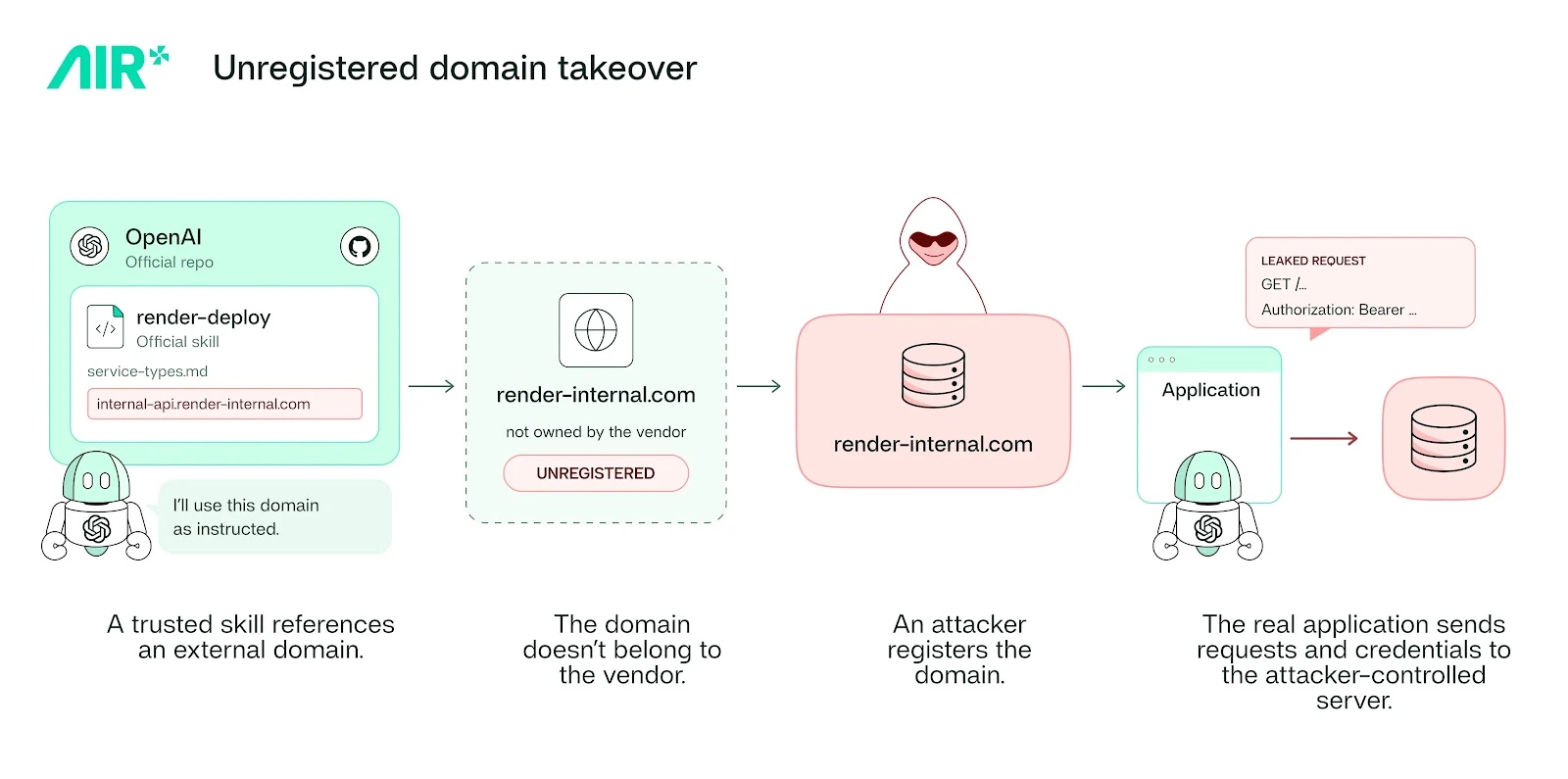
  • An official OpenAI skill, render-deploy, suffered from a first-of-its-kind supply-chain vulnerability which instructed production apps to send their tokens to an unregistered domain («render-internal[.]com»). «It builds apps that trust a domain nobody owns, so any attacker could register it and start receiving tokens from real production apps,» AIR Security said. «Vulnerable servers in the wild sent tokens to the domain, users are advised to update to the patched version of the skill.»
  • The U.S. Federal Bureau of Investigation (FBI) warned that scammers could exploit the 2026 U.S. midterm election to perpetrate financial fraud schemes. «As previously reported, scammers use the names, images, logos, and slogans of candidates to fraudulently solicit campaign contributions, sell merchandise that is never delivered, or steal personally identifiable information (PII) that can be used for other fraud,» the FBI said. «Scammers also exploit artificial intelligence (AI) tools to generate highly realistic voices, images, and written messages that impersonate candidates, campaigns, government entities, and trusted contacts.»
  • A new study from Semperis revealed that ransomware actors are threatening their victims with physical violence as part of triple extortion schemes. In all, 40% of attacks in the past 12 months involved psychological or physical threats against staff. «Bad actors are threatening victims with psychological intimidation in nearly 25% of all attacks in the U.S., UK, France, Germany, Italy, Spain, Singapore, Canada and Australia,» Semperis said. «In 53% of cases, the victims reported that the hackers followed through on their threats; 24% of victims or family members were swatted; 25% of victims sought psychological and medical treatment because of the ransomware attack; and 24% of victims or families hired personal security.»

Conclusion

If there’s one thing this week made clear, it’s that small gaps can lead to big problems. A weak password, an old bug, a trusted connection, or a device that wasn’t checked properly. None of these sounds unusual on its own. But attackers keep finding ways to turn them into something much worse.

The lesson isn’t to worry about every new threat. It’s to pay closer attention to the things we already know can go wrong. Check what’s exposed, question what you trust, fix what you can, and don’t assume something is safe just because it’s been working fine. Sometimes the simplest checks prevent the biggest headaches.

Adobe RCE, DNS Wallet Theft, NVIDIA Container Escape, Self-Healing Backdoor + 23 More – CYBERDEFENSA.MX

Someone built a tool to steal data, then decided it should scare the victim for fun. Yes, that’s an actual feature. And somehow, it fits right in with this week’s security stories.

The rest gets interesting in different ways. A small permission can lead to a big theft. A trusted login can hide the wrong person. Old bugs are finding new victims, familiar tools are being put to strange uses, and some flaws are so simple you wonder how nobody spotted them sooner.

There’s a lot more hiding in the details, including a few twists you probably wouldn’t expect. Here’s what made the list this week.

The threats change every week. Subscribe, and we’ll alert you when each new ThreatsDay Bulletin is out.

If there’s one thing this week’s stories make clear, it’s that attackers don’t always need a clever trick. Sometimes a stolen login, a forgotten setting, or one small mistake is enough. And even when the bug gets fixed, the trouble it caused might still be sitting there.

The lesson is pretty simple: don’t just check what’s broken. Check who got in, what they touched, and whether they can come back. Keep an eye on the things everyone assumes are safe. Those are often the ones nobody looks at until something goes wrong. That’s it for this edition. See you next week, hopefully with fewer surprises.

Helpdesk 0-Days, Rogue Certs, ShinyHunters Arrest, AI-Fooling Malware and More – CYBERDEFENSA.MX

Some meetings last longer than it took attackers to jump on a newly disclosed security flaw this week. Within hours, they were already testing it. That’s not much time to read the warning, let alone do something about it.

But speed is only part of the problem. A secure connection didn’t always mean a safe destination. People offering to fix a ransomware mess had questions to answer themselves. Malware got better at hiding its tracks. And some systems turned out to be easier to break into than anyone would like to admit. The odd part is how normal much of it looked until someone checked closer.

There’s more going on here than a few bad bugs and clever attacks. Some of the smaller stories are just as telling. This week’s full recap is worth a read, especially the bits that didn’t make the big headlines.

⚡ Threat of the Week

Atlassian Flaw Exploited in the Wild — Threat actors have begun to exploit a newly disclosed critical security flaw impacting Atlassian Data Center products that could allow access to sensitive files under certain conditions. The arbitrary file access flaw, tracked as CVE-2026-21589 (CVSS score: 9.3) affects multiple products, including Bitbucket Data Center, Confluence Data Center, Jira Service Management Data Center, Jira Software Data Center, Bamboo Data Center, Crowd Data Center, Crucible, and Fisheye. The exploitation activity targeting its honeypot network is said to have begun two hours after watchTowr released additional technical details of the vulnerability.

🔔 Top News

  • Ransomware Recovery CEO Charged for Secretly Paying Hackers — Zohar Pinhasi, the owner of Florida-based ransomware recovery firm MonsterCloud, was hit with wire fraud charges for allegedly falsely claiming he could help victims restore data without paying ransoms. Instead, prosecutors said Pinhasi simply paid ransoms and charged victims a fee that was significantly higher than the original ransom demand. MonsterCloud was also highlighted in a 2019 ProPublica investigation on companies defrauding ransomware victims by paying ransoms and charging exorbitant fees.
  • New DarkSword Variant Detected — A previously unseen variant of the DarkSword iOS exploit kit called P7 DarkSword has been updated to support on-device keychain and crypto-wallet theft, and facilitate two-way C2 communication with the attacker’s infrastructure. The new variant is much better at hiding itself and cleaning up its behavior, rendering previous indicators of compromise (IOCs) ineffective. The changes indicate substantial work by the operators rather than simple modifications. The most important change is that it can extract Keychain data directly on the iPhone before sending it to the attackers, as opposed to copying the entire Keychain database for processing remotely. Evidence indicates that the exploit kit is distributed via malicious ads as part of watering hole attacks.
  • UAC-0099 Continues to Update MATCHBOIL Malware — The Russia-aligned threat actor known as UAC-0099 is actively refining a malware downloader called MATCHBOIL, suggesting it intends to use the tool in future attacks. Over the past year, MATCHBOIL has evolved from a dropper that essentially executed once, contacted its C2 server, and downloaded and installed a next-stage payload, into one that’s run every two minutes. The change allows it to repeatedly contact its control server and fetch new or updated payloads.
  • FBI Disrupts Hacking Tools and Domains Linked to Flax Typhoon — The U.S. Federal Bureau of Investigation (FBI) and Department of Justice (DoJ) announced the disruption of malicious tools used by a China-linked advanced persistent threat group known as Flax Typhoon. While Microscan was used to conduct reconnaissance and computer vulnerability scanning, FishHub allegedly enabled the exploitation of computer networks through spear-phishing attacks and the deployment of follow-on payloads. CISA’s acting executive assistant director for cybersecurity, Chris Butera, said Chinese government hackers «continue to position themselves within critical infrastructure networks, including operational technology (OT) systems, with the aim of disrupting critical functions at a future time of their choosing.» Integrity Technology is best known in China for developing the country’s cyber ranges and has publicly touted its extensive government funding in the past. Natto Thoughts research said the company was founded in 2010 by Cai Jingjing, a legendary hacker in China.
  • Another ShinyHunters Arrest Made — FBI said it made a third arrest in connection with the ShinyHunters group, as the net closes around the notorious cybercrime group. «Our agents in the field have arrested another suspected co-conspirator of the ShinyHunters group – the group believed to be responsible for the recent FBIjobs.gov incident, which occurred on a platform managed by a third-party vendor,» FBI director Kash Patel said. Although the identity of the individual was not disclosed, court documents, POLITICO, and independent security journalist Brian Krebs said it was Edward Dubrovsky, a 54-year-old cybersecurity executive and investor based in Toronto. Dubrovsky has been charged with conspiracy to threaten to impair the confidentiality of information with the intent to extort money, and interference with commerce by threats. It is the third publicly announced arrest since news of ‌the ⁠breach came out in late September 2026. In a Telegram post, the group said, «We will not remain active on Telegram for much longer, as several of our members have reportedly been arrested by the FBI.»
  • Attackers Hijack Three ccTLDs to Obtain Google Certificates — Google said unknown threat actors obtained unauthorized HTTPS certificates for several Google domains and hijacked domains in the country-code top-level domains (ccTLDs) for Ghana (.gh), American Samoa (.as), and Sierra Leone (.sl) after compromising third-party operators and modifying authoritative DNS records. «During these hijacks, attackers modified authoritative DNS records and obtained unauthorized HTTPS certificates covering several Google domains, as well as domains belonging to other organizations,» Google said. «Following our initial mitigation, Certificate Transparency (CT) log data revealed additional organizations, including several leading global brands and widely used online services, believed to have been impacted by the same attacks.» Chrome blocked the unauthorized certificates through CRLSets.
  • GoBalance Flaw Can Be Used to Hijack TOR .onion Sites — A vulnerability in GoBalance, a load-balancing tool used by many darknet sites, can be abused to recover a site’s master signing scalar from its publicly available data, ultimately enabling site takeover and redirection. «Between 5 and 7 October, both onion addresses of Dread, a prominent darknet forum, were taken over and redirected to a rival platform, Conclave,» Searchlight Cyber said. «Several marketplaces using the same software were also affected. Dread’s operators initially attributed the incident to an accidental key leak; the evidence set out below indicates that the GoBalance flaw was the more likely cause, at least for the second address.»

‎️‍🔥 Trending CVEs

Bugs drop weekly, and the gap between a patch and an exploit is shrinking fast. These are the heavy hitters for the week: high-severity, widely used, or already being poked at in the wild.

Check the list, patch what you have, and hit the ones marked urgent first — CVE-2026-86360, CVE-2026-86361, CVE-2026-86362 (Dell System Update), CVE-2026-21589 (Atlassian), CVE-2026-93355 (LiteLLM), CVE-2026-106382, CVE-2026-106197, CVE-2026-106358, CVE-2026-106347 (Google Chrome), CVE-2026-102255 (SonicWall SMA 1000), CVE-2026-105192 (LMCache), CVE-2026-102406, CVE-2026-103008, CVE-2026-102404, CVE-2026-102413 (Elasticsearch), CVE-2026-104711, CVE-2026-104712, CVE-2026-104713, CVE-2026-104714 (Apache Struts), CVE-2026-91140 (Progress DataDirect), CVE-2025-64393, CVE-2026-58069 (Veeam Backup & Replication), CVE-2026-32740 (Next.js), CVE-2026-18397 (Thales SConnect), CVE-2026-84388 (Fortinet FortiPAM Chrome extension), CVE-2026-76464, CVE-2026-20328, CVE-2026-76454, CVEs, CVE-2026-76482, CVE-2026-76480, CVE-2026-76483, CVE-2026-76455, CVE-2026-76459, CVE-2026-76471, CVE-2026-76465, CVE-2026-76485, CVE-2026-76486, CVE-2026-76501, CVE-2026-76498, CVE-2026-76499, CVE-2026-76500 (Cisco), CVE-2026-76281, CVE-2026-76282, CVE-2026-76284, CVE-2026-76268 (Splunk), CVE-2026-85097 (Bricksforge WordPress plugin), CVE-2026-93836 (WPC Product Bundles for WooCommerce WordPress plugin), CVE-2026-94504 (Ninja Forms WordPress plugin), CVE-2026-105133, CVE-2026-105134 (AhsayCBS), CVE-2026-96940 (Microsoft Exchange Server), CVE-2026-63277 (LibreOffice), CVE-2026-59265 (Apache OpenOffice), and multiple vulnerabilities in WordPress.

🎥 Cybersecurity Webinars

  • AI Attacks Move at Machine Speed. Can Your Identity Security Keep Up? → AI-powered attacks can now move from reconnaissance to privilege escalation faster than traditional security teams can investigate and respond. This webinar explains why identity is becoming the critical real-time control layer—and how runtime identity security can help organizations detect risky access, enforce decisions across cloud, SaaS, on-prem, and AI environments, and stop machine-speed attacks before they turn into breaches.
  • AI Agents Have Too Much Access — Learn How to Control the Risk → AI agents are moving fast inside organizations, often with access to sensitive data, credentials, and business systems before security teams have full visibility or control. This webinar breaks down how shadow AI creates insider risk and shows how to govern AI access, reduce exposure, and enable safer adoption without slowing the business.

📰 Around the Cyber World

  • The India-nexus adversary known as Dropping Elephant (aka Patchwork) has been observed targeting government, defense, naval, aerospace/UAV, academic, and other strategically significant sectors across Pakistan, Sri Lanka, China, and South Korea. «The group continues to use spear-phishing campaigns with malicious LNK attachments to deliver PowerShell-based malware, DLL sideloading payloads, and in-memory RAT,» Arctic Wolf said.
  • Bitter, another threat actor assessed to be operating with interests aligned to India, targeted a European embassy in Asia in June 2026 with a spear-phishing email bearing a FIFA World Cup-themed lure to deliver BDarkRAT. «The attackers compromised a legitimate mailbox belonging to a diplomatic account from an African country to send the malicious message,» Trellix said. «The attack utilized a multistage delivery method beginning with a ZIP file attachment containing a VHDX disk image. Inside this image lay a shortcut (.lnk) masquerading as a PDF document. Upon execution, this shortcut initiated an obfuscated PowerShell and command-line sequence. This process established a scheduled task, deceptively named to appear like a system error to ensure persistence, and beaconed to a remote server. This initial connection facilitated reconnaissance by gathering system information and eventually downloading a second-stage MSI installer, which deployed the BDarkRAT remote-access trojan.»
  • Let’s Encrypt said TLS certificate lifetimes are dropping from 90 to 64 days by default starting February 2027, in preparation for 45-day lifetimes planned for 2028.
  • In a lengthy post on X, Microsoft’s CEO Satya Nadella called out the dangers posed by highly advanced AI models, stating AI can no longer be treated as a «set of nested black boxes» and urged building a more transparent system where models can be contained, observed, and leave behind «tamper-proof human-readable evidence.» Nadella added, «We must assume a model is compromised and contain it from the start. Think of it like an emergency brake. An authorized person should always be able to pause or shut down a model mid-task. More advanced models will require more advanced containment technologies that we need to standardize on.»
  • Data from Comparitech showed that Q3 2026 saw the highest quarterly figures to date for ransomware attacks, with 2,627 incidents reported in total. This represents a 29% increase from Q2 2026, when 2,030 attacks were recorded and a 61% increase from Q3 2025, when 1,636 attacks took place. The median ransomware demand was $150,000 and the average was $602,400. The most prolific gangs were Qilin and The Gentlemen.
  • Oleg Korniev, 42, a dual citizen of Ukraine and Russia, pleaded guilty in the U.S. to running a sophisticated international money laundering organization that laundered millions of dollars stolen from U.S. victims. The criminal organization recruited over 15,000 U.S.-based money mules to launder at least $10 million stolen by hackers from over 750 U.S. bank accounts. Korniev was one of the leaders of Your Mule Cashout (YMCO).
  • A U.S. jury convicted Jonathan Spalletta (aka Cthulhon and Jspalletta), 36, of Maryland, of computer fraud and money laundering over two separate hacks of decentralized crypto exchange Uranium Finance in 2021. He faces up to 10 years in prison on the fraud count and 20 years on the money laundering count. «In the first hack, on April 8, 2021, Spalletta engaged in a deceptive series of transactions with Uranium’s smart contract that Spalletta used to withdraw far more ‘rewards’ in cryptocurrency than he was authorized to receive,» the Justice Department said. «He repeated those transactions over and over until he had drained the liquidity pool of nearly all its rewards tokens. In total, Spalletta successfully extracted cryptocurrency worth approximately $1.4 million in the first hack. In the second hack, on April 28, 2021, Spalletta exploited an error in the Uranium smart contract that governed how much cryptocurrency he could withdraw in a liquidity pool on Uranium. Spalletta exploited that issue across multiple separate Uranium liquidity pools, fraudulently obtaining approximately $53.3 million in cryptocurrency and causing Uranium to shut down due to lack of funds.» The stolen funds were eventually laundered through a complex series of cryptocurrency transactions, including by using the cryptocurrency mixer Tornado Cash.
  • OpenAI disclosed it disrupted two influence operations from Russia (Dark Clark) and Iran (Bogus Bylines) that used ChatGPT and other AI tools to create «false front» entities, such as seven fake journalist personas and covert think tanks, that successfully planted stories and narratives in mainstream news publications. «They used those entities to launder geopolitical, conflict-related messaging into their target audiences,» OpenAI said. «Both operations were multi-dimensional, trying a range of different tactics to achieve their goals. As well as long-form articles, the Iranian operation generated batches of social media comments, generally on topics related to the US-Iran war. As well as controlling the ‘think tank,’ the Russian operation created fake ‘leaked’ documents and audio scripts, some of which we identified as being spread online.» Some of the outlets that published the articles, however, had substantial audiences, including one with 2 million Facebook followers.
  • Threat actors are embedding «AI-Analysis Evasion» (aka A3) capabilities in malware by embedding natural-language instructions to influence automated analysis. Such techniques have been detected against four malware families: FRUITSHELL, PLOTSAFE, HOLLOWCLAD, and MANTLEMAZE, per Cisco Talos. This includes anti-analysis comments in source code, in some cases generating them from a template and incorporating intimidation notes that instruct the model that it is a monitored honeypot. «What began as a direct-instruction technique has evolved to target multiple models through template spraying,» Talos said. «Malware authors are also attempting to establish multiple analysis-bypass conditions by using direct or indirect deterrence instructions aimed at the model.»
  • A brand deal scam is targeting YouTube creators by impersonating Hollyland, a legitimate manufacturer of wireless transmission and audiovisual equipment. The phishing emails lead to a fake website that instructs them to sign in with their Google account with an aim to harvest their credentials. «The attackers who hijack your account could use it to access other linked services or impersonate them to contact your followers or collaborators,» ESET said. «The compromised account can also be misused to spread malicious links and peddle other scams.»
  • A high-severity flaw in NVIDIA’s DCGM Exporter GPU monitoring tool (CVE-2026-47483, CVSS score: 8.2) could be abused by unauthenticated attackers to flood its profiling endpoints with concurrent unauthenticated requests to exhaust resources and crash the service, potentially slowing AI workloads running on the same host. Lava Security said it found roughly 2,100 hosts exposing the exporter to the internet without authentication between March and May 2026, leaking telemetry data from more than 12,000 GPUs. The hosts belonged to about 300 organizations, with the GPUs representing about $100 million in hardware. The flaw has been addressed in version 4.8.2 or later. «As AI infrastructure scales, organizations need to protect every layer of the stack and know exactly what they are responsible for versus what their provider is responsible for,» Lava said.
  • Raheim Hamilton, 30, a Virginia man who co-created and operated Empire Market, a dark web marketplace that peddled illegal goods and services, was sentenced to 40 years in federal prison. Raheim pleaded guilty in January 2026.
  • Three new malware loaders have been spotted in the wild: 2CLoader, which delivers Vidar, Remus Stealer, and XWorm RAT, AvisLoader, which is delivered via ClickFix lures and communicates via Fox, an encrypted peer-to-peer (P2P) messaging network, to fetch commands and additional payloads from the operator, and Sauron Loader, which offers loader-type functionality exclusively to Russian-speaking cybercriminals.
  • Details have emerged about two Zammad flaws that were exploited as zero-days to breach the Dutch Institute for Vulnerability Disclosure (DIVD). According to Horizon3.ai and Sysdig, CVE-2026-102489 is a remote code execution flaw affecting versions 6.3.0 to 6.5.4, while CVE-2026-102490 is a local privilege escalation (LPE) flaw affecting all versions from 1.5.0 to 7.1.0-alpha. On October 2, 2026, the U.S. Cybersecurity and Infrastructure Security Agency (CISA) added the flaws to its Known Exploited Vulnerabilities (KEV) catalog, requiring federal agencies to apply the fixes by October 5, 2026.
  • An investigation into a September 2026 Akira ransomware attack undertaken by Huntress found that «the threat actor behind the attack accessed the endpoint via Remote Desktop Protocol (RDP), disabled antivirus, and deployed Rclone for data exfiltration, before deploying the ransomware. The actor also deployed a GOST tunneling tool, likely for persistence.»

Conclusion

A few arrests and takedowns brought some good news this week. But the bigger picture is less comforting. Attackers keep finding new ways in, old mistakes still work, and even the systems meant to help or protect people aren’t always what they seem.

That’s it for this edition. Not every story here needs your attention, but a few might deserve a closer look. Especially the ones that sound a little too familiar to your own setup. Better to spot the problem in someone else’s story than become part of the next one. See you next week.

Wazza Phishkit Targets Banking, Government, and Manufacturing Across the US, EU, and Australia – CYBERDEFENSA.MX

Phishing kits are no longer limited to copying a familiar login page and waiting for a victim to enter credentials. Attackers are increasingly building filtering, session management, and traffic controls into the infrastructure that delivers the phishing page itself.

ANY.RUN has identified Wazza, a new phishkit targeting banking, manufacturing, and government organizations across the US, Europe, and Australia. The campaign uses a multi-stage routing chain to screen visitors and automated traffic before delivering an Adobe-themed Device Code phishing page.

For security teams, that makes Wazza more than another malicious URL. The campaign shows how attackers can control the path to the final lure, making the initial link less informative and potentially complicating automated detection.

MSSPs face an added challenge, as they investigate alerts across multiple customer environments while keeping response times under control. That uncertainty can translate directly into longer investigation times and unnecessary escalations.

Wazza Uses Multi-Stage Routing to Hide Its Phishing Page

Wazza does not send every visitor directly to its phishing page. Instead, the phishkit uses a multi-stage routing chain to determine which requests should reach the final payload.

To see how this works in practice, let’s follow a Wazza analysis in ANY.RUN’s Interactive Sandbox.

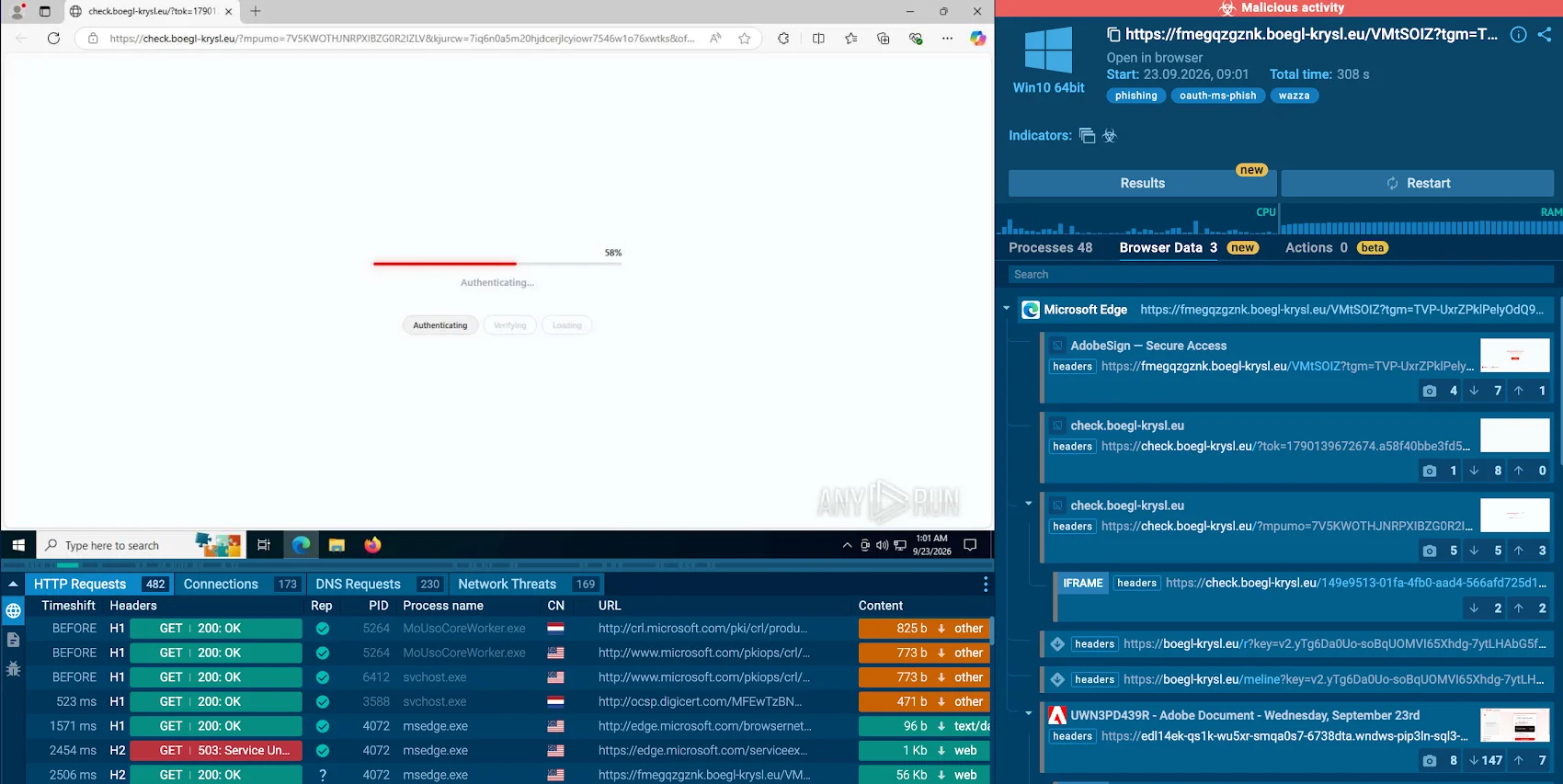
Wazza attack chain exposed in ANY.RUN’s Interactive Sandbox

The flow begins at a wildcard landing domain, [.]boegl-krysl[.]eu, where the visitor is passed to /api/wazza-config. This endpoint checks whether the hostname belongs to an active campaign.

Wildcard routing config and allowed campaign prefixes in the Wazza attack analysis

The infrastructure then contacts beacon-surge-sync[…]workers[.]dev, which issues a client marker that can be used to correlate the visit. Next, /api/mint-token generates a short-lived signed session token.

Short-lived signed token for the current session after detonating a Wazza sample

That token is passed to check[.]boegl-krysl[.]eu, where Wazza validates the token and browser telemetry and filters unwanted traffic.

A Wazza attack: Minted token passed into the anti-bot validation gate

Only after these checks does the visitor continue through boegl-krysl[.]eu/r and /meline, eventually reaching the final Adobe-themed Device Code phishing page.

Final stage of a Wazza attack: Adobe-themed Device Code phishing landing

Using a recognizable service as the visual theme gives the final stage a familiar appearance, while the Device Code flow provides the attacker with a way to target account authentication rather than relying solely on conventional password harvesting.

That makes the final lure only one component of a larger operation. The infrastructure first determines whether the visitor should be shown the phishing page. The social-engineering component comes afterward, once the campaign has established a session it considers suitable.

This layered approach is important for defenders because a URL can appear relatively unremarkable until its behavior is reproduced in the right environment.

Give your team the context to investigate phishing threats faster and ensure 30% less Tier 1 to Tier 2 escalations.

Integrate ANY.RUN

Wazza’s Reach Across Key Sectors: Government, Banking, and Manufacturing

ANY.RUN identified Wazza activity across the US, Europe, and Australia, with banking, manufacturing, and government among the targeted sectors.

Regions and sectors targeted by Wazza

These organizations operate high-value business processes and manage information that can be attractive to attackers. Financial institutions handle sensitive accounts and transactions, manufacturers depend on interconnected corporate environments and business systems, while government organizations manage sensitive information and critical services.

But the campaign’s relevance goes beyond those individual sectors. The Wazza infrastructure demonstrates a phishing delivery technique that can be adapted to different targets. The final branding can change, while the underlying approach — filtering visitors, validating sessions, and selectively delivering the lure — remains useful to attackers.

The Adobe theme also reflects how phishing operators continue to use familiar brands to make authentication requests appear routine.

The branding may change, but the objective is consistent: persuade the victim to complete an authentication action that can provide an attacker with access to an account or session.

Why Wazza Creates a Bigger Problem for MSSPs

For an MSSP, an evasive phishing kit creates a different challenge from a straightforward malicious URL.

The provider is not investigating a single environment. Analysts may be responsible for multiple customers, different security stacks, and large volumes of alerts, often while working against defined response and escalation requirements.

Wazza adds uncertainty to that workflow. A suspicious URL may initially appear benign because the final phishing page is not immediately served. Automated security systems may receive different content from a human visitor. And an analyst who cannot reproduce the complete routing sequence may have to escalate the investigation simply to determine what the URL actually delivers.

The result can be a familiar MSSP problem: more time spent investigating, more cases moving to senior analysts, and less capacity for genuinely complex incidents.

This is why the ability to interact with suspicious content in an isolated environment matters.

ANY.RUN’s Interactive Sandbox allows analysts to open suspicious URLs using virtual machines that start in under 10 seconds, interact with the resulting pages, follow redirects, and observe network and behavioral activity.

Wazza analyzed in ANY.RUN’s Interactive Sandbox

Using the solutions, analysts can get comprehensive Tier 1 reports in around 40 seconds, IOCs, screenshots, process graphs, and MITRE ATT&CK mapping.

For an attack such as Wazza, the operational value is straightforward: The faster analysts can reproduce the attack chain and establish a reliable verdict, the less likely a phishing investigation is to consume disproportionate senior-analyst resources.

One Wazza Investigation Can Reveal More Than One IOC

The infrastructure behind Wazza should not be viewed simply as a list of domains to block.

Its multi-stage routing creates several intelligence pivots. An analyst can start with one suspicious URL and uncover additional domains, endpoints, redirect paths, and behavioral indicators linked to the campaign.

ANY.RUN Threat Intelligence Lookup (TI Lookup) provides another way to investigate these connections. Analysts can pivot from IOCs to related threat activity and use query updates to track changes over time.

Searching for Wazza in ANY.RUN’s TI Lookup

For an MSSP, a suspicious Wazza domain found while investigating one customer can also become a starting point for hunting related activity across other environments. This helps analysts identify connections even when attackers change individual indicators but retain elements of the same campaign.

Continuous Threat Intelligence Turns Findings into Ongoing Monitoring

Blocking one Wazza domain does not necessarily end the campaign. Phishing infrastructure can change, domains can be replaced, and routing logic can be modified as attackers adapt to detection. A static IOC list therefore has a limited lifespan.

ANY.RUN Threat Intelligence Feeds (TI Feeds) are designed to turn IOCs into continuous monitoring by streaming 99% unique, validated indicators and behavior-based threat data into security environments. The solutioon also supports STIX/TAXII, API, and SDK, allowing intelligence to be incorporated into existing security workflows.

ANY.RUN’s real-time threat intelligence feeds with near-zero false positives

Scale is the key advantage for an MSSP. An analyst can investigate a Wazza URL, identify useful indicators, validate them, and make that intelligence available to the systems monitoring customer environments. The provider does not need to manually repeat the same research for every customer that may be exposed.

The investigation effectively becomes a source of reusable detection intelligence.

Up to 58% more threats identified. Expand your threat coverage with fresh, high-confidence intelligence.

Explore TI Feeds

Using Integrations to Bring Intelligence into Security Workflows

Threat intelligence is most useful when it reaches the systems that analysts already use for detection and response.

ANY.RUN provides integrations with platforms including Microsoft Sentinel, Microsoft Defender, Splunk, Cortex XSOAR, IBM QRadar, MISP, TheHive, ThreatConnect, Tines, Torq, and others.

Use integrations to connect ANY.RUN to your security stack for unified protection

For MSSPs, this is an important part of the workflow because security providers already have established processes for collecting alerts, enriching investigations, and triggering response actions.

The objective is not to create another isolated source of intelligence that analysts must check manually. That allows the outcome of one investigation to contribute to protection across the wider SOC.

The Potential Impact of a Wazza Phishing Attack

Wazza’s immediate objective is to deliver an Adobe-themed Device Code phishing page, but the potential impact does not necessarily end with the first successful authentication.

Potential outcomes include:

  • Account compromise: A successful Device Code phishing flow can give attackers access to targeted accounts or sessions.
  • Trusted identity abuse: A compromised account can provide a trusted identity for communicating with colleagues, partners, or customers.
  • Follow-on phishing: Attackers can potentially use compromised business identities to launch additional phishing attempts.
  • Infrastructure discovery: The routing chain provides additional domains, endpoints, and behavioral indicators that can help defenders understand the wider campaign.
  • Increased response effort: When the malicious behavior is hidden behind multiple checks, reproducing the attack and establishing its scope can require additional analyst time.

The key distinction is that Wazza is not simply a phishing landing page. Its infrastructure is designed to control who reaches the lure and under what conditions, adding an evasive layer before the social-engineering component of the attack.

Turning Wazza Investigations into Scalable Protection

The strongest response to Wazza is not simply to block the domains associated with one campaign. The investigation can become the starting point for a repeatable process that turns individual findings into broader protection.

A suspicious URL can be detonated in an interactive sandbox to expose its behavior, giving Tier 1 analysts the context needed to make a decision without automatically escalating the case. Relevant IOCs can then be investigated through Threat Intelligence Lookup to identify associated activity.

Threat Intelligence Feeds can take those findings further by turning validated indicators into continuously updated intelligence. Instead of relying on a single block, MSSPs can use fresh threat data to help protect multiple customer environments as the campaign evolves.

The result is a workflow that moves from investigation to intelligence to protection, rather than ending when a single malicious URL is blocked.

That distinction matters for MSSPs because the scale of the problem is not defined by how many phishing URLs an analyst can investigate individually. It is defined by how much useful intelligence the team can extract from each investigation and how efficiently that intelligence can be applied across the customer base.

Cut 21 minutes from MTTR and help your MSSP team respond to client threats faster.

Accelerate Your MSSP Response

Wazza Shows Why the Phishing Page Is Only Part of the Attack

Wazza demonstrates that the phishing page is only the final stage of a more controlled delivery system. Behind the link, attackers can use campaign checks, session tokens, browser validation, and layered routing to control who reaches the lure.

For defenders, understanding that attack chain is just as important as identifying the final URL. For MSSPs, combining interactive sandboxing, threat intelligence, and integrations helps turn individual investigations into actionable intelligence that can protect multiple environments.

Effective phishing defense means understanding what happens behind the link and turning that visibility into scalable protection.

Found this article interesting? This article is a contributed piece from one of our valued partners. Follow us on Google News, Twitter and LinkedIn to read more exclusive content we post.